
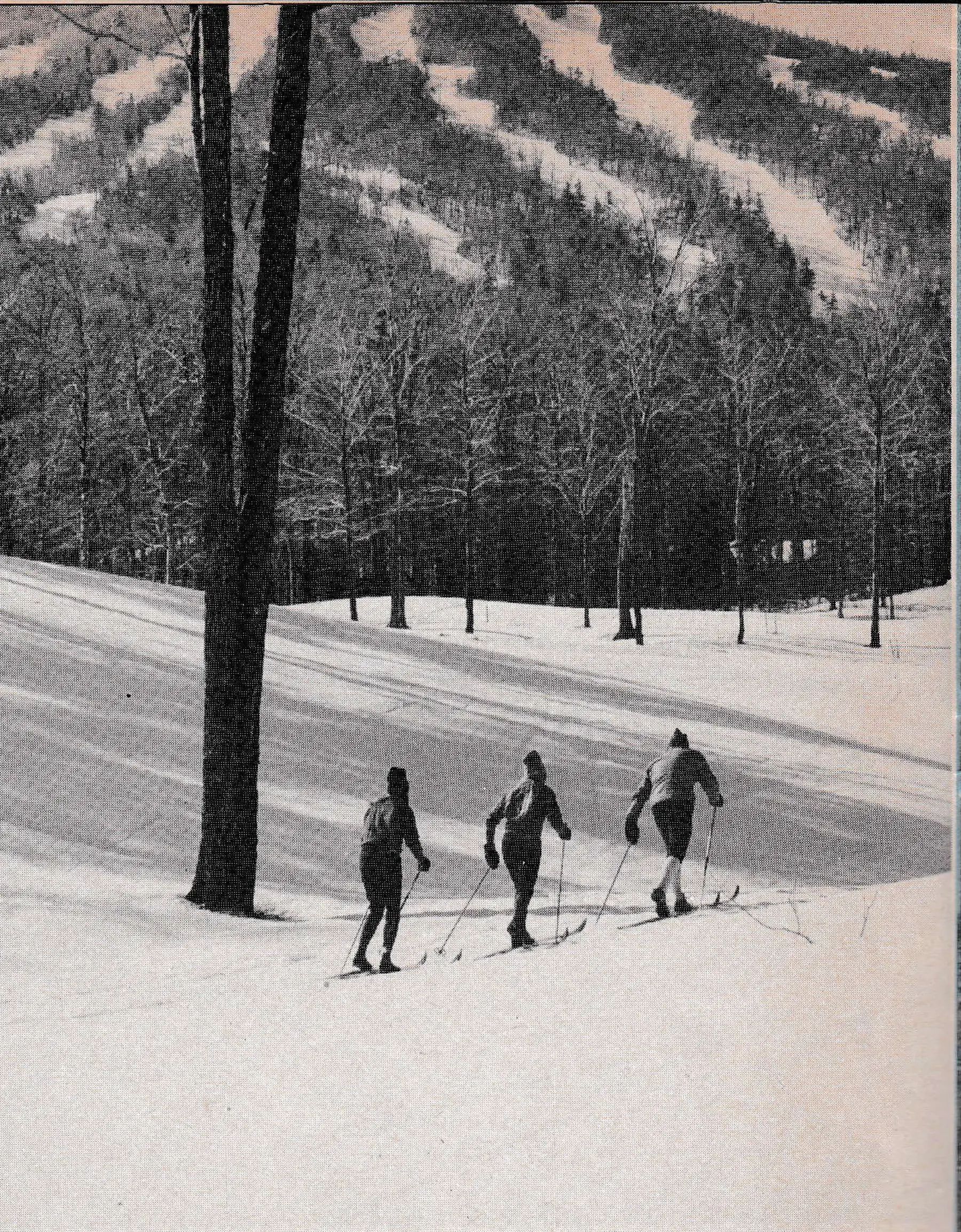
An esoteric and certainly limited activity until Rudi Mattesich and his Metropolitan Touring Council cohorts began plugging the joys of self-propelled skiing 10 years ago, cross-country skiing did not turn “commercial” until about five year ago. Now, it is estimated that there are half a million langlaufers in the U.S., while the highest estimate placed on the number of downhill skiers is five million—and this after 40 years of lift-building and promoting.
Trapp Family Lodge in Stowe, the first and still premier touring center in the East, reports up to 1,000 skiers a day. Johannes von Trapp feels that he must soon institute a daily limit, with season membership holders receiving first priority.
There are now a couple of hundred touring centers in the country, about evenly divided between specialty operations and those run by Alpine areas.
Are touring centers a necessity in today’s ski business? And, can they become profit centers?
“Yes,” to both questions says Waterville’s Tom Corcoran, whose New Hampshire operation is considered one of the best in the ranks of the combination-type resorts.
“Yes” to the first and “no” to the second, maintains Charles Skinner, owner since 1962 of Sugar Hills Ski Center in Minnesota and manager the past few years of Sugarloaf, Maine. “The first thing I did at Sugarloaf was to get rid of the cross-country operation, which could never show a profit and took up too much valuable space and time at the downhill area,” says Skinner.
He cooperated with local cross-country enthusiasts, however, in getting Federal funds for the Town of Carrabassett’s recreational program. Sugarloaf Comptroller Larry Warren, a Carrabassett selectman, can now point with pride to a $150,000 community building, which serves as touring operations center, and 75 miles of marked and maintained trails — thanks to Federal funding. The trail system hooks into the old Sugarloaf touring trails and now the publicly-supported program shows an operating profit.
In Minnesota, the state pays $2,000 a mile for the construction of either cross-country or skimobile trails, and Skinner has built 25 miles of cross-country trails, all wide enough for a full-size Thiokol or Snocat. Such trails can be located on state, county or private land (with the owners’ consent, of course) and the touring center operator reaps the benefit of a good trail system at no cost.
Skinner feels that cross-country skiing is just beginning to grow, but still thinks that a completely privately-run operation can not become a profit center in itself.
Von Trapp agrees. The Trapp Family Lodge has 125 beds and the touring center helps keep the beds filled with big-spending tourists. “Touring would not be economically feasible without the lodge income,” von Trapp says.
He recalls reading in an Eastern Ski Annual some 35 years old that touring would become the ski sport of the future, not downhill skiing.
The author maintained that downhill skiing requires too much athletic ability, fancy equipment and cash. While slope maintainence, advanced ski teaching techniques and the modern equipment makes it possible for almost anyone to master the sport, the costs are still there and a beginner must take at least a ski-week to gain proficiency and have fun.

On the other hand, cross-country ski schools do most of their business with one or two lessons per person—after that they are own their own or learn from friends. Many never take lessons. And, even with the advent of synthetic cross-country skis, it is still possible to get completely outfitted for under $100, thanks to the competitive retail business in the larger cities.
Corcoran feels that a major ski area should be able to operate a cross-country center at a modest profit. Phil Saluter of Mount Snow, Vt., disagrees, as does Kit Cooper at Bromley, Vt.
Saluter points out that the Mount Snow operation, one of the most popular in Southern Vermont, returns little in the way of cash to the corporation. “We provide the 18-hole golf course, cut additional trails, keep the club house open and heated, and provide a skimobile and grooming equipment. Last winter we charged a $1 trail-use fee, and this coming winter it will go to $2. With about 100 persons paying the fee on a busy day, you can see the cash flow,” Saluter said. Ruedi Veraguth runs the center and keeps all of the ski school income, plus the profit on retail sales.
“But cross-country skiing is necessary. The skiers want it, and it is fun and relatively inexpensive to provide,” Saluter maintains.
At Pico Peak, Vt., Bruce Belden provides a training trail and a small jump for the Rutland High School team, but is happy to let the specialty centers at nearby Mountain Meadows and Mountain Top Inn take care of the demand. Both centers are first class and located within a few miles of Pico.
Belden has cast an appraising eye at the situation and then turned back to the chairlifts. There are several requirements before going into cross-country operations, he says. First, there must be a demand and the competitive picture must be reasonable. Second, there should be suitable terrain, preferably with some open meadows and pastures. The average downhill area lacks enough level terrain, and that is usually needed for parking and buildings. Third, there should be sufficient space for the touring center headquarters, and the right personnel.
Bromley dropped cross-country skiing after two winters in which there was relatively little snow in the woods, according to Cooper. In addition, there was almost no place at the busy Vermont resort to house the operation, and finally, Viking and Wild Wings Touring Centers are practically within shouting distance.
Terrain is no problem west of Syracuse, N.Y., with the midwest loaded with the open slopes and quite often great snow conditions. The Rockies and westward can offer too much snow, although unlimited semi-open terrain.
At Mammoth Mountain in California, Per Fostvedt has enjoyed great success since coming over from Norway six years ago. Only Yosemite has a larger operation in the West Coast area, and his season runs from Nov. 1 to the end of May. Fostvedt’s center is two miles north of Dave McCoy’s down-