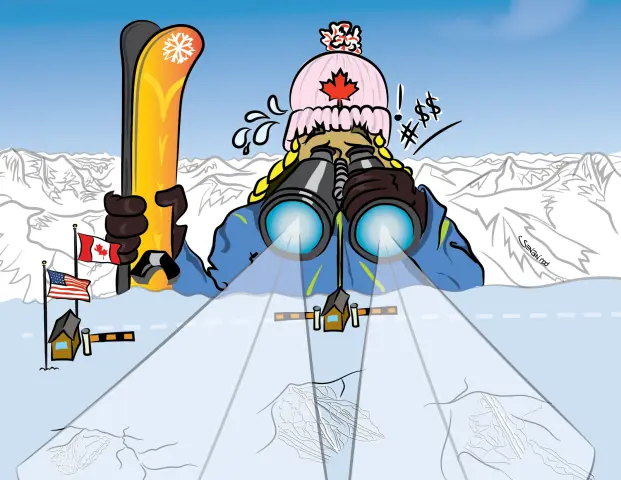

At issue is a complex situation created by the federal government. In this case, by its laudable desire to provide better recreation for the American people by using matching funds to enhance existing public facilities or to create new ones. The problem, according to the private sector, is that these “existing public facilities” have a habit of being in direct competition with existing private facilities, which cannot tap into these matching funds, and that there is one specific federal regulation says that this is a no-no.
The source of the largesse is the BOR (Bureau of Outdoor Recreation, Department of the Interior), and the current supplicants are Mount Sunapee State Park’s ski area in New Hampshire and the Whiteface Mountain ski area in New York, both seeking large chunks ($750,000 and $1.1-million respectively) of BOR money to underwrite half the cost of major snow-making installations on state-owned ski areas. (Whiteface’s application also covers proposed trail-cutting.) Pennsylvania Gas and Water Co. (PaW&G) reportedly is trying to build an entirely new area on its land-holdings near Scranton, while Gore has already received $264,000 for its more modest snowmaking plant in the Adirondacks, after an unpleasant dispute with West Mountain inter alia in federal district court, and with another currently on the docket.
In all probability, the Whiteface application is guaranteed approval at least for part of the money, because of the area’s role in the Lake Placid Winter Olympics of 1980: The Alpine events will be held on this often-snowless giant (3,100 vertical), and federal and state governments, by appropriate legislation, have deemed the Olympics to be a Good Thing for America (and New York). Thus, while BOR recently returned the original application (for $600,000, covering the trail-cutting plus a new chair, but not the snowmaking) and demanded a full Environmental Impact Statement (EIS), with which the state’s Department of Environmental Conservation (EnCon) is currently complying before submitting its new request for $1.1-million, something ultimately has to go through because without Whiteface there is no Olympics, and Congress and the President (plus Albany) have said there will be an Olympics. Further complicating this unique situation, the Commerce Department’s Economic Development Authority has been designated the lead agency for the Games, which means EDA will perfect the EIS and what BOR means . . . ah, the hell with it. What it means is that Whiteface will submerge into the alphabet soup and surface with most, if not all, of its $1.1-million. Lay an easy 8-to-5 on it.
The Gore application is officially approved and closed: The state got the bread, and won its original suit against West, Willard and the state ski area association last year, although the current suit may be based on more solid grounds (see below). Rumors that the state is planning a second money application for Gore remain just that: Rumors. And, the Pennsylvania plan is so far down the trail, it now appears, as to render any discussion futile — which is not to say that the Pennsylvania ski area operators are not upset; rather, it’s just not a clear and present danger. Yet.
Thus, the Sunapee application is the best statement of both the situation and the problem: Should federal funds be used to create expanded facilities at state-owned areas, almost certainly at the expense of the private sector whose taxes provide at least part of the funding? Especially when BOR’s own Regulation 660 suggests — or mandates — otherwise?
The New Hampshire Connection
Sunapee, like Cannon, is a major state-owned ski area: Slightly smaller (1,600 vertical to Cannon’s 2,100), but vastly more intermediate, it has dominated the southwest corner of New Hampshire against far smaller mountains like Pat’s Peak and King Ridge, while Cannon has had to battle significant competition from Waterville Valley, Loon and the Mount Washington Valley group in the northeastern sector. As a result of these and other factors, Sunapee has, for the past decade, consistently outgrossed its more famous partner and, uniquely in New England, it has reached the 150,000-skier-day level without any snowmaking plant. (Cannon has a modest system, by Killington-Hunter standards, which is slowly being upgraded.)
Well, almost consistently. Sunapee has outdrawn Cannon for nine of these last ten years, all but the disastrous drought season of 1973-74 when it attracted roughly 20 inches of snow, damned few skiers, and an awful lot of flak from the local merchants who saw their business fleeing to competitors at ski areas with snowmaking installations. And that spring the movement to get the state legislature to approve funding for a snowmaking system, a movement which for years had varied inversely with Sunapee’s snowfall and skier-day volume, finally picked up a full head of steam.
For many years — unlike his counterparts in New York — Sunapee’s longtime (25 years) and highly respected general manager, Dick Parker, had fought both a frontal and rearguard battle against (repeat, against) installing snowmaking on Sunapee (a position with which Bill Norton, general manager at Cannon and president of NSAA, essentially concurs). Snowmaking, Parker has said often, “doesn’t guarantee skiing, it guarantees skiers”; and in several battles stretching through the ’60s and early ’70s, he successfully thwarted efforts to install a small system on the lower mountain because, he felt (and convinced the legislature and the commissioner of the Department of Resources and Economic Development), anything except a complete top-to-bottom system was basically a fraud on the consumer.
Parker, like most knowledgeable Granite-Staters, also believed that the traditionally conservative, tight-fisted state legislature wasn’t about to spring for the 1.5-million the total system would cost, especially with right-of-Reagan Gov. Meldrim Thomson in the State House. But, like many, he reckoned without the fact that Thomson is about to face a tough election in 1976 and needs the votes in the Sunapee region. So last year Thomson nudged the legislature to approve a $750,000 bond issue, provided that BOR kicks in with a matching amount. And further provided that the state — unlike New York in its Gore application — comply fully with BOR Regulation 660.
Going Like 660
Essentially, Regulation 660 says that no public facility, be it marina or campground or ski area or what, should be funded unless comparable, competing private facilities are operating at 65 percent of capacity. The regulation reads as if it were a firm rule, but BOR aides have consistently said it is a “guideline,” a “base,” a “general statement of policy” and not an arbitrary figure. This definition first arose during the Gore application dispute and, since it was not specifically challenged, remains the operating rule of the BOR regional office in Philadelphia, which controls the entire Northeast.
Governor Thomson, to effect compliance, named an eight-man study commission, which included Mike Beebe, owner of Temple Mountain and president of the New Hampshire Ski Area Operators Association (NHSAOA). The panel hired Jim Branch to study and report on how much installing snowmaking on Sunapee would affect competing private ski areas. Branch completed the survey in the spring and submitted the report to both the commission and the Department of Resources and Economic Development (DRED). The commission accepted the report 7-0 (Beebe abstaining), AND DRED proceeded to fle its application with BOR in July. Beebe and several other private operators have filed strong objections both to the report and the application with BOR, and the situation is currently under study in Philadelphia.
During his study Branch had two major problems to overcome: (One) The weather in the East turned unseasonably warm from nid-February through March, reducing both the number and credibility of skier-surveys conducted; and (Two), he was well aware that literally no ski area in the country operates at 65 percent of capacity. “The highest,” he said in an interview, “is Keystone, Colorado, at 61 percent,” with no one else really close. NHSAOA director Bill Beardsley, general manager of King Ridge, the area closest to Sunapee, noted in one letter that the national average is 36 percent, and the eastern average is 32 percent. He cited as his authority a recent report by the Colorado University School of Business Administration. “I told BOR,” Branch said, “that if 65 percent was a firm figure, we could forget about conducting the study because I could tell them right away” that the state could not comply with 660. “I was told,” he said, “to ignore it and proceed with the study.”
New York has gone even further. Vic Glider, who directs New York’s ski areas for EnCon, noted last winter, in discussing the then-pending application for Gore, “I don’t like committees,” he said, “they slow things down too much.” So EnCon took no Thomson-commission route and submitted no report directly concerning 660’s requirements, and Gore still received matching funds. “It’s a once-and-gone situation,” explained BOR deputy regional director, Anthony Corbisiero, “and a small amount at that. We’ll hold Whiteface to a higher standard” of compliance. So far, BOR has done that by returning the $600,000 application and demanding an EIS.
This summer, EnCon’s assistant counsel, Philip Gitlen, conceded the Whiteface EIS will continue the policy of virtually ignoring 660. “We take the position,” he said flatly, “that Whiteface does not compete with any private ski areas.”
Mike Brandt, owner of West Mountain, both agrees and disagrees with Gitlen’s assessment. “Certainly,” he said, “Gore is much more our competitor (as it is) of any (other) area I can think of in New York. Whiteface keys on the expert and on the Canadian market and doesn’t affect us much. But several areas in northern Vermont will be hurt by it,” he added, referring to Jay Peak, Smugglers Notch and Burke Mountain.

Actually, the role of Vermont (caught in a vise between its eastern and western neighbors) has been widely ignored — except, of course, by the Vermont Ski Areas Association and some of the more astute marketing directors, such as Foster Chandler of Killington, which competes directly with Gore in New York and Sunapee in New Hampshire. “I really don’t want to say too much,” Chandler laughed, “because it will sound like sour grapes. But it really is unfair to use public money from our taxes to compete directly with us. Don’t misunderstand,” he added, “we’ll still do a better job because it takes years to learn how to use a system properly and economically, and I doubt the state governments will give them enough money to get maximum use from their equipment.” (Oddly, Parker and Norton agree — emphatically.)
“I think it’s a terrible idea,” added Joe Parkinson, VSAA’s executive director, who essentially repeated the objections and firm opposition voiced by all private-area operators contacted in all three states as well as in Pennsylvania. Literally no one in the private sector is willing to concede any validity to BOR’s position, which if nothing else, makes the issue unique: An absolute consensus among private ski area operators!
More on BOR
The ramifications of each pending or impending application are too intricate to examine closely in the alloted space. The new West-vs-Gore court action is in litigation, which proscribes too much discussion although BOR’s contention that West has “no standing to sue” should raise a few eyebrows. Branch’s 121-page Sunapee report raises as many questions as it answers, according to Beebe, who notes that NHSAOA is weighing a lawsuit. And, no one seems to be sure exactly what Whiteface is going to ask for or do, according to BOR grant officer John Bayless.
But beneath it all is a constant theme: Is BOR doing the right thing? The gut-reaction is a strong no, especially in these presidential days of consistent attack on excessive governmentalism and interference with the private sector, and especially when authorities like Dick Parker, among others, insist the system cannot pay for itself, and when experts like Jim Branch concede that no private area could afford to install a system like Sunapee’s (only the state’s bonding authority makes it feqasible, he said), a sentiment in which Mike Brandt concurs concerning Gore’s.
BOR insists its mandate is to provide the best possible public recreation for as many people as possible on public lands. Furthermore, say BOR administrators, if it only funds projects where none exist now, they would be in highly remote, possibly too remote, regions, inaccessible to the public it must serve.
The states — especially New Hampshire — add the further justification that improving facilities at Sunapee (and, inevitably, the pragmatics of state politics being what they are, at Cannon later) and at Whiteface will provide business for the private sector: Inn keepers, restauranteurs and the like. Thus, one spokesman in Concord commented rather humomorously, “It’s not a public-vs-private battle, it’s a battle between different private interests. Let the hotel-motel association and the ski operators fight it out and leave us alone. Hell, that’s the only reason we built Cannon and Sunapee in the first palce, to provide jobs and business in summer resort areas which were disintegrating.” Could be. But the merchants providing support facilities around Waterville Valley, Loon, Pat’s Peak, King Ridge, West and Willard and even Hunter (not to mention in Vermont) aren’t overjoyed at the prospect of seeing their business going to their counterparts elsewhere, courtesy of the federal government. So ultimately, it all returns to BOR’s position, and that strong, negative gut reaction, which virtually everyone seems to feel.
Getting beyond that, though, is one indisputable fact: The snowmaking installations, if properly funded by the states for operation and maintenance, will provide more consistent and probably better, skiing at Gore, Whiteface and Sunapee, especially in the bad snow years. In all three cases, large major mountains will be more available for use by the public, even though they may not even earn their debt service in added revenue.
The hooker, of course, is whether Regulation 660 means what it says or what BOR says it means: Whether “65 percent of capacity” is a rule or a guideline. Right now, it’s anyone’s bet. But with one case in federal court in New York and another being weighed in New Hampshire, we may know soon. And then again, different district courts located in different circuits being the autonomous beings they are, we may not.
Two questions, after-thoughts, or sidebars, to the remarks above. The first concerns relative costs: Given a $1.5-million installation of the type Sunapee is planning what are the relative public vs. private costs?
Cost of installation: Obviously, with BOR matching funds, the state of New Hampshire must raise only $750,000, while a private area would have to raise the full amount. Against this, however, the state must put everything out to bid and contracting. This generally increases the bottom-line figure, especially compared with an area like Hunter, whose owners are in the construction business and who do most, if not all, of the installation themselves. Thus, the final out-of-pocket might be much closer than it seems at first.
Cost of Debt: The situation here can be very tricky, because states, like corporations, have different credit ratings. Solvent New Hampshire will almost certainly pay less interest on its bonds than would rather tenuous New York, much as Ralston-Purina can borrow long-term financing for its Keystone Resort for less than Mom-and Pop Inc. would pay. Generally, however, state bonds go for less interest than does long-term corporate financing (the prime rate is not the key figure), and only the largest and most solvent of corporations — such as Ralston — have the leverage and assets to wheel the bottom-line to a competitive figure. However, that assumes the state will go to market, which in fact New York is not doing with Whiteface and Gore. Instead, Albany is handling the expansions with appropriations, which (at least in the short-haul) has no debt service at all. In contrast, only the most solvent of ski areas are able to pay for expansions out of operating surplus. Thus, overall, the states have a solid advantage in debt-service even above their ability to pledge their full-faith-and-credit to support a bond issue.
Mr. Berry won the 1976 Harold Hirsch Award for “excellence in ski journalism.” He is ski columnist for Long Island Press, and is a frequent contributor to Ski Magazine.