
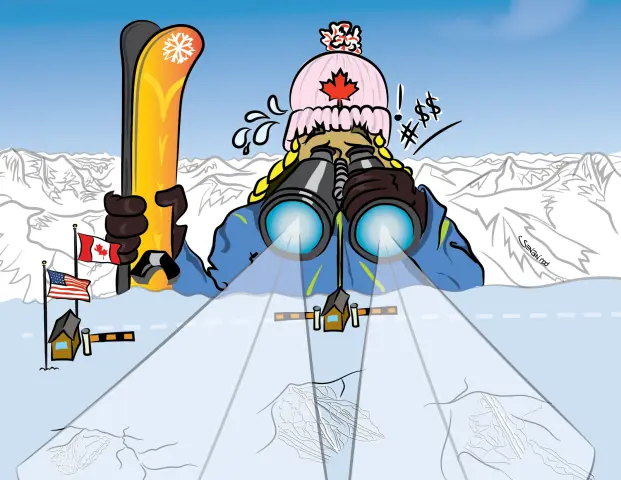

Aside from skiers’ demands for perfect skiing conditions, there is a growing concern among touring center operators about the liability and safety problems connected with tracks and trails. Several cross-country facilities have experienced potential lawsuit problems stemming from accidents that occurred on their track system. In these cases, poor track preparation was blamed for the accident, rather than the skier ineptness.
A decade ago, cross-country was purely a backwoods sport, so even the thought of a lawsuit, or skiers demanding a well prepared track would have seemed outrageous. The track setter of that era was a sled, a metal or wood box, with two groove cutters on its underside. The sled was dragged around the snow by a slow moving snowmobile in an attempt to groom and track in one pass.
Some days the results were great, others they were poor. Generally the homemade sled and snowmobile combination left uneven tracks (one groove higher than the other), sloping tracks (the sled following sidehill angles), rubble piles (snow build-up in front of the sled would leave mounds in the middle of the track), and tracks that were too deep (skiers’ boots would press into the track’s sidewalls).
Touring center operators began to realize that the sled alone could not do the entire job. To eliminate uneven tracks and the other nemesis, they would have to groom the trails before setting a good track. Borrowing a few ideas from their Alpine counterparts, cross-country operators began to experiment with grooming equipment. Grooming meant learning about which procedures worked best in different snow conditions. The problems were packing down deep powder, breaking up ice, levelling out sidehills, and chopping through crust. Everything from Alpine slope rollers to bedsprings and car chains were pulled behind the snowmobile to get the grooming job done. But, gradually the state of the trail maintenance art began to advance.
The interest in tracks and touring centers began to grow when the pioneers were grooming before setting. With the increased interest in prepared tracks, touring centers and Alpine areas began to put in trails across the country. Nationwide expansion of cross-country trails meant new problems. In the powder rich Rockies and out on the heavy wet snow Pacific Coast, the best track preparation devices from the East and Mid-west were often useless. What might work well in Vermont for setting track literally couldn’t cut it in three feet of heavy wet Sierra cement on Donner Pass. The track grooming concepts remained the same, but they were adapted to fit the geographical area of the country and the type of snowfall in that area.
Eastern and Midwestern tour center people are more involved with recycling snow than packing it. Certainly, there are times when operators in the East and Midwest have to pack deeper snow, but their main concern lies in recycling what’s been on the ground for a period of time. In the West, it’s more a case of packing out the deep snows to be able to set a track in. The Western snows are harder to groom and require heavier equipment for the job.
One Western touring center, associated with an Alpine ski area, reported putting on 2,500 miles on a snowmobile in a year’s time just to pack out trails before tracking them. This area has subsequently gone to using a Tucker SnoCat and heavier equipment to get their track job done more efficiently. A track groomer/setter combination was built for the area by a local iron works. It will groom and set in a one step operation in settled snow. When the snow is deep and fresh, the center uses either Teflon coated slope rollers (the wet snow will not cling to the Teflon), or a hydraulic mogul cutter. The mogul cutter is very effective in cutting out sidehill sections of the track that get blown in and in leveling out corners.
In settled snow, the one pass groomer/setter, works on a very simple principle. The weighted slightly rounded front groomer portion of the device flattens out the snow and smooths it for tracking, then the cutters on the rear section of the device cuts two sets of parallel grooves. This particular groomer/setter is made to cover the width of the touring centers’ trails and along with the well cut tracks, it makes a firm flat pole plant area. On steep downhills, a wire mesh panel is dropped off the back of the groomer/setter to keep the snow rough and untracked so skiers can use a snowplow or turn to lose speed and gain control.
Like so many other areas, this western touring center is dropping the use of the SnoCat and the snowmobile, in favor of the Thiokol IMP. The IMP has become very popular with cross-country trail maintenance people because it has the power to pull grooming and setting equipment at slow speeds in even the deepest wettest snow. It also has the versatility, with the blade attached, to engage in first class trail leveling and maintenance work while grooming. Although a bit too expensive for most smaller touring centers, the IMP’s cost effectiveness over using many snowmobiles for the same job makes it an attractive purchase for medium to large centers.
But until the dollars are there, most touring centers still rely on the snowmobile to do the pulling work. Instead of homemade sleds and devices borrowed from the Alpine area, there are new specialized cross-country grooming and track setting pieces of equipment that are making a big impact on the whole art of making tracks. Three noteworthy sources of new equipment are Larven, Baechler, and Woodcrest.
The Woodcrest line of grooming and tracking equipment is the brainchild of New Hampshireite Stan Cheney. Baechler is Swiss made and gained notoriety with the tracks set with their equipment during the 1976 Olympic games in Seefeld. Larven of Sweden offers a unique total system which includes a small snow machine to pull their grooming and setting devices. Here’s a closer look at all three companies’ equipment.
Larven
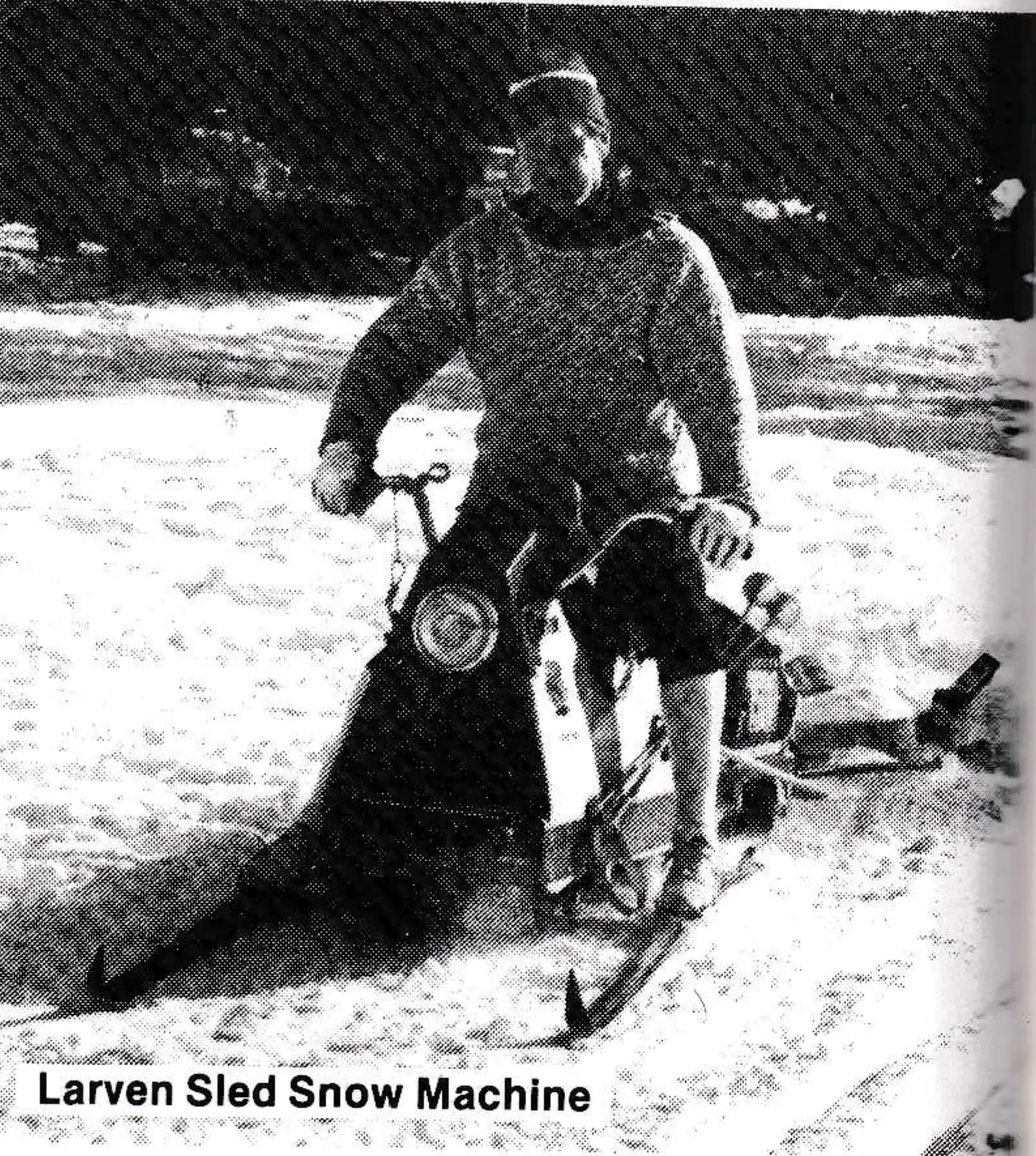
The Larven system is built around the lightweight snow machine. Although it looks like a snowmobile, the Larven snow machine is not. It is 70″ long with a two-cycle engine and can only be operated if the driver is wearing a pair of skis to assist in steering.
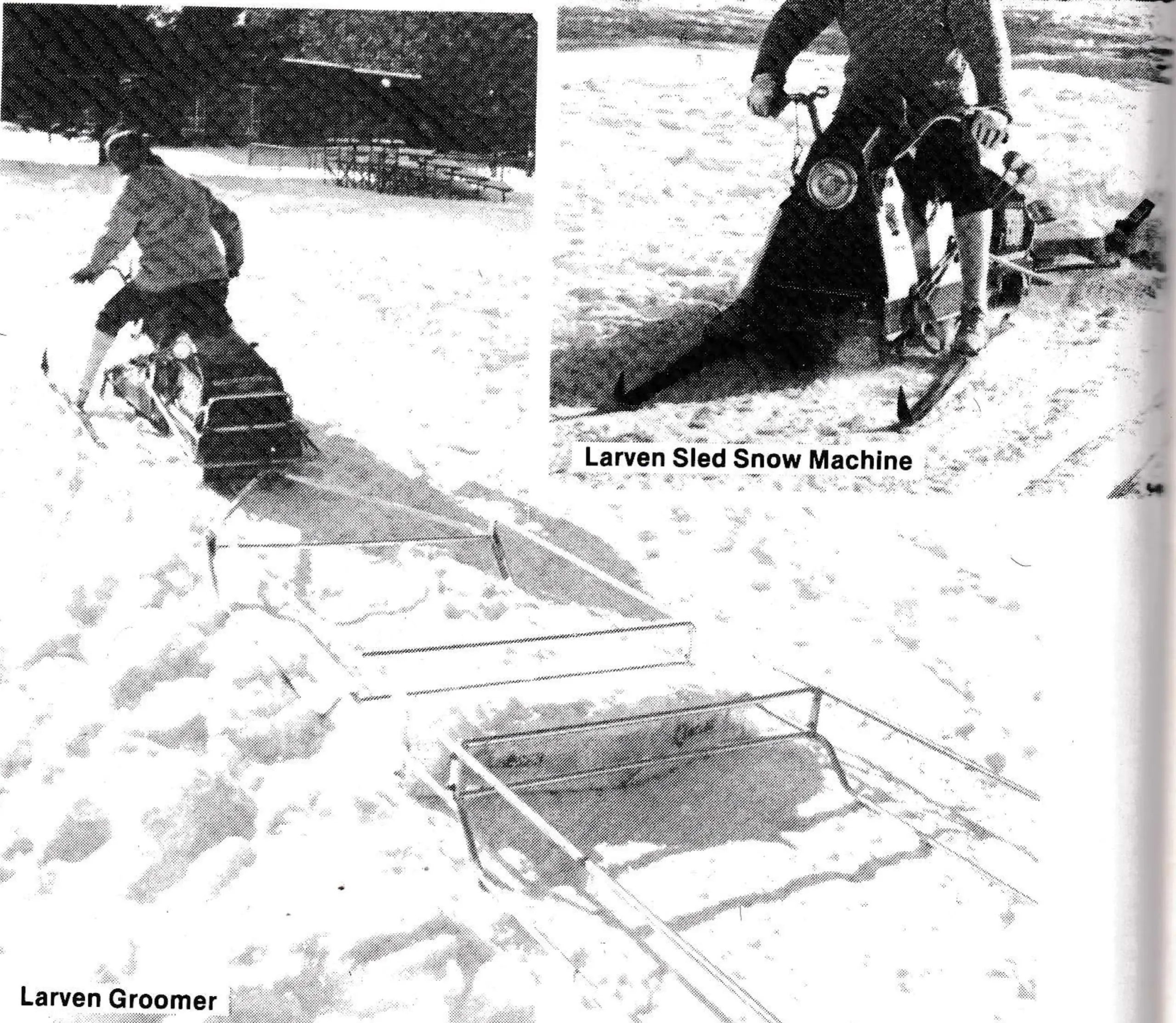
Attached to the snow machine are the other components that make up the Larven system: the grader and track setter. The grader cuts, levels, and packs a trail wide enough for a single track with outside poling areas (39″). There are two grader models, one with a fixed blade and a new adjustable blade model with a blade that raises or lowers to accommodate different snow conditions and depths.
After the groomer passes over the trail, the snow machine can be driven, pulling the track sled to form a single track. The track setter cuts a track that is 3/4″ deep and 3¼” wide, with the grooves 5½” apart.
One of the more attractive features of the Larven is its portability. Clubs, teams, and touring centers can pack the system up and carry it to a new location without too much fuss. The snow machine weighs 150 pounds, the track setter 60, and the grader 75. A car top carrier which holds the entire system is offered by the American importer.
The new more powerful 1980 model Larven snow machine costs $2,300, while last year’s model (still available) is $1,500. Individual item costs are $385 for the adjustable grader, $185 for the regular grader and track setter, and $60 for the cartop carrier and loading platform. Detailed information on the Larven system is available from Reliable Racing Supply, 624 Glens Street, Glens Falls, N.Y. 12801.
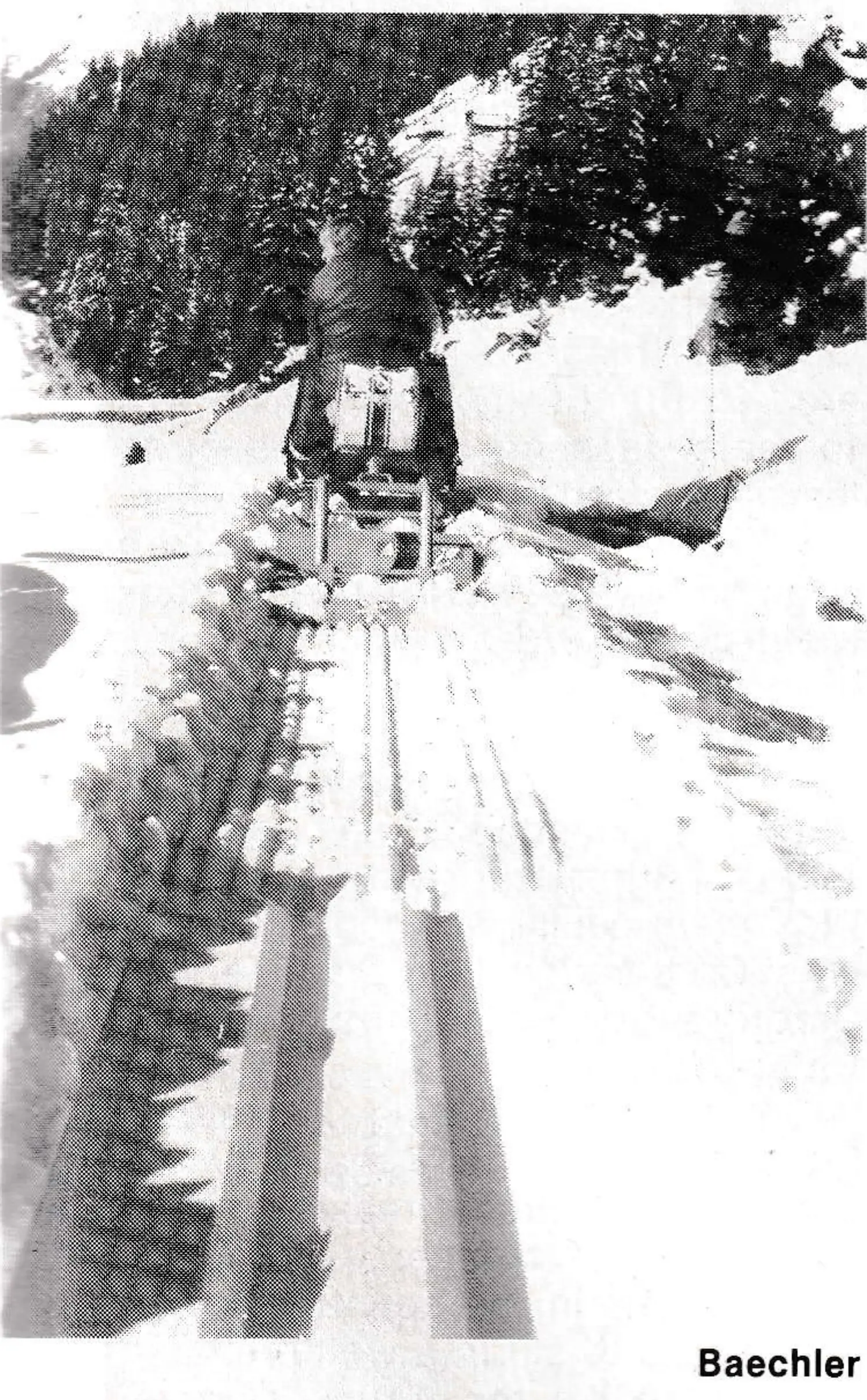
Baechler
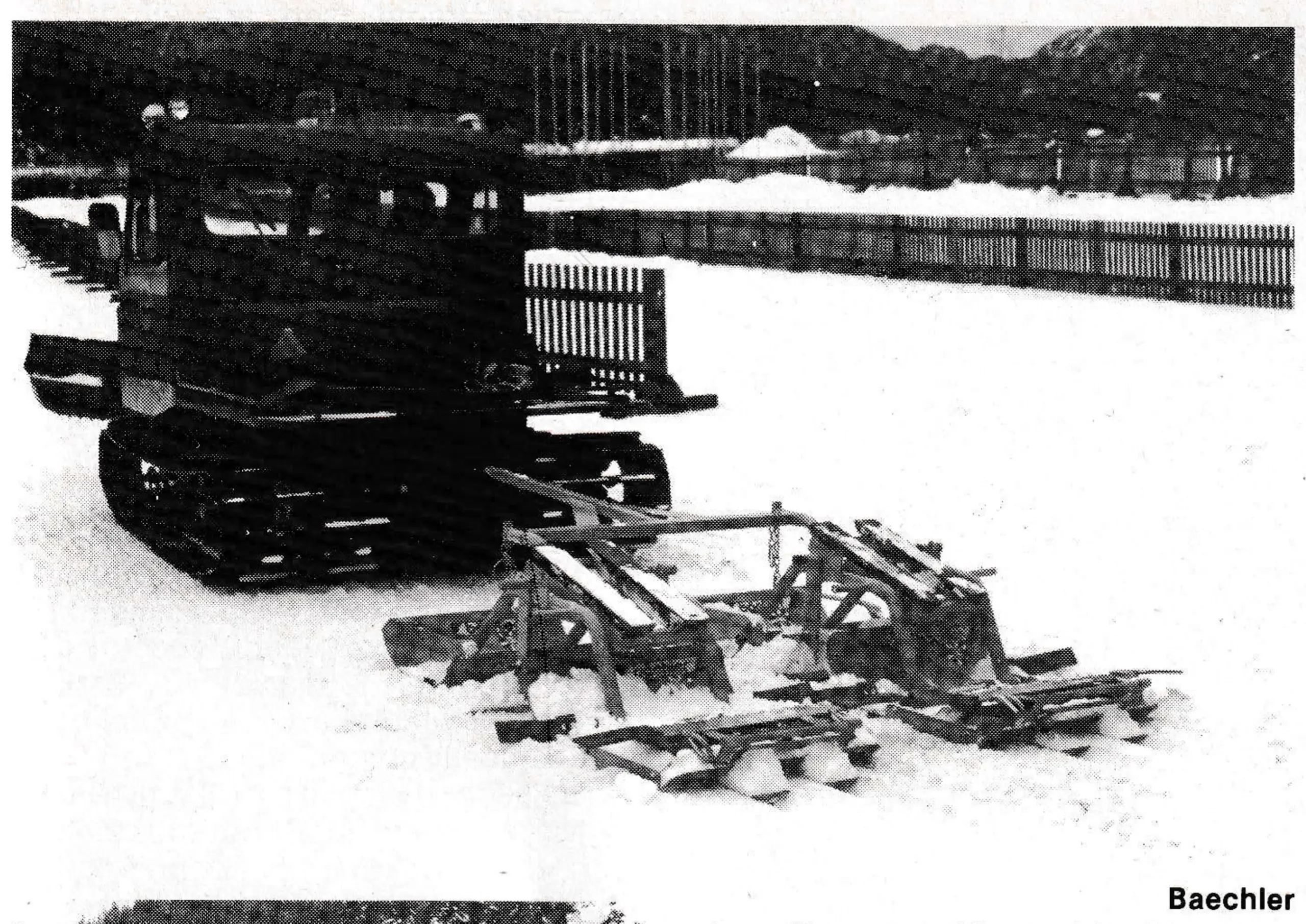
Baechler’s “Loipenstar” system has two major components: the Tracksetter (LSTS) and the Renovator (LSVR). The Tracksetter is designed to pack and cut a track in new, soft, or untouched snow. For older snow, a Renovator is required to groom the snow before it is tracked by the Tracksetter. The company actively promotes the one-step grooming and setting abilities of both the Tracksetter and the combination Tracksetter/Renovator.
In softer snow, there is a tendency for the machine pulling the track equipment to bog down. To counteract this, the Baechler Tracksetter is extremely light (95 lbs.). It may be easily pulled behind a single or double track Skidoo. The Tracksetter’s cutting blades can be adjusted to make the track wider or narrower, and its sideguides, which cut to a depth of 2½ inches, will prevent the Tracksetter from sideslipping on sloping terrain.

A snow rake can be attached to the rear of the Tracksetter and lowered to erase the track on downhills, narrow passages, and corners. Wings can be attached to flatten out snow along fresh tracks for better pole plant areas.
When the snow is old, the Baechler Renovator is required to break up the snow before tracking. The Renovator is attached to the pulling machine ahead of the Tracksetter. Vertical cutting blades on the Renovator cut the snow in narrow vertical strips. Then, a second row of blades, which may be adjusted for height and angle of cutting, cut through the snow horizontally below the already cut vertical tracks. The snow is chopped and mixed to be flattened and tracked by the trailing Tracksetter.
The combined weight of the Tracksetter and Renovator is 190 pounds. Baechler offers accessory weights for both the Tracksetter and Renovator to help in snow conditions that require excess weight to get the equipment in contact with the snow. An excellent accessory for low snow areas is the shovel attachment for the Renovator. Attached to each end of the horizontal cutting bar, the shovel will scoop snow to the center for packing and setting. When the track maintenance person comes to a road or bridge, they can lift the cutting teeth on the Renovator for safe passage with the simple pull of a lever.
The Swiss-patented Baechler equipment is soon to be available for the U.S. market through Valley Engineering of Gray, Maine under a licensing agreement. It is also currently being made in Canada by Jaeger Ski Enterprises Ltd., 1958 West 4th Avenue, Vancouver, B.C. V6J 1M5.
Prices in Canadian dollars (FOB Vancouver) for Baechler equipment are shown below (U.S. prices are not yet set, but the Canadian prices can be used as a very rough guide):
A single Tracksetter costs $609, the Renovator $1,074, or a total of $1,683 for the combination and a single towing bar. Two single Tracksetters with a double towing bar are $1,358, two Renovators with double bar are $2,256, and the combination two of both is $3,616. The rake attachment for the Tracksetter is $203, and the shovel attachment for the Renovator is $42.
Woodcrest
Now in its fifth year of operation, Woodcrest has patented a two-part grooming and tracking system designed to be pulled by all sizes of snowmobiles and over-the-snow vehicles, including the new power fifth wheel and multiple hitch models. The easy two-step system component parts are the Gyro Groomer and the Track Mold.
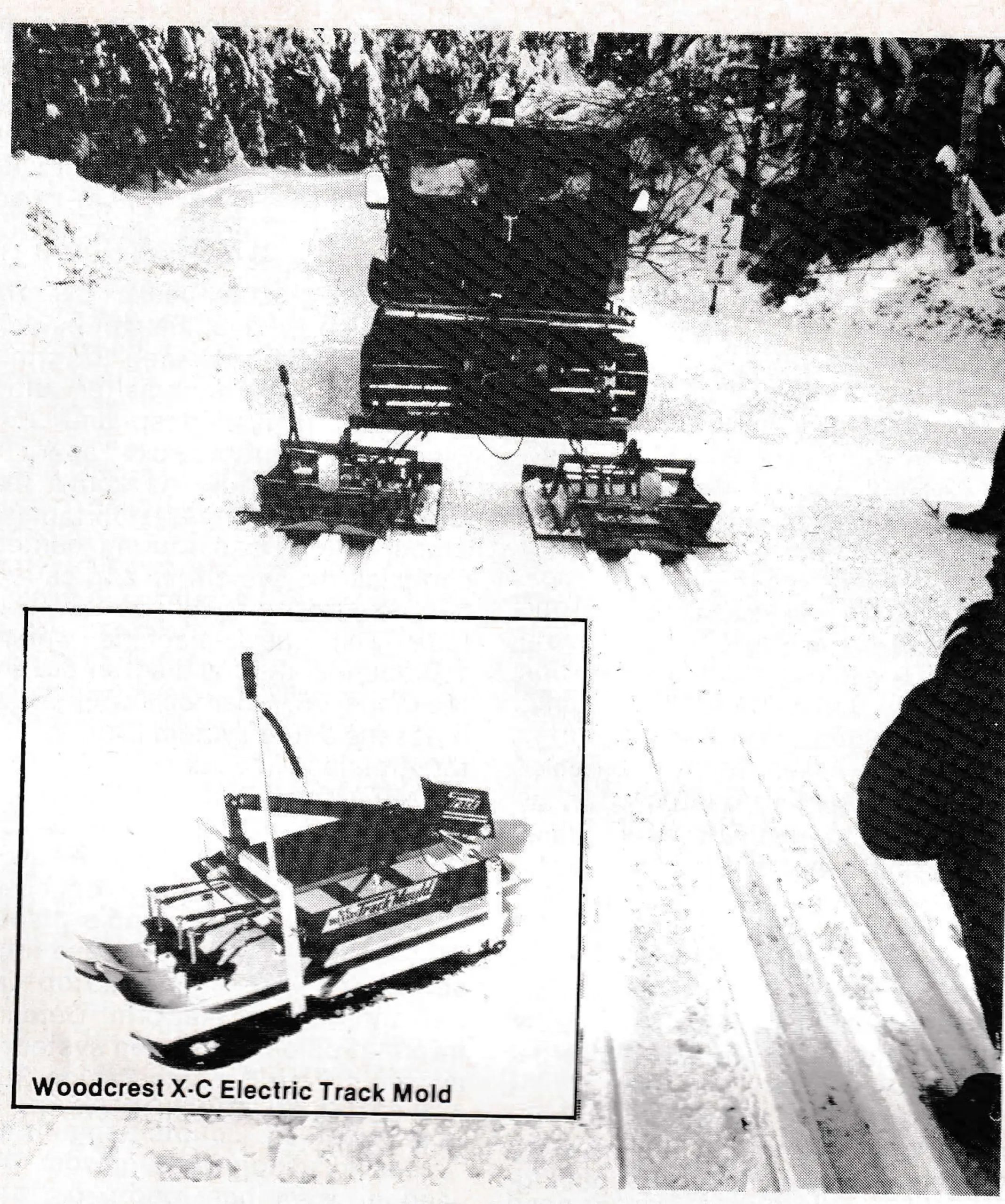
The Gyro Groomer is designed to condition the snow through a high velocity milling process. On the groomers frame, there are two “C” shaped tempered steel shears. These shears face the snow, cut it, and force it across the arc where it collects in the center. The action mixes snow of lower density from the edge of the track with higher density snow from the edge of the track with higher density snow from the track’s midsection. This well-conditioned snow attains greater strength and allows for more rapid age hardening.
A Gyro Groomer is equally effective on dry powder, wet snow, packed powder, and aged frozen snow. According to Woodcrest president Stan Cheney, snow conditioned by a Gyro Groomer is easier to track than snow which has been rolled or mechanically compacted.
The second step in the Woodcrest two-step system is setting the track with the Track Mold. Each Track Mold has two cast iron mold blocks designed with a three-dimensional profile to shear, distribute, and compact the conditioned snow into a track. There are several optional track mold profile designs for different types of skiing (touring/racing). Optional transport skis can be lowered to lift the mold off the snow for safe passage over roads or to leave a section of the trail untracked.
Without any options, the Gyro Groomer is $220. The basic Track Molder is $475 without options. Woodcrest emphasizes customizing both the Gyro Groomer and Track Mold to best suit the individual touring centers needed.
For further information on the Woodcrest equipment contact Woodcrest Corporation, Route 114A North, Bradford, New Hampshire 03221.
Future Tracks
Cross-country skiing is becoming popular for many reasons, and one of the strongest reasons is the growth in the number of well prepared tracks in the country. People simply like to ski in a well prepared track, just like the Alpine skier of today likes a well groomed slope. What the slope roller did for Alpine skiing, the track setting equipment is doing for cross-country…getting more people out skiing.
Even in those areas of the country where there has been resistance to tracks, people are beginning to see the value of grooming and setting. The cross-country purist still has miles of untracked forests to ski in, while the day skier, exercise skier, racer, and hacker have two finely cut parallel grooves to hum along in. The future of cross-country skiing is tied directly to track development, and the touring centers who will reap the benefits of the boom will be those who set and maintain good track.