
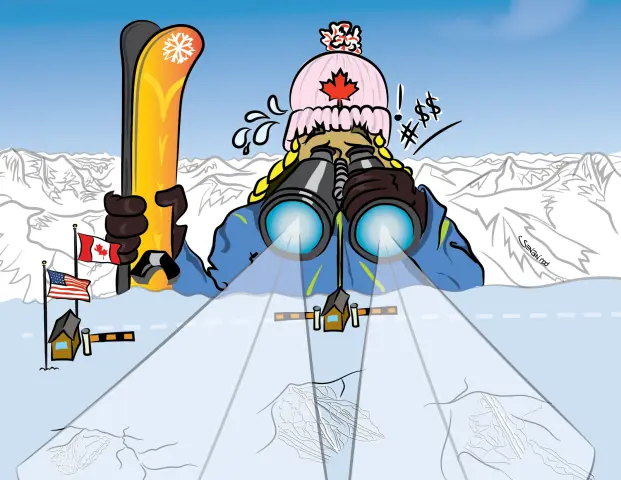

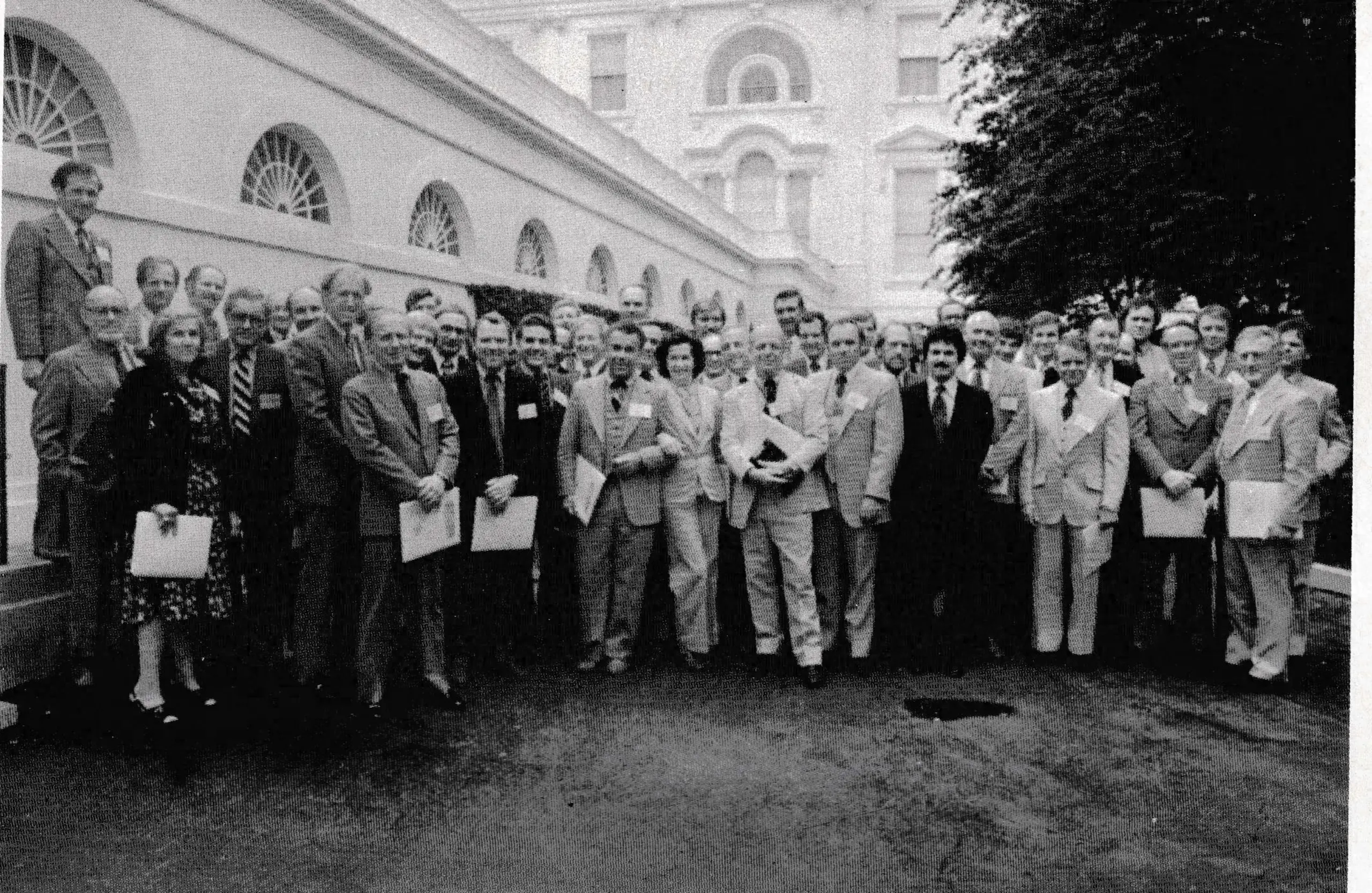
Joe Prendergast, the bright, young president of the American Ski Federation, had set it up, and expectation ran high as we all met in the Senate Room of the Capital Hilton for lunch prior to our 2 o’clock White House rendezvous. The combined boards and top staff of NSAA and SIA were there, plus a gaggle of ski press and some U.S. Ski Association bigwigs. The ski establishment was ready — and ready to express its concerns about energy and public land use as they pertained to the future of skiing.
Joe Prendergast made some housekeeping announcements, and told us what we might expect: Agriculture Secretary Robert Berglund was to be there, as well as Forest Service Chief, John McGuire. Department of Energy (DOE) Secretary James Schlesinger was not going to be able to make it, but we could expect a high-level DOE person to fill in. Ditto Ann Wexler, Assistant to the President. Vice President “Fritz” Mondale, a skier, might be able to drop in, and perhaps “Chip” Carter. White House inflation advisor, Alfred Kahn was not going to show.
Joe told us the format called for us to meet in the White House “family theater” (where Nixon had delighted in repeatedly watching Patton) and our ski group was to present its concerns to the administration officials present. We were to have three minutes for this. (Three minutes??? Yes, I had heard correctly.) Then we would be briefed on the areas of our concern. There might be — but don’t be surprised if there isn’t — an opportunity to ask questions.
Some of the bright-eyed anticipation was clearly dimming. Was this really what everyone had gathered from all over the country to attend? One person asked whether this was the normal procedure with groups like ours. Yes, Joe assured him, this is normal.
But still, the mood of the group was still positive and everyone seemed a little excited. I felt like an eighth grader on a social studies outing to the capital.
We all walked the few blocks to the White House where our names were checked by a guard against a master list. (It was the same entrance I had used on my tourist visit, which dismayed me a little, but I pretended it wasn’t the same.)
We went into the East wing and seated ourselves in the small theater. On the way in we were handed folders bearing a drawing of the White House on the cover, and containing two sheets of White House stationery (souvenir for the kids?) and numerous background documents on the SALT talks. Whoops! Wrong group? No, a young man who looked as though he was barely of drinking age, and who is Ann Wexler’s first assistant, welcomed us to the White House and told us the SALT materials were indeed for our general background information. (A little later an assistant to Hamilton Jordan appeared who looked to be 14 — certainly much younger than Chip Carter, who had come in to be introduced by Tom Corcoran as a skiing Carter who had survived below zero skiing at Waterville Valley this past winter. Chip had spoken for a minute and had agreed that it was too cold for him.)
Prendergast then summarized our concerns — within the allotted three minutes — with a statement on “the developing energy policy…most specifically the way it relates to our particular needs — that is, in the rural areas — problems that we have of getting the skiers to the ski areas.” He also said the ski world was “very concerned about the current land withdrawal program,” — referring to RARE II procedures.
Secretary Berglund and Chief McGuire then spent a generously long time answering everyone’s questions. Summarizing, they went something like this:
Q. What can you do to help us with the energy problem?
A. Not really our bailiwick. Our principal responsibility in the Department of Agriculture is food production, and our energy concerns are directed along those lines.
Q. We keep hearing that at the federal level, skiing is viewed as frivolous and non-essential. We believe it is important for today’s American to have recreation. (Jay Price.)
A. “We have no quarrel with your general assumptions that the spiritual, physical, mental well-being of the United States is safeguarded”… by such activities as skiing. (Berglund.)
Q. But if the Department of Energy starts calling us “non-essential and frivolous,” can we look to you for help at the cabinet level? (Jay Price and Jim Woolner.)
A. (In a round-a-bout, non-committal, friendly way): We don’t want to become the Department of Recreational Affairs, but Yes. Dont forget, though, that “the energy shortage is real. It is no spring-time crisis.” (Berglund): “There are things you’ve been doing or talking about that would ‘improve your image’ — if that is the right word — of cooperativeness in view of the country’s situation…such things as incentives for car-pooling. Maybe there are some things you could do that would stimulate skiers to make efficient use of the energy they consume. The same thing is true for the energy you use in the operation of your own facilities.” (McGuire.) “It is essential we adopt every proven conservation technology and technique ever invented!” (Berglund.)

Q. We have a real problem with excess demand for skiing and a shortage of supply. We’re concerned about potential ski areas getting tied up in wilderness; we’re concerned about the 5-year delays in the permit process. (USSA speakers and Chuck Lewis.)
A. The RARE II process has been completed now, and legislation is going up based on it. Very little ski potential has been put into wilderness. There are some good potential ski area sites in the land set aside for further study and we must all study these further. Certainly the Forest Service is aware of the need for more developed ski areas, and with RARE II behind us “we can go back to work on it.” (McGuire.) And we are working at streamlining the permit process, but don’t forget that we have no control over the other jurisdictions which can cause delays.
And so it went. No new solutions came – (car-pooling was not overwhelming as a new idea), but there was new procedural ground broken. “I offer a suggestion: I’m prepared to learn as much as possible, and maybe it would be a good idea within the next month or two for some of your people to sit down with us at the top level and kind of go over the situation. I’d be curious as to how it’s handled in Europe, where fuel has always been high-priced and generally in short supply. How do they accommodate their ski industry?…Maybe we need a bilateral relationship between your industry and our department.” (Berglund.)
Then one of us pointed out that our problem was not with USDA, where we at least know where we stood and where there was give and take, but with Energy. It was why most of us were here. “We’re very frustrated today that DOE didn’t have the politeness or courtesy to send a representative here!”
The answer from Berglund was again constructive. “We will continue to help you as best we can to get to the right places in DOE, in setting up meetings and trying to get DOE to come to these meetings with you — in our offices, if that will help.”
Perhaps Berglund’s strongest tie to the ski group came when he said, “I have a son who is an avid downhill skier, and he called me last week and asked the same questions as you about whether they’re going to close up gas stations on weekends. He told me to ‘tell Jimmy I’m prepared to give up a lot of things, but not my ski trip.’” Earlier he had said, “I am not a leading authority on allocating of fuels for essential and high purposes, but as a person of Norwegian stock, and one who prides himself in his capacity as a cross-country skier, I can assure you of my interest in the whole, very essential enterprise.”
“We do regard you as important,” Berglund said as his final words, and there was real warmth in that room. The Washington building blocks, small though they seemed, were being set in place for the future, and this, of course, is what it had all been about.
We filed out to a couple more small disappointments: Mondale couldn’t break loose from his meeting, and the President was using the public rooms so we could not go through them on the way out, as had been planned.
The group was deflated as it left, clutching their White House folders, peering listlessly at the famous rose garden (which had no roses in it that I could see). There had been no real answers, no solutions, not even a light to look at at the end of a tunnel. Nothing had changed. And we still were not completely sure about weekend closings.
But, we had found an understanding friend in high places. And in Washington it is friends who count.
Later, in a de-briefing, the shape and content of a viable energy policy for the ski industry was hammered out in a vigorous discussion. The SIA and NSAA Boards would take over from there.