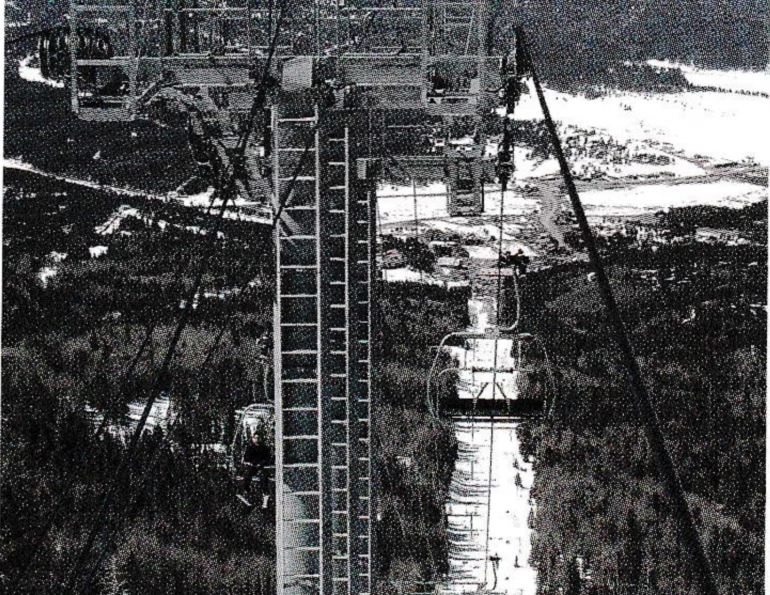
The level of technology incorporated into ski lifts has been impressive over the last few years. However, it seems that every increase in technology brings increased fragility. PLCs and PCs are very particular about their environment. Combining CPUs with lift systems is like hooking your computer to a giant antenna. Thanks to all these electronics, lift problems are becoming more complex.
Angel Fire ski area in New Mexico has such a problem lift. It encountered numerous shutdowns and electrical issues, and we couldn’t seem to eliminate them. We basically had to start over from the ground up when investigating the sources of the trouble.
The problems we were having with this lift came to a head during the 2000-2001 ski season. We discovered this also coincided with one of the worst years in recent history for sunspots and solar storms. (We spent a fair amount of time on the Space Environment Center website, www.sec.noaa.gov, reviewing real time space weather, alerts and forecasts.) We learned that two aspects of this lift were contributing to the electronic nightmare: with its length, nearly two miles long, and its orientation, along a perfect east-west axis, the lift was acting as a giant catch net for any solar winds that pushed geomagnetic storms down from magnetic north.
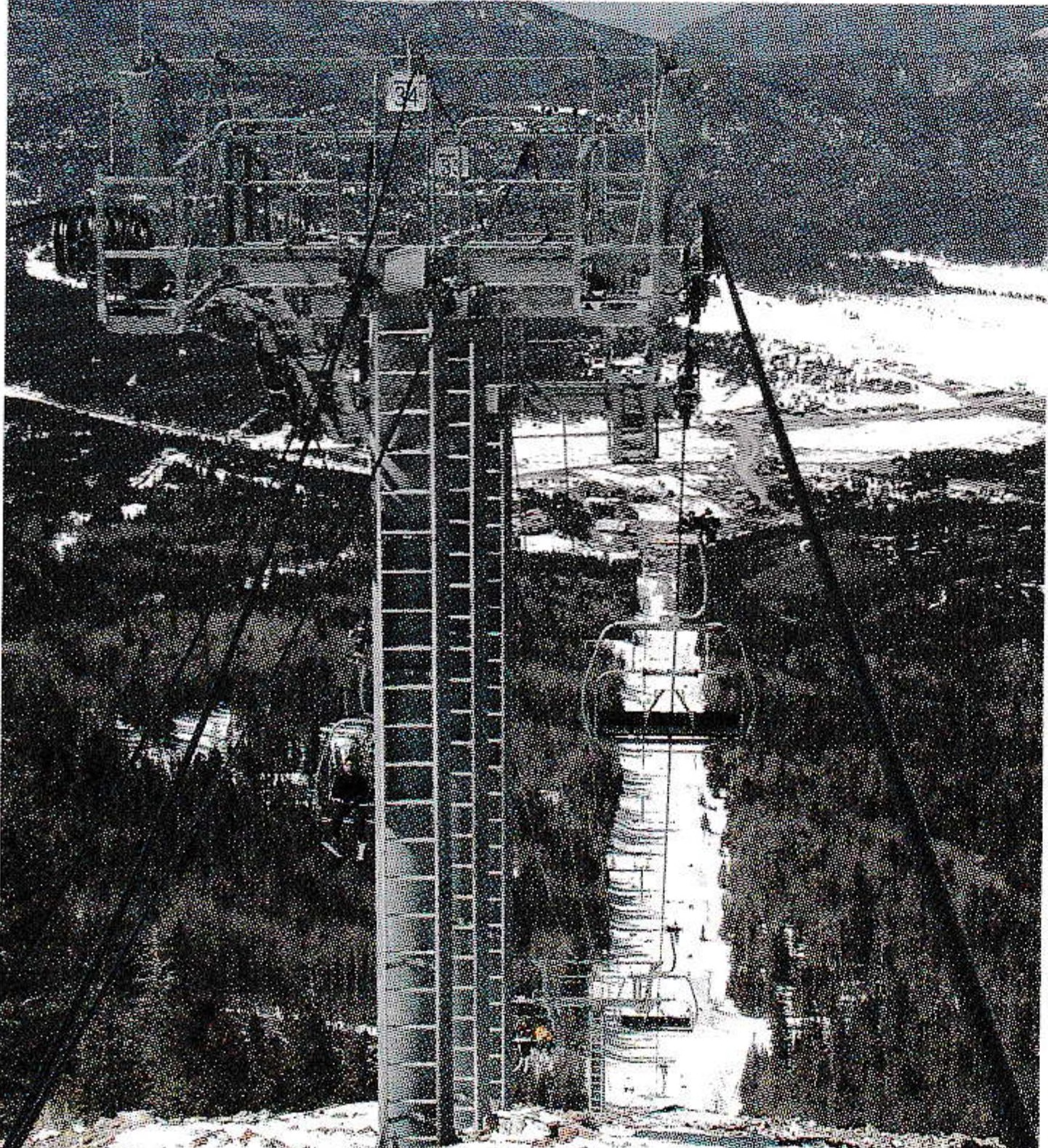
Then we looked at other environmental factors that might affect the lift. There were induced voltages on the haul rope from a power line that ran parallel to the lift. The towers themselves were acting as antennae, picking up radio communications from 100 miles away. The power quality we were getting was not the cleanest.
In the summer, lightning was taking a large number of proximity switches along with I/O blocks and fuses in the filter bank, and it was damaging our computer operating system, which became corrupted due to the constant noise and power fluctuations. There is a radio station transmitting tower on one side of the drive, and the diesel APU would seek the radio frequency instead of the magnetic pickup frequency, causing the lift to surge and droop.

Discovering the sources of these problems—and their solutions—required much research. We consulted with people from diverse fields: power quality experts, grounding experts from PowerQG, surge protection people from MTI, consultants who worked with NASA, lift specialists with years of experience including Leitner-Poma’s Mike Carhart, and radio communications professionals.
Ultimately, though, it was the Angel Fire lift maintenance and electrical department that had to sort through all the data and come up with solutions. And these proved to be as complex as the problems.
Exorcising the Demons
Starting from the ground up, we looked at grounding and bonding. We installed a ground loop around the top and bottom terminals and bonded together through all the towers. This eliminated any potential differences and gave all the noise we were picking up a place to go. This also helped with the lightning in the summer.
Surge protectors and filters were put on all incoming power, including the power to the battery chargers for the control circuits. We also put protection at the end of our power rails on the towers. The power line was buried, and the top one third diverted away from the lift. We went through all bonding and tried to equalize all potential differences. A new operating system was installed that did not require top to bottom I/O links. We also installed Franklin rods on all the towers to divert lightning away from the proximity switches.
We discovered that the haul rope needed to be grounded at all times, especially in the summer when trying to unload the lift with severe weather approaching. This was achieved by putting grounding studs in the bullwheel at the return and grounding brushes at the drive.
The fix was not perfect, but lift downtime was dramatically reduced in both summer and winter. We no longer lost proximity switches and other components due to lightning. We were also able to reduce the weather window. Before we completed our fix, lightning 40 miles out would fault the lift. Last summer a tower took a direct hit and the lift stopped—but reset immediately, with no lost components. Our equipment was also protected when the local power company decided to drop the power to both our quads this past winter, without notification. The same occurrence two years before took out blower motors and other 480 VAC equipment. The faults on the operating system were reduced to nuisance faults and did not cripple the lift.
Lessons of Experience
Our experience shows just how much lift maintenance has changed. For starters, lift personnel must be acquainted with more than just mechanical systems. They must also know electrical, electronic components, computer operating systems, PLC programs and troubleshooting, power quality, grounding, bonding, and the effects of environmental factors on lift systems. These environmental effects can be local, such as poor harmonics due to unfiltered DC drives, or global, such as sunstorm activity.
And so the answer to the question posed back in the beginning is yes, we do need a rocket scientist. Taos Ski Valley in New Mexico has a head electrician, Dan Craybill, so well versed in multiple disciplines that the area did, in fact, hire a rocket scientist to apprentice with him. The resort management reasoned that only a rocket scientist would be able to replace Craybill when he eventually decides to retire. Simply hiring another electrician—even a very good one—would not cut the mustard.
The answers to modern lift problems are not cut and dried. They require eliminating as many detrimental factors as possible and taking a broad overview of the problem. Lift maintenance personnel cannot get tunnel vision.
Ultimately we cannot put ski lifts into a Faraday cage isolating them from their environment. The lift industry needs to begin to look at lift-specific environmental technologies. This will be a hard task, since most lift technology comes off the shelf from technologies that fit a wide range of applications. But it would be great to find ways to adapt them for our purposes and our extraordinary environment.
Electronic Terminology
*Definitions for the electrically challenged.*

**BONDING:** The permanent joining of metallic parts to form an electrically conductive path which will assure the capacity to conduct safely any current likely to be imposed.
**CPU:** The Central Processing Unit (CPU) is the brains (Intel or others) within a computer that comprises all of the sophisticated electronics that manage the software programs and hardware add-ons (printers, disc drives, etc.)
**FARADAY CAGE:** A metallic cage that “absorbs” all types of electrostatic charges and thus protects its occupant, such as an entire ski lift (not really practical). Named after its inventor, Michael Faraday, a British physicist and chemist of the early 1700s.
**FRANKLIN RODS:** Among Ben Franklin’s many accomplishments was the lightning rod, aka the Franklin Rod. Recent studies have determined that blunt-end rods attract lightning better than Franklin’s original pointed models.
**GROUND:** A conducting connection between an electrical circuit or equipment and the earth, or to some conducting body that serves in place of the earth. For a proper ground, the metal-to-metal connection must be clean and resist corrosion or other deterioration for the life of the connection.
**GROUNDING BRUSHES:** Metal bristle “scrub brushes,” usually mounted over the haul rope, that maintain continuous contact with the rope either though their own weight or springs. The bristles are grounded to the terminal and thus “bleed off” undesirable electrical charges.
**GROUNDING STUDS:** Usually brass rods or bolts that are driven into the liner and seated against the inner steel liner retainer, thus providing continuous contact (and grounding) between the haul rope and terminal ground.
**I/O BLOCKS:** Input/Output data (signal) links or terminals that connect two or more locations.
**PC:** A desktop or laptop computer.
**PLC:** A Programmable Logic Controller (PLC) is a computer that allows coded access to its vital software for the purpose of updating or otherwise fine-tuning individual items that control a machine (such as an aerial ski lift).
**POTENTIAL:** In this case, “potential” refers to electrical potential or an imbalance of some electrical force, usually volts.
—Nils Ericksen