


But that’s not exactly what they had in mind when they went into it. Originally, RCR was looking to deal with one supplier for its rental fleet to simplify operations, and they chose Head/Tyrolia. The Sports Rental software was a bonus suggested by the folks at Head/Tyrolia and RCR hasn’t looked back since.
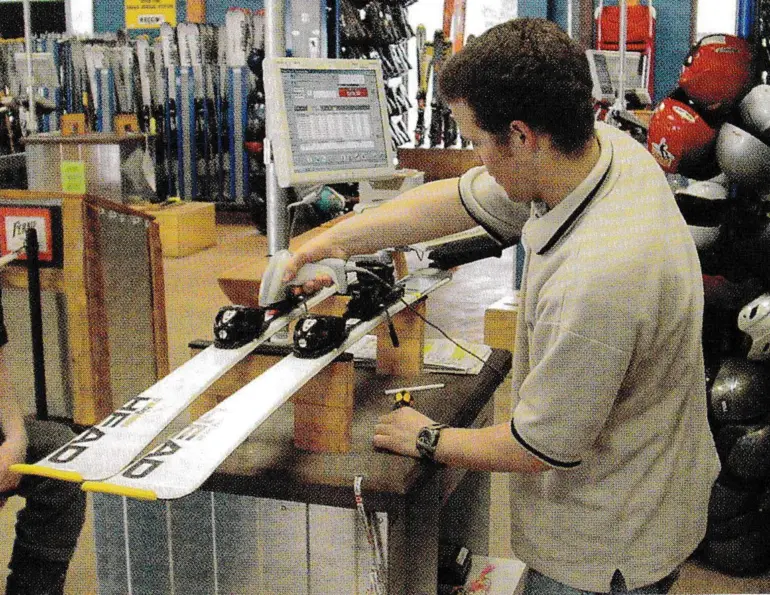
The Sports Rental software works with RCR’s Head/Tyrolia inventory largely because of computer chips—proprietary technology developed by Sports Rental and licensed to Head/Tyrolia— embedded in the company’s skis and boots. Computers running Sports Rental’s software use the chips to track inventory and reservations and make important calculations during the rental process. Although the system is not paper-free, from the rental staff’s point of view it is nearly pencil-free, and can be cash-free as well.
Entering the Millennium
“The package—new equipment and the software—took us from 1980s-style paper-driven shops into the new millennium with a computer-assisted rental operation,” Neil Jackson, GM at RCR, said. “It truly took us from the dark ages into the light.”
That involves capturing data electronically to the greatest extent possible. Ironically, it starts with the customer filling out the form by hand. The top section of the rental form records typical name, address, phone number and security information. The remainder of the form is organized so that skiers check off a box that corresponds to their height, weight, age and skier type—most of the information needed to determine binding settings. Bar codes next to the skiers’ choices are scanned by the rental technicians for computer input. The system then gives the binding position and release indicator setting information.
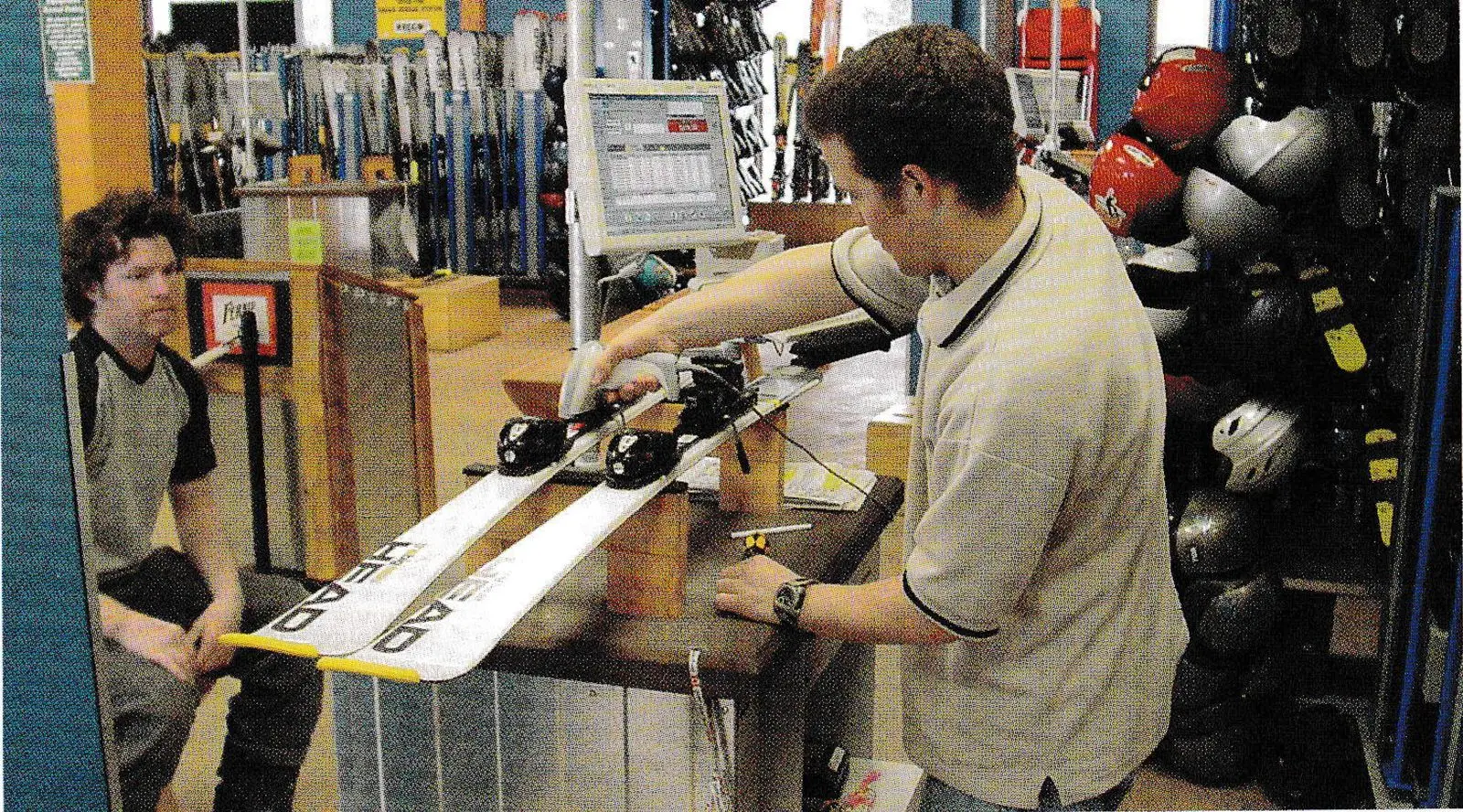
At Lake Louise, Alberta, customers complete their forms and then proceed first to a boot fit station and then to a tech bench. There, a rental technician keys in the customer’s written information—name, address—and then scans the bar codes next to the selected personal information—height, weight. Sports Rental software uses the information, along with the sole length of the boot provided by the embedded chip, to determine the appropriate release indicator settings and binding toe and heel locations.
Additional rental items—poles, helmets, radios, etc.—are keyed in by the technician, and the software computes charges based on the length of the rental. It also removes these items from the ready-to-rent inventory over the selected period. When equipment is returned, it is scanned and the software logs it in as again available for rental.
Lake Louise uses Sports Rental to dispatch and track 1,300 units. Despite the need to key in customer information, rental shop manager Ryan Capel says that the system has cut down on the time required to process a customer through the facility.
In past years, the maximum time for rental customers to process through the shop on the resort’s busiest weekends was around an hour and a half. “This year, in the same time periods when the shop is working at capacity, the maximum time that customers had to wait was under a half hour,” Jackson said.
The other benefit is reduced staff requirements. “On days when we are running at around 60 percent of capacity, we are typically using 17 people to run the facility,” Capel said. “Before, we would have had 26 people working. That’s a pretty significant reduction in labor cost.”
Overall, Jackson said that in the first season, labor cost reductions ran from five percent at Lake Louise up to 50 percent at the company’s Fernie, B.C. operation. “The big reductions at Fernie aren’t just due to the Sports Rental software or the new Head/Tyrolia equipment,” he said. “But they are both an important part of the mix.”
Fernie: Pods of Success
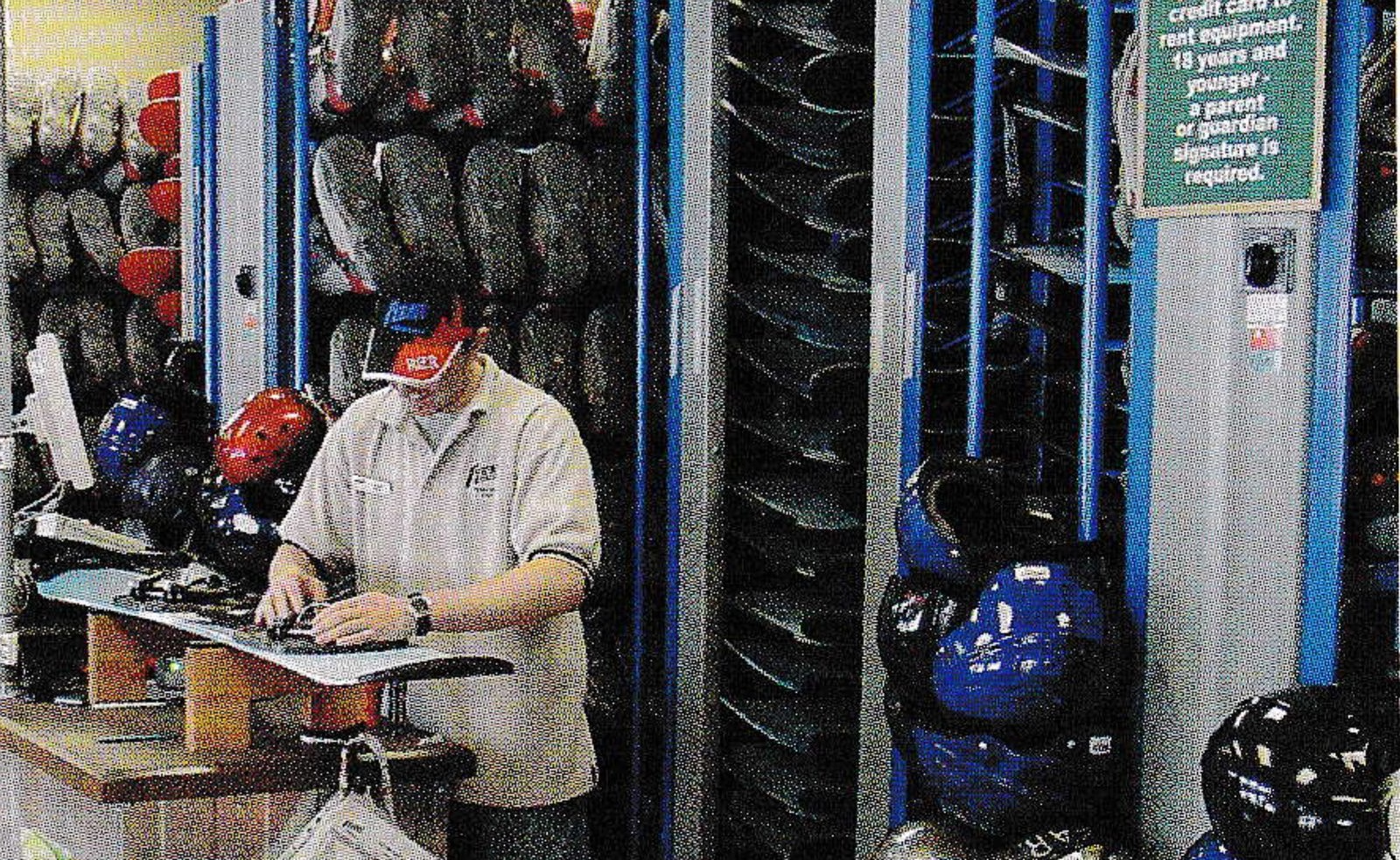
The other part of the mix at Fernie was going to a pod, customer-based operation. “The pod system at Fernie is totally centered around the customer,” Jackson said. “The guest goes to one location. Each pod is a completely outfitted mini-shop.
“We have one employee who functions as a maitre d’, and helps guests decide which equipment they need. There is also a ski school representative there who encourages guests to take lessons.”
The Fernie operation has 900 skis and 350 snowboards in inventory. “We have five pods,” said Jason Howlett, RCR’s rental manager at Fernie. “There are three standard rental pods, one high-performance pod, and a snowboard pod. One of the standard pods is geared towards smaller people and children.
“Our maitre d’ directs people to the correct pod. The Sports Rental software lets us link all of the pods. When a family rents, Dad can get a standard rental, Mom can get high performance gear, and Junior can rent a snowboard. Dad will be able to pay for all three rentals at his pod. The Sports Rental software also allows us to do all of the cash transactions for ski school and lift tickets at each pod.”

“The system lets us help the customers be more flexible, too,” Howlett said. “If a customer is unsure whether they want to rent for three or four days, we can charge them for three days, and if they decide to keep the equipment for a fourth the software recognizes the extra charge when the equipment is returned and alerts the staff.
“Probably the best part of the pod system is that the customer doesn’t have to walk around the shop collecting more and more equipment,” Howlett said. “Once they arrive at the pod they deal with only one or two of the staff. That setup is not only more efficient for us, but it’s a much better experience for the guest, and we’ve noticed that improvement in our customer satisfaction comments this year.”
The Cost of Progress
Efficiency comes—naturally—at a cost. A bare-bones Sports Rental setup for a small area starts at around $1,000, and runs up to about $15,000 as additional software capabilities are added. Hardware costs are extra. At an operation like RCR’s at Lake Louise each workstation has a keyboard, monitor, mouse and scanner.
The charge for the software is a one-time charge, but upgrades are available for around ten percent of the original charge, according to Bill Hutton, sales manager for Montana Sport North America, European-based Sports Rental’s North American distributor.
“Charges are based on the number of units in inventory and the number of stations that the operation uses,” Hutton said. “There are optional modules available to customize the software for individual requirements. We can add ticket sales, store photos of the renter or the renter’s identification, add on small point-of-sale items like sunblock, and store maintenance information. The system is very flexible.”
Optional upgrades for winter sports rental operations include maintenance records. “With the embedded chips we can track how often a given piece of equipment has been rented,” he said. “We can even track how many times an individual ski has passed over a belt sander or stone grinder.”
Sports Rental’s software can also be applied to other operations. “It’s used for other activities besides winter sports, like rafting and kayak rentals,” Hutton said.
The Bottom Line
“From a management point of view, Sports Rental gives us a very significant database that we are just starting to use,” said Jackson. “For the first time we can look at our inventory by unit. That’s helping us put together our next order from Head/Tyrolia. We can identify situations where we lost revenue because a particular piece of equipment wasn’t available for rental, and we can shift inventory from one location to another to fine-tune things or order new equipment in specific sizes for areas where it’s needed.”
RCR is just beginning to put Sports Rental’s software capabilities to use, Jackson said. “I’d say that at this point we are operating it at about the high school level. We’re going to work with our rental managers so that next year we can take our operations up to the university level.
“Most important for us, though, is that we’ve tracked significant improvements in customer satisfaction,” concludes Jackson. “That’s going to continue to be our number one focus. We want to use all of the tools at our disposal to keep our guests happy.”
