In other words, given their importance as front-line staff, how do you keep your resort labor force happy and productive when they can’t afford to live in the place they work? It’s a huge and complicated problem, particularly considering the limited space available for development in environmentally-sensitive mountain locales.
And it’s not as though the subject has been swept under the rug. Resort critics like Miles Rademan have railed on the industry for years, comparing the situation to Third World countries where gated communities are only accessible to bussed-in workers from dawn to dusk. It’s a situation, says Rademan, that can only lead to disastrous consequences if it’s not more aggressively addressed.
For all intents and purposes, the battle has already been lost at some of America’s most famous resorts. Whether It’s Vail, Aspen or Sun Valley, few mountain employees can aspire to live on-site. “We’ve gotten to the point,” says one Vail manager, “where the filthy rich have displaced the merely wealthy. As for Vail employees living on-site, forget it. It’s a totally unrealistic goal for most of them to even consider.”
All you need to do is get caught up in the 6:30 a.m. rush-hour traffic on Highway 82 to Aspen to get a clear picture of the problem. “The people who really aspire to the mountain lifestyle—the young kids who leave the city and want to devote their lives to mountain sports— don’t have a chance of finding a place in Aspen,” says longtime resident Jim Oates. “And in the end, that impacts negatively on the spirit of the town. We need passionate people here—not just poseurs.”
While American resort managers continue to struggle with the problem, management at Canadian-based Intrawest has decided that the solution is simple: You bite the bullet and simply allocate valuable real estate for employee housing. Since 1988, Intrawest has contributed over 1,500 employee-bed units to the community serving Whistler/Blackcomb. Some say it’s just a drop in the bucket; others appreciate the effort.
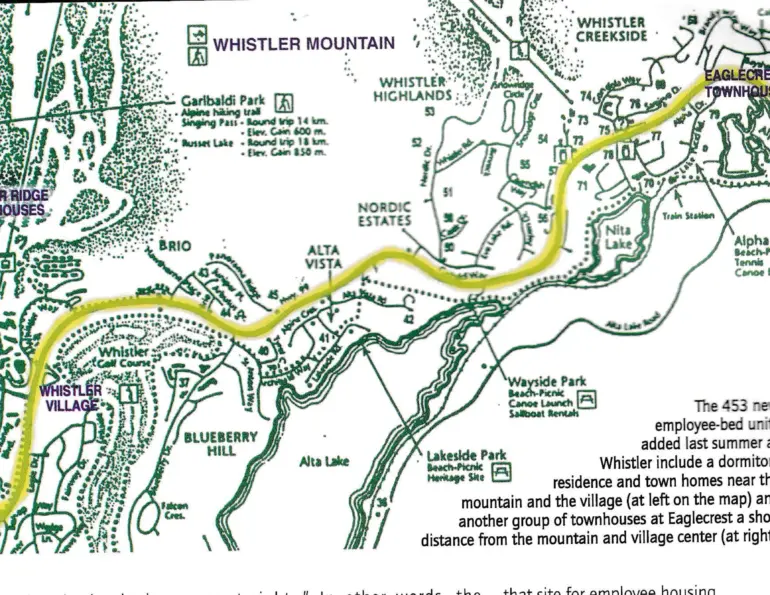
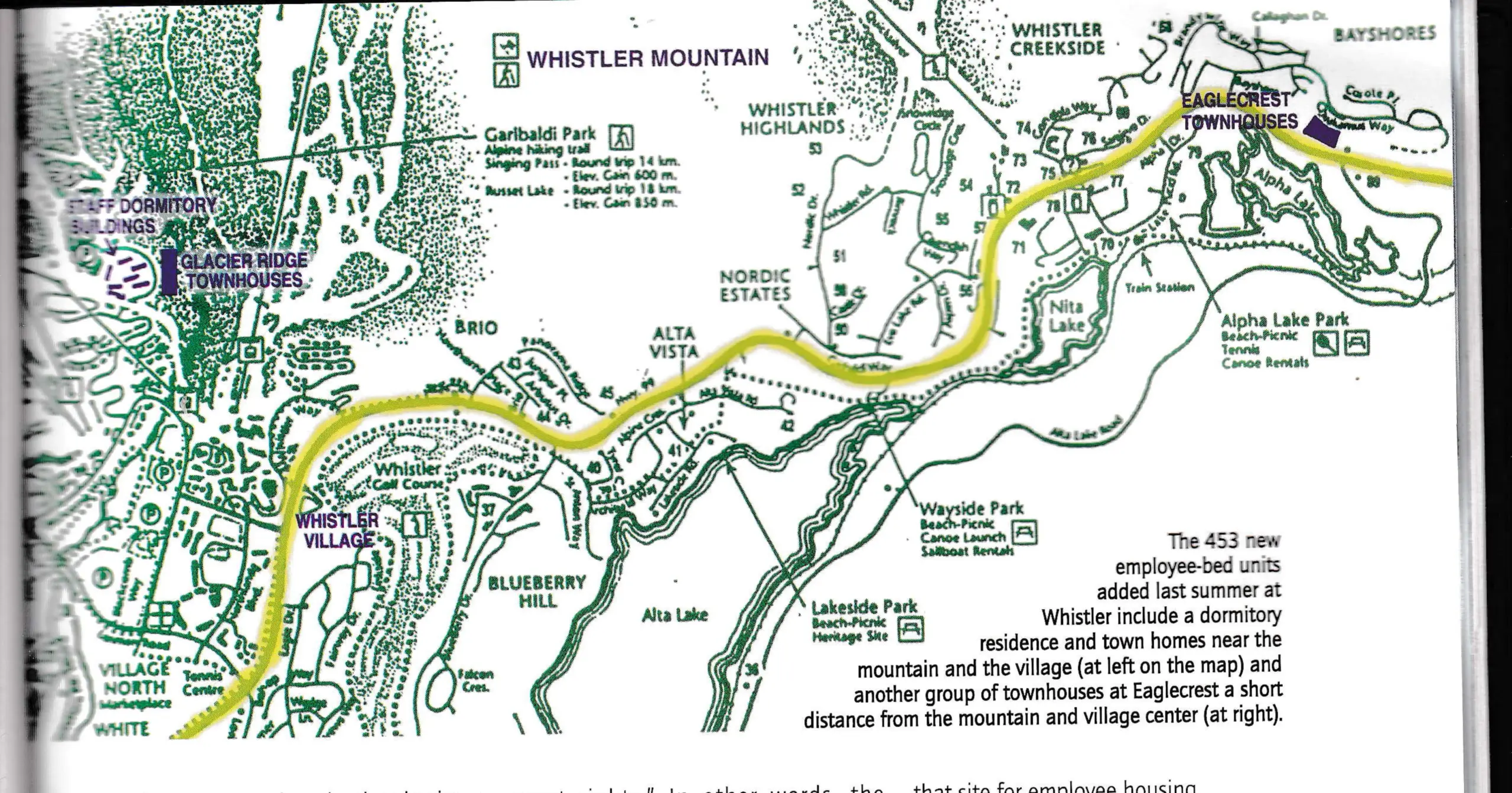
Last summer, Intrawest built 453 new employee bed units—most within walking or skiing distance of the village and the lifts—at a cost of more than $13 million.
While a significant portion of these were dormitory-style residences targeted at the company’s seasonal employees, 60 townhomes were built and sold under a lottery system to full-time mountain staff. This followed the initial offering of eight townhomes developed in 1995 for full-time employees—the first time in North American mountain-resort history that a company gave up valuable real estate for employee-purchased housing.
“While there has been a lot of talk over the years,” says Bob Barnett, editor-in-chief of the Whistler Pique, a weekly community magazine. “Intrawest has been the only one to really do anything about employee housing. Now, finally, others are following their lead and taking measures to fill the yawning demand gap.”
With Whistler’s employee housing underway, a number of property owners in the region, including Westin Hotels, which has a project on paper, Burrard International, operators of a lodge and a golf course, and Bosa Development, which is building a 160-room hotel, all have employee-housing components in their plans.
“There is no question about it,” says Mike Vance, director of Planning and Development for the municipality of Whistler. “Intrawest deserves a lot of credit for the employee housing initiatives they’ve undertaken in recent years. Today, the developers and operators with whom we’re dealing realize this issue is fundamental to the healthy growth of this valley. But that wasn’t always the case.”
Prior to the 1988 projects, Intrawest had not addressed the employee-housing problem. “We saw early on that the development of employee housing was going to play a big part in our growth plans,” says Gary Raymond, president of the Resort Development Group at Intrawest. “In fact, we’re convinced that employee housing is an integral part of being a successful mountain operations company today. We know that if our employees are happy at their job, our guests are too.” And nothing, he adds,
makes employees happier than having a secure roof over their heads.
The man most widely credited with implementing and developing the employee-housing program for Intrawest, Raymond adopted the issue as his personal mission back in 1984. “As a longtime resident of Whistler, I knew first hand how tough the housing market was becoming,” he says. “I also knew that if we made it too tough for local people to buy here, we’d never become a true community.”

In early 1988, Raymond supervised what would be his first real estate development project for Intrawest—the construction of four ski-in/ski-out apartment-style buildings near the old Blackcomb base lodge that would eventually provide 200 two-bedroom rental units for seasonal employees. “It was, in effect, my transition from operations to real estate,” says Raymond. “Although I didn’t realize it then, that first employee-housing project was my springboard to a whole new level of involvement with the company.”
To call that first project a success is to put it mildly. Those first four buildings were eventually followed by three more, bringing the total cost to about $20 million. Today, nearly 700 seasonal employees can be accommodated in short-term rental units.
And they couldn’t have done it without the support of the municipality. “We zoned it for them,” says Vance. “Essentially, they got to develop those bed units with no charges against their development rights.” In other words, the employee-housing units built there were considered above and beyond the development ceiling that Intrawest had been assigned under Whistler’s OCP. “In this case,” says Vance, “everybody won.”
But that was just a start. “We also realized that we had to find a way to keep our full-time staff, our middle managers and their families, happy, too,” adds Raymond. “That’s basically where the motivation came to build ‘subsidized’ townhouses that could be purchased at a substantial discount by our managers and supervisors.”
Not one to hog the spotlight, Raymond is quick to credit the municipality with the foresight to make it all possible. “Ultimately it’s a team effort,” says Raymond, “Without the support of council and municipal staff, there’s no way we could have succeeded with these projects. Clearly, the will was there to make affordable housing a reality in this valley.”
The most recent Intrawest employee-housing initiative, for example, was undertaken on a parcel of land called Miller’s Pond, where the company had, initially, no development rights. The deal Intrawest worked out with the municipality, according to Vance, is called density bonusing. “We negotiated—and agreed—to a certain mix of employee housing to market housing based on the cost of servicing the lots,” says Vance. That way, Intrawest received additional development rights for market housing on the Miller’s Pond site in return for designating part of the land at that site for employee housing.
“There has to be some give-and-take if this kind of deal is to work for all the parties involved,” says Vance. And some long-term planning as well. “All controls—price, use, re-sale—are registered on the land so the deal never changes.”
Fortunately, the lessons learned at Whistler are being applied to other Intrawest resorts. At Keystone, Colo., (where Intrawest has some major real estate deals going) Raymond says employee housing is included in the development mix from the very beginning of the master planning stage. “That’s the key,” he says. “Unless you take those needs into account right from the start of your planning, there’s no way you’ll be able to accommodate for them later.”
Although employee housing for Intrawest’s huge new housing development at Mammoth Mountain, Calif., is still in the planning stage, more employee apartments at Whistler, to be constructed in the summer of 1998, are confirmed. And beyond that, a variety of housing for employees is planned for succeeding years.
While the issue of employee housing will continue to haunt most mountain resort operators well into the next century, Intrawest’s innovative programs have shown how it is possible to deal successfully with the problem. “Unless you find a way for working people to live at your resort, it will never become a true community,” reiterates Raymond. It’s that simple.