There are only two reasons why an area should concession out its food and beverage operations: to secure capital or to secure managerial expertise. Unfortunately, the need for capital and/or managerial talent which leads to contract feeding arrangements often brings about situations where the food department’s objectives are working at cross purposes to the area’s objectives. To shed light on this problem, let’s first look at the function of food service at a ski area.
The food service function
It’s unrealistic to think that people visit a ski area because of the food operation; they visit the area to ski or to engage in or be entertained by the tourist attractions of the area.
Consequently, the function of the food operation is 1) to provide a service so visitors will not have to leave the area for meals or have to bring their own food, and 2) to act as positive reinforcement of the area’s impact on the visitor experience. That is, the food operation should be a selling tool which complements (never detracts from) the other aspects of the area’s merchandising mix—good skiing, convenient parking, comfortable base lodge, quality ski school, etc. This second point is particularly important since virtually every customer experiences or has to contend with the food service provided at the area.
Quite often concessionaires are myopic about the importance of repeat customers and the function of food service as a selling tool. They tend to concentrate on short-term goals (length of contract) at the expense of long-term growth. This means that concessionaires studiously apply pricing and budget control techniques to insure that they receive a profit after meeting expenses and concession fees.
For the most part, the concessionaire must be tight-fisted. Food service is a low operating leverage/high variable cost operation—consequently, each additional dollar of sales brings a proportionately high amount of additional expense. Since employee productivity is somewhat fixed by the system’s design, the concessionaire is often faced with the alternatives of increasing prices or decreasing quality to meet his objectives.
High prices, low value?
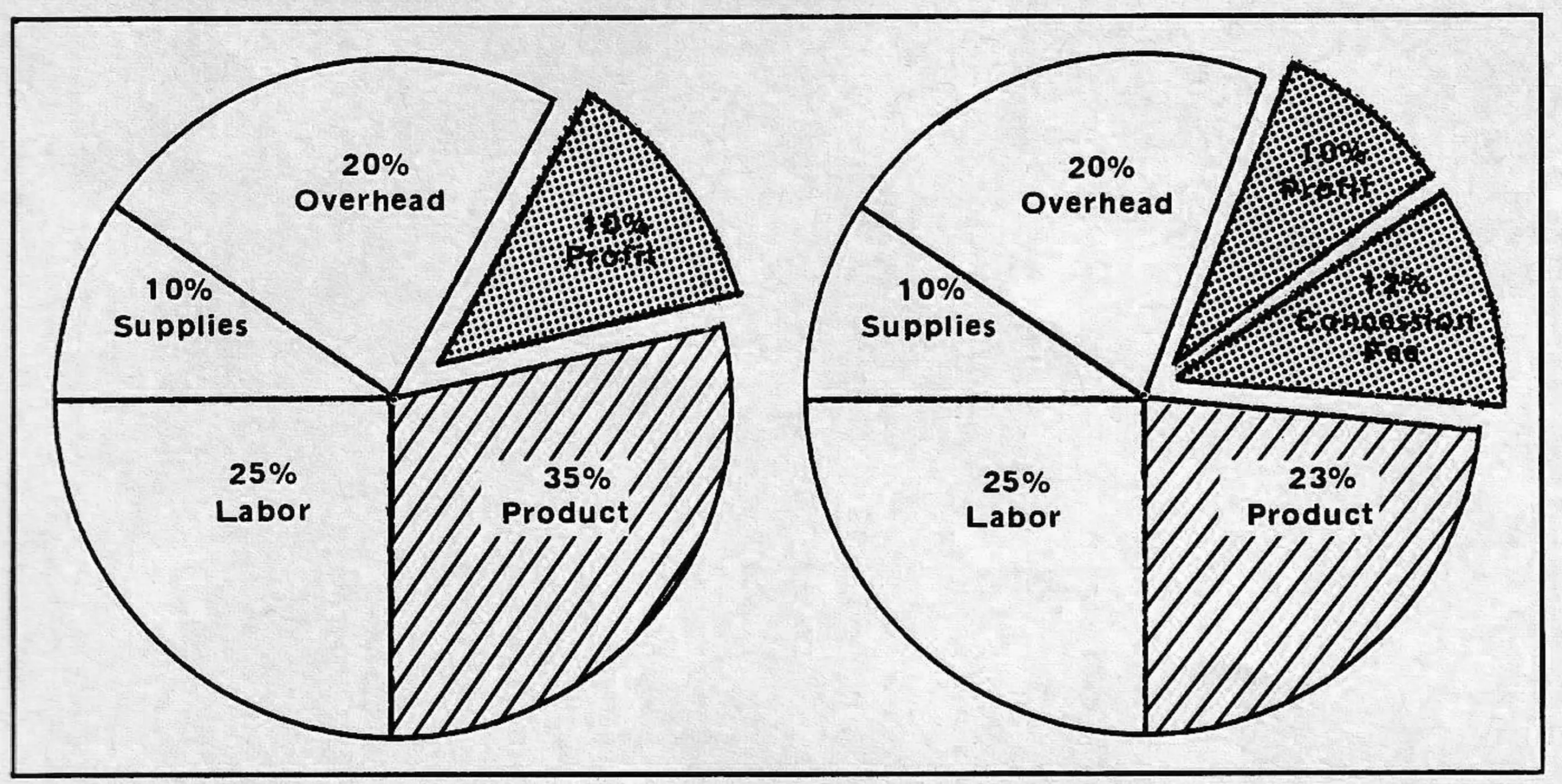
A close approximation of how much prices increase or value decreases when a concessionaire operates the food department is the concession fee. That is, if the concessionaire pays the area 12 per cent of gross food sales less sales tax, then the customer is likely paying close to 12 per cent higher than at competing areas for an equivalent product or is getting 12 per cent less quality in terms of product cost.
The reason? With a concession, two groups are trying to make money off the food operation, whereas area-operated units require a profit for only one source. Perhaps the reason is not so much that two groups require profits but that both groups look for big cash payouts and do not temper their expectations with return on investment analysis.
The simplest alternative is for the area to own all the equipment and lease it to the food concessionaire. This allows the operator to write off the depreciation against lease revenues, but it requires front money which may be needed elsewhere in the development of the area. In addition, there is the attitude that a concessionaire does not maintain and repair “someone else’s” equipment as well as his own and a very real danger that utensils, which are expense items and not part of capital, will disappear several times over the life of the contract.
The converse situation, where the concessionaire owns all the equipment and utensils and merely rents space from the area, makes the concessionaire a real part of the area’s growth and conserves the area’s dollars for other development or working capital.
Whether the concessionaire owns all or part of the equipment, the contract should have a buy-back clause which obligates the concessionaire to sell such equipment and utensils to the area or to a new contract feeder in the event that a new concessionaire succeeds him.
Company concessionaire
It is often assumed that concession problems can be eliminated by choosing the right company. This usually comes down to a choice between a regional or national company and a local operation. The larger companies have purchasing power and problem solving experience at many different locations. The local operator has his reputation at stake; his performance is extremely visible and he must do well to save face in the community.
The larger companies are more likely to keep pace with product innovation since they are in the mainstream of the market. This is especially true of packaging and disposable ware. Smaller companies, while not tuned to national trends, are more adaptive to local tastes.
Another trade-off exists in decision-making prowess. Larger companies usually have a solution to any problem that crops up, but often their decision-makers are in central offices which could be anywhere from 100 miles to several states away. Smaller companies, while often not as sophisticated, have the top man close at hand where he can be called upon to suffer through the problem.

There’s no question that food operations are intricate and complex systems. Of all businesses, eating and drinking establishments have the highests failure rate; the world’s must successful lodging chain, in fact, has a disproportionate number of restaurant failures, and hotels (people go to hotels to sleep, not to eat) have long been hard pressed to make food departments pay off.
Regardless of the size of the food operation, the department head must have knowhow in purchasing, production, service and control of cash, product and labor. The three P’s—purchasing, production and product control—are the talents which make a food manager distinct from other capable, but non-food oriented, managers. And these talents require both education and job experience.
An area embarking on a food-service operation should attempt an executive search before or concurrent with their efforts to solicit bids for the concession contract. The food service industry is a $30 billion industry. There are over 3,000 colleges and junior colleges in the country offering training and education in food service. There are more than a dozen industry trade magazines and newspapers which carry classified advertising. Almost every city of 750,000 or more has at least one personnel agency which specializes in food service and lodging placements. National and regional trade associations, although not normally involved in disseminating job information, can usually provide invaluable contacts. There are 3.5 million workers employed in food service in the U.S. More than a few of them would find opportunities at your area attractive.
Contract necessary
If an area decides to bring in a company to run its food service, it is essential that all duties, responsibilities and payment schedules be outlined in contractual agreements. These instruments may vary from two or three page letters of intent to 20-25 page documents which tend to certify the mistrust that often exists between the two parties.
Here’s a checklist of items that should be contained in any contract: 1) fee structure; 2) length of contract; 3) renewal clause; 4) termination clause; 5) liability clause and insurance requirements; and 6) performance clause in terms of quality and service.
While there are many types of fee schedules for food service contracts, most ski areas use a percentage of sales figure. This type of arrangement often leads to the mistaken notion that the higher the percentage, the better negotiation the area manager has secured. Unfortunately, this usually results in over-priced merchandise. Clauses which retain the right to set price-portion structure are tough to implement and generally ineffective because few operators can tell the difference between a 5:1 and a 6:1 hamburger much less one that contains 20 percent soybean protein.
Instead of portion size, the area operator would better meet his objectives by specifying quality in terms of product cost. Concessionaires should be required to produce externally prepared accounting data to verify that their food cost is within some specified range. Many areas which are only concerned with how much revenue flows through the concessionaires’ cash registers would be shocked to find that less than 25 cents of every customer’s dollar actually pays for the food he is buying.
Also common is the area operator’s attempt to push through contracts which border on the unconscionable. This is because area operators are quick to sell their headaches to the concessionaire. Most ski area food service contracts are little more than cleaning contracts. Some have such questionable duties as window washing, snow removal and fireplace maintenance. All of these extras not only drive the cost of operating—and, resultingly, food prices—up but also demoralize the food service ranks.
Because of limited resources, capital or knowhow, many areas will have to concession out their food operations. This need not be a bad experience for the area or its customers. Exhaustive search for the right company and realistic contract obligations are important, but the most important criteria for a successful relationship between the area and the concessionaire is their willingness to work together in setting mutual objectives. This involves pre-season and multi year planning not only of visitor counts and revenues, but of complete operating budgets including past performance figures. Unless the area man and concessionaire are willing to swap financial statements, they shouldn’t be in bed with one another.