
Streamline your checkout
In a well designed cafeteria every service station is capable of serving customers faster than the cashier station. Anything less would cause bottlenecks within the line while the cashier stood idle. Therefore the serving stations must all be altered to work at top speed and the cashier’s speed will determine what this top speed must not exceed.
A standard cashier checkout speed is 15 seconds per customer, while highly efficient systems process customers at 10 seconds each. The lighting, the number of prices, packaging, sales tax treatment and the placement of the checkout counter all affect this rate.
With more lumens of lighting power at the checkout area, for example, the cashier can process customers faster. About 25-30 candles will illuminate an efficient work area.
Once at the counter, the checkout process can be slowed unnecessarily by requiring the cashier to remember and manipulate too many prices. Psychologists espouse a theory called the “magic number seven” which is supposed to be the mean of the number of bits of information an individual can handle in one operation while keeping them distinct. Operators should therefore force their pricing schedules into a maximum of seven categories even if it means sacrificing cost considerations for line speed.
In addition to limiting the number of prices, the cashier should be able to quickly recognize the price of each item. A distinctive wrapper, the sandwich name or a clearly-marked price will circumvent this problem.
Your line can be further speeded up by including the sales tax in the price of the product. Astute operators will point out that inclusive sales tax tends to diminish revenues per skier (receipts less sales tax ÷ skier days). They fail to recognize that greater line speed permits more customers to be served, thus offsetting the diminished revenue. (Revenue=Avg. Price x Quantity.)
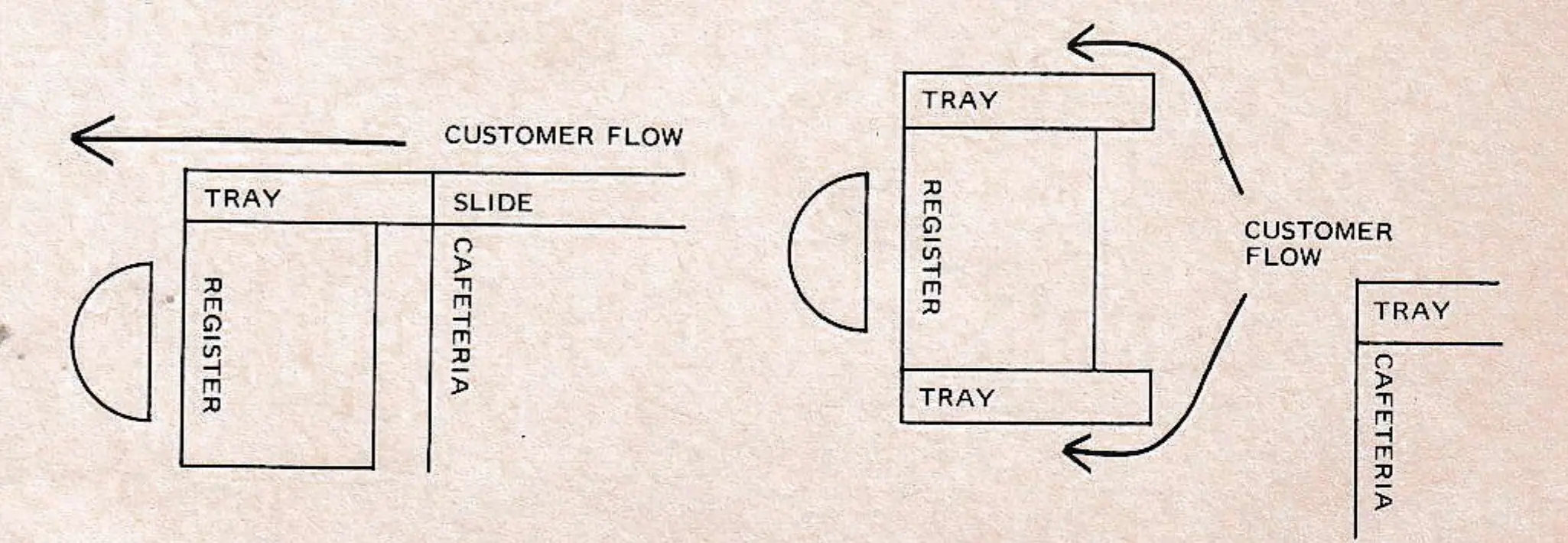
How do you increase the quantity of customers served? Recent studies have shown that providing a double-tray slide checkout counter instead of a single-tray slide will increase the checkout speed by 25 per cent. The reason—customers seldom reach for their wallets or change purses until they are next to the cash register and are informed of the amount. With a dual-tray slide, the customer is next to the register while the opposite tray slide is being served. When the cashier turns to this customer, he has his money in his hand.
However, a cafeteria should have a demand in excess of 250 customers per hour before a double tray slide becomes advantageous. Ski areas which can benefit from dual tray slides during peak demand periods and cannot afford to isolate the employee at the cashier station during slow periods, should construct a detachable checkout counter on wheels. During slow periods, it will be part of the cafeteria line, allowing the cashiers to work at other jobs. During the rush, the counter is pulled away from the line, becoming 25 per cent more efficient in terms of checkout speed.—Richard D. McHugh.