
Whether Bob James is found in the boardroom of a bank or in the boiler room of a ski lodge, you’re impressed. Patient, perceptive, but a juggernaut of energy accustomed to getting results. At 6 foot 4 he’d almost be expected to play for the Green Bay Packers, but instead he tells a story of unusual success in the fielding of a national ski management service team which has established an impressive track record.
James is president of the Kissing Bridge resort complex in Glenwood near Buffalo, N.Y., and it has been from this base of operations that he and his associates have pioneered a new facet of the ski business: installing professional management teams at failing ski areas. During the 12 years since its opening, Kissing Bridge has undergone continuous expansion of both winter and summer facilities and has produced impressive revenue growth.
There have been a variety of new approaches to summer programming at Kissing Bridge, ranging from theatrical productions and art exhibitions to the operation of youth camps and convention functions. Thus, the Kissing Bridge story is similar to that of many ski resorts. But one fact makes it significantly different. The Kissing Bridge Ski Corporation shows one of the healthiest profit pictures of any such facility in the United States. Last year Kissing Bridge earned 21 per cent on its $850,000 in sales, pre-tax, placing it in the top 3 per cent of all ski areas in the country. “We’re not schooled in failure, but in success,” says James. “We’re not moved by mediocre results and we demand a high level of profitability of our operation and any we move into.”
“Any ski area more than five years old whose pre-tax profits in 1970-71 were below the average of 10½ per cent of sales shown in the NSAA’s Economic Analysis is on shaky financial ground,” he claims.
“My observations are that more than half of these problem areas could enjoy improved results with better management. Many of the remaining areas are terminal cases whose basic problems are incurable and are being kept alive artificially for perfectly sound land development reasons or for not so sound non-business reasons.”
“A well-run, established ski area should expect to at least break even in a poor snow year, make a good return on its investment in an average snow year and clean up with a 20-30 per cent return on equity when one of those dream winters comes along.”
From running their own profitable operation came Ski Management Services. The SMS approach is to provide enough professional management to take a failing ski area and make it healthy again. James refers to himself as a “ski area doctor” who, once his patient is on the way to recovery, isn’t at all opposed to purchasing a sizable portion of the area if it is available. SMS is presently overseeing operations at five areas in the East: Kissing Bridge, Concord and Intermont in New York, Jiminy Peak in Massachusetts and Ascutney in Vermont.
In short, SMS offers owners of ski areas an experienced management team at a cost within the present budget of most medium-sized operations. They provide a carefully selected and experienced full-time general manager for the client area and also provide, as required, the advice and supervision of the other departmental experts scattered throughout the staffs at their five separate operations.
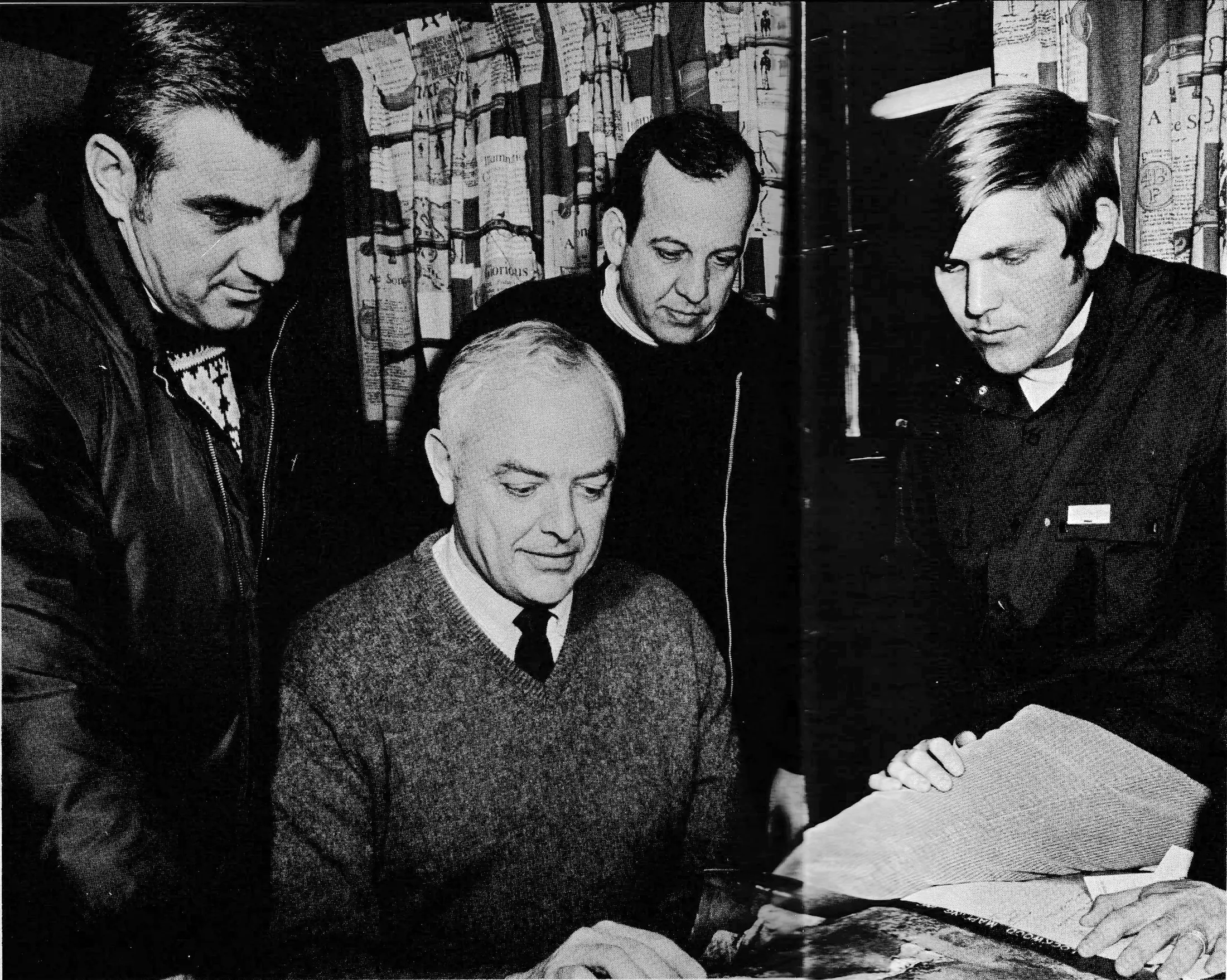
The team, which represents the combined experience of 36 years at the general management level, is headed by 47-year-old James. He’s the coach, the father-confessor, the catalyst, the master strategist and information center of the group. His job is to pick the right men and then to help create the right situations and atmosphere so that they can do their best work. Says James, “I try to be an effective blocking back making the openings for the guys carrying the ball.” James is a director of several businesses including the progressive Camelback Ski Area in the Poconos, headed by Washington, D.C., attorney James Moore, also on the Kissing Bridge board of directors. Moore himself has influenced the building of several profitable banana-belt ski areas, and it was his and James’ similar business philosophies that drew them together.
Others on the team include Kissing Bridge vice president and general manager Harry Loomis who, with James, co-founded Kissing Bridge. Loomis is a low profile, deliberate man, an expert in day-to-day operations who has particular expertise in the subtle art of lift placement and slope design. Loomis invented the “elevated” principle of snow making back in 1968—an idea later copied by snowmaking equipment manufacturers.
“Harry controls his costs well and yet is strictly customer oriented,” says James. “He’s the realist on the team who keeps our optimism in bounds.”
An early brainchild of James and Loomis was Kissing Bridge’s outside venture, the nearby Concord Ski Club which they founded in 1964. Here they put to use some unused skiable geography and developed it into a steady profit producer in what is normally a non-profit segment of the ski industry, the private ski club.
Rounding out the key participants are Bob Paron, Kissing Bridge general manager at Mt. Ascutney in Vermont, Brian Fairbank who heads up Jiminy Peak in Hancock, Mass., and Art Klein, general manager at Intermont in New York State and the newest member of the team. James refers to Klein as a can-do marvel who can take an antique ski lift that someone has scrapped and get it up to 1,000 safe rides an hour.
James likes to speak more about the effectiveness of his team approach than applauding the profits it generates for its clients and for itself. “We’re highly qualified,” he says, “we’ve already made about every mistake there is to make in the ski business. But we made most of them at our own expense years ago. The team has developed the knack of freely pooling ideas with a minimum of the competitive stance that usually shows up in discussions at association meetings when competitors get together. We simply refuse to weaken to glory-grabbing, false pride or one-up-manship, so the best ideas usually bubble to the top.
“There is no one best way to reach a business goal. Individual style must be allowed to shape the exact manner in which the goal is reached. We thrive on the fact that each of our four general managers has different strengths, personality, experience and style. We can close the gap between ski area planning and consultation and successful operation by taking over the job of seeing, through our collective efforts, that the plan produces profits. To the non-operating owners of ski areas we can take over where the original consultants and planners leave off. We run the place and get results.”
Much of the team’s work is done without the clients’ knowledge at “off-campus” meetings. The results of such planning are then presented to the ski area’s owner by Kissing Bridge’s resident general manager. “We decided long ago that if the general manager was to be effective he should take the lead in working with our clients. Our other experts remain in the background except when absolutely necessary.”
“We’ve found that the shifting of the burden of the day-to-day decisions from the owner to us allows him to enjoy owning his ski area again. In every case, so far, we’ve found that for the owner, the original fun had long since worn off. Now he can ski for a change and not have to be bothered with the operational details of running his area.”
In addition to moving the top men around, Kissing Bridge makes it a policy that assistant managers, mountain managers, ski school directors, head snowmakers, office managers and other key personnel visit other areas in the group to exchange ideas and examine other approaches. Says James, “It’s a marvelous morale booster to send a department head to one of our other ski areas for a few days to swap notes . . . and a great cure for overcoming the mid-season blahs.”
Beginnings at Ascutney
SMS began five years ago. Buoyed by their success with the Glenwood ski operation and the Concord Ski Club, James along with Harry Loomis and the Kissing Bridge board of directors agreed in 1965 to tackle Ascutney Mountain at Brownville, Vt. Ascutney had had a parade of managers, a history of continuous losses and a damaging credibility gap with local people in the area. Bob Paron, a certified ski instructor with a degree in business administration, was installed as general manager at Ascutney. Then a member of the Kissing Bridge staff, he also had previous experience in restaurant and construction management. Today he is also an officer and director of the Vermont Ski Area Operators Association, PSIA and President of the New England Ski Areas Council.
The new management team made some immediate changes. To provide more skiable area for beginners and intermediates, a “mid-station” was installed on the main chairlift, allowing skiers to avoid the expert trails at the top. New lifts were installed and old ones relocated. The need at Ascutney was to create additional space for novice and intermediate enthusiasts on what had previously been an expert’s mountain.
New snowmaking equipment, patterned after Kissing Bridge’s own innovative system, was added. Paron brought a Kissing Bridge specialty to Vermont–night skiing. An old abandoned lodge on the property was renovated to provide additional chalet space. Even one of the parking lots underwent a change and it was converted into a children’s play area.
Those visible improvements were complemented by a variety of invisible, but equally important, changes. Everything from bookkeeping methods to the advertising schedule was carefully scrutinized. Much was modified; staff responsibilities were re-aligned, promotions and demotions made. Kissing Bridge also initiated an effective real estate development, this time with a joint venturer, Hawk Mountain Corp. from Pittsfield, Vt.
The net result? from a $239,000 loss in 1967 to a 300 per cent increase in revenue by the 1971-72 season and a continuing upward trend.
Jiminy Peak added
Three years ago, Jiminy Peak, located near the New York State border at Hancock, Mass., came under Kissing Bridge’s wing. Brian Fairbank, a genius at building staff morale and team effort, became general manager of the facility. A certified instructor, examiner and member of the U.S. Demonstration Team, he had been on the Kissing Bridge staff and also was assistant manager of the Frank Lloyd Wright-designed Wintergreen resort in Wisconsin.
Like Ascutney, Jiminy Peak had good potential. The new management added a chairlift, snowmaking equipment and expanded the ski school. Once again, changes were made in personnel, accounting procedures and promotional programs. In 1969, the year before the SMS team moved in, Jiminy had lost over $40,000. In two years, SMS had helped double the gross and produced an after-tax net of $29,600.

Intermont newest
It’s too early to determine their total effect on their fifth and newest venture, Intermont in Solon, N.Y. Intermont was an almost abandoned and badly neglected ski area with no staff. It had to be brought up to operating condition three months after James’ group was called in last fall. Kissing Bridge threw its total SMS team into the effort, refurbished the area, including lifts and base lodge, and while laboring under a snow drought, began to increase revenues and recapture a respectable share of the central New York market.
SMS doesn’t grab at every opportunity to expand. One of the group’s most important business victories, for example, was a “catastrophe” that was averted last spring. SMS was hired as a consulting group to guide a highly motivated young man who was bent on developing and operating a ski area in central New York. His wealthy father was anxious to back his son to the hilt.
The entire family was fairly aching to start on the grand adventure. Land had been acquired, lift lines cut and lift suppliers were poised; it was definitely D-Day when Kissing Bridge came on the scene. SMS studied the proposition for two days and recommended that the entire project be abandoned.
“The client was frustrated and a little sore,” says James. “It was obvious that we had been hired to support the conclusions they had already made about the feasibility of the project.”
“They immediately called in Jim Branch of Sno-Engineering and it was learned later that his independent-expert opinion was ‘no way’ and the project was killed.” James is sure they saved the family $300,000-$400,000.
SMS plans to add additional clients. “The more areas which are a part of our system,” says Harry Loomis, “the stronger it will become. Ideally, we would like to add one additional area each year.”
“When our team management method of operation began to jell about four years ago, we had an idea that its effectiveness would be self-limiting at about three areas. We were worried that we would be spread too thin with more.”
“Our experience has been just the opposite. We get stronger as each new area is brought into our operation and our pool of experience and knowledge grows. Our best judgment now is that our team management may hit a point of diminishing returns at six or seven areas.”
Loomis cites other advantages to team management of an area network, including group purchasing, sharing of equipment and supplies, interchangeable lift tickets, a constant personnel pool “and a lot of promotional clout.”
Start to finish
The SMS concept is to assume total responsibility for the success or failure of a ski area operation. “We do the entire job from start to finish. We don’t duck in, tell them how it should be done, leave and send a bill for services rendered,” James explains.
“We have rigid contracts which stipulate we must annually present a client with a detailed budget, comprehensive management strategy and sales forecasts for each profit center. We live or die on the outcome of these projections. Often we have to suggest additional capital investment before new revenues can be assured. This is never a popular point.”
“But we approach the matter head-on and, because we’ve done our homework, we are confident that we can predict the approximate results. It isn’t easy to convince the owner of a financially ailing operation to spend $150,000 on, say, a new chairlift, but our experience indicates that when he does, it will help us reach our forecasts for better profits.”
“In analyzing the client ski area’s operation, we try to draw a bead on the profits from the cafeteria, bar, ski shop, rentals and ski school. Some ski areas have taken the lazy way out and have given up, through overly generous contracts with concessionaries, much of the profit that rightfully should go to the area’s stockholders.
If the ski area is paying its general manager a cost-conscious salary but at the same time is giving away too much to its concessionaires, it may actually be paying two or three times more for management than it thinks.”
Bankers interest
James claims some of his greatest satisfactions comes from dealings with heretofore disinterested banks that were all too anxious to remove their support from a floundering ski area. “We double check our basic planning on all major reorganizations,” says James, “by a dry-run presentation before our 14-man board of directors before taking it to the bankers and outside investors. They’re an excellent sounding board and can spot a weakness in our story almost from the beginning.”
“Bankers are beginning to notice what we have accomplished under both good and adverse circumstances. They now see that many ski areas have increased their levels of investment respectability.”
“The earlier negative reputation of the ski industry continues to cloud the facts that there are some ski areas that are well run, profitable, and hold out exciting opportunity for continued solid growth. However, there are signs that smart money is beginning to wake up to these facts.”
Goals in sight
Kissing Bridge is well on its way to realizing an ambitious goal. “Where they are compatible,” James says, “we’ll develop a chain of five to seven profitable ski areas under one corporate ownership. We fully expect that within three to five years we’ll be able to go public with our corporate stock and raise several million dollars. With this leverage, we’ll be able to move into the leisure-time field in a very major way.”
To do this, James lists four interim objectives: 1) To bring a high level of professionalism to ski area management; 2) to reach continuously higher levels of performance; 3) to attract still more highly skilled individuals to the team; and 4) to motivate team members with the most generous possible compensation plans consistent with good business practice.
With five areas under their management plan, three of which are partially or totally owned by Kissing Bridge, they’ll likely succeed. Comments the president of a bank in Cortland, N.Y., “These fellows are movers. Their confidence is contagious. But what’s most important to me, they always keep their word.”