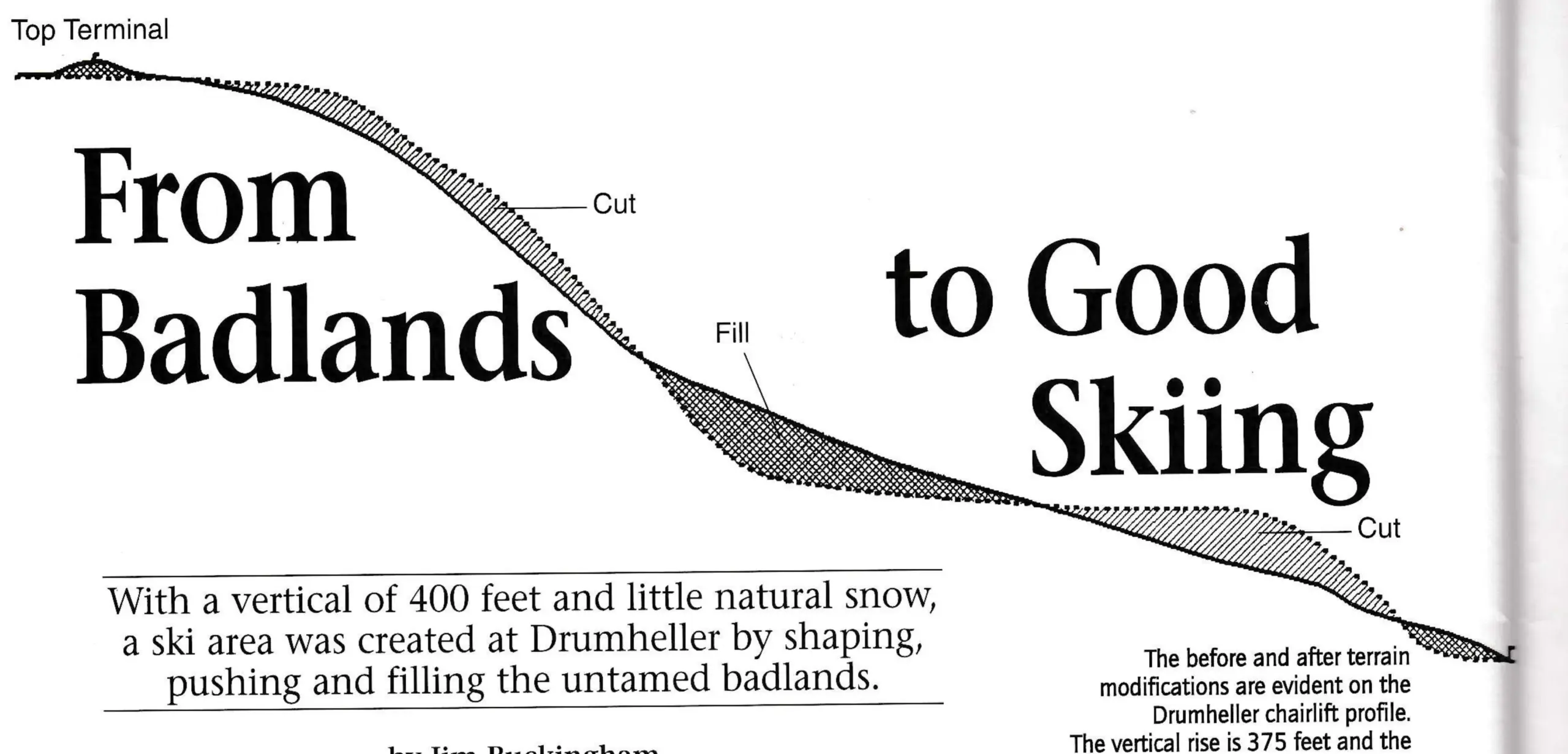
Badlands might seem to be an unlikely place for a ski area. They are characterized by a dry climate and terrain eroded into weird and near vertical buttes, cliffs and canyons with rocks layered in sharply contrasting colors. Because such lands cannot be farmed and are not good for stock raising, they were called “badlands” by the people who settled western North America in the late 1800’s.
The city of Drumheller (6,000 population), which is about 62 miles north of Calgary in Alberta, is situated in the middle of an area of such badlands and is best known as the home of the Tyrrell Museum of Palaeontology. The plains surrounding the badlands were once treeless short-grass prairie, but now are dedicated to grain farming.
Like most prairie communities, Drumheller (named after a pioneer who founded coal mining in the region) is always looking for activities to keep residents involved and bring outsiders to town. The museum attracts great numbers of tourists in the summer, but in the winter the number of visitors drops precipitously.
In recent years, other Canadian Prairie communities have had success generating economic activity from ski areas with limited hills and snow. At Drumheller, there is a 400-foot vertical drop from the prairie down to the river that runs through the middle of the badlands, which is more vertical than many of the nearby successful ski areas have. Natural snowfall, however, is very small at Drumheller, but ski areas near Calgary, 100 miles to the southwest, and at Red Deer, 100 miles to the northwest, successfully operate on machine-made snow.
With that background, a small group of the Drumheller citizens who were skiers and other interested people, organized a committee to investigate how to develop and operate a ski area. The immediate questions were: What is the best place for a ski area? Can it be successful? How much would it cost to build and operate a ski area on that site?
This group hired me as consultant. I studied contour maps and aerial photographs and drove up and down the river valley, and quickly discovered that none of the slopes within 40 miles of Drumheller were suitable as ski terrain in their natural state. The rocks and soils of the badlands are, however, quite soft and easy to move with heavy machinery. Several roads have been built across badlands and, although a lot of earth had to be moved, no difficulties were encountered in creating appropriate grades. It appeared that there would be no technical difficulty in moving earth to create ski terrain. The problem might be cost.
Once the idea of moving earth was accepted, the search for the best place to build a ski area was changed completely. One piece of land immediately adjacent to the city was good in shape and aspect, and had the advantage of easy administration and oversight.
When I worked out approximate costs of lifts, buildings, snowmaking and other components of a ski area, the committee agreed that it might be possible to raise enough money to proceed. The question then became: How much earth would be moved? How much would it cost?
With a local engineer who had experience in earth moving, I determined how the hill could be reshaped to provide the best configuration for skiing with the lowest cost in earth moving.
All this was the opposite of conventional ski area design. Instead of trying to fit ski trails onto a piece of natural terrain with a little cut and fill here and there, we would have to move earth to create skiable slopes. It would be like having a huge block of Plasticine—400 feet high, 2,500 feet long and 1,000 feet wide—to cut and shape into a ski hill.
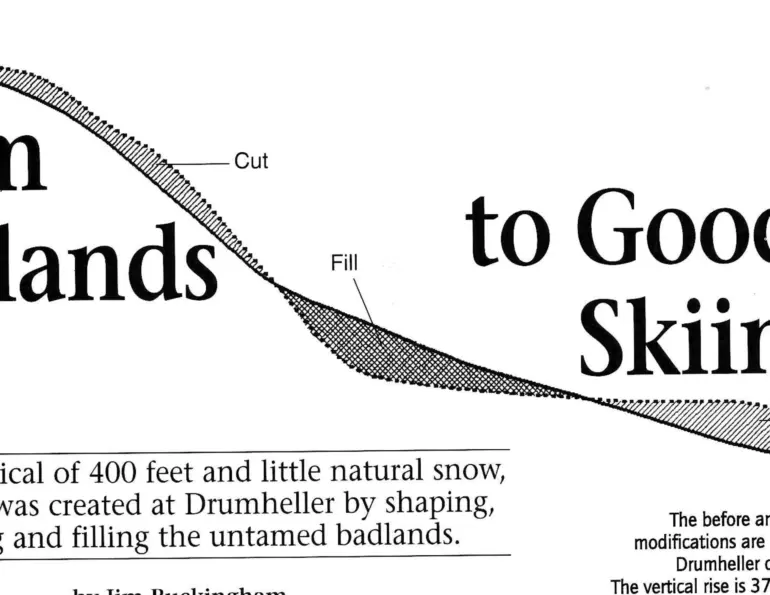
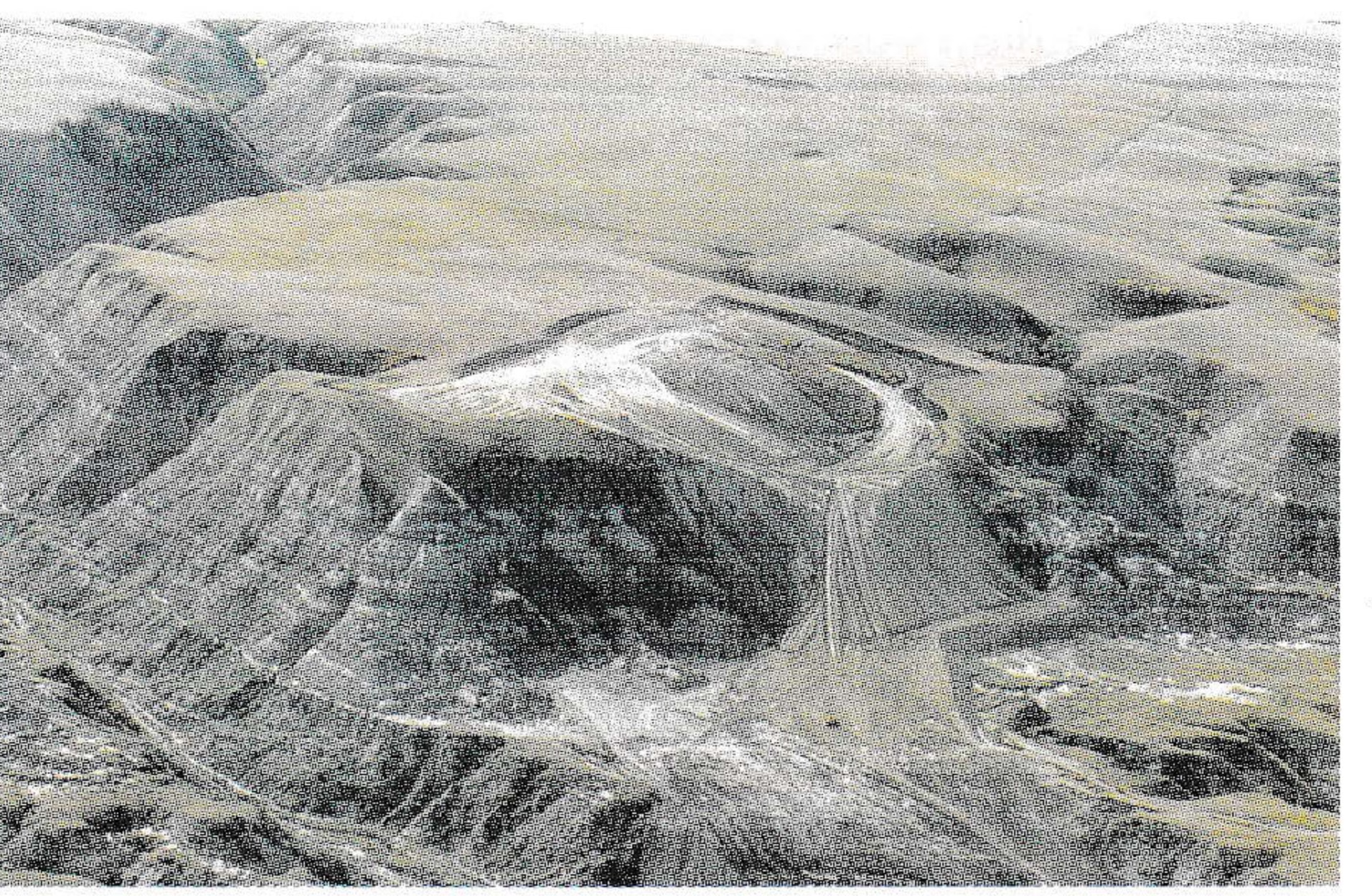
The piece of badland terrain on which we would be working consisted of two cliffs, one above the other, with a large flat bench between them. The top was gently rolling prairie and the base a large flat space between several badland buttes. It was obvious that to create skiable slopes, large cuts would have to be made into the cliffs and the material from the cuts would have to be pushed downhill and tapered across the bench and the bottom flat.
Photos by Jim Buckingham
What we could not create, that exists at most ski areas, would be trails with strips of woods between them—there are no trees on badland terrain. The natural vegetation was bunch grass, sagebrush and cactus. Attempting to make a separate cut through the cliffs for each trail would not be practical because each cut would require major side slopes on either side and these would need expensive finishing work, but not be useful as ski terrain. Obviously, it would be much cheaper to make one big slope and put the main lift right up its center.
On this big, open slope, we could create a little hill for first-time skiers near the base that would be suitable for teaching, and a slightly steeper slope for skiers to graduate to after an introductory lesson. We also had to have some steeper terrain to challenge racers and more aggressive skiers as well as a large segment for intermediates.
Photos by Jim Buckingham
There were, however, factors that made shaping the hill more complex.
The lower cliff was irregular with deep gullies cut into it. The best we could do with this portion was to reduce one side to a steepness suitable for beginners and make the other side slightly steeper. At the top of the hill, a broad gentle slope that, starting from the place we had chosen for the top terminal, formed a natural spiral down which could be an easy trail from the top. Unfortunately, this gentle spiral ended abruptly where it intersected the upper cliff. It would take a lot of dozer work to eliminate the cliff and taper out the fill to produce a slope gentle enough for beginners, but it was possible.
With the knowledge that a ski area could be built on this site, the Drumheller Ski Club was formed to develop a ski facility. Club members solicited financial support from businesses, government agencies and individuals, and asked several earth-moving companies to bid on shaping the hill. One company, which completed a large road-building job nearby, had suitable equipment sitting at the site and came in with a very reasonable bid.

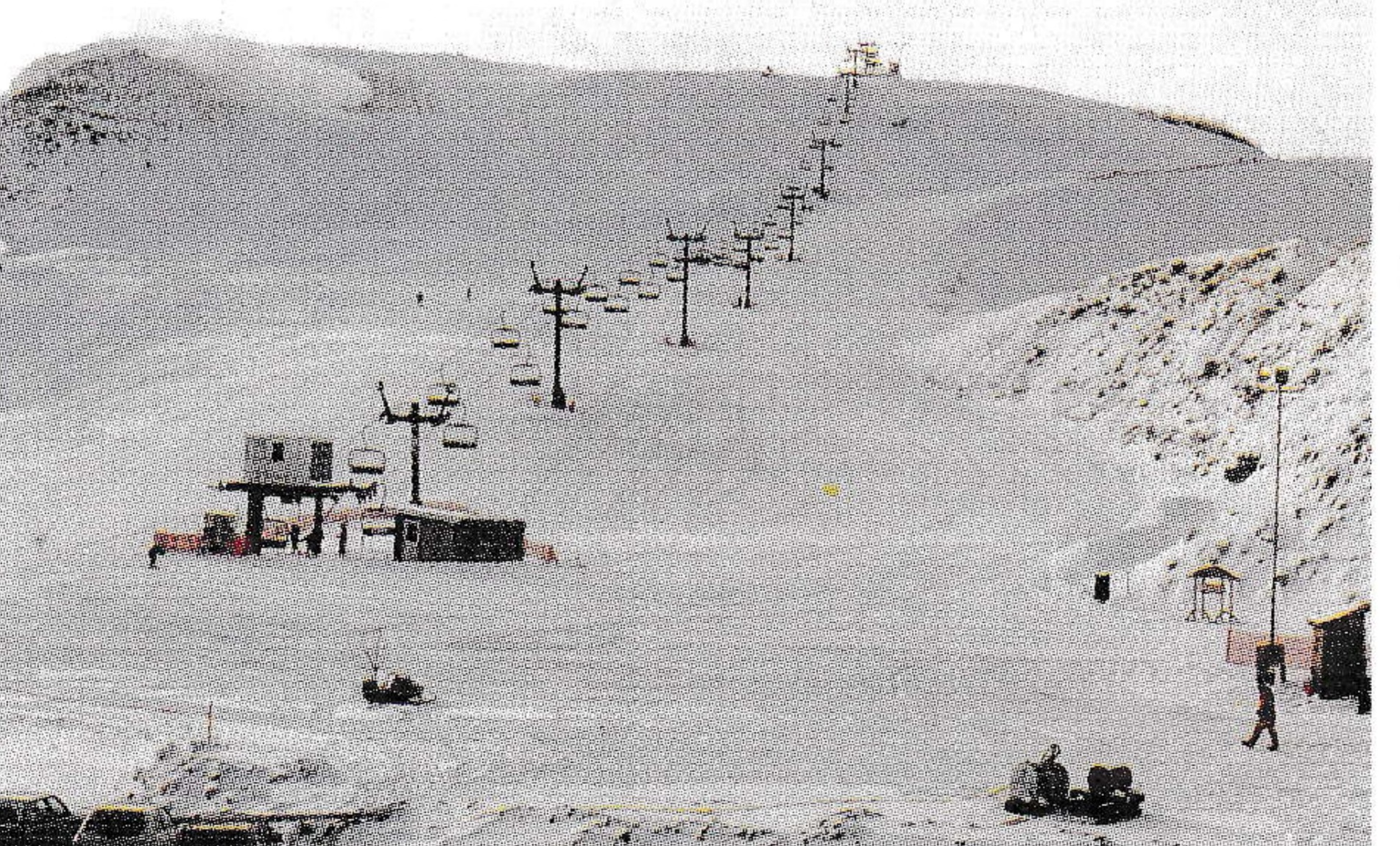
Photos by Jim Buckingham
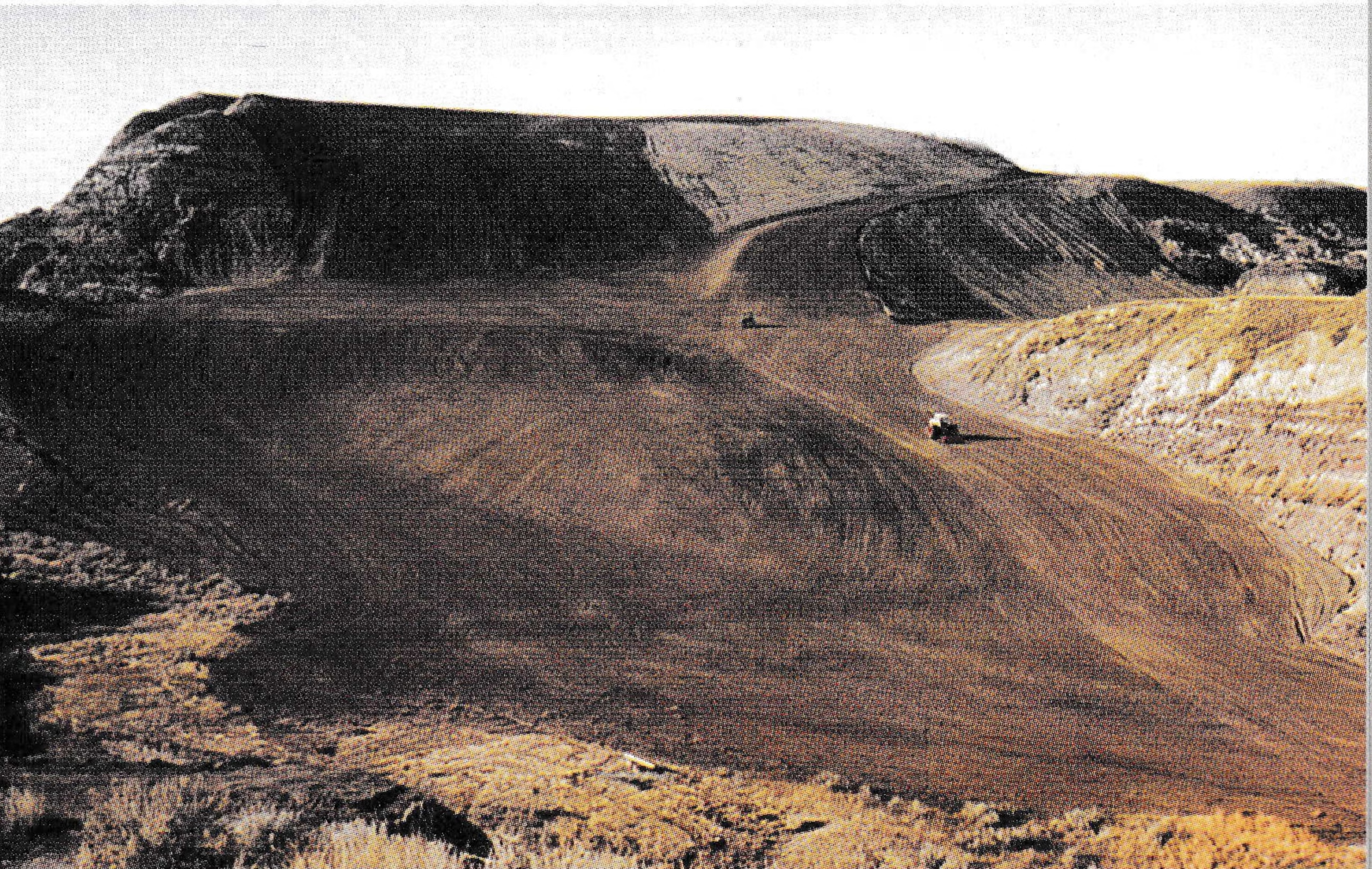
In the fall of 1992, they proceeded to make badlands into ski terrain. Although the work consisted mostly of pushing earth downhill, it was essential to get all the right grades in the right places. The teaching hill was built adjacent to the bottom of the main hill by heaping up a wedge-shaped mound of earth on what was essentially flat ground. The topsoil from the area was saved and, at completion of the shaping work, spread back over the slopes. Local farmers contributed time and machinery to seed the slopes and provided straw, equipment and more time to mulch them.
In the end, dozers and scrapers had pushed and shoved 250,000 cubic meters of earth at a cost of $227,000 (Canadian).
By the spring of 1993, enough money had been raised to start construction of a chairlift and a Riblet fixed-grip quad chair was built on the main hill. A used handle tow was installed on the teaching hill.
An interesting aspect of this project was a partnership with an interdenominational church organization that represented various groups across the prairies. That organization wanted an outdoor theatre to present religious plays and felt the badlands and the dry, warm summer climate at Drumheller would be perfect for their purposes. Close to the base of the ski terrain, but separated and screened from the ski area by a couple of small buttes, is a natural amphitheater in the badland topography. The theater would only operate in the summer and the ski area only in the winter, and both groups needed a building and a parking lot which could be owned in partnership.
The day lodge located between the two buttes that separate the ski area from the theatre is easily accessible from either side, but neither venue is visible from the other. The lodge, a building from an Alberta Correctional Center and moved about 10 miles to the site, was purchased for $1. Volunteers dug a basement, wired, plumbed and modified the building for the purposes of both groups.
By late summer of 1993, the slopes were completed, there was no doubt that the chairlift would be finished before winter and the day lodge was almost ready for use. The missing component was snowmaking. Unfortunately, there were no funds to buy snowmaking equipment or install a system. Could the opening of the area be held off for another year while more fund raising was done? Could the volunteers who had put so much into the project sustain the effort for yet another year?
The sources of funding were running dry and volunteers were burning out. But directors of the ski club felt if another winter went by without the ski area operating, it might be the end of the project. They said it was now or never and made the rounds again in a last ditch effort to raise money for a snowmaking system.
The local Chamber of Commerce came through with money and an oil company loaned a trenching machine for one weekend. Volunteers rallied again and placed and glued 6,300 feet of pipe in the three days of a long weekend. More volunteer effort went into the pumphouse and the city agreed to supply water from the municipal system at a very low rate.
Snowmaking started on December 5th and the area opened to the public, on a limited basis, on December 24th.
The area was fully operational by January 24, 1994.
The Drumheller ski area in the badlands has been operating for three winters and downhill skiing is an important part of the community. Kids and adults who had never thought of skiing before there was a local ski hill are out on the slopes regularly. People also come from Calgary and as far as Saskatchewan for a day on the slopes. Lift ticket prices are $19 for adults, $14 for young people and $10 for children with a family season pass going for $600. Skier days were 7,000 the first year, 11,000 the second and 9,500 last season, which was unusually cold.
The effect on the town economy has been significant. Winter seasonal jobs have been created to complement some of the summer seasonal jobs that already existed. There is more winter tourism and restaurants and sporting goods stores have seen an increase in business. Although the strain on the community, and especially on the members of the ski club, was enormous, all would agree that the benefits of having a community ski area made the trouble and effort well worthwhile.