


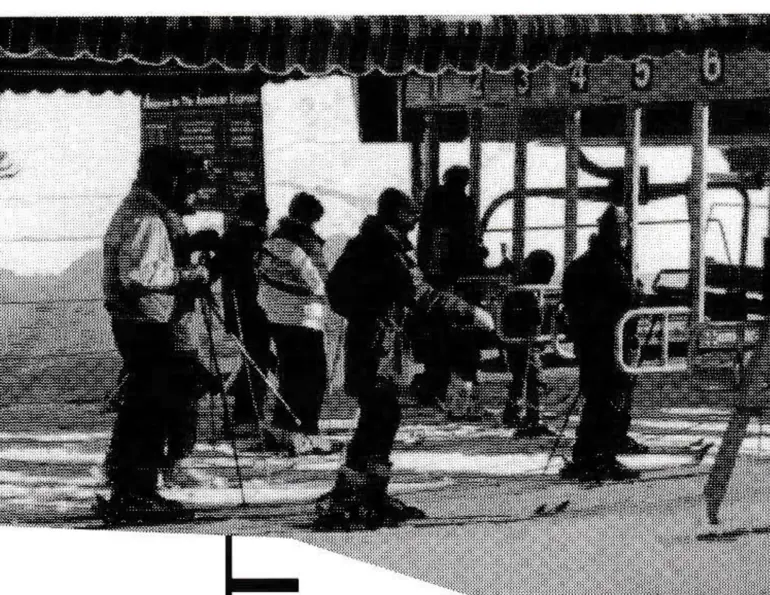
Six seconds seemed to be the right amount of time for skiers to load onto the new high-speed, six-passenger lift that was installed at Stratton Mountain, Vt., in 1995. But when winter came, mountain personnel discovered that many chairs were speeding to the top empty and shutdowns were frequent in order to sort out loading confusion. The theoretical capacity of 3,600 was far from reality.
“There were a thousand reasons why people wouldn’t go on when it was their turn, but the main reason was because we gave them too much space between waiting and loading,” said Peter Brewitt, lift maintenance supervisor. Skiers wound their way through a maze, then scrambled to form groups of six in the loading area in time to catch the chairs swinging around every six seconds. “Extra skiers would try to line up, or half the group would go and the other half got left behind,” said Brewitt.
Last summer, Brewitt and his righthand man, Butch Rowley, decided to solve the loading problem. Using materials at hand, they built a 30-foot-long system of angled ramps supported by hydraulic jacks at each seam to deliver skiers quickly and efficiently to the loading area.
The maze leading up to the new ramp system was also redesigned, ending in a holding area that is three skiers deep and six across. Six clearly-marked lanes in the holding area position skiers to enter the ramp system. With three groups of six skiers lined up and ready to go, the lag time between waiting and loading is eliminated.
From the holding area, a lift attendant dispatches a waiting group of six skiers onto the first ramp, which slopes down at a 2.2-percent incline to an automatic load gate. The gate opens at a .02-second interval and delivers skiers to the next section of the ramp, where they pick up more speed on a 5-percent incline. Then the platform flattens to a 2-percent incline and finally finishes at a minus 1.5-percent incline to stop skiers at the right spot, ready to load.
The hydraulic jacks can be manually adjusted, adapting ramp angles to changing weather conditions so the system works as well on a sunny, 50-degree day in March as it does on a snowy, 10-degree day in January. The entire platform is covered with a polyethylene ski mat for both easy sliding and maintenance of a consistent chair height of 19 inches regardless of snow accumulation.
“The adjustable loading ramp and hydraulic gate systems have made a measurable difference in the uphill capacity this season,” said Troy Hermansky, lift supervisor. “During the Christmas holiday period we were able to load well over 80 percent of the chairs with five or six guests even though the lift serves skiers and riders of all ages and ability levels. No system can eliminate all skier and rider miscues, but the gate and ramp system combined with quality operators have created a consistent and reliable loading experience.”
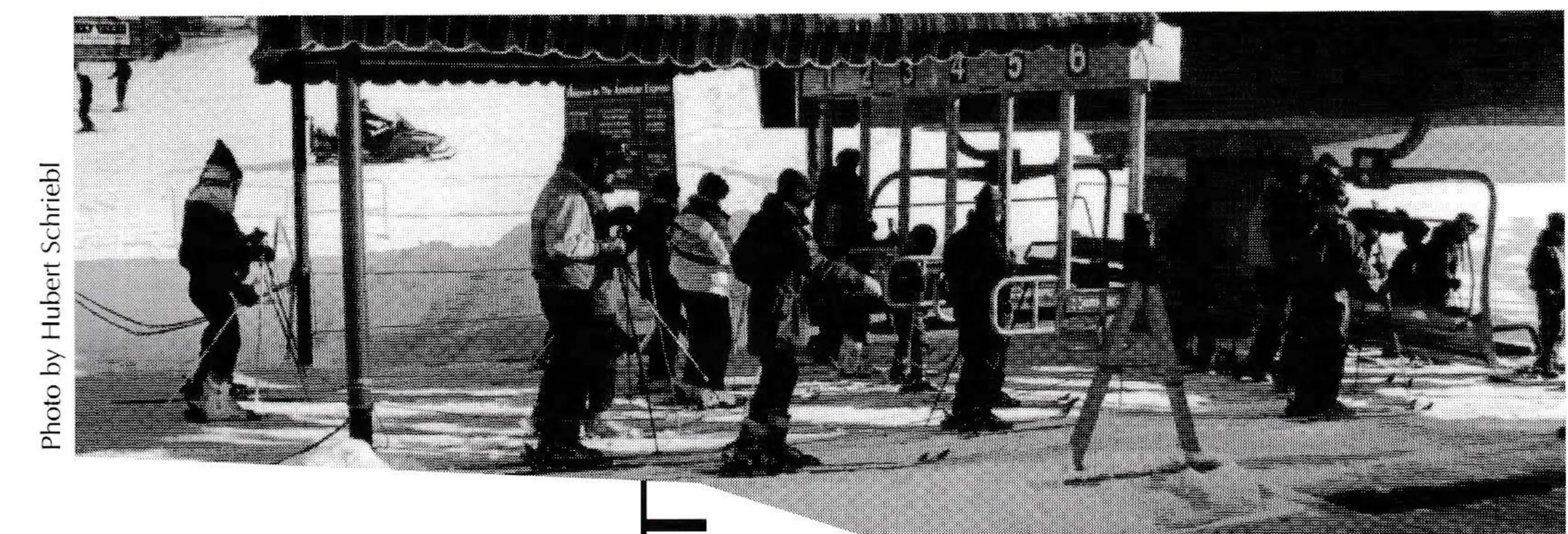
Photo by Hubert Schriebl


