


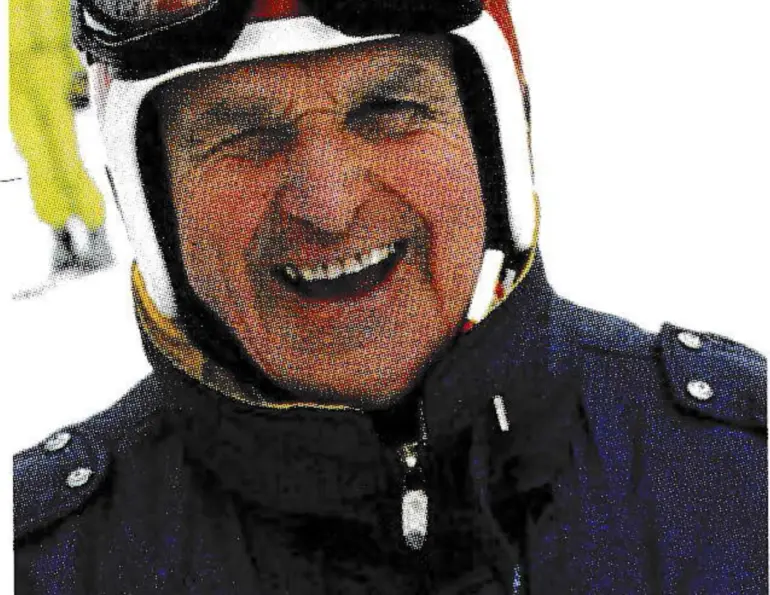
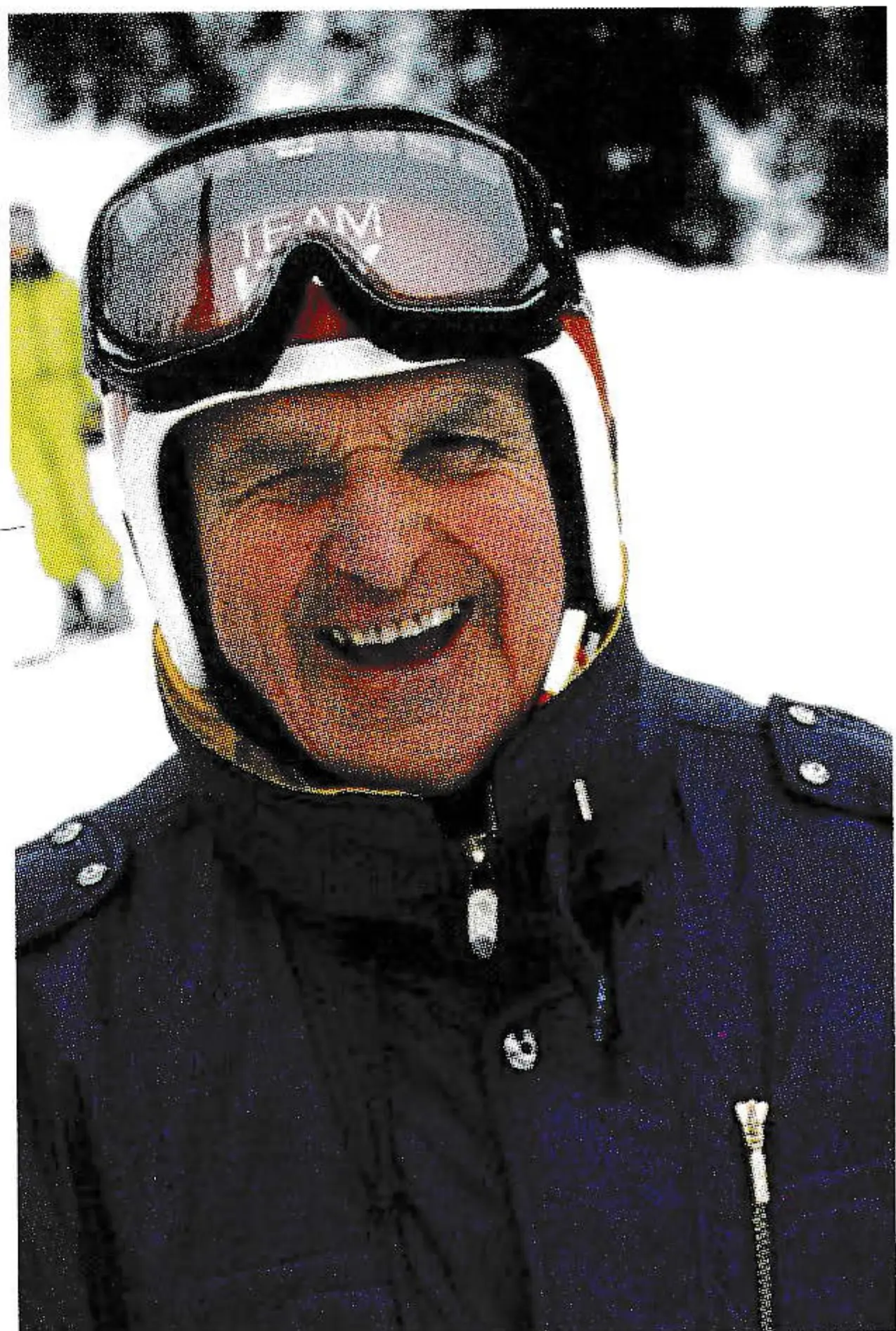
But it wasn’t his military bearing that created a stir when he came to Vernon, B.C., in 1979 as the new executive director of Canada West Ski Areas Association (CWSAA), a group of 125 ski areas in the provinces of British Columbia, Alberta, Saskatchewan and Manitoba. “It was mid-summer,” recalls Mike Duggan, executive director of Sun Peaks Resort Association, a local tourism organization, “and we were experiencing a typical 104-degree Okanagan heat wave. Jimmie and I shared office space and living accommodations in one of those trailers that had really shoddy air conditioning. It was stifling hot, but Jimmie would show up every morning wearing a very proper, very British tweed suit. It took me 10 days to bring him around to wearing shorts and a golf shirt, which is now his trademark summer attire.”
Although at first the colonel from Greenock, Scotland, may have appeared an odd fit with the Canadian ski industry—and, indeed, there were some who had reservations about hiring him—he has become “one of the greats of the Canadian ski business,” according to John Gow, president of Silver Star Mountain Resorts in B.C. and past chairman of the Tourism Industry Association of Canada. In the last 18 years, Spencer has served as a leader, facilitator, representative and number one fan of what has become one of the world’s premier ski regions.
Spencer’s love of skiing developed during his army years, primarily in the Austrian Alps. “In those days, all soldiers were required to learn to ski as part of training,” he says. “We used cross-country equipment, but most of my experience was in the mountains.”
He raced cross-country internationally in the 1940s and ’50s, including participation in two Olympic Games (1952 and 1956) and several World Championships. His army skiing career is starred with achievements such as captaining a winning team in the British army ski championships on six separate occasions. In addition, as chairman of alpine skiing for the army, Spencer became involved in organizing championship racing events in both alpine and cross-country skiing. To this day, his Canadian associates are in awe of the number of European operators—particularly in Austria—who know and respect him.
The relationships Spencer built while in the army have served both the Canadian and European ski industry well over the years. In 1994, the Austrian government honored him with an award recognizing his prominence in international tourism.
“Perhaps one of Spencer’s greatest contributions to CWSAA has been the initiation of educational visits to Europe and the U.S.,” says Paul Mathews, president of Ecosign Mountain Resort Planners in Vancouver, B.C. The visits have been offered biannually since 1981, alternating between Europe and the U.S., and the first trip to Japan was introduced two years ago.
Participants in these fact-finding missions agree that the trips are as much fun as they are valuable learning experiences. His personally-guided tours of European bars draw rave reviews, according to Hugh Smythe, president of Intrawest’s resort operations group. “I think Jimmie knows every bar and barmaid in the Austrian Alps. He loves to tip a glass or two, and he tells a great story,” says Smythe. “He has a warm, engaging personality and he and Andy are just plain fun to be with.” Andy, Spencer’s wife of 25 years, has established her own presence in the ski industry as the efficient manager of the CWSAA office.
Spencer also has been known to be a bit of a hazard on both snow and water while engaging in recreational pursuits. A pellet gun injury he suffered as a teenager left him with only 10 percent of his eyesight in one eye, affecting his depth perception considerably. Mike Duggan, Spencer’s skiing buddy for many years, recalls colossal tumbles he has taken—particularly after some lunchtime schnapps.
Equally memorable is Duggan’s account of an annual long-distance windsurfing race on Lake Vernon, when the rescuer himself had to be rescued. “A major storm came up, and windsurfers were getting blown all over the place,” recounts Duggan. “On this particular occasion, Jimmie’s was the only rescue boat. He approached a wharf at a pretty good speed and drove right into it, doing some major damage.”
Fun-loving though he is, it is the serious side of Jimmie Spencer that is the secret to his success and longevity in what can be an unforgiving business. When he started at CWSAA, the organization was a fragmented group of independent operators, according to Paul Mathews.
“Jimmie’s fairness and impartiality has been pivotal in bringing a previously diverse group together in a very focused, team approach to doing business,” says Mathews. “His fiscal responsibility and the fact that he is fiercely protective of his turf has secured him a comfort level with his members.”
Anyone who has dealt with Spencer will tell you that he is strong in his resolve. “Jimmie has a terrific sense of honor, and he won’t back down from what he believes is right,” says Duggan.
Indeed, anyone on the wrong side of Spencer’s resolve is sure to know about it in no uncertain terms. For the most part, the federal and provincial governments have taken his hardest hits. “Cumbersome regulations that don’t make sense to the average businessman are my greatest frustration,” he says. Hugh Smythe compares Spencer’s approach in government negotiation to a dog with a bone, saying, “He sinks his teeth into it and he won’t let go.”

The negotiation of the Alpine Ski Policy in the early 1980’s with the government of British Columbia is an excellent example of how Spencer has successfully protected the interests of ski resorts. When he became executive director, CWSAA was in the midst of discussions with the provincial government to establish a policy that would facilitate ski resort development. The resulting policy is essentially a step-by-step guide that leads government and ski resort developers through the murky waters of demonstrating market demand, acquiring public approvals and achieving government legislation.
“Jimmie was the point person for Canada West in the government negotiations for the Alpine Ski Policy,” says Smythe. “Once the policy was established, the whole aura surrounding the use of public land for ski area development became more positive, enabling ski areas to strike their own agreements for development. It really opened the door for the development of Blackcomb, and the following ski resort expansion in B.C. has been mind-boggling.”
According to Smythe, skier visits in British Columbia have increased more in the last 10 to 15 years than in any other region in North America. Intrawest’s Whistler Resort (Blackcomb and Whistler Mountains combined) has quadrupled skier visits since 1979—from 425,000 to 1.7 million visits in 1995-96.
More significantly, Whistler Resort has been a model for similar growth in the Okanagan (Silver Star, Big White, Apex) and, recently, at Sun Peaks in Kamloops, B.C. In Alberta, the Banff ski areas—located in a strictly regulated national park—have won some critical, hard-fought battles for expansion and improvement. “This growth trend is not unique to Canada, but what is remarkable is how rapid the change has been here,” says Spencer.
In 1979, western Canada was barely on the skier map. For the 1995-96 season, however, ski areas in the region generated 7,065,000 skier visits, a figure that represents 44 percent of all skier visits in Canada. In the process of accommodating such explosive growth, the region has been transformed into an internationally acclaimed ski destination.
Spencer declines any credit for these successes. In addition to having an outstanding “made in Canada” product to sell, he says that Canada West has “an encouraging number of senior operators who have great vision. They see an opportunity and seize it. They are good at sharing their ideas, which has bred an environment of highly developed, healthy competition.” This groundswell of success keeps everyone on their toes, he says, and has kept the ski industry in western Canada moving forward.
As president and CEO of CWSAA, Spencer has the significant responsibility of carrying out, as he sees fit, the broad policies determined by the board of directors. But he claims that dealing with people is still the most attractive part of his job. “It’s what I did in the army, and my work in the ski industry is an extension of that,” he says. “I still get a kick out of talking to people, pointing the way and seeing the results.”
Throughout a career spanning the army and the ski industry, from a colonel’s uniform to a golf shirt, Jimmie Spencer has maintained a consistent approach to new challenges. His reputation among both friends and adversaries is of being forthright and forceful, opinionated and honorable. And 18 years of impressive results confirm the accuracy of the way he is pointing for the ski industry in western Canada.
Grand Master of Ceremonies
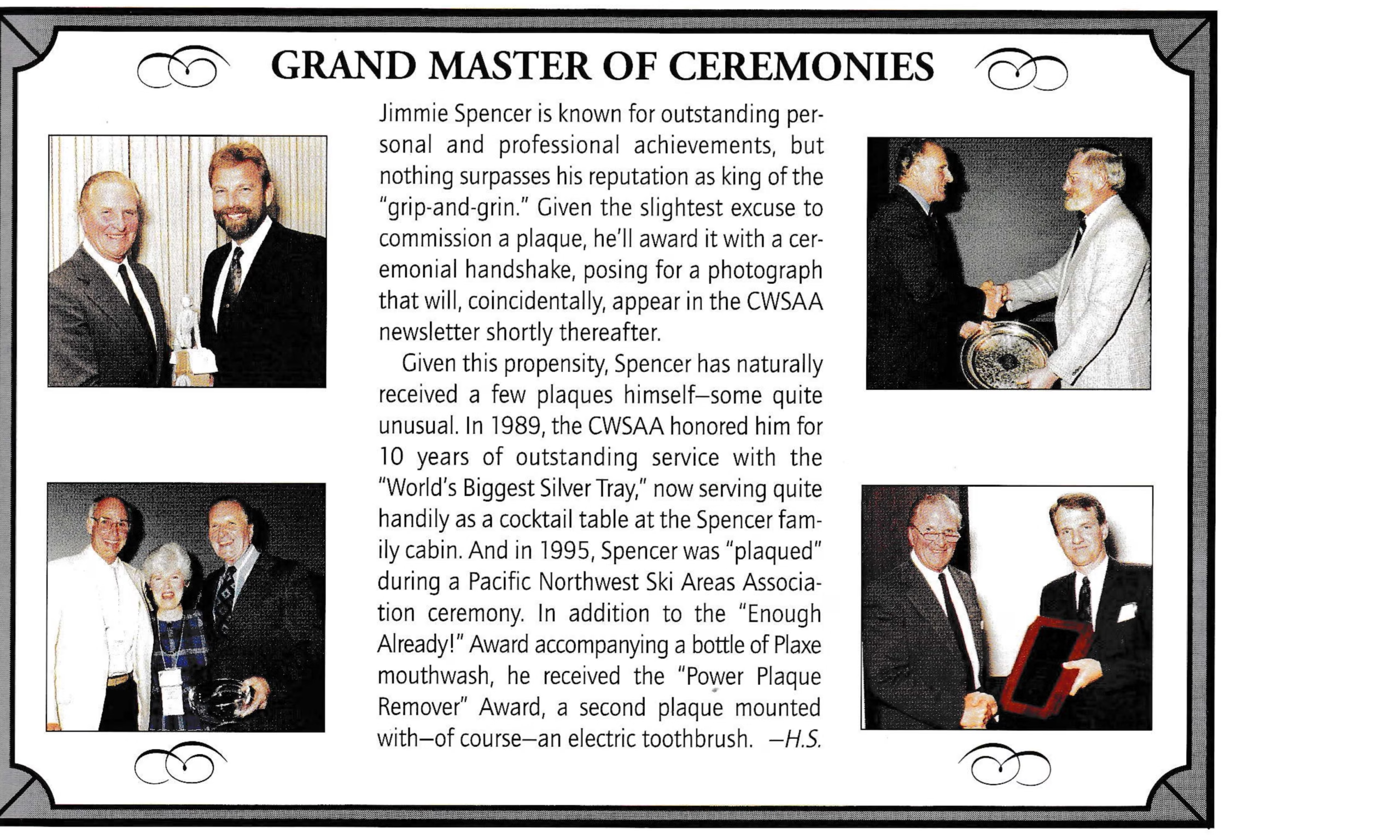
Jimmie Spencer is known for outstanding personal and professional achievements, but nothing surpasses his reputation as king of the “grip-and-grin.” Given the slightest excuse to commission a plaque, he’ll award it with a ceremonial handshake, posing for a photograph that will, coincidentally, appear in the CWSAA newsletter shortly thereafter.
Given this propensity, Spencer has naturally received a few plaques himself—some quite unusual. In 1989, the CWSAA honored him for 10 years of outstanding service with the “World’s Biggest Silver Tray,” now serving quite handily as a cocktail table at the Spencer family cabin. And in 1995, Spencer was “plaqued” during a Pacific Northwest Ski Areas Association ceremony. In addition to the “Enough Already!” Award accompanying a bottle of Plaxe mouthwash, he received the “Power Plaque Remover” Award, a second plaque mounted with—of course—an electric toothbrush. —H.S.
