
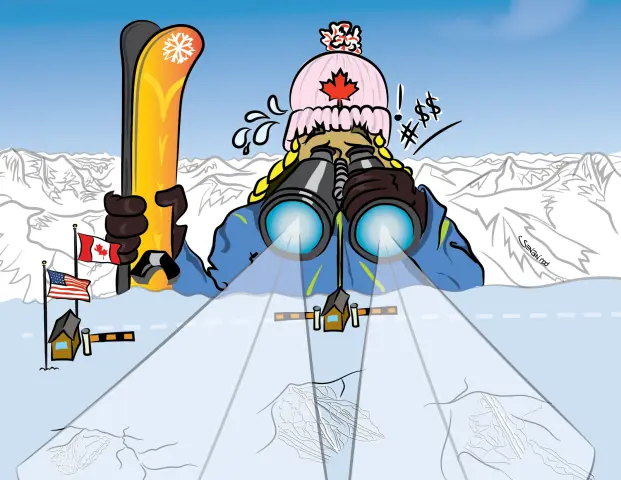

Don’t believe it? Just ask John McGregor, general manager of Boyne Highlands in Harbor Springs, Mich. Few states are hurting as much as Michigan in this recession. Yet for the last three years at Boyne Highlands and its sister resort Boyne Mt., “each year has been better than the one before,” McGregor said. “I have to read the newspaper every day to know that we are in a recession.”
On the December morning McGregor made this statement, the Michigan newspapers were full of more recession news, including two more plant closings by General Motors.
In case McGregor’s experience at Boyne Highlands was a fluke, let’s look in on rust-belt neighbor, Ohio. And just to keep the survey honest, we’ll go to Richland County, which has one of the highest unemployment rates in the state.
Yes, unemployment is high, confirmed Dave Carto, president and general manager of Snow Trails in Mansfield, but at his ski area business has actually picked up the last couple of years.
“We had an increase in business last year,” Carto said, “People who were laid off decided to do something with their time, so they came skiing. They might have put off buying a new car or a new suit, but they didn’t put off recreational activities.”
In Massachusetts, at least some of the same theory of laid off and unemployed workers also apparently decided to use their newfound spare time to go skiing. “When times are tough people can and will find a way to entertain themselves,” said Matt Kelly, general manager of Brodie Mt. in New Ashford. Brodie has not broken any records the last few years, but it has posted solid seasons, which is more than the Massachusetts economy has done. The state’s unemployment rate of 9.0 percent is still well above the national average of 7.2 percent, but season pass sales at Brodie were up 30 percent over last year.
New York has been another hard-hit northeastern state, but it’s hard to tell from Bristol Mt. near Rochester. “I don’t think the economy has affected our business at all,” said general manager Daniel Fuller. “This year our fall pre-sales were very strong. Our season pass sales were up about 9 or 10 percent. We would have felt good with a 4 or 5 percent increase. So we’re very pleased.”
The story is much the same in recession devastated California, badly hurt by defense cuts and a decline in the aerospace and high-tech industries. Nevertheless, Snow Summit, which draws its clientele from probably the hardest-hit region of them all — southern California — posted a record-breaker last year, in both volume and profitability.
If the news is good from hurting states, it must be positively glowing from states where the economy is relatively strong. Right? Wrong.
“On a scale of 1 to 10, if California’s economy is a 5, Utah’s is probably an 8 or 9,” said Kent Matthews, mountain manager of Snowbasin, Utah. But while Snow Summit, Calif., has had back-to-back record-breaking seasons, Snowbasin has had back-to-back record-wrecking seasons, and appears on its way to another less-than-average year. “Our preseason is down,” conceded Matthews in early December.
The northwest is yet another bastion of good economic news. Seattle is now said to have the largest concentration of corporate wealth in the country. But over the last five years, business at Mission Ridge in Wenatchee has dropped close to 50 percent.
In North Carolina, where the local economy has for the most part performed better than the national average, Ian Nesbit, assistant general manager of Scaly Mt. said, “We’ve been hurting the last couple of years.”

What’s going on here? Just how much of an impact is the recession having on the ski industry? The answer appears to be: “It depends.” Mostly it depends on the weather. Nesbit says Scaly Mt. and other southeastern resorts have been hurting, not because of the soft economy, but because of the weather — too warm to make snow.
Utah is in the fifth year of a drought. That drought, which has cut the normal snowfall almost in half, has negated any positive effects that some resorts might have reaped from a comparatively solid economy.
On the plus side, good weather patterns can often overcome the negatives of a weak economy. That is what happened at Snow Summit in California. While the state is in the midst of a severe drought, the lack of snow has not hurt Snow Summit’s ability to make snow. “We’ve had two very strong years precisely because we were able to make snow and deliver a good product,” said Dick Kun, president and general manager of the area.
While good weather can overcome a poor economy and bad weather can negate a strong economy for many operators, the positive effect of plant improvements are also clear. For instance, the Boyne resorts have spent considerable sums on improvements the last couple of years, including putting up the nation’s first six-passenger chairlift at Boyne Mt. “The reason we’ve been recession-proof is because of all the expansion and improvements we’ve done,” McGregor said.
On the flip side, few, if any, improvements had been made at Mission Ridge, Wash., for several years. New owner Malcolm McInnis believes the deteriorating product contributed to the decline in skier visits despite the state’s fairly robust economy. “The product was not up to what skiers could experience at other Washington resorts,” he said. The new owners spent the summer making some needed improvements, an effort that appeared to be paying dividends early. According to McInnis, season pass sales were up 30 percent over previous years.
At New York’s Bristol Mt., Fuller has another theory on why his area was able to buck a bad statewide and regional economy. He attributes at least part of Bristol’s success to its positioning as a local area and to two small snow making serviced, learn-to-ski rope tows Bristol started in the suburbs. “We’re getting out into the areas where the people are,” Fuller said.
For individual ski areas, the current recession ranks a distant second behind the weather in terms of impact. And, as indicated, other factors such as marketing and capital improvements can diminish the impact still further. But when it comes to the ski industry as a whole, the impact of a poor economy is more insidious.
“After a record season it’s hard to say that we’ve been hurt by the economy,” said Kun. “But I believe we could have done even better if it hadn’t been for the economy. That may sound greedy, but after being in this business for 30 years I’ve learned that there is no tomorrow. Every dollar counts. Volume not realized is lost forever. And overall the economy has softened demand.
“So even though we’ve done very well by industry standards, industry standards stink. In that way the economy has hurt us very much.”