
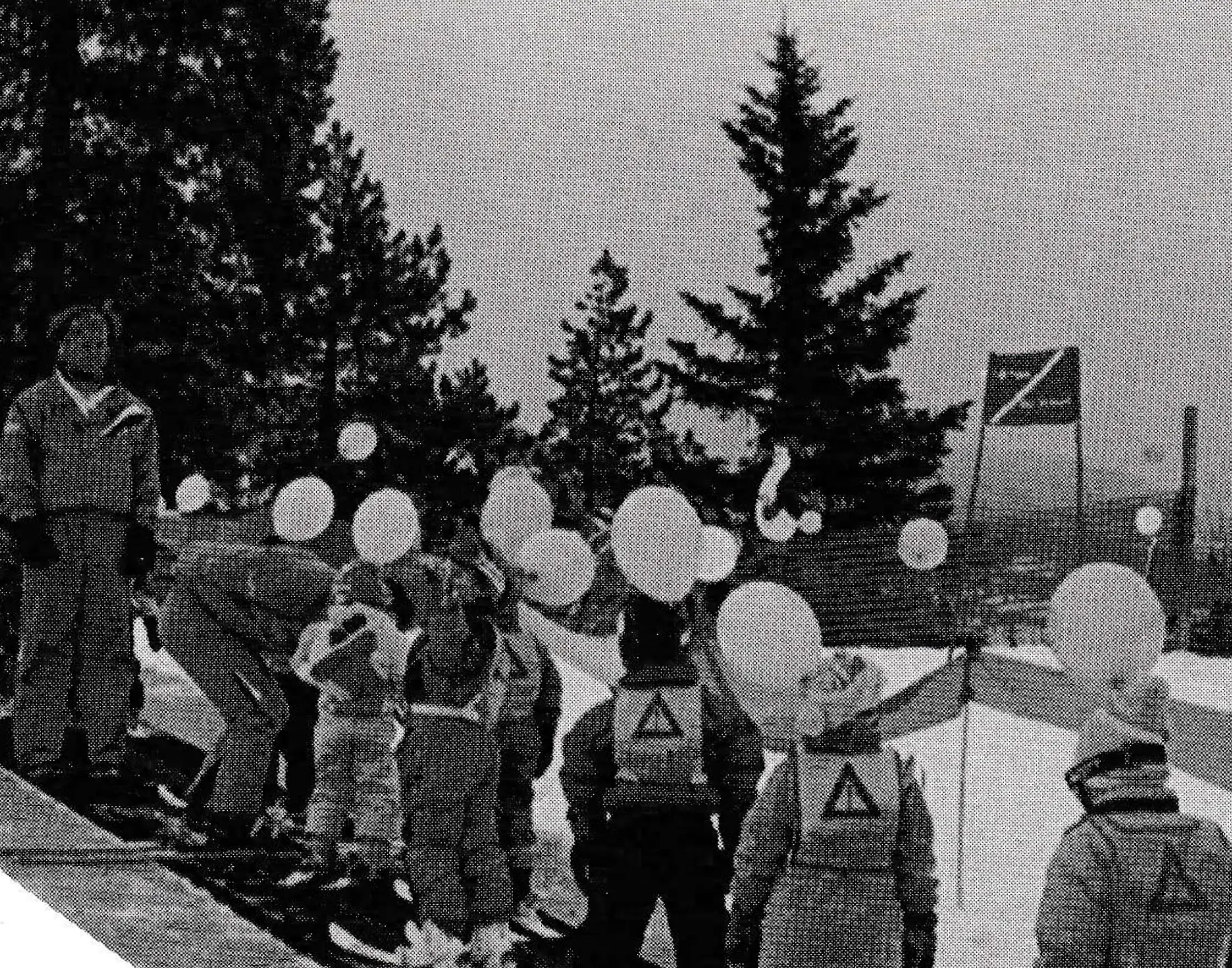
Vail Associates, Inc. hopes to change that by employing three conveyor-belt lift systems at ski school sites in Vail and Beaver Creek. The “Magic Carpet” lifts, which were installed in November, transport beginning skiers slowly uphill on high-friction rubber belts.
The Magic Carpets allow the beginners to save energy for more important challenges – like learning to ski. Previously, rank beginners had to sidestep uphill before going downhill, a tedious and frustrating task for children who have a difficult time buckling their own boots.
“We’ve been trying to think what little preschoolers could actually use by themselves,” said Karen Larsen, supervisor for three-to-six-year-olds at the Beaver Creek Children’s Center. “It boosts their self esteem a little bit.”
The first Magic Carpet was installed at Breckenridge’s Kinderhut ski school two years ago. Tom Grosse, then Kinderhut’s program director, was seeking a simple solution to a complex problem. “We just needed to come up with a solution to transporting children safely and gently up small grades, so they could enjoy skiing for the first time,” he said.
Grosse developed a conceptual plan for the first Magic Carpet and approached Dave Kelly at Rocky Mountain Conveyor and Equipment in Denver to design such a device. Kelly came up with a self-contained conveyor system that moves skiers uphill at a rate of 30 to 40 feet per minute. To board the Magic Carpet, a young skier simply steps forward onto the belt.
The Magic Carpets are recessed halfway into the ground and snowcats groom the surrounding slopes until they are level with the conveyor. The machines are designed to carry a maximum load of 50,000 pounds, including snow build-up. They are 80 feet long and eight feet wide, including carpeted walkways on the sides of the rubber belts, which instructors can use to assist the children.
The conveyor system is driven by a five horsepower motor that drives a worm-gear reducer, which uses synthetic lubricant for low-temperature operations. The reducer drives an output chain to a sprocket that propels the belt. Speed is controlled through an AC variable-frequency drive providing a speed range of 16 to 80 feet per minute. The variable-speed drive, which is mounted away from the lift to prevent tampering, is controlled by pushbutton stations at both ends of the Magic Carpet. Acceleration and deceleration time is adjustable to provide for smooth starts and stops.
A mechanical brush mounted beneath the drive pulley cleans off snow in the return run of the belt, keeping buildup to a minimum. The belt has 18 inches of clearance on the underside. A “relief plate” at the top of the conveyor prevents clothing and other objects from getting trapped in the belt.
Larsen said the idea of riding a “Magic Carpet” to the top of the hill is intended to inspire children’s imaginations. “Children are so image-oriented, it’s just going to take one word from the instructor about a magic carpet ride, and the kids are going to be thrilled,” Larsen said. “There’s just going to be a whole bunch of games the instructors are going to think of.”
Vail officials are hoping Magic Carpets will also teach children to be alert when boarding ski lifts. Larsen said the conveyor belts allow young skiers to build confidence before boarding a real chairlift for the first time.
Magic Carpets cost between $45,000 and $60,000 before installation costs, Kelly said. Installing the machines takes about one day.
Kelly expects to sell between five and 15 Magic Carpets next season and he thinks the concept will grow as the industry realizes its benefits. Kelly said ski instructors aided by Magic Carpets will suffer fewer back injuries from picking up small children, while children will enjoy learning to ski more.
“You’re giving the kids back to their parents when they’re not as tired,” Kelly said. “If kids cry less, they’re happier.”
Old Lifts with New Uses
At a time when high-tech, high-speed chairlifts are the rage of the ski industry, Vail is finding new use for lift technology from an earlier age. Crews have installed three used platter surface lifts on Vail Mountain this season, two of which are designed simply to propel skiers across flat stretches of terrain. The company also relocated a fixed-grip triple chair from Beaver Creek to Vail, allowing skiers to easily access seldom-used terrain in China Bowl.
“I think there are places within a ski mountain where getting from point A to point B can be improved upon,” said Dave Larson, Vail’s director of lift operations. “We think it makes sense from a financial standpoint and we think it makes sense for the guest.”
Mountain officials, who call the lifts “customer convenience conveyances,” say their goal is to give guests more enjoyable ski days while promoting better use of existing terrain. “It, quite frankly, is an extension of the company’s desire to improve customer service in any way that we can,” Larson said.
While the surface lifts appear humble in the shadow of Vail’s seven high-speed detachable quads, mountain officials think they will loom powerful in the hearts of skiers. The Westwall surface lift, a 1,490-foot platter lift installed in November, stretches from the top of the Sun Up bowl to the Two Elk restaurant and skiers can ride it in either direction. The lift bridges a stretch of flat terrain.
“We have people who would like to come from the top of Sun Up to Two Elk, and we also have people who would like to come out from Two Elk to the west wall of China Bowl, Tea Cup Bowl and the Yonder series of Sun Up Bowl,” Larson said. “All of that is accessed by taking the surface lift.”
Nearby, crews have installed a second Poma F-10 platter lift, the one-directional Wapiti. The Wapiti stretches 700 feet between the top of the Oriental Express high-speed quad and the south side of Two Elk. That lift also allows skiers access to skiing above Chair 14, a feat that required uphill skating last season.
Vail acquired the four surface lifts from defunct Hidden Valley Ski Area in Estes Park for $11,500. One Poma F-10 became the Wapiti and a second Poma F-10 was installed at Golden Peak to serve beginners. The Westwall lift was purchased from Summit Motor Sports and was last used at a tiny ski area called Indian Mountain in Como, Colo.
A Doppelmayr T-bar and a Von Roll T-bar from Hidden Valley were also purchased, but Vail planners have yet to determine uses for them.
But the ski company was able to use Beaver Creek’s fixed-grip Chair 7, which became obsolete when the Centennial high-speed quad was installed in 1986. In its new home at Vail, the triple chair will transport skiers from the bottom Sun Up bowl to the top of China bowl to a spot that was not lift-accessible last season.
“What it does is open up more terrain than what we opened up at Grouse Mountain (at Beaver Creek) last year,” said Mike Shim-Konis, Vail Associates’ public relations manager. “There’s about 150 acres of skiing that has been in bounds for a couple of years, and now it’s easily accessible.”
The triple chair, now dubbed the Sun Up Lift or Chair 17, should help alleviate long lines that often formed at Chair 5, a fixed-grip triple serving both Sun Up and Sun Down bowls. Shim-Konis said Chairs 17 and 5 together can carry as many skiers per hour as a high-speed quad. “At the same time, Chair 17 disperses the skiers in the Back Bowls,” he added.
That dispersion keeps quality snow coverage in the bowls for longer periods between snowfalls — another offshoot skiers may find “convenient.”