
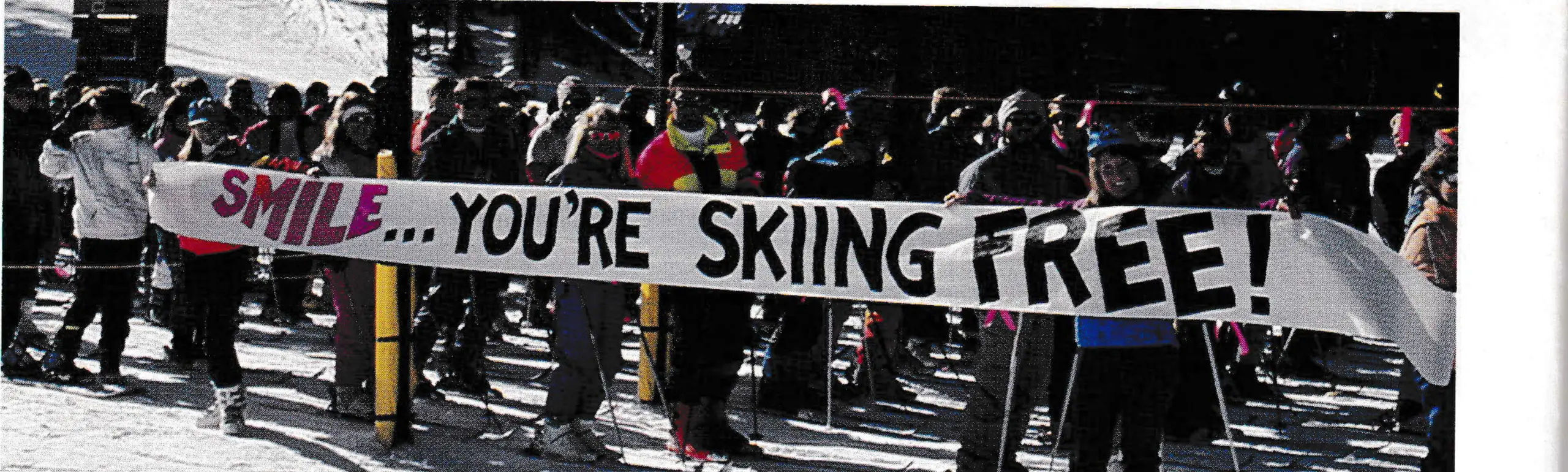
It was a simple but revolutionary concept: don’t charge for lift tickets. For the first 18 days of the 1991-92 season, Crested Butte Mountain resort in Colorado decided to give away skiing to create enough volume to make money through other sources. And it worked – beyond all expectations – though not without some surprises.
The idea was John Norton’s, then vice president of marketing for the resort, and grew out of the Learn-to-Ski-Free program the resort had tried for two years. Learn-to-Ski-Free was to have been the solution to early season woes, filling long, dead spaces between the Thanksgiving opener and the beginning of the Christmas holiday. We felt if we offered never-ever skiers free lessons, free lift tickets and free rentals, they would come in droves and bring their friends and family – or their friends and family would bring them.
Well, some came, but not in droves, and we were still looking at a dearth of business early in the season that resulted in financial models showing it would be more cost-effective not to open until December 15. Not opening until mid-December might make some economic sense for the ski area, but it would be devastating to the local community whose livelihood is geared to the ski season. So why not go the other way and not charge anyone for skiing?
Admittedly, it sounded like the classic Polish marketing scheme where the business lost money on every customer, but made it up in volume. But there was some logic to the scheme. It took tactical advantage of Crested Butte’s main differences from it’s Colorado rivals – the Butte was more than 200 miles from the nearest major metropolitan center (Denver) and had very little day business, and the resort enjoyed good relations with the community and local businesses.
The theory was this: The vast majority of skiers at Crested Butte are destination visitors who spend at least a long weekend, so attract more of them with free skiing and then, through the cooperation of local businesses, tap into other revenue sources. The big hurdle was convincing a sufficient number of other businesses to go along.
We announced the idea in late December after a disappointing early season had segued in a non-record holiday and various businesses were looking for new marketing concepts. The go/no-go point was to sign up the lodging companies. If virtually all of them didn’t come on board, the project would wither. The second target – once the property management companies had agreed – was the other retail establishments and the towns themselves.
There were two basic agreements: one, that the property management companies give the resort a few dollars for every guest-night booked, and two, that retail establishments give the resort a percentage of the increase in their revenue over what they had made during the same period in the past. All participation was voluntary and had to be motivated by community spirit, as even those who declined to participate would benefit from the program. Every contract was negotiated separately with each business, a time-consuming process that involved hundreds of presentations.
There were several substantial objections:
- Many were critical of the program because they felt that giving away the product would cheapen our image.
- Some felt that only “freeloaders, students and unemployed hippies” would come. (This criticism was deflected somewhat at a public meeting when a city councilman made the comment, “Hey, that was us when we moved here.”)
- A few were philosophically opposed to contributing money to a private business that was in competition with them (with its own bars, restaurants and retail establishments).
It took us six months to sign up the necessary support – a public process that was covered, analyzed and criticized almost weekly in the local press. We couldn’t handle every objection raised because, frankly, we weren’t sure just what would happen with the program, but the concept that “free is a powerful marketing tool” attracted enough support to launch the deal.
Then we hit our second big hurdle: The “Ski Free” offer was literally unbelievable – we had trouble explaining it to people. A typical conversation at a consumer show went like this:
“So what’s the Ski Free thing?”
“You can ski free at Crested Butte November 27 to December 14.”
“What do I have to buy?”
“Nothing, you ski free.”
“So what do I have to do?”
“You don’t have to do anything, you just ski.”
“What’s the catch?”
“There isn’t any catch.”
“So how do I get my ticket?”
“You just go to the window to get your tickets.”
“And then what?”
“You ski.”
“And what is it again that I have to do?”
“Nothing, you just………”
And so on.
We quickly changed the name of the program from the catchy (and difficult to explain) “Ski Free” to “Free Lift Tickets.” It shortened conversations considerably.
Publicizing the program was fun, because it hit a nerve with a recession-conscious public. The headline on our first release said it all: “You Can Question Their Sanity, But You Can’t Beat Their Price.” We announced the program to 100 journalists during the North American Ski Journalists annual meeting at Whistler-Blackcomb, B.C., in April and followed that by attending five of the ski writer regional meetings.
Naturally enough, the program was the lead item in bargains-of-the-year stories in all the ski publications. And in the fall it was featured in more than 200 newspaper articles across the country. Two Denver area television stations did live coverage of our opening day and our billboard in Denver proclaiming “Free Lift Tickets” became a business-news story. It was the most press attention Crested Butte had ever received.
In fact, we became alarmed at the number of people who seemed to be planning to come to Crested Butte for the Thanksgiving weekend and on the Monday before, sent out a press release saying, “Don’t Come; We’re Full.” THAT announcement became news in and of itself, and the press coverage approached a feeding frenzy with even business columnists doing features on the program and the Aspen and Vail press covering it. Aided by the greatest opening snow conditions in a decade, we set every skier-day record possible during the 18 days of “Free Lift Tickets.”

Here are the facts:
- Crested Butte did 86,000-plus skier days during the 18 days of the program, a 350 percent increase over the previous year. We set our all-time record with 8,455 skiers and four of six of our all-time days.
- Lodging reservations were up by 300 percent.
- We taught more than 4,300 people how to ski (we had continued the Learn-to-Ski-Free program).
- Crested Butte increased it’s “lift ticket” revenue over the period – substituting revenue sharing for the price of the lift tickets – but, although this substantially reduced the loss for that time of the season, it was not a home-run revenue-wise. We didn’t totally cover expenses for running the area.
- About 15,000 skiers skied the resort for the first time – a big hit in sampling and the successful “test drive” Crested Butte result we were hoping for. According to our surveys, the majority of these new skiers were from the Front Range – 200-plus miles away – a market in which we never had been competitive. More than 75 percent said they expected to return soon.
- Also, according to our surveys, about 49 percent of the skiers were advanced to expert, our target audience for our Extreme Limits terrain which we had been able to open for the first weekend.
- Although we sold out every expensive room, there were thousands of other skiers who were cheap, cheap, cheap. They came, skied and left, leaving the scantest of economic trails. Brown bags and coolers were common, tips were down and, although business was up everywhere, expensive shops and restaurants didn’t see the percentage of increase of the less pricey places.
- There was an exceptionally high level of satisfaction with the ski and resort experience, even given the world-class lift lines. As one guest, who put together a group of thirteen and rented a house for Thanksgiving, said in a letter: “Thank you for the free skiing… We had a wonderful time. It was our first time at Crested Butte; we will be back. You handled the crowds in a wonderfully efficient, courteous manner; all the employees we came in contact with were helpful, pleasant and downright friendly.”
- Traditional guests were put off by the crowds and indicated that since they were willing to pay, they would ski Crested Butte other times. In that sense, the “bad” will drive out the “good” in this kind of promotion, and we may be building a new kind of customer base for this period.
- The national recognition factor from the program was a pleasant surprise. Our sales people at consumer shows on both coasts noted a much higher recognition among prospective customers. Skiers were favorably disposed to try a resort that would offer this type of program, even though they couldn’t get there during the ski-free period. Although it’s impossible to measure, we believe this was an important factor in increasing our booking for the season. We finished the year up more than 23 percent – our biggest single season increase in a decade and the most successful year in the resort’s history.
Will we try it again? Yes, and longer – next season the Free-Lift-Ticket program will extend from November 20 to December 19. We hope to get more direct flights into the Gunnison-Crested Butte Airport to attract longer vacations from out-of-state guests.
Would I advise other resorts to try it? With caution, particularly if you’re within 200 miles of a major metropolitan center. Skiing free is a powerful concept indeed.
Marketing Monster?
More than the sheer numbers of skiers we saw during the Free-Lift-Ticket program at Crested Butte, I was impressed by the different kinds of skiers showing up. The thing that struck home was the old equipment – and I don’t mean unfashionably out of style, I mean ancient.
I saw Hexels, some matched with Spademan bindings and Scott boots; I saw a bunch of the original Lange bananas; I saw Cubco bindings with weathered straps.
Finally I saw one older woman skiing with lace-up leather boots, Head standards from the 50’s and poles – well, I asked her about the bamboo poles with the huge leather baskets and she said her mother gave them to her on Christmas, 1945… and they were still good.
Where was all this stuff coming from? The closet, basically. Liftline conversations indicated that these people just hadn’t been skiing. It was my impression that many had felt “priced-out” of the sport, although realistically they could afford to go skiing. They certainly weren’t reluctant to buy hotel rooms and dinners – items that greatly exceeded the cost of the lift tickets.
As one father put it, his kids in tow, “We just wanted to try skiing again to see if we still liked it.” Did they? “Oh yes! This is great; we’ll be back.”
We had targeted the Free-Lift-Ticket program as a “test drive Crested Butte,” but we were surprised at how many people were test-driving the sport. Taking away the price of lift tickets as an objection to going skiing created an avalanche of interest.
Perhaps the industry has been obsessive on the price of lift tickets. It’s odd, when compared with other consumer goods and services industries, that skiing always advertises its highest price, that it ranks its areas in order of lift ticket price and that every market-share battle is waged by discounting at the lift ticket window. Seldom is anything other than lift ticket price promoted as a difference among ski areas. (Yes, I’m cognizant of a certain hypocrisy in pointing this out after having promoted the ultimate lift ticket discount.)
The public feels very strongly – too strongly – about lift ticket costs. They think far more about lift ticket prices than they do airlines or lodging prices which are four times the lift ticket cost for an average ski vacation. (Can you