


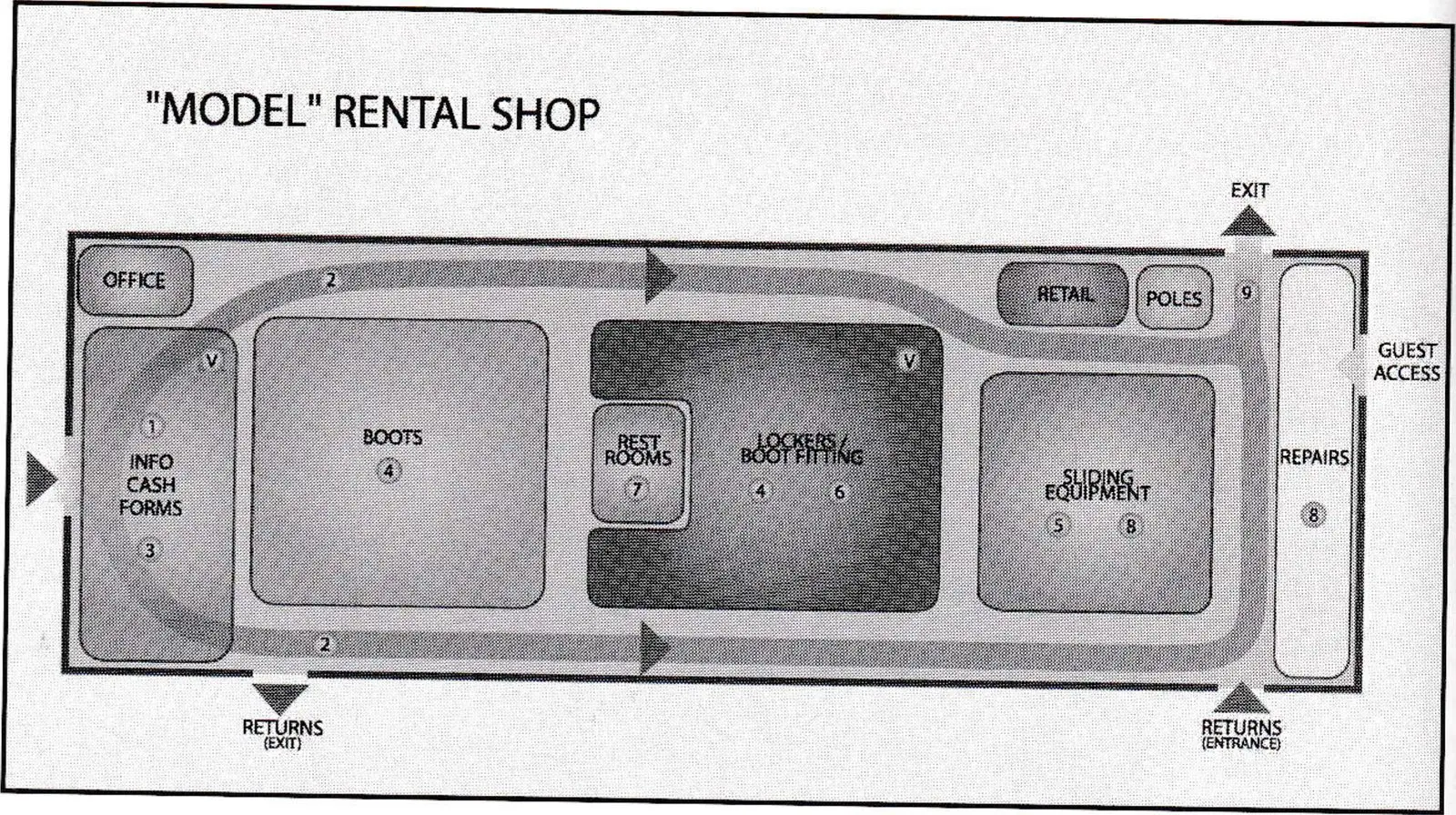
The rental shop is often where we lose potential core customers. While every ski and snowboard resort has very specific needs and constraints, there is a right way and a wrong way to process both first-time visitors as well as returning renters. Though the right way is not set in stone, some basic attributes of getting people outfitted correctly and swiftly are common to any successful operation and should be considered when planning any rental shop renovation or new design.
The most successful and efficient rental shops will address four fundamental elements of the new visitor’s experience in their day-to-day operations. Those elements include the first-timer’s orientation, comfort, satisfaction and sequencing, which refers to providing efficient connections to other aspects and amenities of the resort.
Proper Orientation Dispels Fear
Informing the guest about what he or she will encounter is a valuable opportunity to pacify inherent fears of the unknown and show the newcomer (or repeat visitor) that he or she is a valued customer. There are many ways to orient visitors either before they enter the rental shop or once they are inside.
Assuming it was easy to find the rental shop, it then becomes helpful to educate new skiers and snowboarders about the equipment they are about to encounter, how to protect themselves from the elements and where to find their ski school instructor if they are headed for a lesson.
- Blue Mountain Resorts, Ont., mails a simple brochure along with marketing materials. It explains, in simple terms, what a first-time visitor can expect when they arrive at the resort.
- It might make sense to run a continuous video within the rental shop showing guests what they will encounter. The video would be effective if it included segments on how to carry, put on and take off equipment. It should also demonstrate how to find the ski school meeting area and the facility’s rest rooms. And it might also be worthwhile to include a short segment that reminds customers about the importance of wearing proper hat, gloves and layered clothing. A reminder that helmets are available for rent might drive some business as well. Monitors should be located in areas where guests might be asked to wait on line.
- Rental shop ambassadors have become key to helping customers, especially first-timers. Many successful resorts employ personable ski professionals to work in the rental shop prior to the day’s morning lessons to greet first-timers and help them through this confusing stage of the process.
Parallel or Separate Paths
Create multiple paths for processing different groups of visitors during peak times. Separate paths can be created for first-timers, overnight guests, people taking lessons, bus groups, children, etc. These separate paths can also be instituted only on days when large crowds are expected.
- Jiminy Peak, Mass., has created two symmetrical sides of the rental shop that can be split for a variety of purposes. Often, riders are processed on one side, while skiers use the other. During weekdays and some nights, one side of the […] first-time visitors from the repeat visitors by designating a side of the shop exclusively for each group. This allows the resort to place properly trained employees and specific equipment to accommodate first timer’s needs and saves time spent on line.
Eliminating Bottlenecks
A very important aspect of sound rental-shop planning is to understand how many visitors are moving through each stage of the process and using that knowledge to eliminate bottlenecks. For example, the average waiting time at the cash registers might be 20 minutes, while guests only wait five minutes afterward to get skis. To eliminate capacity imbalances and bottlenecks, it is necessary to measure these numbers throughout each stage of the operation. Keeping track on a continual basis will help determine, for example, if the shop needs more cash registers, bootfitting stations or ski-technician stations.
- A welcome center or one-stop point of sale before the guests enter the rental pod can help alleviate bottlenecks in many instances. Since the cash registers are the one place where traffic often slows, having the guests wait just once at a cash register at the beginning of the visit to purchase all services will eliminate the need for an additional set of registers in the rental shop. Make sure signs point out that a lift ticket is necessary; some first-timers don’t realize this. Appropriate software is a key component and will aid in data collection for tracking guests, which is useful to survey guests and measure conversion rates.
- At The Homestead, Mich., a welcome center was built at the entrance to the village where guests purchase all services. The resort has also separated the rental shop into two locations, integrating all stages of the process with a customized software package. After guests have their boots fitted in the first shop, they walk out to the ski-storage location (on-snow) where their already-fitted skis are waiting.
Equipment Concerns
Keeping equipment in proper shape keeps guests comfortable and helps move the rental process along. A well-maintained fleet of skis and snowboards that is stored in a flexible and efficient system will help greatly.

It is important that all guests—especially first-timers—are comfortable in their boots. Too often, guests end up wearing poorly fitting or wet boots, made even more uncomfortable by mistakenly wearing thick, loose-fitting socks or tucking pants into the boot cuff. Much of this discomfort can be prevented by boot drying systems and placing a knowledgeable staff member in the boot-fitting area who can provide advice to guests.
- ASC Discovery Centers provide boot fitting with an instructor on hand as part of the learn-to-ski process. This takes place in a very relaxed and informal atmosphere.
- Jiminy Peak starts all first-time skiers on 120 cm shaped skis, which apparently allows for very rapid improvement.
- All rental sliding equipment should be tuned regularly. Tuned skis and snowboards allow beginner skiers and riders the best chance to learn the sport.
- Learning to ride should not be overlooked. Manufacturers are now producing snowboards that are tailored specifically for the first-timer.
- Stowe Mountain Resort’s snowboard rental shop uses limited space well by storing all bindings separate from the boards. Every board is custom mounted for the customer.
- Several resorts have found that using temporary structures to house skis and poles can be very effective when space is limited. These structures must be linked to the indoor registration/orientation and boot fitting area. At Stratton Mountain, Vt., an on-snow Sprung structure shortens the distance guests must carry equipment to reach the slopes.
Guest Conveniences Key
Making the transition from street to slopes easy and comfortable can simply be a matter of creating handy storage cubbies and conveniently located restrooms. Place lockable and non-lockable storage units in the central boot-fitting area of the rental shop, allowing guests the ability to store any personal belongings (especially street clothing) directly in the rental shop so that they can leave the shop worry-free.
- At Chestnut Mountain, Ill., benches, lockers and cubbies were incorporated into the new rental shop facility. Customers have the ability to deposit belongings while they are fitting their boots, giving them less to worry about for the rest of the rental process, and the rest of the day.
- Providing restrooms in the same area allows guests to make needed pit stops during boot-fitting or while putting shoes away. Individuals move at their own paces during this phase and providing for their needs is good policy.
Once you’ve determined what your facilities should provide for renting guests, make sure the rental shop is properly linked to other parts of the resort. For example, a proper sequence of facilities that makes going from the welcome center to the lifts a smooth experience, tying in the learning center, lesson meeting place, base lodge and learning terrain, will enhance the guest’s overall impression of the resort and help turn apprehensive first-timers into confident repeat customers.
Contributors to this article include Donn Downey, Walter Elander, Claire Humber, Stuart Jones and Mike Repyak.
