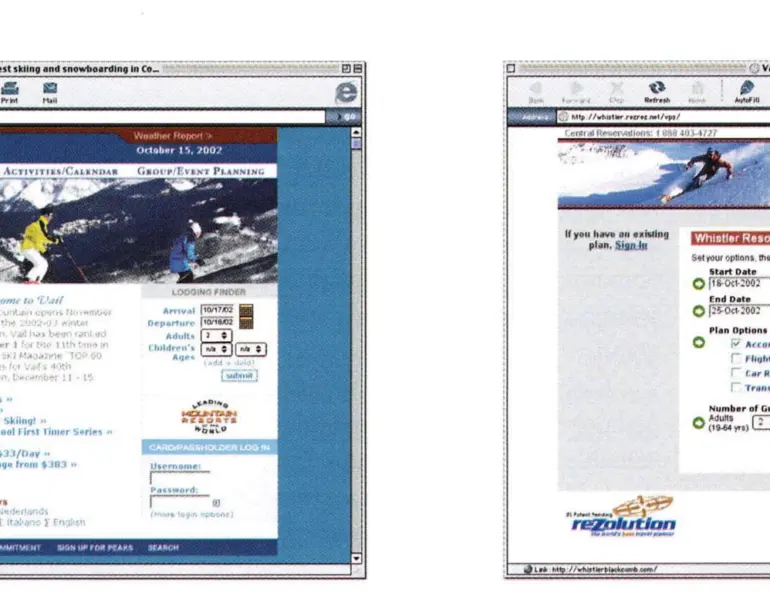
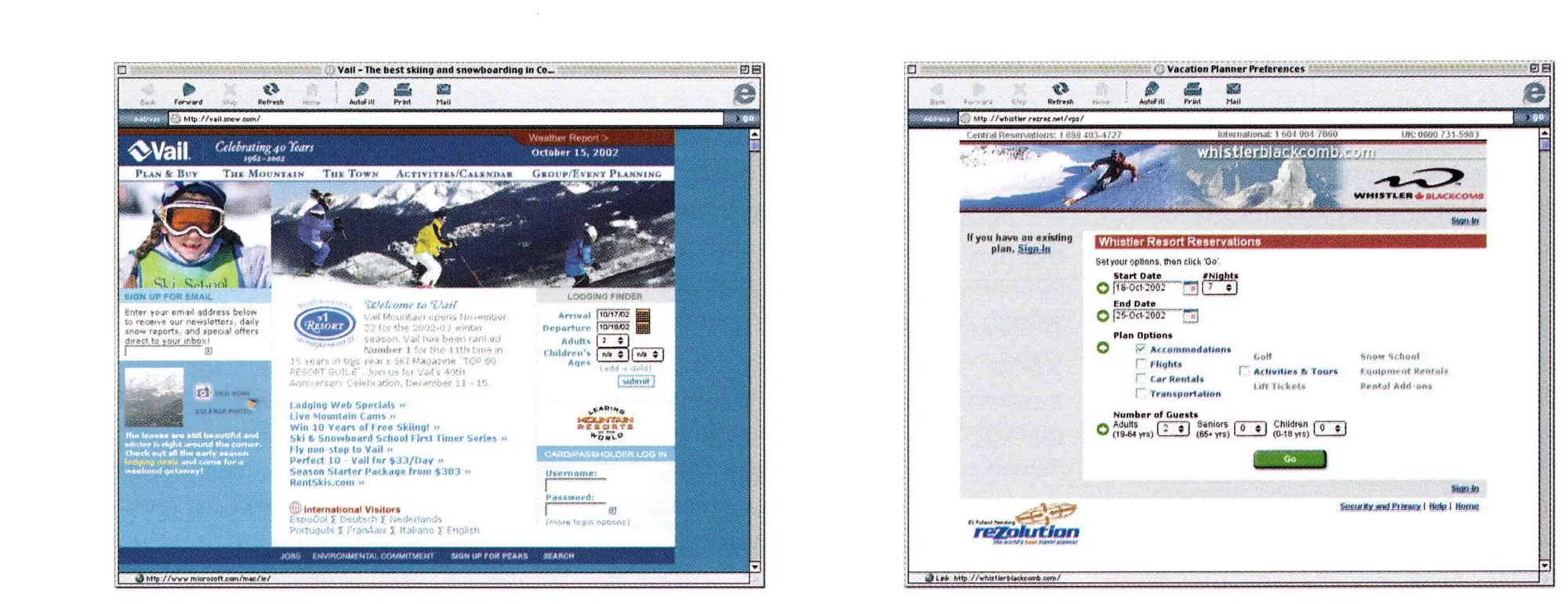
Wanna peek into the future? Take a look at the new Whistler and Tremblant websites, and their Internet booking engine, Rezolution (they can be found at http://whistler.rezrez.net/vps/Lodging.asp or http://tremblant.rezrez.net/vps/Preferences/Preferences.asp?PageName=PreferencesChoices). This complex piece of programming, built in stages over the past half decade, gives vacationing skiers their first full one-stop on-line shopping tool. With it, you can book a flight to Vancouver, ground transportation or a rental car to Whistler, lodging, snow school group lessons, and rental gear.
Could you install a similar system for your resort? The simple answer is no. Right now, you can install a more limited and reliable system, one that lets you sell any inventory you own and control. You may already have done so, for services such as lodging or season pass sales. But as soon as you add elements to a booking engine, the complexity—in addition to the cost and the risk of failure—rises astronomically. And the system can become unmanageable if you try to build in a payment system for independent vendors—like lodging properties you don’t own, and rental cars and airline tickets.
Building a web interface into your reservation system, though, is much more doable. After all, you’ve already installed a central bookkeeping system that talks to all your resort’s point-of-sale terminals. The back end of the system produces a general ledger, payroll functions and inventory reports. It even uses bar code readers to track retail and rental inventory. These systems are so common that installation is routine: A company like FCS Development (www.fcsdevelopment.com) can install a plain-vanilla system in a week, for a couple of grand.
A web interface lets your customers prebook via your website, and this can be valuable for a couple of reasons (more on that below). At Sirius Software (www.siriusware.com), president Mark Danneman estimates he could install a web-capable system beginning at $10,000 (where the only e-commerce product is the season pass), and going to $50,000 where multiple products are sold on-line. Sirius doesn’t do the website development—that’s up to your own local Internet services vendor—but Sirius provides an interface to its installed system, and trains your web developer to use it. Lead time for design and installation of a full system is about eight weeks.
So, where do you start? Let’s look at the different products a typical winter resort offers and see which ones make sense to book online and which ones don’t.
Season Passes
This is the easiest thing to sell on-line, and dozens of ski resorts now do it. A season pass promotion is an easy way to enter the wonderful world of e-commerce: It’s a single product, at two price points (for kids and adults), sold only once each year and over a limited time period. All you need to do is take a credit card and log in the customer’s name and address—the customer will come to your season pass desk for fulfillment. You don’t have to track any inventory.
Rental Gear
If you want to bring your rental shop into the world of e-commerce, there are a few more considerations. First, there is more product choice, from single ski and snowboard packages on up to demo packages. Second, you need to be able to compare bookings to inventory. In fact, your shop probably installed a specialized rental system years ago and you need to figure out if you can interface with it. Third, the rental shop manager undoubtedly loves his old system and doesn’t want to change anything.
But, the project is worth tackling for two reasons: Prebooking saves a huge amount of time, for both staff and customer, at the fulfillment point; and it captures your customers, steering them to your profit center and away from all those rental shops lining the state highway. Several vendors have efficient, standardized rental shop modules as part of a resort-wide system.
Ski/Snowboard School
Ski/snowboard school adds a whole new set of roadblocks to going high-tech. The range of products offered is complex (big resorts handle this by booking only group lessons on-line—the customer who wants a private lesson must phone ahead), and the inventory is unpredictable—it checks out every evening and heads for the bar. Plus, every ski area in the country has its own unique pay scale for ski instructors, so every ski school payroll installation is unique. There’s no off-the-shelf software. System vendors hate ski schools. Nonetheless, companies like Sirius, Comptrol Systems (www.comptrolsystems.com) and Intouch Technology (www.intouchusa.com), which sell resort-wide systems, provide ski/snowboard school modules.
Day Care and Group Sales
These are two more products you control, which are fairly simple to prebook through a website. But realistically, web booking of these two products doesn’t save a lot of employee time.
Lodging
Lodging is pretty easy—if you own all the lodges. Install the Springer-Miller system and let them build the website interface, and be prepared for costs to escalate as you tie lift tickets and other products to the bed sale.
But what if the resort-owned lodge overflows, and you need to pass traffic along to nearby lodges you don’t own? Ah. Now it gets complicated. If you don’t own the inventory, your system needs to:
- read the vendor’s inventory status,
- reserve it,
- take payment, and
- transfer that payment, possibly in two stages for deposit and final bill.
Most independent lodges won’t give you control of their inventory. You may be able to negotiate a block of rooms for each week in the season. This is what tour operators do, and so do the big travel booking services like Expedia and Orbitz.
What this means for a busy lodge owner is that he allocates blocks of rooms to several booking services, each of which has its own commission or transaction charge. If I own the 250-room Chalet Lodge, on any given weekend I might allocate 50 rooms to the resort’s Central Reservations service, 50 rooms to Expedia, 50 rooms to Orbitz, 50 rooms to WorldRes, and 50 rooms to Moguls. I can change the allocations from week to week as I see who does the better job filling them, and at what margin.
It creates a weird issue for the consumer, though. If Slats Grabski goes to Expedia to book a flight to Vail, then requests a room at the Chalet Lodge, and the Expedia allocation is sold out, he’ll get a “Sorry, no availability” message. He will naturally conclude that the Chalet Lodge is sold out that week, and will try the Snow Star Chalet, also listed with Expedia. If Expedia has sold out all its rooms in Vail, Slats won’t think to check out Central Reservations or Orbitz—he’ll simply try to get into Aspen. In reality, the Chalet Lodge may have 30 or 40 rooms available, but most of its booking agents won’t know it—they’ll turn away business. There is no research on how much business is lost this way.

The bottom line: On-line room booking works wonderfully for a large resort that controls huge blocks of rooms—Intrawest, for example, or Vail Resorts. It’s a lousy deal for a resort that depends on a scattering of independent properties up and down the valley. In that case, your best bet is to build a link from your website into a specialized booking service that can sign up blocks of rooms around town. John Clifford, who was vice president for marketing information systems at ASC from 1997 to 1999, chose Worldres to do just that for all the ASC resorts, then watched while Worldres spent millions figuring out how to do something as seemingly simple as tying a complicated lift ticket sale to the room.
Lessons from the Big Boys
How do Whistler and Tremblant manage to integrate everything? They got a head start by buying Stan Sprenger’s tour packaging operation. Sprenger started out in Montreal, packaging tours to Tremblant, then to Whistler. Two years ago his company, Intrawest Vacations, began building a web-based booking operation called Resort Reservations (rezrez.com), licensing software from Radixx. By the time they were up and running, the total investment in software stood well north of CAN$10 million. Rezrez still functions like a tour packager: The company controls blocks of inventory in everything it sells, including airline seats. This means that the system is independent of the bookkeeping systems in use at Stratton, Copper and Mammoth—a babel of legacy systems still being coaxed to talk to Vancouver.
Aspen and Vail Resorts face similar problems: At Aspen, if you want to book a room online, you might wind up using Expedia, Orbitz, Aspen4U.com (a central reservation system), snowmassvillage.com (another cenres), aspenlodging.com (East West Partners), a tour operator, or websites operated by property management firms or individual lodges.
At Vail Resorts, at least five different property management systems are in place within the company. Eric Phannenstiel, founder of Resort Technology Partners LLC, a joint venture with Vail, says there are plans eventually to institute a single system across all the Vail lodging properties, but in the meantime the websites he builds for Vail, and other resorts, have to talk to a wide variety of booking agents. Resort Technology (www.resorttech.com) recently signed up an Irish vendor, Datalex, to provide booking software across the complex system.
Lessons for Everyone Else
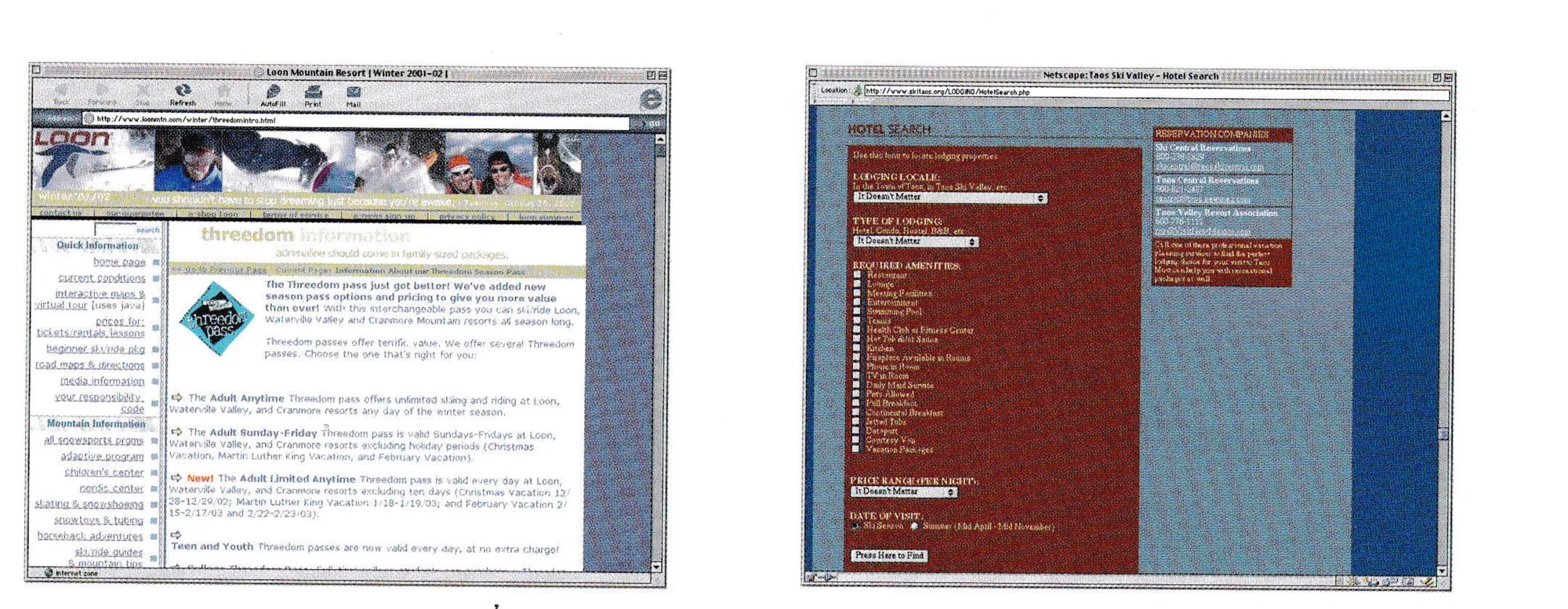
If you’re a resort in an isolated area—a Jackson Hole or Taos—it’s cost-efficient simply to list a lot of lodges on your website and let customers link out to independent booking sites. Clifford recommends that if you do this, it pays to educate the lodge owners on the best way to allocate rooms among the agents.
If you’re in a more competitive environment, where a visitor at a lodge down the valley might choose to ski with you or your arch-rival across the way, you may choose to book the room yourself, so as to sell a ticket with it.
When installing a complex system, the risk of failure is very high. Dozens of larger resorts have launched their own integrated systems, only to find that one or more of the modules couldn’t be made to work efficiently, or at all. When that happens, the affected managers quickly become disaffected. Forced to resort to manual work-around solutions, they grow grumpy and hostile, and will greet further IT upgrades with all the enthusiasm they might have for a root canal. It’s important to work with a vendor who can show a successful track record installing and debugging all the modules you need.
Ironically, if your small resort is just starting out on the e-commerce track, you’re probably in better shape than a resort that already has efficient but separate internal systems up and running in its various profit centers. You can start with a clean slate and put together an integrated system. The resort with a variety of incompatible systems has to replace them and retrain everyone, or spend the time and money to make them talk to the website, with no guarantee of success.
Even if you’re starting fresh, it’s wise to start web sales slowly, launching one product at a time. That way, when you have a problem with training, hardware, networking, software bugs, internet access or website design, it will only affect one department. If your season pass sales go well, you can add another product group the following year.
Begin planning for a summer installation in January, and try to have the new module running smoothly by July. That will give you August for staff training, and a fully-operational system selling product at Labor Day.
Seth Masia has been managing websites since 1996. He had a close encounter with e-commerce during a brief stint as Intrawest’s director of Internet strategy.