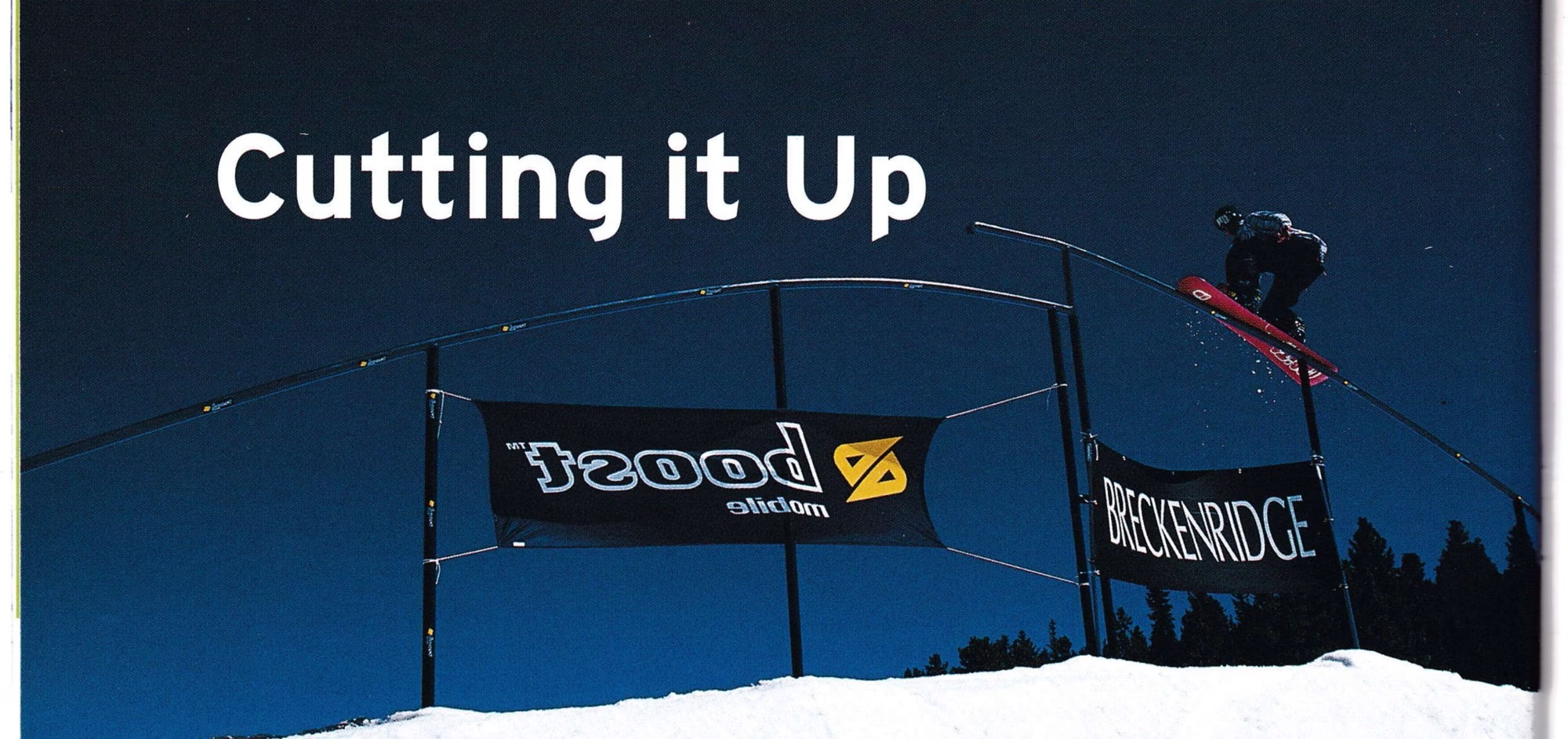
- Start with a pristine, snow-covered slope.
- Add four of the hottest terrain park designers in North America.
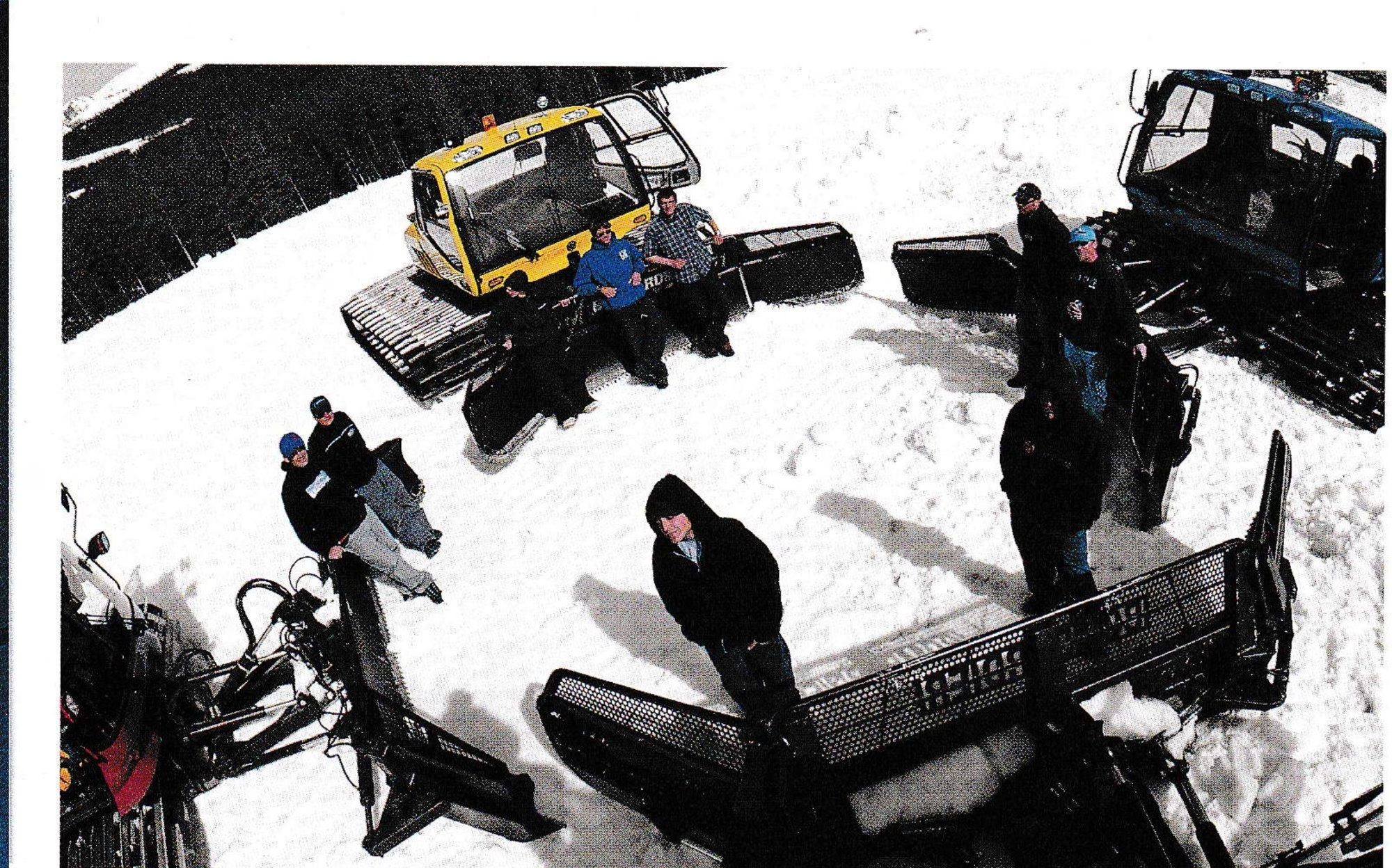
- Sprinkle the trail with several Bombardiers and Pisten Bullys.
- Stand back for four days and let the designers sculpt, weld, and build feverishly.
Presto! You’ve got Snowboarder magazine’s first-ever Cutter’s Cup World Park Building Championships, held last April 25-30 at Breckenridge.
The Cutter’s Cup is a new twist on Snowboarder’s annual “Superpark” event, a promotional banquet that only a snowboarder could cook up. Here’s the setup: The magazine convinces a host area to build a fantastic terrain park of extraordinary dimension, then invites top riders, photographers, and film crews to come and feast on it. The riders explore the outer limits of the possible, in the air and along the rails. The magazine gets enough photographs to fill a significant portion of one issue, filmmakers get tons of cool footage for their movies, sponsors get their logos in print and celluloid, and the host resort gets massive exposure throughout (even in the pages of SAM). So it is a success for everyone involved.
But Snowboarder editor Mark Sullivan wanted even more from this year’s event. He wanted to inspire areas everywhere to devote time and turf to parks. So this past spring, Sullivan concocted the Cutter’s Cup. He invited park designers from three A-list resorts—Whistler/Blackcomb, B.C., Mammoth, Calif., Breckenridge, Colo.—and SoCal’s upstart, park-happy Mountain High to each design a portion of the Superpark and thus show other resorts how easily they can get into the game.
Each team of three (two designer/cat operators and a guinea-pig tester) was given a leveled quadrant of Breck’s Freeway Terrain Park, 30 hours of cat time, and eight hours in the welding room. Their challenge: to create the most compelling park features possible. “The point is to show what kind of hits you can build in a small amount of time,” says Sullivan. The riders would judge the results, and the winning team would pocket $7,500.
Inside-the-Park Home Runs
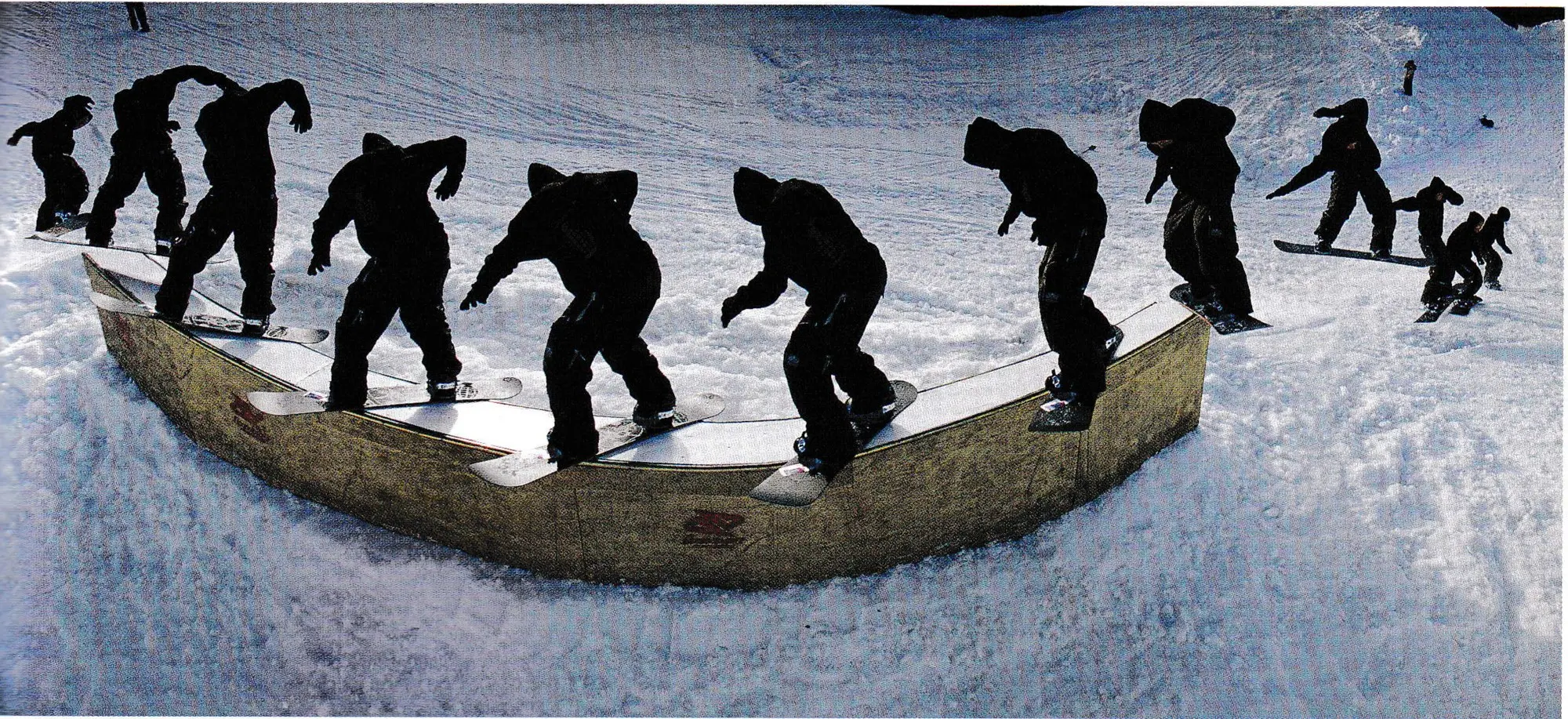
And in fact, the teams produced an amazing collection of hits, a greatest hits of hits. Each team produced at least three features. Among the most notable: Whistler’s team built an enormous spine gap jump (see cover). The gap was wide enough to drive a cat through, and taller. Mammoth built a 56-foot, multi-sectioned, kinked rail. Mountain High produced its clever C-box, perhaps the most unusual and popular single jib of the event. And Breck produced a flowing chain of jumps and jibs, culminating in a rainbow sharkfin step-down rail.
For the record, the Breck crew earned the $7,500 prize. “What separated us is that the riders could hit all three hits in one run—it was the flow,” says Breck designer/driver Elliot Cone. “And we also had the best jump,” he says with a smile. “The jump was an optical illusion. It looked like the riders were really high, but they weren’t. It looked harder than it was. I figured the riders would be tired after a long season and would go for that.”
“Features need big transitions and big landings,” Cone says. “I like sequential jumps, because they help riders make sure they have the correct amount of speed.”
A Cutter’s Convention
The losing teams didn’t seem particularly upset—they had too much fun hanging out with each other. “It was just good to get together, talk about common problems and come up with a few solutions,” says Steve Petrie, a driver and terrain designer from Whistler-Blackcomb. “We got a few good ideas for rails, for example.”
And that was precisely the point. “This is the first time anyone’s gotten park cutters together,” says Sullivan. “This can be a coming-together to push the state of the art.”
The cutters agreed whole-heartedly. “It was a great event,” says designer/driver Day Franzen from Mountain High. “It was Whistler-Blackcomb, Mammoth, Breckenridge and—Mountain High? We were just happy to be there. Park builders don’t mingle much. All the teams will benefit from learning each other’s techniques.”
“The C-box was new for me,” says Yannick Rioux of Whistler-Blackcomb. “It opened my mind to watch the others build stuff. We’re going to try to make different things, even more different than in the past.”
“Everyone had their own style,” says Mammoth driver/designer Mike Gerstner. “That was the coolest thing about the event. I was impressed with how unique each section was.”
All that sharing of ideas is spawning new hits. “We have to keep coming up with new ideas and creations to keep the sport hot,” says Cone. “And I’ve got 10 rails that I’m ready to debut that have never been seen. We’re going to hold a Superpark Week at Breck to debut the new rails.” He’s also modifying the rainbow sharkfin for mere mortals. “It’s 17 feet tall, but we’re cutting it down so it’s just a few feet off the snow,” he says.
And the designers want other resorts to do the same. “I hope the Cup promotes parks at all mountains,” Gerstner says. “At heart I’m a snowboarder, and I want my friends all over the country to get the same terrain-park quality we have at Mammoth.”
To assist designers at other areas, the Cutter designers are trying to organize a guild, and plan to host a week-long seminar at Timberline, Ore., next May. Franzen and Eric Rosenwald, part of the design team from Mammoth/June Mountain, are spearheading the effort. They are also marketing rail installations to areas across the country (see “Rails From Coast to Coast,” page 48).
All this makes Mark Sullivan smile. Parks, he says, are a form of snow insurance. Even if snow conditions throughout a resort are bad, the park is always packed. Everyone, from first-time tricksters to experienced riders, prefers parks as the place to learn and polish tricks. They are more fun and, in the riders’ view, safer than riding and doing tricks in “natural” terrain.
Sullivan also believes that there are not enough parks currently to meet the demand for them. He argues that the percentage of trails that are devoted to terrain parks should reflect the percentage of people who use terrain parks.
“The Cutter’s Cup is part of an effort to keep evolving the Superpark,” he says. “It showcases innovative features and aims to inspire park designers and riders all across the continent.”
Cup Full of Ideas
So what can other resorts learn from the Cup experience? After watching the assembled pro riders play in the park, several lessons emerged.

Size doesn’t matter. The most popular features with the riders were not the biggest and burliest, but those that allowed what Gerstner termed “super trickability.” These included Mountain High’s C-box, Mammoth’s kinked rail, and Breck’s rainbow rail. The C-box, Franzen says, is the one feature from the Cup that has been in nearly every major new snowboard film this year—and it’s something just about anyone can ride. “The C-box is the most-used feature at Mountain High,” he says.
Size does matter. Every park benefits from a signature hit, just as a resort gains from having a signature mogul run or supersteep slope. While it took riders a few days to warm up to Whistler’s huge gap jump, Breck’s tall sharkfin, and Mountain High’s rail gap jib the riders nicknamed “the impaler,” these features were the ultimate challenges at the Cup. And the riders who mastered them were the superstars.
Creativity counts. The popularity of the rails and box at the Cup inspired the Cutter crews to focus on new rails and configurations for the coming season. For example, the Mammoth/June designers are exploring urban and skate-style features. All agreed that park designers have just scratched the surface of what is possible, and all are developing new jibs for the coming season.
Bigger is better. Bigger, as in bigger transitions and big landings, is better because it makes takeoffs and landings as safe as possible, the cutters say. Several designers noted that the goal is to create fun features, not huge features.
Build on your strengths. The cat drivers say that building parks with big trannies and big landings suits their machines’ capabilities and makes parks easier to build and maintain. “With today’s equipment, you can leave the park 99 percent complete, with very little to do by hand,” says Rosenwald.
Investment spending. It takes commitment to devote cat time and snowmaking capacity to build and maintain the parks, the designers say. The payoff is that it brings in the kids. “Areas that want to appeal to this [young] demographic have to invest a little effort in the market,” says Gerstner.
“The park is the only real area of growth in the business,” says Franzen. “Food and beverage isn’t bringing more people to the mountain, the parks are. A good park will draw more numbers than anything else. Right now, it’s the only thing you can build on, and only a few resorts seem to understand that.”
Riders make the best drivers. It’s possible that the driver/designers at the Cup are prejudiced on this point. Most are riders who were asked at some point to ride shotgun and advise the experienced flat-snow groomers on how to build hits. Invariably, the designers got impatient and insisted on doing it themselves. They know what works because they are the end user as well as the designer.
Wait Till Next Year
Sullivan is already planning to make next year’s event an even bigger draw. Mark your calendars now.
Cat Tracks
The Cutter’s Cup was co-sponsored by Bombardier and Kassbohrer, each of whom supplied machines. Which cats did the groomers prefer? For park work, all favored the smaller, more maneuverable models. But their dream machines would also include the ability to move small mountains in a single pass, and groom down the steepest landing without a trace of sliding, regardless of how bad the snow was. Several drivers emphasized the need to consider the machines’ strengths and weaknesses, and to work with the strengths while constructing features.
Mountain High’s Day Franzen drove both the Bombardier BR 2000 and BR 275. “I really like the new BR 275,” he says. “The new one has some improvements that make quite a bit of difference. I like the 2000, too, but it’s more of a flat groomers’ machine. I like having control over every part of the 275.” Mike Gerstner of Mammoth also preferred the 275, for the same reason.
“Park Bully is what we run at Blackcomb,” says driver Steve Petrie. “We think it’s the best snowpark cat. The tiller, especially, is great for the heavy snow we get. Plus, the blade has a wider range of movement. As a result, it’s easier to back-blade features to finish them cleanly. A fine finish is part of the routine at Whistler.” The Whistler-Blackcomb grooming crew has built a comb attachment for the blade to further improve the finish quality. —RK
Rails From Coast to Coast
Mammoth/June designers Day Franzen and Eric Rosenwald have formed a new company, railbuilder.com, to offer pre-fab rails and boxes to resorts nationwide. They are creating signature rails with top freeskiers and riders, such as Tanner Hall and Ali Goulet, to get young riders pumped. “Kids will be able to brag about riding the Tanner Hall rail,” Franzen says. The duo is creating packages of four to eight rails and snow/skate features.
“The pros have come up with some pretty sick ideas,” Franzen says. “Half are for everyone to ride, half are for advanced riders. In all, we’ll have 40 to 50 different rails. They will arrive pre-made, pre-skirted, ready to be installed. We even have a backyard section for groms to buy, an eight-foot section for $125. These break down small enough that they can be shipped UPS.” —RK
Snowboarder magazine’s November 2002 issue, which is (alas) now off the newsstands, devoted 32 pages to the Cutter’s Cup. For more photos and insights into the events, send an e-mail to [email protected].