

After over a year of study by National Ski Areas Association, and with the blessings of such organizations as the National Ski Patrol System, the U.S. Ski Association and the U.S. Forest Service, the long-awaited uniform trail-marking system goes into effect this winter. Concurrently, a massive education program is underway to inform the recreational skier of the meaning of the signs, and how they will help him.
At the heart of the new system is the principle of three-way protection: protecting the skier from his own ignorance or folly; protecting the skier from the thoughtless area operator; and giving the conscientious area operator some measure of protection from the thoughtless skier. To explain, consider the skier who heretofore may have been enticed down a trail rated “intermediate” which he, having been told by his instructor that he is an intermediate, assumes he can negotiate. He may not realize—or prefers to forget—that the “intermediate” slope may challenge the expert skier under some snow conditions.
Consider, then, the second protective device. Some lowland area operators have felt commercially coerced into offering “challenging runs for everybody from beginner to expert.” The skier who found he could negotiate the 15-degree “expert” trail at Lowland Area ‘X’ may have incorrectly and dangerously assumed he could negotiate the 45-degree steilhangs and narrow chutes on the truly expert runs at Highland Area ‘Y’.
Finally, consider the third protective measure. The new trail marking system imposes on the skier a reasonable responsibility to exercise his judgment. Put more bluntly, he must think a little for himself, and thereby assume some of the risks of thoughtlessness.
These three protective measures are achieved because the system calls for the grading of the various runs at an area relative to each other. Every area with at least three different lines of descent has one which is the easiest, one which is more difficult and one which is the most difficult. The system does not say how difficult or easy they are. Further, there is no correlation implied—and therefore none should be assumed—between the easier runs at two different areas.
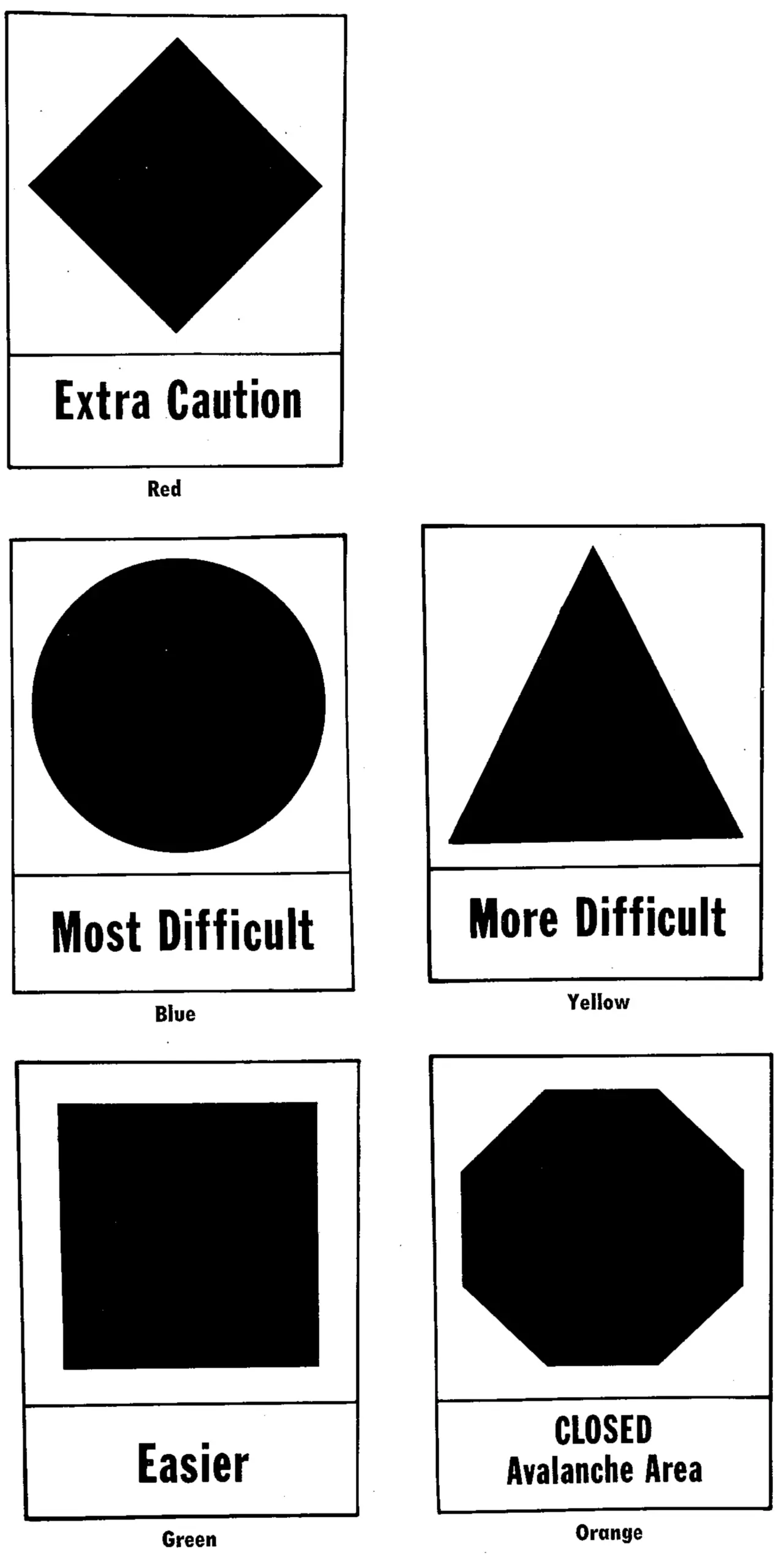
Thus it is that runs will be marked with a green square for the easiest runs, a yellow triangle for the more difficult and a blue circle for the most difficult—at that area being understood in each case. In addition, there is an orange octagonal sign to indicate an avalanche slope, and a red diamond-shaped sign to alert the skier to the need for exercising extra caution.
There is, of course, a direct correlation with highway signing. Everyone has seen the sign which looks like an “N” on its side, which indicates a double curve. We see this sign in the plains states to indicate a couple of mild jogs in the road; we see the same sign in crossing a mountain pass to indicate a couple of 180-degree hairpin turns in a row. The car driver recognizes, from the sort of terrain he is traversing, what sort of double curve the sign is foretelling. By the same token, the skier should be able to judge how difficult the “most difficult run is at an area he is skiing for the first time. It is a matter of context.
We have, perhaps, oversimplified the whole problem. The inherent simplicity of the signing solution arrived at by NSAA is deceptive. Let us say that you operate a ski area on a fairly complex mountain. The skier has a choice of four ways to start down from the top. Each of these four runs, because of merging and intersecting trails, confronts the skier with a number of choices in the course of his descent. In combination, then, you may have sixteen different ways of getting from top to bottom; further, it is probable that you can start down a trail which would be marked with a green sign to designate an easier run, but you can take a right at an intersection which will bring you down a decidedly more difficult slope. How do you mark this trail at the top?
To answer these and other such questions it is necessary to invoke the good, sound horse sense of the individual area operator. For instance, it would be wrong to mark any trail at the top of the mountain with a green square if that trail, or clearly-marked cut-offs from it, did not permit the skier to go from top to bottom on terrain warranting such signing. It would be wrong to invite the skier down an easy beginning section only to confront him with no choice but to continue down a precipitous slope.
Then, too, the use of the red diamond-shaped sign for extra caution will be subject to individual interpretations. Should this be used to warn of special hazards of a temporary nature, such as washouts or icy patches? Or should it be used to warn of particularly steep slopes? Or for both?
A year from now, after a year’s experience, the ski area industry may be able to answer these questions better. The only guideline at this stage is that the red diamond-shaped sign should be used with intelligence and reasonable consistency by the area manager. If it is used to designate a particularly precipitous run, like the International at Stowe, it should definitely be used in conjunction with the blue circle sign indicating “Most Difficult.” Again, the highway sign analogy can be useful. In the context of the terrain being traversed the driver can probably assess the sign which warns of a “steep hill” ahead. This is the equivalent of the blue circle trail sign. But if the highway sign accompanies its warning with the legend “Trucks Use Lower Gear” the prudent driver will be that much more alert. Just so with the red diamond-shaped extra caution sign for the ski trail.
This sign, however, may also prove useful for marking temporarily hazardous conditions caused by snow conditions or construction. This awakens the old bugaboo of the veteran area operator: “If I mark one hazard—be it a tree stump or a washout or an icy patch—am I not in danger of leading the skier to believe I have marked them all, and am I not then inviting litigation?”
Here again, the good sense of the operator must prevail—sometimes against the advice of his worried attorney. The over-use of the extra caution signs will certainly dilute their impact and effectiveness. Since the operator patently cannot undertake to mark all hazards when conditions are continuously changing, he should probably limit his efforts to marking those hazards which he sincerely feels are most likely to cause accidents. This might mean marking above a bare patch of which the skier has little visual warning; and not, perhaps, marking the bare patch which the skier can clearly see thirty yards ahead of him. There is also a gray area here where the experienced operator judges that the legal risks of marking are outweighed by the practical consideration that his only real risk exposure is the injured skier, and an injury prevented is a liability risk removed.
With regard to the use of the orange avalanche sign, this is a problem peculiar to the West. A large majority of these areas are on U.S. Forest Service land, where the use of the sign will most often be on the advice of the ranger.
Perhaps the most important part in the introduction of this new signing system is the legend. There should be prominent signs, both at the bottom and at the top, explaining the color, and shape-coded symbols. This can either mean prominently incorporating the legend into the area’s existing trail maps, or it can mean displaying the specially designed legend signs, or both.
All of the signs, including the five color-coded symbols and the legend sign, can be obtained through NSAA. Thanks to the efforts of Bill Parke, then of the Forest Service, soft, adhesive-backed, heavy-duty Scotchlite signs, 18″ x 24″ in size, which can be affixed to plywood or aluminum alloy backings are being produced. This is the same technique used in hundreds of thousands of highway signs across the country.
The cost per sign is $2.00, except for the legend and avalanche signs, which run $2.50 per sign. These signs are available to all areas through the NSAA national office, whether NSAA members or not but members are entitled to a 20 percent discount. An order card for the signs is bound into this issue.
A further refinement to the signing system is the addition of a numerical code, with the number “1” being used in conjunction with the easiest run, the higher numbers designating the more difficult runs in order of difficulty. This additional grading, which many areas feel is desirable, is at the option of the individual area. The old designations of “beginner,” “intermediate” and “expert” should not be used in conjunction with the new signs.
The rest of the uniform signing system adopted by NSAA will also find its way into general use over a period of time. These are the signs, familiar to many operators, which identify congested areas, intersecting trails, telephone locations etc. While these signs are part of the whole system of uniform trail marking adopted by NSAA, it was felt that those designating the relative degree of downhill difficulty were the most urgently needed, and it is these with which the skiing public will become familiar first.
A giant step forward has been made with these new signs which will inevitably mean safer, more enjoyable and more intelligent skiing for the public. For this and other reasons, they serve the ski area industry well. The ski world is greatly in the debt of the men who worked for them.