


Is New Development Dead . . . Or Dormant?
Major new ski resorts don’t exactly sprout like mushrooms these days. So, it is a rarity—and a pleasant one—to be able to report on two that are poised. To celebrate the event editorially, we not only describe the two, but also offer the reader a challenging overview by award-winning ski writer, Bill Berry, whose special beat is ski area growth.—The Editors
It’s all a matter of energy—internal-conviction, not internal-combustion—this business of getting new ski resorts through the maze of regulations and confrontations which, in recent years, have converted the old 18-month straight-line, on-line road into a five-year obstacle course. (Add another three years if Sen. Floyd Haskell’s silly little bill ever fights its way up the Hill through the House of Representatives.)
This energy idea flashed like a comic-strip lightbulb in March, when I visited with Hans Geier at Ski Yellowstone during a long swing through Montana, then drove the 40 miles back to Big Sky. It received a re-charge when, a few weeks later, I chatted briefly with Pam Conklin, then of Vail Associates, about “Whither Beaver Creek?” “Oh,” she said, “Bob (Parker) has a few new wrinkles to iron out, but we won that other battle . . .” and the current target is 1980-81. Or perhaps, 1981-82. It really doesn’t matter, except to VA’s cash-flow projections, because Beaver Creek is going to happen. And probably, Ski Yellowstone won’t. And of course, Big Sky has. More or less.
Now, I’m not about to run through the usual it-all-started-with-Mineral-King jazz, because anyone who doesn’t know that liturgy by now hasn’t been reading the right consumer catechism. I’ve covered this for Ski so thoroughly and often (most recently, March 1977) that when I hit that sequence I put the typer on auto-pilot and wake up three pages later: Mineral King, Independence Lake, Snowbird, Bigelow, Vermont and Act 250, Adam’s Rib. We have a new firefight brewing with the Aspen Skiing Corp.’s expedition into Washington State but what the hell, it looks like the same game with different players and if ASC didn’t know what the “buy” and stakes were it had just been away from the table for too long (which, given its home base is hard to believe). The fact is, that battle was as inevitable as new snowmaking installations following a bad snow year.
The only thing unsettled is, who’s going to win?
Or, to put it another way, how badly does ASC really want to win—and to hell with all the press-release nonsense. Has it got the psychic and fiscal reserves to battle through, as VA has shown it has, or will it—as Geier put it so simply—“be stopped by a 13-cent stamp” Which seems to be the Ski Yellowstone story.
No question, it’s a rigged game these days: Environmentalists have all the cards. But developers have the chips, because with rare exceptions — like Disney fighting Sierra on the latter’s home turf—enviro-freaks are a highly transitory crew, with roots far shallower than the flora they try to protect. They need momentum and threat plus the smell of easy victory to fill those fold-song concerts; faced with a long, low-keyed and amiable battle—Come, let us reason together—they lose their fire. When told convincingly that, “If it takes 10 years and an extra $10-million, we’re going to put a resort over there that looks like this,” they just haven’t got that kind of bankroll . . . which is, basically, what happened at Big Sky. And which will happen—assuming the money holds out—at Snowbird. (Disney-Sierra is a separate, complex and unique symbiotic relationship; but hell, anything that happens in California has no relevance for the rational world.)
Unfair, you claim; why should that 13-cent stamp stop a $2-million-plus investment at Ski Yellowstone? Well . . . why not? It’s certainly true that the environmemtalists in the ’70s have tossed a lot of bullshit on the garden—ego power trips, blunt misstatements of fact (“pristine” Mineral King Valley, for example)—but how does it balance against the crap ski and satellite developers slapped on mountains and in the valleys in the ’60s? Who’s “ahead”? Damned if I know, and I’ve been fence-straddling this issue for roughly a decade now.
Yes, it’s true that today’s plans and planners are a lot more careful and competent, but would they have become thus without a little painful prompting? I doubt it.
Understand, I’m sorry Geier has felt obliged to resign as president, after four tough years of battling; and frankly, I think Yellowstone would have been a fine resort (and a hell of a lot better ski mountain than Big Sky). I’m especially sad that his backers have, essentially, walked away. But perhaps there is a certain beneficial “shake out” to this: The industry needs moneymen whose convictions are as strong as their competence and cash-flow, and who are willing to press the fight. We are going to be looking at some damned tough days ahead as the energy-resource crisis worsens (and don’t for a moment think it won’t), and we need people running these resorts who, like VA and Parker, believe the game is worth winning and the problems worth solving.
Yes, ’50s-type overcrowding is beginning to re-emerge; yes, the whole federal permit system has got to be made less cumbersome; and certainly, the Haskell bill is the kind of re-election-mongering, self-serving and overkilling legislation that makes a mockery of the process. But let’s not forget why the pendulum overswung—and let’s make sure the people ramrodding our new resorts are fit to run them.
(Ed Note: At presstime we learned that Aspen has given up its efforts to develop a resort in Washington.)
Blackcomb Mountain
Obstacles minimized, and rarin’ to go — when right developer is found
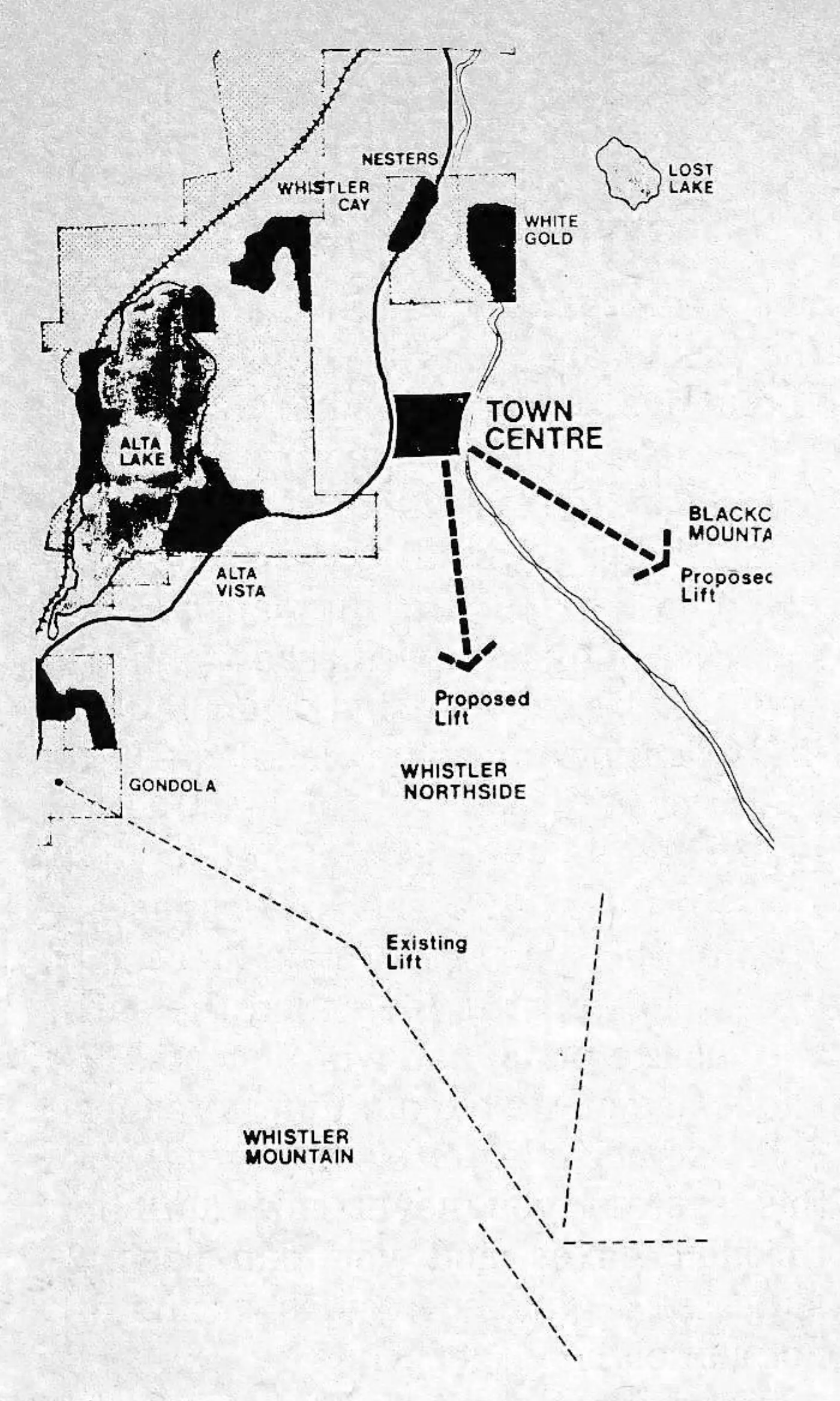
Following the success of helicopter skiing in British Columbia, the provincial government is pursuing the development of a major destination resort complex on Blackcomb Mountain just north of the Whistler Mountain. Because of the long and reliable snow season and a skier growth rate of 18 per cent a year in British Columbia, the prospects for the new ski resort are considered excellent. The only hitch, so far, is investment money.
The potential ski slopes have been assessed by Sno engineering with the conclusion that, “The Blackcomb Mountain site offers excellent ski development potential. It possesses downhill terrain meeting the demands of each particular skier grouping, thus permitting the design and construction of balanced skiing facilities to adequately meet the requirements of the skier market and provide for every skier’s recreational needs.”
The ski slopes proposed offer approximately 4,000 vertical feet of predominately intermediate skiing. The upper slopes include sub-alpine skiing as well as potential glacier skiing. Combined with the present Whistler lift facilities, the estimated ultimate uphill capacity is 10,500 skier per day. One proposal calls for more than a dozen lifts.
The estimated total development costs are $15 million, including base and mountain servicing requirements. It is expected that the project would be phased in three to five development stages over 10 to 15 years.
Eventually the plans call for overnight accommodations for about 2,000 persons in hotels and other lodging facilities, and housing for about 750 permanent residents. There are also plans for eight to ten restaurants and roughly a dozen shops and other buildings.
The Whistler-Blackcomb development complex plan began when the Whistler Mountain region was reorgnaized as a special resort municipality and elected a local council. Last summer, with the help of federal and provincial funding, the resort municipality installed a sophisticated sewage treatment plant and trunk system at a cost of over five million dollars. A community development plan calling for concentrated public accommodation located near the ski lift base areas has been approved by the local council and the provincial government. The Department of Environment then officially called for development proposals for a major new resort located adjacent to Whistler on Blackcomb Mountain.
Subsequent to the Blackcomb Proposal Call, the provincial government announced plans for the release of provincial lands at the foot of Blackcomb and Whistler Mountains for the development of a new town center. This land had been held by the government for the site of the Olympic village for the unsuccessful 1972 and 1976 Olympic Games bids. The land will be serviced by the Housing Corporation of British Columbia and leased to private investors through bid proposals with a purchase option. The new town center has been approved and endorsed by the local and Provincial Governments.

“We plan to make it easy for long term developers and investors to build ski and related facilities,” says Al Raine, coordinator of ski development and former head coach of the Canadian ski team. “The various approving agencies have previously not been able to coordinate their efforts to quickly and efficiently meet the public objectives, but we are now getting organized to better handle development proposals.” Many of the planning studies and assessments normally required with ski hill development have been completed and it appears as though the only missing link is a substantial long term investor for Blackcomb Mountain. Raine is confident that this problem will be answered as the terms are favorable and because U.S. developments are becoming bogged down with environmental and conservation debates and long delays. He says the interest to date in Blackcomb and the town center is running very high according to the development planners.
The benefit of coordinating the ski-interested government agencies will be felt across the province. “Our policies recognize the need for base development associated with ski facilities,” says Raine. “The new policy should give the ski lift developer control and access to the use of land near and related to his operation.” Government officials hope that the success at Whistler will provide incentive for other ski operators across the province.
Part of the government schemes emphasizes the need for master plan studies and guidelines for environmental and resource management evaluation; however, Raine suggests that the master plan is a conceptual master plan and the environmental considerations are reasonable and will not restrict good development.
In a province with a 140-to 190-day ski season, great snow conditions and big mountains, the optimism is high. British Columbians feel they have produced world class skiers and now the challenge is quality resort development for vacationing skiers. While the development may be several years away, the plans and initial start-up development is now firmly underway.
Heritage Mountain
A new Utah resort is poised and ready
by Mike Korologos
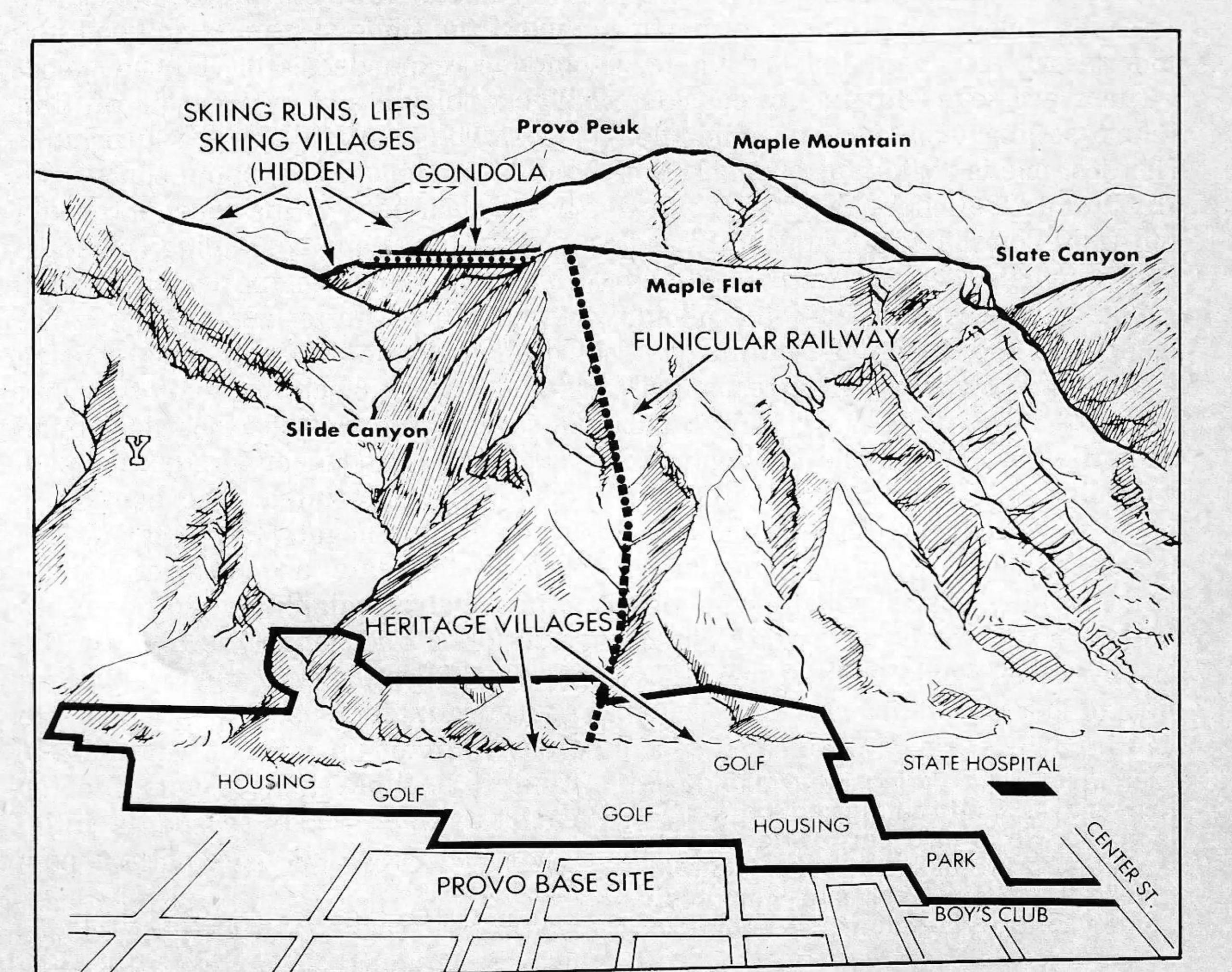
With a green light from the U.S. Forest Service in hand, Utah’s Wilderness Associates are going after another kind of green — like that on U.S. currency — in an effort to open a major ski and recreational complex in the mountains east of Provo.
Last fall the Forest Service approved a modified version of the resort project. Since then, two individuals have requested reviews of the permit issuance. One of these challenges has been disposed of; the other is expected to be, and in time to permit at least some skiing in the 1978-79 season.
The original 7,500-acre development proposed by Wilderness Associates in Uinta National Forest was reduced to 4,500 acres in Rock and Slide Canyons before the permit was allowed. Development of 3,000 acres in Slate Canyon was rejected, according to Forest Supervisor Don Nebeker, because of soil conditions, slumping shale, watershed threat, avalanche potential and disruption of peregrine falcon habitat.
With receipt of approval from the Forest Service, project principals began intensive planning and financial search. Initial development money was all raised locally in Utah, according to Norman L. Nielson, vice president of Wilderness Associates, and well over a million dollars has already been spent. Mostly on impact statements and land acquisition.
“After construction begins, it will take 18 months to two years for completition of the first phase,” says Nielsen. “That includes cultural village at the base of the mountain, the funicular railway up the mountain and the construction of Maple Flat and three other villages.”
Nielsen said he was disappointed about rejection of Slate Canyon plans, but that was scheduled as a later, ultimate development, adding that the loss of that land was not critical to the overall development. Nielsen said cost of the total project, originally set at $100 million, may be down to $90 million.
In addition to trimming $10 million, loss of Slate Canyon to the project will reduce capacity from the original 10,500 skiers per day to about 8,000, said Nielsen. The 8,000 figure is the project’s ultimate capacity and it won’t be achieved for about 12 years.
Facilities in the 186-acre base village will include three Heritage Villages with 500 hotel rooms, housing, a golf course and other entertainment facilities. This area caused principals to change the name from the original Four Seasons Resort to Heritage Mountain.
A 6,310-foot long funicular railway, placed on risers anchored to the mountainside at intervals, rather than cutting railbed into the mountain, will run from base village to Maple Flat, focal point of the mountain facilities. From Maple Flat Village a six-passenger gondola system, 2.5 miles long, will transport skiers to and from three other separate villages named Cascade, Knoll and Lion Saddle. Maple Flat will include overnight facilities, ski lodges, restaurants, commercial shops and related facilities. The other villages, with emphasis on daytime activities, will be less developed and have no overnight accommodations. Five double and one triple chairlift also are on the drawing boards.