The ski industry has caught the eye—and the ire—of the Occupational Safety and Health Administration (OSHA), and ski areas should not be surprised.
Over the past 18 months or so, ski areas from California to Colorado to Vermont have experienced OSHA’s Site-Specific Targeting program, which includes so called “wall-to-wall” inspections. The increased scrutiny comes as the ski industry continues to record high rates of workplace injuries, both in frequency and severity, at operations ranging from small ski areas to large destination resorts.
From 2018 through 2024, the ski industry consistently ranked among the top 10 industries with the highest rates of nonfatal occupational injuries in the United States. In 2024, its DART rate—days away, restricted or transferred, a key OSHA measure of injury severity—was the second highest of any industry in the country.
Thus, OSHA’s current scrutiny has been a long time coming. The industry has known about its injury rates for at least a decade, and most longtime ski area employees know coworkers who have suffered serious or even catastrophic workplace injuries. Some have lost friends and colleagues on the job. The wake these tragedies leave is immense, and far more impactful than the resulting citations from OSHA.
But, oftentimes, when OSHA does show up, it isn’t focused on the exposure that helped put the industry on the agency’s radar, i.e., skiing and snowboarding incidents. OSHA inspectors tend to look at the same maintenance activities and standards that are common across all industries: lockout tagout, machine guarding, employee training, electrical systems, personal protective equipment, hazard communication, and so on.
That gives ski areas a fairly clear roadmap for where to start making safety improvements.
Know the Standards
Much of the general industry standard applies to the ski industry. There is no specific standard for skiing and riding, and OSHA has this covered with the General Duty Clause, which states: “Each employer shall furnish to each of his employees employment and a place of employment which are free from recognized hazards that are causing or are likely to cause death or serious physical harm to his employees.”
That may sound like a difficult standard to reconcile with an industry built around inherently risky activities. But there is plenty ski areas can do to mitigate the frequency and severity of employee injuries while improving understanding of and compliance with OSHA standards.
Since 2003, according to the U.S. Department of Labor, ski areas have been cited by OSHA 208 times. (The fine amount, safety standard, level of citation, and in many cases the specific findings, are all publicly available from OSHA.) In ranked order, the most commonly cited standards include electrical systems, lockout tagout, machine guarding, personal protective equipment, and hazard communication.
Understanding what happens during an OSHA inspection is important. More important is making sure a resort’s safety and compliance programs are sound before an inspector arrives.
The National Ski Areas Association Risk & Education Committee is working on a long-term program to help ski areas improve safety and compliance, with a lot of help from ski areas that have experienced inspections and citations. In the meantime, here’s a breakdown of some basic requirements for the ski industry:
1. Understand Which OSHA Standards Apply
OSHA regulations and standards apply to all employers “engaged in a business affecting commerce who has employees …” For most winter and summer ski area activities, CFR 1910 general industry standards apply. Construction activities outside of routine maintenance are governed by CFR 1926, OSHA’s construction standard.
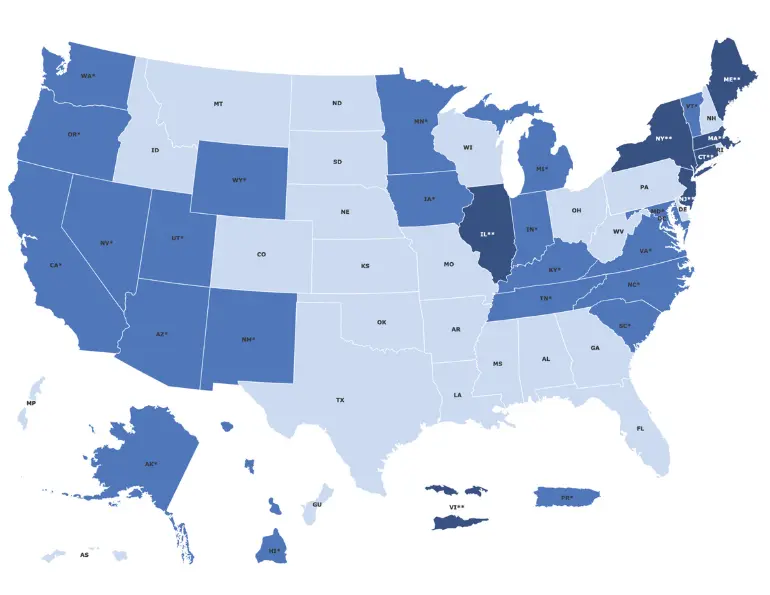
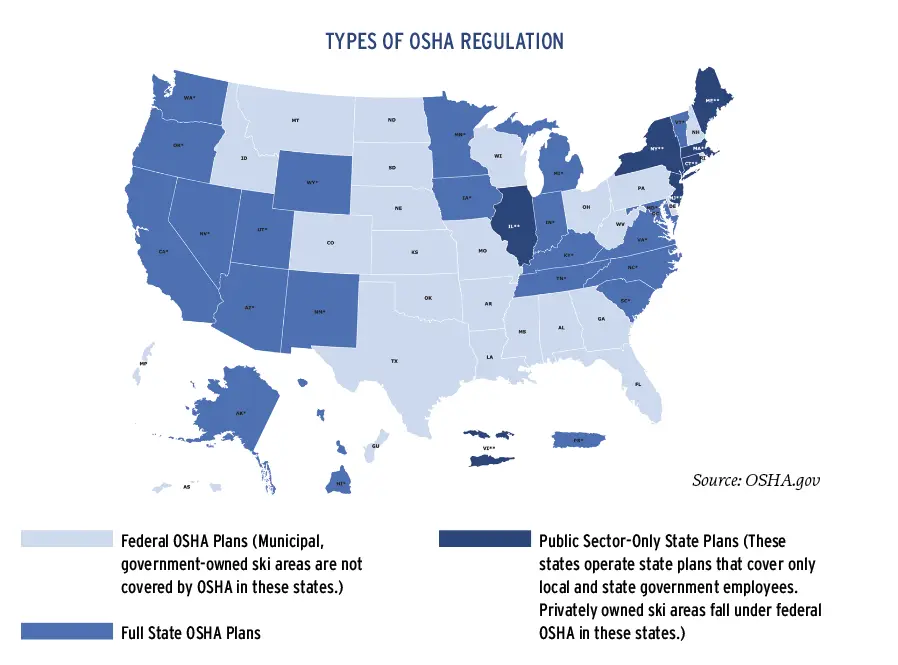
Ski areas should also know whether they operate under federal OSHA, a state-administered plan, or a hybrid program (see map, below). State plans must meet the minimum federal standards or exceed those federal regulations. California, Vermont, and Minnesota, for example, have additional regulations that can, and do, impact ski areas. » continued
2. Know Your Reporting Requirements
Regardless of size, employers must notify OSHA within eight hours of a work-related fatality and within 24 hours of any work-related in-patient hospitalization, amputation, or loss of an eye. Some state plans, such as Washington and California, have stricter requirements.
Federal OSHA reporting can be done at www.osha.gov/report or 1-800-321-OSHA.
3. Keep Accurate Records
Employers with more than 10 employees are required keep on file records of occupational injuries and illnesses, including:
a. Form 300: Log of Work-Related Injuries and Illnesses
b. Form 300A: Year-End Summary of Work-Related Injuries and Illnesses
c. Form 301: Detailed Injury and Illness Incident Report
The completed Form 300A from the previous year must be posted from February 1 to April 30 and certified by a company executive.
Establishments with 250 or more employees must electronically submit their Form 300A annually by March 2.
OSHA does not distinguish between full-time, part-time, or seasonal staff for recordkeeping requirements: “Each individual employed in the establishment at any time during the calendar year counts as one employee, including full-time, part-time, seasonal, and temporary workers.”
4. Conduct Hazard Assessments
OSHA requires employers to “assess the workplace to determine if hazards are present, or are likely to be present, which necessitate the use of personal protective equipment (PPE).” With few exceptions, PPE must be supplied or paid for by the employer.
Job hazard analyses (JHAs) can go further to identify not just PPE needs, but controls, barriers, and procedures needed to help protect employees and mitigate potential hazards.

5. Train—and Document It
OSHA addresses training requirements within some specific standards. For example, the 1910.1200 hazard communication standard requires that employees be trained “at the time of initial assignment and whenever a new chemical hazard is introduced.”
Identify the hazards and training applicable to each job and train employees. Document all training.
6. Write-Out Programs and Procedures
Some OSHA standards specifically require written programs and procedures. Lockout tagout, 29 CFR 1910.147 the control of hazardous energy standard, is one example that “requires employers to establish a program and utilize procedures for affixing appropriate lockout devices or tagout devices to energy isolating devices.”
Develop written safety programs that cover procedures specific to OSHA standards and hazards that are present at your ski area. Hazard communication, bloodborne pathogens, emergency action plans, respiratory protection, and confined spaces are common OSHA standards that apply to ski areas and require written programs.
7. Involve Employees
A safety program written without input from the people doing the work is less likely to succeed. Employees that have high hazard jobs need to buy into the safety program and their insights are just as relevant as management’s input. Involve them in the sausage making.
8. Learn from Incidents, Near Misses, and Successes
Do not let incidents and near misses, especially high consequence scenarios, go to waste. Be curious about what happened, identify what can be learned, and follow through on corrective actions. Apply the same level of discipline to examining your wins—what worked and why.
Document and track your findings so lessons translate into operational changes rather than disappearing once the immediate scenario has passed.
9. Focus on High-Hazard Work
Regular work for ski area employees involves significant energy and forces, whether that is working at height, skiing/riding, lockout tagout, or confined spaces. Where practical, look for barriers and engineering solutions to isolate employees from the hazard—a key tenet of any risk management program.
10. Start with Leadership
There is one ingredient that influences the safety performance and culture of an organization more than any other: leadership.
A meta-analysis published in Frontiers of Psychology reviewed 35 studies focused on the impact of leaders on safety leadership, safety climate, and safety participation. The analysis found that transformational leaders have the most influence on safety climate and safety participation versus transactional and passive leaders. Simply put, leaders who inspire and communicate the value of safety to their employees and hold themselves accountable get better results.
For ski areas, that means leaders should be asking hard questions about how work is performed—including when, how and why employees ski or ride for work—and holding themselves and their managers accountable for improving processes rather than simply assigning blame after an incident.
If safety and risk management are treated as a business imperative, and leaders show and demonstrate sincere care and concern for their team, the resulting performance is typically better than average.
Consider Reaching Out to OSHA
One resource ski areas may overlook is OSHA’s On-Site Consultation Program. The agency provides free consultation, primarily for smaller employers, through state agencies and universities. The voluntary inspections are confidential, separate from OSHA enforcement and do not result in citations or penalties. Employers are obligated to fix any serious hazards within the timeframe set by the consultation, though, and if those deadlines are not met, the consultation service must notify OSHA enforcement.
The program is targeted to employers with 250 or fewer employees. Ski areas of that size have often found these consultation programs remarkably helpful. Layne Anderson, general manager of Powder Ridge in Kimball, Minn., used Minnesota’s OSHA consultation program several years ago and found the experience constructive.
Inspectors reviewed the ski area’s training records and provided recommendations related to equipment training and documentation. They also provided insight on “homemade” equipment—i.e., equipment that isn’t engineered and fabricated by a reputable manufacturer and which may present compliance concerns—and educated staff on other basic compliance matters.
Anderson believes safety starts at the top. “I don’t want to have anything happen on my watch; it’s family here,” he said, and a voluntary consultation helped him to walk the talk. He plans on inviting the inspectors back because he wants to make sure his team remains compliant and safe.
No Finish Line
OSHA compliance can feel overwhelming, particularly for an industry with significant operational risks. The NSAA Risk & Education Committee is developing resources to help ski areas improve safety and compliance, but resorts don’t need to wait for those resources—or for an OSHA inspector—to start.
Ski areas cannot eliminate every workplace risk. But they can examine how work is performed, identify recognized hazards, strengthen training and documentation, involve employees in developing safer processes, and hold leaders accountable for following through.