
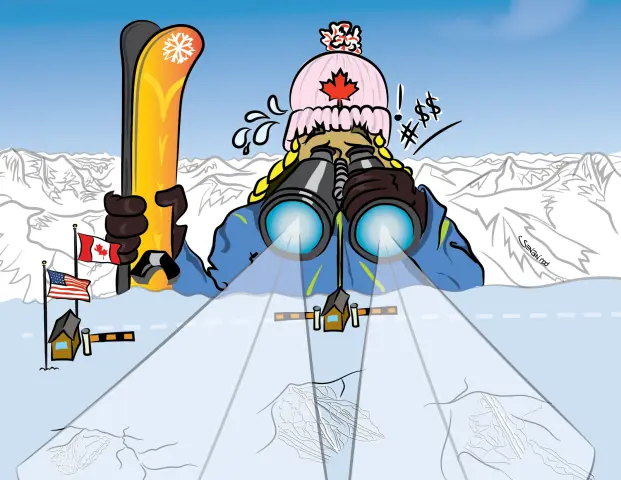

Whether it’s lobbying on Capitol Hill, taking on the huge environmental lobby out in the hinterlands, educating members on environmental compliance, or promoting good environmental management practices, ski area operators across the country said over and over that the environment is the one area where they need the most help from NSAA — and is the one area where the newly reconstituted NSAA can help them the most.
“We need help on the environment,” said Tom McAllister, vice president and general manager of Saddleback ski area in Rangeley, Me. “We have environmental groups that are opposing everything we want to do. Despite the fact that Saddleback owns 100 percent of its land, and that an expansion plan by the area has been approved by the state land-use authority, the area has been unable to proceed with the plan because of opposition from several environmental groups.
“These are national groups,” McAllister said. “We’ve spent thousands and thousands of dollars trying to get this plan through. I think a national organization can fight back better than we can. And I know other ski areas are having the same trouble.”
For Stewart Collins, assistant general manager at Bretton Woods, N.H., the major environmental issue confronting his ski area is environmental compliance. “These regulations are open to so much interpretation,” Collins said. “We can’t possibly do the research on all the EPA and federal regulations and guidelines ourselves. The most important function NSAA can provide for us is as an outlet of information on these regulations.”
For many western ski areas, the environment — particularly the National Forest Service fee structure, the Endangered Species Act, water use and allocation regulations, and wetlands protection, among others — is also the topic of the hour. These areas, too, are looking to NSAA for help and leadership.
“The national organization has to concentrate on government issues in Washington,” said Larry Shake, general manager of Brundage ski area in McCall, Id. “NSAA needs to get more involved on a national level with ASF. We need to lobby our congressional delegates that the ski industry has some very important concerns on these environmental issues, and that we need to be considered when decisions on these issues are made.”
Washington Clout
“Lobbying Washington is where NSAA can help us the most,” agreed Michael Somma, general manager at Loon Mt., N.H., which is about 85 percent located on National Forest Service land. “As a region or a state we don’t have the same clout in Washington that a national organization has.”
“One of the main reasons I belong to NSAA is because I need a voice to speak for me on these big issues in Washington,” said Jim Bartlett, president and general manager of Nubs Nob in Harbor Springs, Mich. Bartlett noted that in addition to environmental regulations coming out of Washington, other important legislation affecting the ski industry, such as general liability and workers’ compensation insurance rules and regulations, are also written in Washington. “There are things that we can do as a national organization that we can’t do as individual ski areas to influence some of these operational expenses that every area has,” Bartlett said.
Bob Kuusinen, vice president of operations at Steamboat Springs, Colo., believes NSAA also has to take the leadership role in influencing good environmental management practices throughout the industry. “We absolutely have to be environmentally sensitive,” Kuusinen said. “The future of our industry depends on it.”
Where the environment is a factor most agree on as a priority, marketing and the role of the NSAA continues to be the issue that most divides members. For Dave Moffett, president of Ski Lifts, Inc., which owns four ski areas in Washington state, marketing is “way down the list” of priorities for NSAA. “I don’t think marketing should be playing a big part in NSAA right now,” said Moffett, adding that the National Forest Service fee structure is the most vital issue facing NSAA right now.
At Timberline, Ore., area operator Jeff Kohnstamm agreed: “We don’t need any more high fallutin’ ‘Ski it to Believe It’ marketing campaigns. One of the troubles with USIA was that we spent a lot of money on skiing but not much on ski areas. NSAA needs to concentrate on a few issues that relate strictly to the ski area business, that only ski areas have.”

Marketing Top or Bottom
For every area operator listing marketing at the bottom of his list of priorities for NSAA, however, there is another one putting it at the top of his list. “Overall, NSAA has got to concentrate on getting more skiers into the sport,” said Paul Maloney, vice president and chief operating officer at Jiminy Peak, Mass. “Marketing has to be done at the national level.”
Small areas in particular said they wanted help from NSAA on marketing. “NSAA has to come to terms with the fact that there are many more areas the size of Hidden Valley than Sunday River or Killington,” said Ken Caffrey, Jr., director of marketing at Hidden Valley, N.J. “Small areas need help from NSAA on co-operative advertising, grant money for starting new programs.”
The concept of “matching grants” from NSAA to individual ski areas or regional associations to help start new programs or finance advertising campaigns is generating a lot of enthusiasm from many members.
Dave Moffett, however, who sits on the NSAA board, says flatly that NSAA “doesn’t have the budget for that.”
Tim Cohee, president of Kirkwood, Calif., says the role of NSAA on the marketing issue is to provide leadership — not necessarily money.
Cohee pointed to the already existing television forum skiing has on ESPN with professional ski racing and called for an industry-financed promotional campaign similar to ones by professional basketball and baseball. “There’s an existing venue to reach people,” Cohee said. “We should be promoting skiing within this existing schedule. It doesn’t take a lot of money to do this. It takes thousands of dollars, not the millions we tried to raise before.”
Cohee said the NSAA needed to provide leadership on this issue, but that the 50 largest ski areas had the responsibility to bankroll a campaign. “I’m in that group,” Cohee said. “I’m ready to kick in my share.”
Satisfying an industry as diverse as the ski industry is not going to be easy for NSAA. But at least it won’t be dull.