
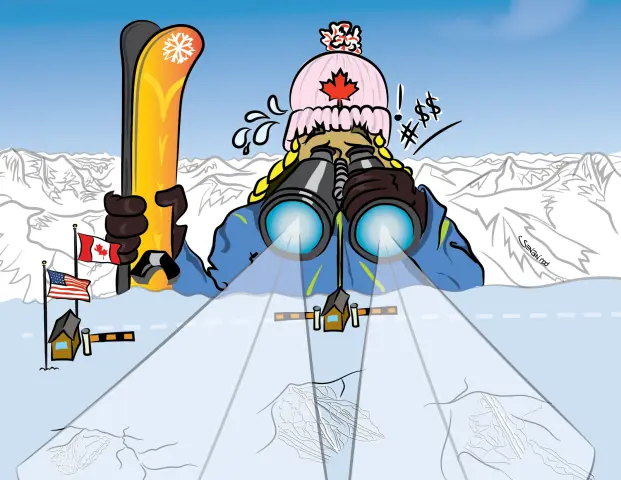

A Massachusetts operator became panicky when he calculated his net profits for the ski season; he hadn’t planned enough projects to avoid a huge tax bite on the windfall. In Utah, operators sheepishly reported a foot of new snow; they knew their rocks were two feet and more.
West Virginia was reported to have the best skiing in the U.S. during one week in January with three to six feet of snow on the ground. About the same time, Rockies resorts were pleading with the press for a more accurate portrayal of their conditions, boasting of recent snowfalls three to five inches deep.
As the Ohio River froze, skiers in Iowa were taking their vacations on local hills that were deep in machine-made snow. In the Sierra Mountains, frantic coaches searched for patches of artificial snow on which to hold major international races.
What went wrong with the weather this past season? How can the aberrant behavior of the climate be explained?
Climatologists say that the normal pattern is for warm air to move from the Pacific northward up the West Coast, then turn inland over Canada, moving sharply south bringing cold air with it. Such patterns usually last a few days and then allow the more usual west to east flow of air to continue. However, this past winter, the north-south loop of warm air was much sharper than usual, going farther north and bringing down colder air farther south. This strange pattern also lasted longer than is normal causing colder temperatures to linger.
Hurd C. Willett, Ph.D., professor emeritus of meteorology at M.I.T. and favorite forecaster of the ski industry, maintains that what happened was to be expected over a period of years and these trends may even continue for two more winter seasons. His educated guess, based on statistical studies of long solar climatic cycles, is that next year will be cold, but not quite as cold as this year and that there will be more snow in the West; but the winter after will be very cold again. Willett emphasizes that this three-year “cycle” is a minor up and down which in broad terms cannot be called a forecast. He also admits that his forecast for this past winter, which called for severe early and late weather in the East with a severe mid-winter condition in the West, missed the mark in one respect, “The break in the East didn’t occur until late winter,” he says, “while the West began to get snows at that time.”
So much for forecasting. But, if you think you had it bad — or good — take a look at how some of your neighbors fared. — J.N.
California
Balmy north, snowy south
by Robert Lochner
Sierra ski area operators bade farewell to the 1976-77 season without tears, and in fact, most of them were heard to mutter, “Good riddance.!”
Perhaps the only resort sorry to see this winter end was Ski Incline, on the Nevada side of Lake Tahoe. Thanks to the urging of Luggi Foeger back in 1966, the compact, well-designed area installed snowmaking equipment on a couple of its lower runs, and with good timing expanded the operation last summer. As a result, it was the first to open, in November, and attracted capacity crowds while virtually everyone else remained closed until after New Year’s.
Boreal, on Donner Summit, hurriedly put in snowmaking midway through the Christmas holidays and was able to salvage some of its lost revenue, then provide relatively good skiing despite only marginal natural snow-cover for the remainder of the season.
Overall, however, ski business in the Sierra was down at least 50 per cent from the previous winter, which was no record-breaker either due to skimpy snowfalls.
The total loss for the two-week Christmas-New York holiday period on lifts, lessons and rentals alone was estimated at $10 million by Bob Roberts, executive director of the Sierra Ski Areas Association.
“Ski Incline and Boreal both fared well because of snowmaking and the fact they cater to beginning and intermediate skiers who are happy with what they can get,” he said. “But more accomplished skiers had few places to go, and when you have Mammoth Mountain running only four lifts and Heavenly Valley only five for much of the season, the big numbers are going to be down.”
John Buchman, president of Squaw Valley Ski Corporation, estimated his area would end the season about 50 per cent below last year. Alpine Meadows indicated it was running at about 60 per cent of its 1975-76 pace through the end of February. Hugh Killebrew, Heavenly Valley’s managing partner, said, “We’ll be below that (Alpine’s) figure.”
Squaw, like most Sierra resorts, didn’t open until January 1, when the first big storm arrived, and as a result, an estimated one-fourth of its anticipated total seasonal revenue went down the drain right there, during the previous two weeks.
There was no additional snow that month, and a light storm in early February merely covered up portions of the rocks.
Several areas, including Dodge Ridge, closed during this period, then reopened when about two feet of snow fell just as the Washington’s Birthday weekend was ending. Mt. Shasta, however, never did operate and gave season-pass holders a rain check (or no-snow check) until next season.
Sugar Bowl did not release any figures, but Roberts said, “They managed to move their snow around and continue to attract skiers, so I think they came out okay. At least that’s what I infer from the rapidity with which they paid their association dues.”
By the first of March, conditions were finally being rated “very good” on two to five feet of snow throughout the Sierra, but the big question was whether skiers had decided to give up and wait until next year. Many did just that, turning to tennis and sailing as the weather remained balmy in San Francisco and Los Angeles. Heavenly Valley, at least, noticed an immediate upsurge and reported attendance averaging about 6000 per day on weekends, 3000 midweek.
Southern California areas, which have traditionally relied more on snowmaking, received a couple of storms that bypassed the north and were able to operate consistently from mid-December on. By March 1, both Snow Summit and Snow Valley reported in excess of 200,000 skier-days thus far.
Pacific Northwest
Too little, too late
by John Hoefling
The Pacific Northwest is usually the land of the early and deep snows. But not this ski season. A drought wiped out the region’s normal mid-to-late November openings, and continued into the heart of the season.
Some areas, such as Timberline Lodge and Mt. Hood Meadows, Ore., Mt. Spokane and Mt. Baker, Wash. managed to get limited operations underway just before Christmas on marginal snow conditions. A few others picked up two or three days to three weeks of operation in January. Then the lifts ground to a halt, with Timerline the only major area barely able to maintain some continuing semblance of operation.
Timerline’s Dick Kohnstamm said it was the latest start for Mt. Hood in 17 years. At Sno-Country Stevens Pass, 90 miles northeast of Seattle, it was the first time in 40 years that skiers were unable to get on the slopes there by Thanksgiving.
The economic damage had been done. Losing Thanksgiving week revenues was the starter. This, compounded by the Christmas-New Year’s week of little or no operation and business, gave rise to early loss estimates in the $12 to $15 million range, according to Mel Borgerson, executive director of the Pacific Northwest Ski Areas Association. This represents 25 per cent of a season’s income.
These figures probably doubled after January and February. The impact on mountain towns and areas has also been disasterous, coupled with the rise in unemployment of ski area personnel.
In Bend, Ore., the Chamber of Commerce estimates 54 per cent of the dollars spent there in the wintertime are skier oriented. Mt. Bachelor is located 21 miles from Bend, and draws over half of its business from out of the local area. Bachelor President Bill Healy proved to be a prophet when, on January 21, he was optimistic about the future. After just quoting 1976-77 revenue losses of $681,000, he said, “There is still much winter to come.”
On February 21, winter finally did come to the Pacific Northwest. Washington’s Birthday, a traditional mid-point of the ski season, found snow falling in measurable quantities in the region. Depths did not return to normal, but most areas were able to begin operating at least a portion of their uphill facilities.
Operators were not able to recoup any of the losses suffered during the high-use holiday periods, but this ‘late’ snow did permit them to at least remain in business, though Mt. Hyak Corp. of Snoqualmie Pass had to go to federal bankruptcy court for help in finding ways to pay off their $2.7 million in debts.
The snow gave Oregon’s Mt. Ashland ski area at least a reprieve from their previously planned March 1 cessation of operations. Unable until then to operate even one day, a community involvement program had raised some, but not enough, operating funds.
Ski industry reps met with governmental bureaus in hopes of gaining federal disaster assistance, but, in the absence of physical damage, U.S. officials could not give even hope of area operators obtaining low-interest loans through the Small Business Administration.
The question of installing snowmaking equipment has been studied by some areas, reports PNSAA’s Borgerson. It was generally felt that the high costs of installation could not be justified in light of the fact that if it is cold enough to manufacture snow, it would usually snow in the Northwest anyway. However, Anthony Lakes manager Mike Lockhart experimented with an agricultural-type irrigation sprinkling system. With three inches of snow on the ground, “The sprinklers worked good and saved the base,” he said. It actually formed an icy base, which firmly held the later minimal snows. This permitted the area to operate one of it’s lower slopes all of January.
As of March 1, both Oregon and Washington began cloud-seeding operations, in hopes of easing the effects of the drought on ground-water levels. These three-month pilot programs will probably be of little use to the ski areas though, according to the weather experts.
Mountain snowpacks are the slowest in recorded history in Washington. Oregon snow surveys show the pack ranges from zero to 25 per cent of normal at 50 different locations around the state.
The Rockies
Drought—then reprieve
by Charlie Meyers
The Rocky Mountain story is one of an unprecedented drought until late February when a series of storms finally brought superb skiing conditions. At presstime it was too soon to tell to what extent this snowy reprieve would affect overall business, but if nothing else it dispelled a lot of gloom. Some areas were downright optimistic, and happiest of all were those areas like Steamboat, Powderhorn and Sunlight which were finally able to reopen.
At most Colorado areas, the surprise was how well the market held in the face of adversity. Using grooming techniques designed to nurture every snowflake, resorts maintained acceptable skiing for much of the new year.
The major problem was the almost total loss of the December season except at those few areas which have major snowmaking facilities. At Aspen, the giant Aspen Skiing Corp. lost a staggering $4 million in revenues by January 1. But by February 10 the town was running about 60 per cent of normal occupancy and overall season lift sales had gained to within 50 percent of the previous year. The late February storms brightened the picture still further and 70 percent of the record levels of 1975-76 were projected.
The winter began with a meteorological quirk which had the normal storm paths missing the mountains completely.
Mild, cloudless days followed in maddening succession. In Aspen, locals were basking shirtless on park benches during the Christmas holidays. After that, things got even warmer. There were gallows humor suggestions that ski areas might cut down trees and install beaches.
Precipitation in the Colorado mountains was at record lows, about a third of normal. Elsewhere, things were worse. As of February 10, Sun Valley reported only 20 per cent of normal snowfall; Snowbird had a 29-inch base where it normally would be in the 80s or 90s.
About the only major resort to receive much snow was Jackson Hole, which credited a cloud seeding operation for a bounty of five feet during the first three weeks of January. But Jackson didn’t see a cloud to seed for weeks thereafter.
The Wyoming resort also affords one of the real puzzles amid all the frustrations the drought offers. Despite the fact that it was one of the very few which had excellent January skiing, visitors stayed away in droves. Through February 9, the area had logged only 12,000 skier days as compared to 45,000 the previous season.
“We were dragged down by all the negative reports on the Rockies in general,” lamented Jackson’s Bruce Nurse. “We were booked solid for the week of February 5, but cancellations brought us down to 25 per cent—and we had good snow.”
The story in Vail was more encouraging. After a soft December and holiday season, the resort rallied to about 65 per cent of the 1976 totals through January. Even better, it was operating at 80 per cent of the previous season in early February, and by the end of the month had returned to old times, complete with lift lines.
Copper Mountain, just 80 miles from Denver, was missing its usual high volume of local skiers, with only 20 per cent in January compared to a “normal” 70 per cent. Despite that, Copper fared better than most, and the almost 9,500 skiers for the weekend of February 26-27 showed that the locals had rejoined the party. Projections for the final season figures looked very promising.
Breckenridge, another area which depends largely on Coloradan skiers, was hit hard. On February 9 area manager John Rahm was reporting from 1 to 8 inches of snow on its runs, resulting in just 25 per cent of the previous year’s skier volume. But again, the late February storms allowed for a rebound, and Breckenridge started logging 4,000 weekend days and 3,000 weekdays. Dave Williams, Breckenridge’s marketing director, also reported heavy March and April tourist bookings.
Snowmaking loomed large in Colorado, and accounted for most of the early success stories.
Keystone was so swamped during the holiday season when it had perhaps the best snow around, that it initiated limited lift ticket sales (5,000) to protect itself from the certainty of rampant overcrowding.
Although things had leveled out a bit through January, Keystone still remained 38,000 skier days ahead of pace, and realized no real upsurge from the late February snows.
Winter Park, which installed $1 million in snowmaking just prior to the season, also showed early gains—up 60 percent from November 13 to December 15. But a lag in total use of the mountain in January leveled things off to a net 18 percent decline compared to last season. Late February business brought this gap down to 16.5 percent.
Curiously, none of the ski areas which installed major snowmaking facilities did so with an eye toward the present utilization. At Keystone, which in its history has experienced thin snow depths on its lower mountain, it was considered “base insurance,” a means of keeping its runs uniformly covered. Loveland, with its ability to retain snow, could gain a few weeks at the start of the season. Winter Park, too, was motivated chiefly by the desire to open earlier.
But now, following a traumatic drought year, and with forecasts of more drought in the future, Rocky Mountain operators are looking at machine-made snow in quite a different light. Because of such irretrievable revenue losses as that at Aspen and $1 million at Snowbird, snowmaking now is viewed as a season-saver—a bargain whatever the price.
Winter Park already had announced plans for an additional 84 acres of snowmaking next season, but now is on the brink of expanding that even further. And Copper Mountain has signed a contract for a $30,000 engineering study preliminary to a possible entry into the snowmaking sweepstakes.
The Aspen Skiing Corporation has announced plans to install an $800,000 snowmaking system on the lower half of the face of Buttermilk mountain. According to Tom Richardson, vice president and general manager of the corporation, the man-made snow system will cover the 70 acres serviced by the two beginner surface tows, the No. 1 chairlift, plus the approaches around the base of the No. 2 lift.
“Even if there is no natural snow in the late fall, this system, with normal fall temperatures, would allow us to guarantee opening of the 35 acres on the beginner slopes by Thanksgiving, and the additional 35 acres to midway by December 10,” Richardson said.
Richardson also said that the system will be designed so that it could be extended to the top of the mountain in the future.
“The decision to make snow at Buttermilk rather than Snowmass or Aspen Mountain was governed conjunctively by water supply, economics and noise” Richardson said.
Steamboat, previously had included snowmaking in a five-year plan and President Glen Paulk said the area would not accelerate its timetable.
Cloud Seeding
by Charlie Meyers
The situation was much the same. The storm centers which passed far north of Colorado for much of the ski season also were missing Jackson Hole, Wyoming. But Jackson acted quickly to do something about the problem. In Colorado, action came more than a month later — perhaps too late.
That something was to embark upon a weather modification program, cloud seeding if you will. Faced with a holiday season without snow, Jackson contacted Colorado International Corporation, which in turn engaged a second Colorado firm, Geophysical Research and Development Corp., to provide weather forecasting.
Jackson President Paul McCollister credits the modification effort for much of what happened next: five feet of snow within the first three weeks of January.
In Colorado, meanwhile, there was much talk of seeding, but no action came until late January. Then it perhaps was the overall concern over potential summer water shortages which prompted the state to act. On February 4 the Colorado Legislature agreed to spend $252,000 on an emergency cloud-seeding program over three broad areas in the Colorado Rockies.
But a week later there still was no snow bounty in the state’s mountains — for the same old reason: There simply had not been a suitable storm system as the ski areas basked under sunny skies.
“I don’t care how much money they spend,” one area operator lamented as the drought wore on, “you can’t make snow unless you have a few clouds.”
The verdict still was out on the effectiveness of cloud seeding in the wake of the season’s heaviest snowfall in Colorado during the week of Feb. 21-26. Seeding practices were employed during the storm and the weather modification technicians naturally claimed credit for the intensity of the storm which dropped up to 30 inches over a six-day period. But there really was no way to prove the claim, particularly since certain areas which received heavy snowfall were well outside the seeding area.
One thing was certain: no one complained in the least, and with more snow on the way, happiness reigned over the Rockies for the first time all season.
The Midwest
Frigid, but profitable
by Teddee Grace
In spite of the coldest winter in more than a century, aggravated by spotty snow conditions in some areas, most midwest ski areas enjoyed a better-than-average season and some set attendance records. Ski area managers noted that many midwesterners who normally head west for the Christmas and New Year holidays skied at home; and mid-week business, a slack time for most midwestern resorts, increased 12 to 25 per cent. Most area spokesmen, however, did not attribute improved business entirely to the snow drought in the Rockies, crediting exceptional natural and machine-made snow in the Midwest as well as aggressive marketing programs with some of the increase.
Typical of Michigan areas, which were blessed with the best snow conditions in two years, was Schuss Mountain, where more than 200 inches of snow had fallen by February 22, with business up 9 to 11 per cent overall, according to Scott Stillings, director of marketing. Midweek business showed a 12 to 15 percent increase over the previous season. Ticket sales at the area were up 25 per cent as of the week before Christmas and the holiday period was a record breaker.
“It was our best holiday season ever,” says Stillings. “Much of that was due to lift ticket and lodging price increases, but restaurant business was up 25 to 30 per cent over the holidays and that was entirely increased volume. I think the literature distributed at the fall ski shows came into play when midwestern skiers started looking around for an alternative to the West.”
Although Stillings attributes early season increases directly to lack of snow in the Rockies, he thinks that overall the record season at Schuss is the result of a very good snow year and more effective marketing.
The story was similar all over Michigan. At Caberfae General Manager Dennis Johnson reported a 50 per cent increase in lift ticket sales as of January 1, attributing it to the early season and good snow. “We opened three weeks earlier than normal and had 120 inches of snow in December compared to about 60 inches for December of 1975-76,” Johnson says. “Because of the cold temperatures we could make good snow consistently. We’re always sold out over the holidays and this would have been a good season anyway so it’s hard to pinpoint the cause.”
Farther north the early season, heavy snows and unusually heavy pre-Christmas traffic were also noted at Boyne Mountain and Boyne Highlands. “Our business is up 20 per cent overall,” says Howard Erickson, director of public relations.
“We opened Thanksgiving and temperatures were cold enough we could have opened two weeks earlier,” says Erickson. The week after Thanksgiving a 34-inch snowfall, the biggest single snowfall in 29 years, fell on Boyne and as of mid-January Boyne had received 85 inches of natural snow, the average season total being 139 inches.
Although snow conditions in the rest of the Midwest were unusually light, the long-term cold temperatures (43 days of continuous below freezing readings in Chicago), combined with the snowmaking equipment very few Midwest areas would be caught without, created an almost impervious base that held up even when early February temperatures soared into the 50’s.
Even though total natural snowfall left the base at Devil’s Head, Wis., down six inches for the season, business was good and lodging sales held in spite of the bitterly cold January that drove lift ticket sales down 21 per cent. “We had skied 53,000 skiers as of the end of January,” says Barbara Dean, public relations director. “December lift ticket sales were up 30 per cent when the cold weather hit, but we’ve been running 95 per cent occupancy on the weekends and our lodging is booked up six weeks in advance for every weekend compared to the normal three to four weeks and our mid-week business is up 30 to 40 per cent. Although some of this may be due to lack of snow in Colorado, we have been promoting an excellent $18 midweek package and we think it’s starting to catch on.”
Snow conditions were exceptionally light in northern Wisconsin too this season with only 5.5 inches of snow falling in December compared to the 10 year average for the month of 17.43 inches. But the conditions at Telemark still looked good to skiers who had planned to go West.
In Ohio at Boston Mills, a metropolitan ski area between Akron and Cleveland, temperatures in January ran about 20 deg. below normal, but the frigid weather didn’t seem to bother local skiers. “We’ve never had a winter like this,” says Bud Peterson, manager. “Conditions are the best we’ve had in 14 years and ticket sales are up 50 to 75 per cent.”
At Sundown in Iowa, temperatures that froze the nearby Mississippi River solid at some points, didn’t keep the ski area from having its best season ever. “It was the outstanding snow conditions,” says Manager Joe Wachtel who supplemented a rather meager 12 inches of natural snowfall with the machine-made stuff.
The East
Laying it on thick
by L. Dana Gatlin
It’s no secret that the East, with its coldest winter in the annals of weather forecasting, has also had a record-breaking ski season.
Although the snows did not arrive early in the big northern destination resorts, the cold did. That made for ideal snowmaking conditions — an important factor in the early season. Undoubtedly the most important reason behind the hordes of skiers showing up, however, was what Eastern Ski Areas Association Executive Director Phil Camp called “heavy snow in the marketplace.”
All that snow piling up in city dwellers’ back yards starting way back in December had its effect. Moreover, the general perception of little or no snow in the West allowed the East for once to benefit from the traditional fickleness of skiers, known to follow the snow wherever it is.
Not only did northeastern resorts have many eastern customers who had cancelled western vacations. There was hardly an area which did not have its story of having played host to groups of midwestern and southern skiers and even refugees from the Rockies and the Far West. The unkindest cut, though, was the rescheduling of several important western racing fixtures in the East.
By February vacation week record-breaking clangs of ski country cash registers were a common sound throughout the East. The touch-and-go period, however, was the all-important Christmas week. In the northern areas natural snows of consequence did not begin to arrive until the day after Christmas. That helped bring out the skiers to insure the season would be a good one. However, many areas with snowmaking capacity had been drawing people to ski in limited conditions since mid and even early November.
Thus, by the end of January areas were already breaking records. Vernon Valley/Great Gorge, N.J., averaged 4,000 skiers a day (who were spending some 30 percent more than in previous seasons) for a “million dollar” December — better than double the previous two.
Sunday River, Me., did a third of last year’s entire volume before Christmas, almost entirely on trails covered by snowmaking. By the end of January it was 22 percent ahead of last year’s revenue. Bolton Valley in the northern Vermont snowbelt was 26 percent over last winter by the end of January — all on natural snow. In the Berkshires, snowmaking and night skiing were given the credit for hitting the record breaking point early in the season. In the South and in Appalachia the heavy snows not only brought in droves of skiers, but gave publicity people a field day. (West Virginia invited ski writers to the powder capital of the nation.)
Area after area sang the praises of snowmaking despite its horrendous expense. (Killington claimed to have spent $400,000 on snowmaking between the end of October and Christmas.)
With the timely Christmas week snows, areas without snowmaking managed to open for Holiday crowds without suffering the profit-eating expense of snowmaking. “We’ve never done much business before Christmas anyway,” said Bill Bardsley of profitable King Ridge, N.H. Bardsley observed that this was an unusually good year for snowmaking.
Waterville Valley, N.H., had its earliest opening in history (Nov. 13) but with some bad weather after Thanksgiving did not significantly improve earnings until Christmas week — and the snows — arrived, according to Vice President and Treasurer Doug Young. Nevertheless, Young is convinced that had Waterville been able to expand snowmaking to the top of its mountain this season, “we’d have been 25 percent ahead” by early January.
As at Waterville Valley, management at Wildcat, N.H., also wants to expand its snowmaking. Despite frigid winds that had cut Christmas business by some 20 percent from last year’s record breaker, manager Stan Judge still estimated income exceeding Wildcat’s current snowmaking costs.
Jiminy chair rollback brings four citations
Jiminy Peak ski area was cited for four violations of safety regulations in connection with a January 30 accident that saw a dozen persons injured when its 3,500-foot Riblet double chairlift went out of control and rolled backwards.
The citations were: 1) improper training of lift operators; 2) failure to make proper inspections of the lift on January 30; 3) failure to maintain the brake systems of the lift; and 4) failure to make operational log entries for that lift on January 30. Maximum fines are $100 in each count.
The lift was fully loaded on a frigid Sunday when the lift stopped, rolled backwards at increasing speeds, and finally stopped on its own accord. The injured were quickly transported to hospitals in Pittsfield and North Adams as a dozen ambulance and rescue units converged on the scene. Broken legs and pelvic bones appeared to be the most serious injuries.
According to testimony, two of the three attendants were substitutes for more experienced operators, and the one experienced operator was on a coffee break. One of the attendants ripped out the electrical control panel on the lift in an attempt to stop the reverse action. In his testimony, he told the board that he didn’t realize the function of the handbrake, thinking it was a tension device. The handbrake was not pulled.
A representative of the manufacturer of the screws which fell loose, causing the failure of the other three brake systems, testified that the screws were put in “sloppily and marginally.”
Vail gondola accident brings suits, countersuits
Attorneys for Bell Engineering of Lucerne, Switzerland, have accused Vail Associates of “stark insensitivity to the safety of the public” in response to a lawsuit stemming from the fatal gon-
In a document filed January 28 in Boulder District Court, Bell answeredthe complaint of Mrs. Arlene Anderson of nearby Longmont, Colo., one of those injured in the crash which killed four skiers.
Vail Associates, co-defendant in the Anderson suit along with Bell, previously had filed a cross-claim alleging that engineering design flaws attributed to Bell were responsible for the mishap.
In its own cross-claim, Bell alleges that Vail was guilty of “a continuing course of conduct reflecting negligent operation, negligent maintenance and negligent inspection” of the gondola.
Errata
In the Spring issue we attempt to correct errors of commission and omission that cropped up in the Winter issue with the Annual New Lift Survey and the Supplier Directory.
In the Lift Survey we misinterpreted the material supplied by Riblet and thus shortchanged them in their share of the total pie. We credited them with 11 new chairlifts for the 1976-77 season and it should have been 13. (The Rib Mt. Wisc. and Sunrise, Ariz. installations were new, and not modifications as shown.) Furthermore, we failed to list their major modifications at Black Hills, S.D. and on No. 1 at Vail.
In the Supplier Director we did another inadvertent disservice to Riblet by not listing them as suppliers of chairlifts. Fortunately, our readership does not need our listing to know that Riblet makes chairs any more than it needs be reminded that Campbell makes soup. Nonetheless, our apologies.
Also apologies to George Molnar of Lift Consultants, who was listed correctly in the Products & Services section, but not in the Directory. Their address is: Lift Consultants, 1355 Joliet Place, Detroit, Mich. 48207 (313) 962-5758. Lift Consultants are specialists in magnetic wire rop testing as well as in other engineering disciplines connected with skilift technology.
We made a similar omission with Albert Pipe Supply, which was correctly listed under “Snowmaking equipment & supplies” but omitted from the Directory. Their address is: Albert Pipe Supply Co. Inc., 103 Varick Avenue., Brooklyn, N.Y. 11237.
Riblet schedules lift maintenance school
Riblet Tramway Company will be conducting its tenth Maintenance School at Jiminy Peak in Massachusetts, June 20-24.
Over the years, the course content has been varied to suit the needs and desires of the participants. It now has only about 20 per cent which is strictly about Riblet. The rest of the course is applicable to any chairlift. The objectives of the course are to share with the mountain managers, key maintenance personnel and even area managers the more technical aspects of lift maintenance.
This intensive course is open to any ski area personnel from area manager to key maintenance staff, and the area need not have Riblet lifts to benefit. Attendees receive a certificate of completion suitable for framing.
For further details on the school, contact Brian Fairbank, Jiminy Peak, Hancock, Ma 01237 (413) 738-5421.
Forest Service schedules National Avalanche School
The U.S. Forest Service, in cooperation with the National Ski Areas Association, will conduct its 5th National Avalanche School at the Pioneer Auditorium in Reno, Nevada. The school is scheduled to take place October 31 through November 4. This year the school will be limited to 150 students.
Inquiries concerning tuition and other information will be handled through the Director, National Avalanche School, Recreation Management, USDA-Forest Service, P.O. Box 2417, Washington, D.C. 20013.
Rocky Mt. maintenance Seminar to be held
The 6th Annual Spring Conference of the Rocky Mountain Lift Maintenance Association will be held at the Colorado Hotel in Glenwood Springs, Colorado on the 19th and 20th of May.
Seminars will be held on the following topics: Welding Safety and New Techniques; Design of Low Voltage Controls for Lifts; Avtek Drive Repair and Maintenance; New Colorado Tramway Regulations; Chairlift Tower Design; Responsibilities of Maintenance Personnel to Insurance Companies; Diesel Motor Repair and Maintenance; Training of Lift Operators; Record Keeping Techniques; Care and Maintenance of Wire Rope; Non-Destructive Testing Techniques; and C.O.S.H. Verticle Standards for the Ski Industry.
Registration is open to anyone wishing to attend. For more information write Steven Holschuh, P.O. Box 430, Nederland, Colorado 80466.
Canadian areas form national association
Ski area operators from Prince Edward Island to British Columbia met at Talisman Ski Resort in Kimberley, Ontario for a two-day series of meetings that resulted in the formation of the Ca-