
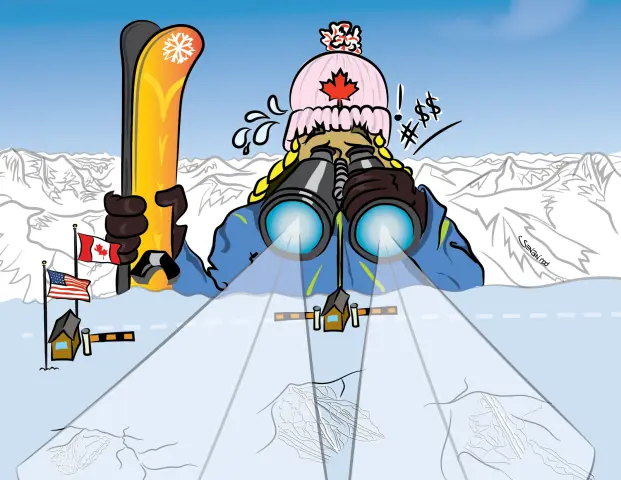

Ed Note: If ever there was a year for snowmaking to be center stage and show its stuff, 1976-77 was it! In the East, the weather got cold early, and it stayed cold. Machine-made snow piled up and up in anticipation of the thaw that never came, and depths were measured in feet, not inches. The snowmaking demonstration at Stratton during the January trade show was a big yawn: there was nothing to prove, there were no converts to be made. And besides, it was to damn cold to go and watch.
In much of the Midwest they were also in a deep freeze that was a natural for snowmaking. And from the Rockies west, those who had the installations were golden. Others hastily threw together some crude, make-shift systems and even they looked good. In Canada the snowmaking areas went great guns, if the expression may be forgiven.
“When you’ve got it, show it!” So we decided to let each snowmaker brag a bit, tell how they, the knights in snow-white armor, came gallantly to the rescue.
SMI at Crested Butte
Like other areas in Colorado, Crested Butte was woefully short of snow and had to make every snowflake count. In spite of everything, there was still a critical 600-foot stretch of bare, rocky ground at the bottom of the chair lift.
Management discussed the problem with their mountain consultant, Vic Dennis, who had had extensive snowmaking experience in the Midwest.
Vic had Snow Machines airfreight a Snowstream 320 to Denver. He picked it up at the airport, tied the unit into the city water supply, hooked up to the lift for electricity and was making snow within 48 hours of telephoning SMI!
Making do with the low water pressure available, and untrained personnel, Gus Lankin had all 600 feet of trail nicely covered with snow in three nights. This kept the area open until it snowed naturally a full week later.
JVK
Larchmont at Incline
When Larchmont Engineering was called to Incline Village, Nevada, to make a feasibility study to improve the snowmaking system, it found that it was dealing with an area on the lee side of Lake Tahoe with limited snowmaking conditions during the six-to-ten hours a night when the temperature ranged from 20 to 32 degrees. During the day temperatures would climb up to between 40 to 60 degrees.
Incline had installed snowmaking some years before. Then, with a great sense of timing, they decided last summer to expand and modernize their system and called on Larchmont to do the job. All twins were installed, plus hydrants to give full flow to the system.
The result: the area was covered in 60 hours with 1-3 feet of excellent snow. And, thanks to snowmaking, Incline Village Ski Area was essentially in a class by itself in the Sierras for much of the ski season when its mighty neighbors like Squaw Valley, Alpine Meadows and Heavenly Valley didn’t have enough natural snow to get under way.
J.T.
Snow Systems at Chantecler Ski Center
Le Chantecler Ski Center, 42 miles north of Montreal in Quebec’s Laurentian mountains, had problems for many years with snow coverage on their highest mountain, No. 4, which is serviced by two 3,000’ chairs and a T-bar, and has a vertical of 900’.
Manager Ed English contacted Snow Systems Engineering, of Toronto, last October advising he had decided to resolve the problem “with a new snowmaking system.”
It just so happened that at that particular time, Glen Abbey Skiway in Oakville, Ont., home of the Canadian Open, decided to phase out their ski hill operation, and put up for sale their entire air/water snowmaking system, which was purchased by Le Chantecler through Snow Systems. Dismantling, moving and installing on No. 4 was completed in four weeks.
The four guns, using 1200 cfm of air and 300 gpm of water, enabled Le Chantecler to open No. 4 a full two weeks earlier than previously, and seasoned skiers reported it was the best snow they had seen in that area for years.
As a direct result of these improved snow conditions, Mt. No. 4 reached its lift saturation point on weekends for the first time ever, thereby justifying an expansion program which will include additional lift capacity. Le Chantecler attributes the success and expansion to the snowmaking installation.

K.N.
Ratnik at Snow Summit
When other Western areas were looking for disaster assistance this season, Snow summit in sunny Southern California was looking for relief from the crowds. Lifts opened at 7 a.m. on weekends, and ran until 11 p.m. five nights per week. Lines began forming at the ticket windows at 2 a.m.
At times, tickets were being scalped for $20 in the parking lot, and the policy of limited ticket sales, which permitted 4,200 skiers on weekend days, had to be amended for families who could not line up in the wee hours of the morning. A system was put into effect whereby skiers reserved tickets the night before with a $2 surcharge to cover the cost of selling them.
The snowmaking system, a $2 million investment, includes a diesel generating plant to power six electric compressors and a 10 million gallon reservoir which was built at the top, and into which the city’s 50-deg water is pumped, stored and cooled.
Snow summit covers 75 of its 125 acres of slope with 30 Ratnik Snow-Giant 11 guns which use 10 cfm of air in the process. Water is pumped at 1,200 gpm from the bottom, or 2,050 gpm from the top.
This year, Snow Summit ran its system for 1,500 hours at a direct cost of $180,000 for power and labor. They realized 300,000 skier-days for a gross income of $2 million.
“It takes more than a system, however,” says Ron Ratnik. “The management and programming skills of Dick Kuhn and Steve Trainor combine to get the most out of the system,” he adds.
C.C.
Hedco at Aspen
Aspen, Colorado, the site of the second stop on this year’s pro tour, was faced with a dilemma: an almost total lack of snow. The fact that the richest pro race in skiing history was held on schedule was the culmination of many long hours of preparation by Aspen Highlands along with their Hedco snowmaking system.
After a conference with the two Aspen ski areas involved, Bob Beattie, head of World Pro Skiing, announced plans for the $80,000 Budweiser Cup, the largest purse in professional skiing history. Aspen Mountain would move the slalom portion of the race up their mountain to Tourtelotte Park, while the GS, scheduled for Aspen Highlands, would remain on Jerome Bowl at the bottom of their mountain. ABC Wide World of Sports was alerted that all systems were ‘Go’ and everyone sat back and watched the skies and waited and waited . . . and waited.
By the time pro spree week reached Aspen, the slopes still had far from their normal snow cover. Fortunately for all parties concerned, Whip Jones, president of Aspen Highlands, had invested in a Hedco snowmaking system in 1974. In the summer, Aspen Highlands is the sight of the Aspen Tennis Ranch, boasting some of the finest outdoor courts in the country; when winter comes to the high country, Hedco snowmaking provides the protective cover for these courts.
By race time there was little natural snow, so a joint decision was made between the two ski corporations to hold the entire week of racing events in Aspen Highlands. Due to the dry humidity and Hedco snowmaking, an ideal race course was preapred. The $80,000 Budweiser Cup went off under bright blue snowless skies with fantastic racing conditions.
L.D.