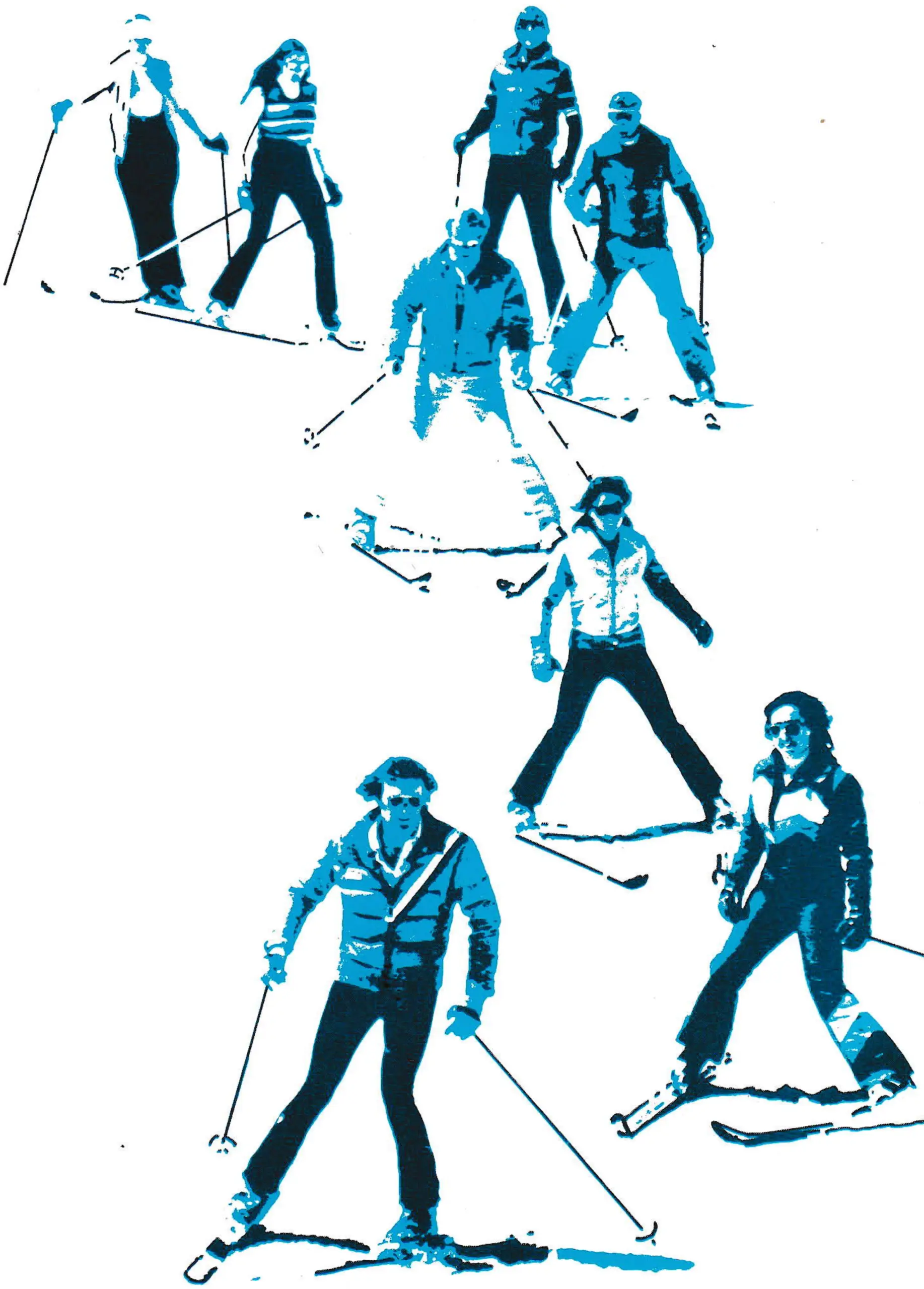

Heavenly Valley in California is very safety-conscious, and tries to make this a matter of area-wide awareness. Safety education is specially intense in the Heavenly Ski School, according to Director of Skier Education, Peter Duke. “The obvious place for the skiing public to learn sound and sensible safety habits is in ski school,” says Duke. “That’s why ski industructors have got to be more than teachers and psychologists; they’re safety guides as well.”
Duke, and Ski School Technical Director, Stu Campbell, have begun a program that is an expansion on one first developed by Paul Maloney, Director of Skiing at Jiminy Peak, Massachusetts. All instructors are educated in–and actually tested on–their knowledge of skier safety procedures.
The Heavenly Ski School has published a three-page manual entitled, “Class Handling Guidelines and Safety Procedures,” which is distributed to all full-time and part-time ski teachers on the staff. Each instructor is held responsible for knowing and understanding all of the thirty-six items on the manual’s list and must get 100 per cent on the written test given. Copies of the completed safety exams are placed in each instructor’s file–as proof that he has had instruction in Heavenly’s safety methods.
“There’s no way we can prevent accidents altogether,” says Duke, “and there’s no way we can foresee every potentially dangerous situation on our mountain. But we’re making every effort to be as prepared as we can be. Our purpose is to protect ourselves, and the skier out on the hill. We think our program is in everybody’s best interest.”
Class Handling Guidelines and Safety Procedures
- Make sure that each member of your class has release bindings with either runaway straps or ski brakes.
- When you line up a class, put their backs to the wind and other elements. Not only will they be more attentive, you will reduce the chances of discomfort and possible frostbite.
- Count the number of students in your class at the beginning of each session, and make sure to check that count periodically throughout the lesson.
- Check to make sure your students have baskets on their poles. A pole without a basket is a dangerous weapon.
- Keep your class together and out of the main stream of traffic at all times.
- Wear gloves or other protective handgear at all times. Encourage your students to do the same — even when it is warm.
- Never assemble a class in the middle of a trail, below a jump, drop-off or blind spot, at a trail intersection, near an operating snow gun, or under a chairlift.
- When your class is getting ready to ride a surface lift for the first time, they should be made aware of the following things:
a. Pole straps should be taken off the wrist and both poles should be held in the outside hand. (Both pole straps can be placed over the outside wrist, thus allowing the poles to drag.)
b. The student should move into the loading area with his skis pointing up the hill and in the track.
c. The student should stand with the knees bent, looking over the inside shoulder so he can see the approaching towing device. (The Poma will be a stick, the Mitey-Mite will be a handle.)
d. In the case of the Mitey-Mite, the student should grasp the handle in the middle, making sure not to touch the cable at any time. When the handle is in front of the student, he may then grasp it with the outside hand also.
In the case of a Poma lift, the attendant will hand the student the stick, which should then be placed between the legs, allowing the disc at the base of the stick to come up against the butt.
e. The key to riding a surface lift is “DO NOT SIT DOWN.” A surface lift is designed to pull a standing skier, not lift and carry him.
f. The student should be instructed that in case of a fall, he should immediately let go of the towing device and move as quickly as possible out of the lift track.
g. While riding the lift the student should stay in the track. Moving from side to side will cause the cable to derail.
h. When the student reaches the unloading area, he should simply let go of the handle in the case of the Mitey-Mite, or pull the stick down and away in the case of the Poma. He should then move quickly away from the lift, clearing a path for the next unloading skier.
i. At no time should anyone move under the cable of the Mitey-Mite when it is operating. - When a class is getting ready to ride the chairlift for the first time, they should be made aware of the following things:
a. Remove the pole straps from both wrists and carry the poles in the inside hand.
b. Have the students move quickly to the loading platform and position themselves with their skis pointing up the hill. They should be looking over their outside shoulder.
c. Make sure all loose clothing is either zipped-up or tucked in.
d. Prepare them for what to expect at the unloading area. They should know to keep their ski tips up while approaching the ramp, and to stand up when they get to the ramp. They should also know that they must move away from the unloading area as soon as possible. - Never dismiss your class and leave them on the mountain. Make sure each member of your group has been returned safely to the base of a lift, preferably to the one where the class began.
- Caution your class about skiing too close to an operating snow-making gun. Warn them about reduced visibility, heavy wet snow, and excessive noise.
- When skiing a trail where a race course has been set, explain the dangers of skiing into the course.
- Caution your class about skiing too close to trail-grooming equipment. The operator may not be able to see them, or stop his machine easily when conditions are icy.
- Explain that any time a student skis down to a class,, he should always stop below the group. This should help prevent a collision in the event of a missed turn or fall.
- Explain that a skier overtaking another from above is responsible for avoiding a collision with that skier. Regardless of who has the “right of way,” everyone should ski defensively.
- Caution your students about the dangers of a runaway ski, and alert them to what the term “SKI” means.
- If someone in your class is injured, stay with them until the Ski Patrol arrives and takes charge of the accident. In the meantime send two of your strongest skiers for help. (Help can be reached at the base of any Heavenly Valley Chairlift.)
- Make your class aware of hazard markers and closed trails.
- Never comment on or discuss an accident in public. You never know who may be listening.
- Instruct your class to always look up the hill before moving out across a slope.
- If someone in your class is injured by another skier, be sure to write down that skier’s name and address.
- Report any and all injuries to yourself or any member of your class immediately and in the properly-prescribed manner.
- Be familiar with and instruct your students about the signs of frostbite. On cold days they should be on the look-out for frostbite symptoms in themselves and in others. Instruct them about how to deal with frostbite once these signs appear.
- Inform your class about the “When in doubt, bail out” procedure to protect themselves and others from injury. Teach them to sit down safely if and when they get out of control.
- Warn your class about the dangers of intense sunshine, and inform them about the need for good sunglasses and protective ski cream — especially at high altitudes.
- Warn your classes about the life-and-death dangers of hypothermia, and make suggestions about proper dress for different snow and weather conditions.!
- Be constantly aware of changing snow conditions, and the dangers involved in each. Suggest ways to handle each in the safest possible manner.
- Warn your students about the dangers of cold muscles and fatigue, and explain that many skiers are injured taking that “one last run.”
- Remind your classes, when it’s appropriate, of the importance of proper physical conditioning. Remind them also, that it’s important — as well as safer — to ski on properly turned equipment.
- Teach your classes what the terms “Track left” and “Track right” mean.
- Remind students to check their bindings periodically. Release settings change with continued use, temperature changes, and the presence of dirt and other foreign substances.
- Students will frequently ask for advice about equipment purchases. Help them select equipment that truly matches their ability.
- Remember — and remind your students: Swinging chairs may be fun, but they’re extremely dangerous!
- Drinking and skiing do not mix. You have the right to refuse a lesson to an intoxicated student. At no time during the skiing day are you — as an instructor — allowed to consume any alcoholic beverage.
- a serious headcold can have an adverse effect on a skier’s balance. Be sensitive to an individual with the “sniffles.”
- Take only very advanced classes off the beaten path — and only with permission from a supervisor. When skiing in the trees, sggest that all skiers remove the pole straps from their wrists.