

The standard electric meter performs one function, registering electric consumption in units of kilowatt hours (KWH). For example, a one kilowatt (KW) appliance operated for five hours will increase the meter reading by 5 KWH. Using a second example, a 5 KW appliance operated for one hour will also increase the meter reading by 5 KWH. The utility company reads the meter on a regular schedule and charges for the cost of the total number of kilowatt hours consumed. As we have seen in the two examples, the size of the appliance utilized does not affect the bill directly. The number of KWH consumed sets the amount of customer’s bill.
An industrial or commercial customer requires more electric power than a residence and therefore usually has a more sophisticated and elaborate electrical distribution system and large electrical loads. Likewise, the utility company has a more complicated electric meter to record the loads.
Electric power to your ski area is usually measured in two forms. The first, consumption, refers to the total number of KWH used during the billing period, usually a month. This is exactly the same situation as the residential customer encounters. The second, demand, is the customer’s maximum load averaged over a specified interval of time. Commonly used demand intervals are 15 and 30 minutes, however, other intervals as short as 5 minutes or as long as one hour might be used in certain cases.
Let’s return to the previous examples to illustrate the demand concept. A one kilowatt appliance operated for five hours still results in a consumption of 5 KWH, however, the demand load is one KW which is the average load occurring during the interval of use. In the second case, a 5 KW appliance operated for one hour also results in 5 KWH consumption, but the demand load is 5 KW. The impact can be seen if we consider the cost of operating the equipment.
Let’s assume that we are customers of the Example Electric Co-Op. The applicable rate schedule reads as follows:
- (a) Energy cost: 3c per KWH consumption
- (b) Demand cost: $2.00 per KW demand
| Case No. 1 | Case No. 2 | |
|---|---|---|
| Load | 1 KW | 5 KW |
| Duration | 5 hours | 1 hour |
| Consumption | 5 KWH | 5 KWH |
| Demand KW | 1 KW | 5 KW |
| Energy Cost | 5x$.03 = $ .15 | 5x$.03 = $ .15 |
| Demand Charge | 1x$2.00 = $2.00 | 5x$2.00 = $10.00 |
| Billed Amount | $2.15 | $10.15 |
It is interesting to note that with the same total consumption, Case two is almost five times as expensive as Case one. What are the reasons for such a variance?
Despite the appearance of an inequity, there is a good explanation from the power company. The power lines and transformer size required to furnish the average power requirements in Case two are larger than those required to meet the average power requirements in Case one. If the utility company were required to construct facilities in both cases in return for revenues based on consumption alone, the financial burden on the power company could become unbearable. The cost of facilities obviously must be justified against revenue received. This is where the concept of a demand charge comes into play.
By instituting a charge based on the average power requirements, the utility has a method to recover some of its capital costs and the customer can set the amount of his charges by controlling his power requirements. Historically this approach has worked to the advantage of both the utilities and their customers as it tends to place an added burden on users of large amounts of power rather than forcing all users to subsidize a few.

While actual rate structures are usually somewhat more complex than the examples presented, the principle is exactly the same. It is not uncommon to find cases where the demand charge accounts for half or more of the monthly electric bill. Obviously, decreasing consumption by 10 per cent will not create as great a cost saving as decreasing demand by 10 per cent. This is particularly true when the relatively low cost per KWH is considered.
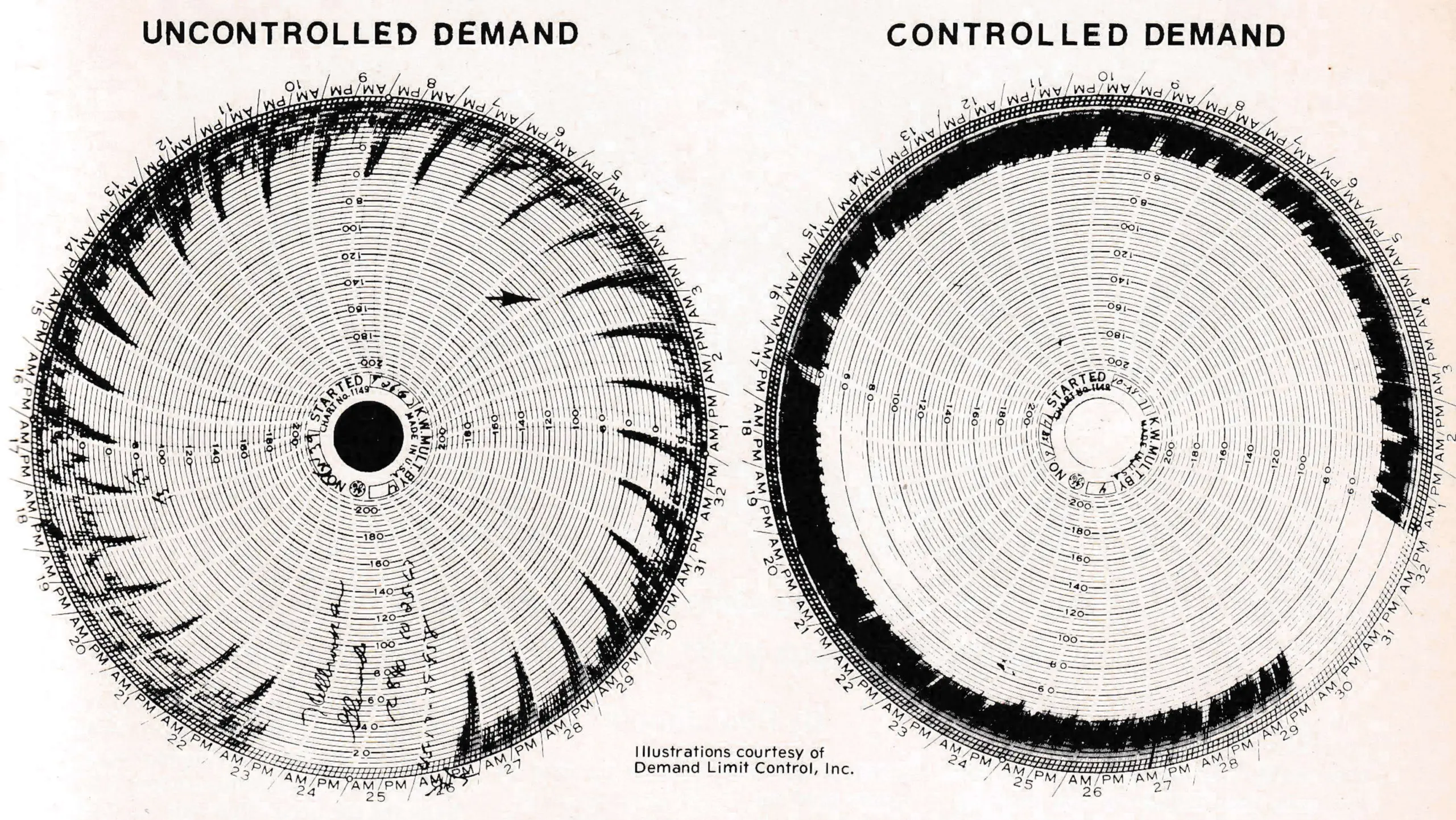
The reason for this is that once the peak load has been established during the 15 or 30 minute demand interval, demands up to this value will have no affect on the measured demand. Only higher demand loads will affect the billing. The ideal situation would be a constant demand throughout the month rather than an intermittent high and low situation.
Keeping in mind the fact that peak demand sets the bill, ski areas can try to even-out large electrical loads created by snowmaking, lifts, heating and lighting. Since snowmaking and lift loads are both large, the demand could probably be reduced by making snow when the lifts are not operating rather than operating both systems simultaneously. Perhaps some heating loads could be deferred during periods of peak electrical usage.
Various companies produce types of automatic demand controls covering the range from relatively simple systems to elaborate mini-computers. The basic principle is to measure the incoming power and selectively turn off non-critical loads in order to keep the demand below a pre-set maximum. The selection of specific equipment depends on the conditions at each area and the nature of the loads to be controlled. Obviously the application of such equipment can help some areas more than others, however, the principles of controlling electrical demand can be used to advantage by all ski areas.
With the energy shortage a reality, utility companies may tend to discourage large demand loads through rate structures in an attempt to share the available quantities of power. You may find that the commercial industrial engineers at your power company can explain the specific rate structure applicable to your ski area and suggest ways of decreasing your demand without adversely affecting operations. Independent consulting engineers can analyze your electrical system and design the load demand control system to keep demand charges under control. Even though all ski areas can’t completely control electrical demands the economic rewards more than justify any efforts expended.