
A collision course in the making?
Thus it is that when the word went out just a couple of years ago that what was needed was “a voice in Washington,” lo and behold we now face the prospect of rival voices echoing in the halls of Congress. Whereas there was recently only one membership organization of skiers to speak as the “voice of the ski consumer” there now bids to be three.
As Alice would no doubt have said in such a situation, “It gets curiouser and curiouser.”
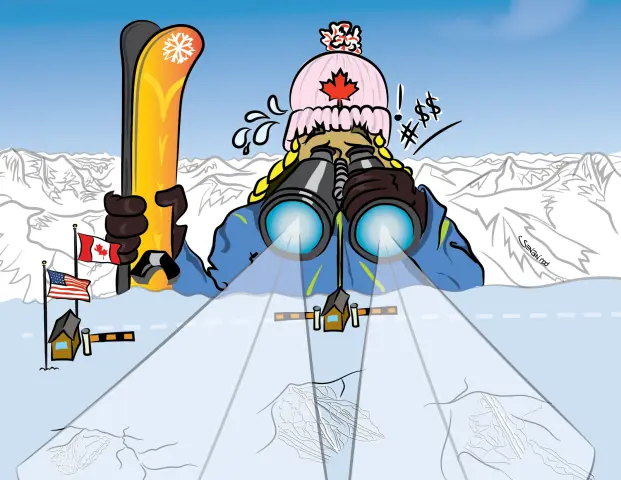
But I must get more specific. What follows is an attempt to bring SAM readers into viewing distance of a swirling, ill-defined and still-developing confrontation in the ski world. Like a storm center in its early stages, the course is hard to predict, to say nothing of the impact, if any. Like such storms, the potential for damage is great, but there is always the strong possibility—in this case, devoutly hoped for by many—that the storm will never actually materialize, but will harmlessly dissipate its potential destruction at sea.
We’re talking about a collision course that currently—at presstime—exists between the U.S. Ski Association and the American Ski Federation. And why should this concern the SAM readership? Simply because it directly and indirectly affects the pocketbook of every ski area operator. Both organizations depend on you for existence.
First off, a very brief, skeletal history—program notes, if you will, to help you understand what’s going on.
The American Ski Federation was born some years ago to provide a forum where the heads of organizations comprising the “ski world” could gather to exchange information and ideas. The ski areas (NSAA) and clothing/equipment suppliers (SIA) and instructors (PSIA), patrol (NSPS), “organized skiing” (USSA) and others were involved. Initially informal, it was reconstituted in 1978 as a “voice in Washington” with funding largely from NSAA and SIA. The consumer voice in ASF was supposed to be U.S. Ski Association, but at that time USSA’s affairs were in a state of considerable disarray, both internally and financially, and its contributions in this period ranged from non-existent to negligible.
For the past couple of years ASF, in the person of its president, Joe Prendergast, has run an active office in Washington, doing the things a lobbyist is supposed to do. This includes keeping key congressional figures informed as to the needs of the ski industry, developing high-level chains of communication between the ski world and the federal departments such as Energy, Agriculture (Forest Service) and Commerce. It includes testifying on legislation important to the ski world, and working with the congressional staffs involved in such legislation. In the last year it has meant giving guidance and opening doors for businesses in search of disaster relief.
Now, a brief recounting of recent USSA history. From the brink of total implosion last summer—which would have effectively ended the once glorious, but more recently, tortured life of this 77-year-old organization—there emerged the double blessing of twins: USSA Competition Division and USSA Sport Division. The latter was given the responsibility of serving the recreational skier, and was built around the only one of the old USSA regional divisions that was both vigorous and viable, the Far West Ski Association.
The FWSA had become big and successful essentially by providing California skiers with an elaborate and efficient ski travel program that offered season-long trips to the Sierras, the Rockies, Western Canada and Europe, with charter flight discounts and complete reservation services. The energetic FWSA staff also developed a taste for political action, and set about mobilizing its membership to fight the Sierra Club and any other constituency that stood in the way of ski area growth. That included active “politicking” for and against candidates for elective office based on their stands on key issues deemed important to FWSA.
When FWSA became, in effect, the operational core for the newly-established Sport Division of USSA, that same staff set about developing national, as opposed to California, programs. And that included a national role in political action. In Washington.
Back to ASF. (Are you still with me?) For some time there have been various voices urging ASF to develop the capability of “speaking for the skier,” and not just for the ski industry. In the absence of a viable USSA, several schemes were advanced whereby ASF would develop a core of concerned skiers who could be called upon to write to the appropriate legislators when key legislation was pending. It was the sort of grass-roots clout that the National Rifle Association has that was sought for ASF—albeit on a much more modest scale.
In Vail this past December there was a meeting of the ASF board, and it was at this meeting that a plan was presented that had been developed largely by ASF Chairman, Tom Corcoran (NSAA and Waterville Valley).
Essentially, it called for ASF to develop a membership organization wherein the primary benefit for a member would be the availability of a 10% discount on ski vacations at a number of ski resorts—no hardship to the resort, since this discount is budgeted for travel agencies anyway.
Membership acquisition would be by direct mail and through ads contributed by various publications on an “as available” basis. The ski world would also be sensitized to the politico/environmental issues that ASF addresses through a multi-page insert in Ski Magazine for which the cost would be offset by institutional advertising from sponsors.
Even among those favoring the whole idea there is debate as to what membership benefits should be. One current thought is that the type of membership being sought might respond less to discounts than it would to a structured program of VIP treatment and privileges for ASF members when they visited ski areas.
The plan was debated, and predictably there was opposition by USSA. On one point, though, there was agreement: the plan was not sufficiently developed to be put into action for the 1980-81 season. However, $10,000 was allocated to develop the details of the plan for re-submission in June, with an eye to implementation in the Fall of 1981. This is currently underway.
In the meantime, USSA is flexing its political action muscles in Washington, and talks about opening up its own shop there.
This brings the reader right up to the moment I am writing this, which, in a fast-moving situation like this, does not mean it represents the situation when you read it.
And so, today we have Washington-based political action group, ASF, getting set to run a skier membership program; and we have a skier membership organization, USSA, cranking up a political action arm. In addition, we have to take notice of a third party which the other two prefer to ignore: the American Ski Association, an aggressive, controversial, but patently successful recreational skier service organization with a claimed (elsewhere disputed) membership of over 237,000 skiers, and goals of 380,000 by the end of the year and a million by 1983. ASA is strong on communication, and is itching to “represent the rights and interests of all recreational skiers.”
How do the various parties involved view this whole situation? On the USSA side there is concern about ASF starting a membership organization. They say ASF doesn’t know what it is getting into, that it is expensive and work-intensive to do, and that it will draw energies away from ASF’s principal function. ASF—or, more accurately, the faction in ASF which supports the new membership organization initiative—answers that on the scale they are proposing there is no big problem in handling it . . . that they don’t want huge numbers, but rather a committed core, whose combined dues are important to the future of ASF, and who can be called upon by ASF to write letters and speak up on issues identified to them by ASF.
On the political action front, ASF reaction—at least in the NSAA and SIA constituencies—ranges from wary to hostile vis a vis the lobbying role being undertaken and being planned by USSA. They wonder why USSA, which is a member of ASF, does not want to work with and through the existing ASF Washington office. They wonder out loud why an organization that is barely out of the grips of bankruptcy, and which has been unable to pay more than token dues to ASF, should establish a Washington office for political action when that same amount of money paid to ASF in dues would relieve ASF of the need for a membership arm. Why, they ask, doesn’t USSA stick to serving the recreational needs of its members and speak politically through a full participation in ASF?
To which USSA—again, more accurately, that faction of the Sport Division which embraces national skier advocacy as its most important function—answers that ASF is a ski industry lobby, not a skier lobby. Most of the time we’ll be on the same side, they say, and what’s wrong with two voices lobbying for the same thing? The more, the merrier. But ultimately, they say, the ski consumer must have his own voice in Washington, independent of the industry voice. And on the few occasions when we disagree it will lend credibility to both of us.
And there is the picture, objectively painted, I hope, and shorn of many fascinating, but non-essential details. I have also painted out the colorful, strong-willed people involved in these confrontations past and confrontations to come, thus giving each the maximum of maneuvering room in which to find the solutions and compromises that most people feel will surely come.
David Rowan
Forest Service dons pricing halo
Confirming the signals coming from the Forest Service, Roy Feuchter, who directs the Recreation Division, said “We pretty much intend to continue in the direction we were going—to step away from involvement in pricing and let the marketplace establish price and see what happens.
“Last year we wanted comparability with the private sector and we asked our field people to monitor this. It worked well, and provided reasonable results.
“The next step is to not even make these kinds of comparisons and let the marketplace decide. We’re not even going to have areas submit rates for approval and we’re not asking for rate analysis from the field—just that they be aware of what is going on. Only in the case of an area going off the deep end with some sort of outlandish usury price would we step in under the authority we have in the permits. But experience suggests that this won’t happen.”
To all of which we say, “Amen.”