Photos by Dann Hall
Snow-fence technology began in the West when early railroaders stacked granite blocks along hillsides to protect tracks from drifting snow. In the 19th Century, snow fences of one kind or another were also used as collectors to augment water supplies for livestock. Later, the so-called “Swedish” and “Wyoming” fences — wooden-slatted contraptions — were placed along railroads and highways to keep them free of drifting snow.
Today, fencing technology is applied to sand control in the desert as well as snow control in the mountains. Different fencing types are used to protect electric power switchyards, oil and gas processing facilities and Arctic villages. But, ski areas with unique problems, have for many years experimented with fences to combat wind scour with relatively little success. Like most ski areas, Schweitzer Mountain Resort in Idaho fought wind-scour problems on many parts of the mountain. One run in particular, the Great Divide, is a windy, rocky, ridge-top access that bisects the area’s two bowls, Schweitzer to the south and Colburn on the north. Strong, southwesterly winds often scoured the run so clean of snow that it couldn’t be opened, restricting access to the Colburn Bowl and severely limiting the amount of terrain available to skiers.
That was the situation until last summer when Schweitzer started year-one of an aggressive $100-million expansion project that over the next 10 years will transform the mountain into a year-round destination resort. Construction began with a new high-speed quad chairlift, an 82-room European-style hotel and a massive window-wrapped daylodge. Night skiing, snowmaking and other refinements were added as the cost topped the $15-million mark.
With that kind of money at stake, and since the Great Divide sits at the head of Schweitzer’s new quad, no one wanted its debut marred by a mine-field of rocks at the topside. To deal with the scouring problem, Mountain Manager Rohn Stilson and Maintenance Engineer Marlin Turinsky went looking for a snow fence that would work; one that would direct snow toward a particular area, not away from it like a conventional highway fence.
First, they contacted wind guru Ron Tabler of Tabler & Associates in Boulder, Colo., who has a reputation for knowing more about snow fences than anyone else in the country.
Years ago, Tabler discovered that many snow fence designs didn’t work very well and almost no research had been done on new technology. In addition, Tabler discerned a common misconception: most people believed that “anyone could build a fence.” He knew differently.
“Snow fence system design is a rather complicated art,” Tabler said. “Many early snow fences were improperly installed and their performance failed to meet expectations.” Not only were many old-style fences ill-placed, they also required heavy maintenance because they often became buried beneath the snow they blocked.
Not surprisingly, when a new 77-mile section of Wyoming Interstate 80 was opened in 1970 — and soon was threatened to be closed by snow drifts — Tabler was summoned to figure out a way to keep the route open. Truckers dubbed that section of I-80 the “Snow Chi Minh Trail” and Wyoming Highway Department crews worked round-the-clock the first winter in a valiant struggle to keep the new highway open. But to keep up with the blowing, drifting snow, the cost in manpower and equipment was astronomical.
In his “Snow Fence Handbook,” Tabler wrote that snowdrifts, some 15 feet high, encroached on the highway at more than 30 different road cuts. Six crawler tractors working round the clock were required to keep drifts from blocking the road. It wasn’t enough. “Winds averaged more than 35 miles per hour for days at a time and visibility often was restricted to less than 100 feet,” he wrote.
To solve this critical problem, Tabler designed and built fences for a specific storage capacity. He used 12-foot-tall fences and implemented different fencing densities to store snow. Subsequent analysis showed that snow removal expenditures were reduced by at least one-third and highway visibility was so improved that accidents dropped by more than half. By 1980, the system included 32 miles of fence protecting 31 miles of highway.
Through the work on the I-80 fence systems, Tabler essentially re-defined snow fence designs because his on-site research enabled him to get a better understanding of snow-transport physics. Today, Tabler’s company specializes in snow and wind engineering for clients ranging from fence companies to users like ski areas, although Schweitzer is believed to be the first area to test a new fence design.
A major source of support for recent snow-fence research came from the Strategic Highway Research Program of the National Research Council, a federal program funding research on blowing snow and snow fences. Under the auspices of this program, Tabler did some of the testing, theoretical research and development of improved snow fencing that became applicable to snow management at ski areas.
Another supporter of snow-fence research was the Tensar Corp., an Atlanta, Ga., manufacturer which makes grid-like fencing material for Tabler’s new portable fence design. (Tensar Snow Fence is made by a proprietary process and a patent is pending on the new fencing system.)
“What makes the system unique,” said Bob Easterle, Tensar vice president of marketing and business development, “is its flexibility. Not only can you change the internal geometry of the wind-control material, the Tensar grid, you can also adjust the panel system for varying needs and applications. Plus, it’s transportable.”
“It can be inclined at any angle you want,” Tabler added, “something you can’t do with other designs. The more you lay the fence back, the smaller the drift because you reduce the effective height. Inclining it steeper displays a taller fence and a larger down-wind drift.”
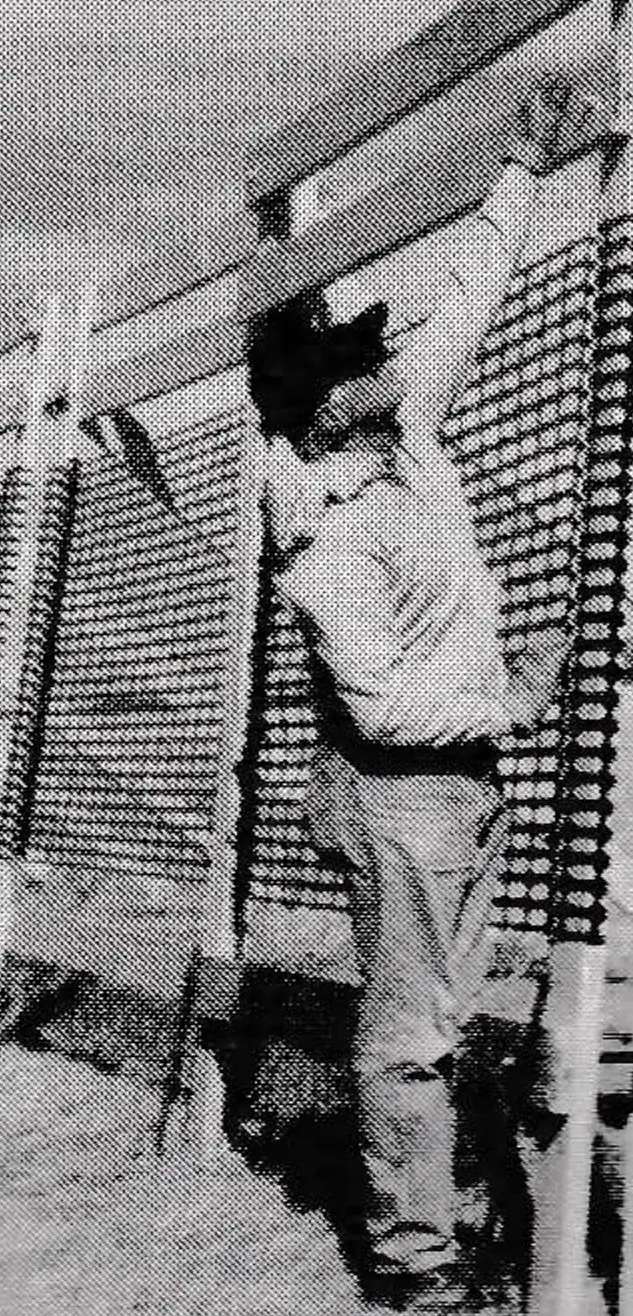
Photo by A.A. Tabler
With Tabler’s design, a 6-foot-high fence will produce a drift 30 times the fence height, about 180 feet; an 8-foot-high fence will create a 240-foot drift. “The taller the fence, the greater the deposition area and the greater the area protected from wind scour,” he said.
The new Tensar Portable Snow Fence System is easy to install and requires virtually no maintenance, two factors that weighed heavily when Stilson and Turinsky went shopping for a snow fence. “We looked at different products currently on the market and when Tabler described his new light-weight experimental design, we jumped on it,” Stilson said.
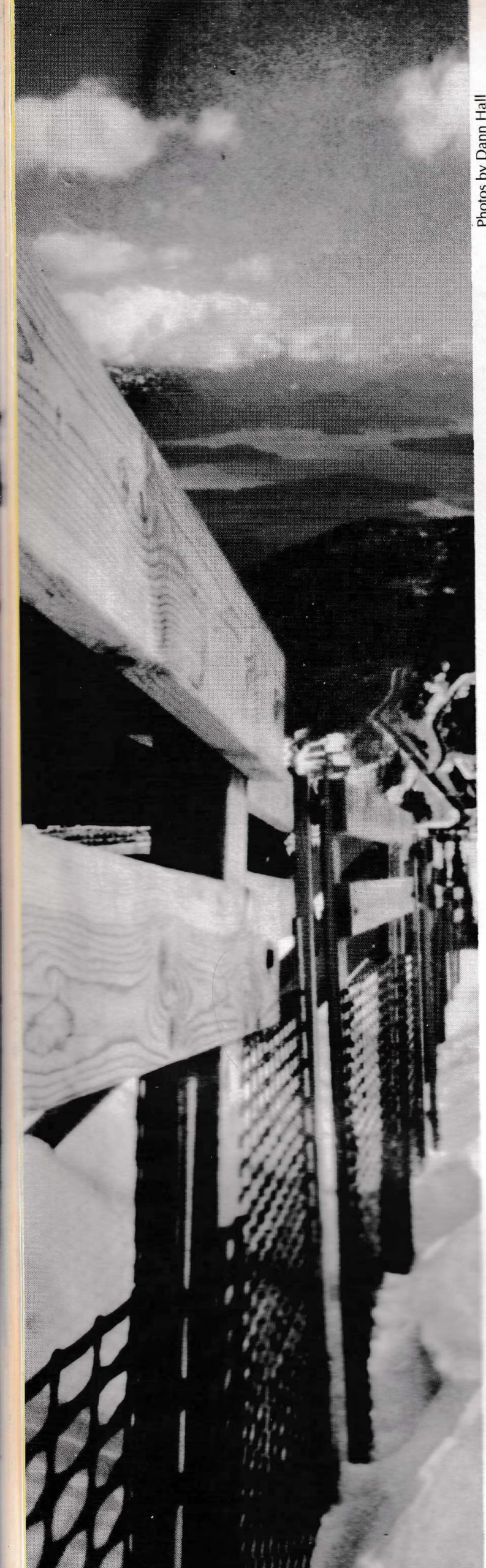
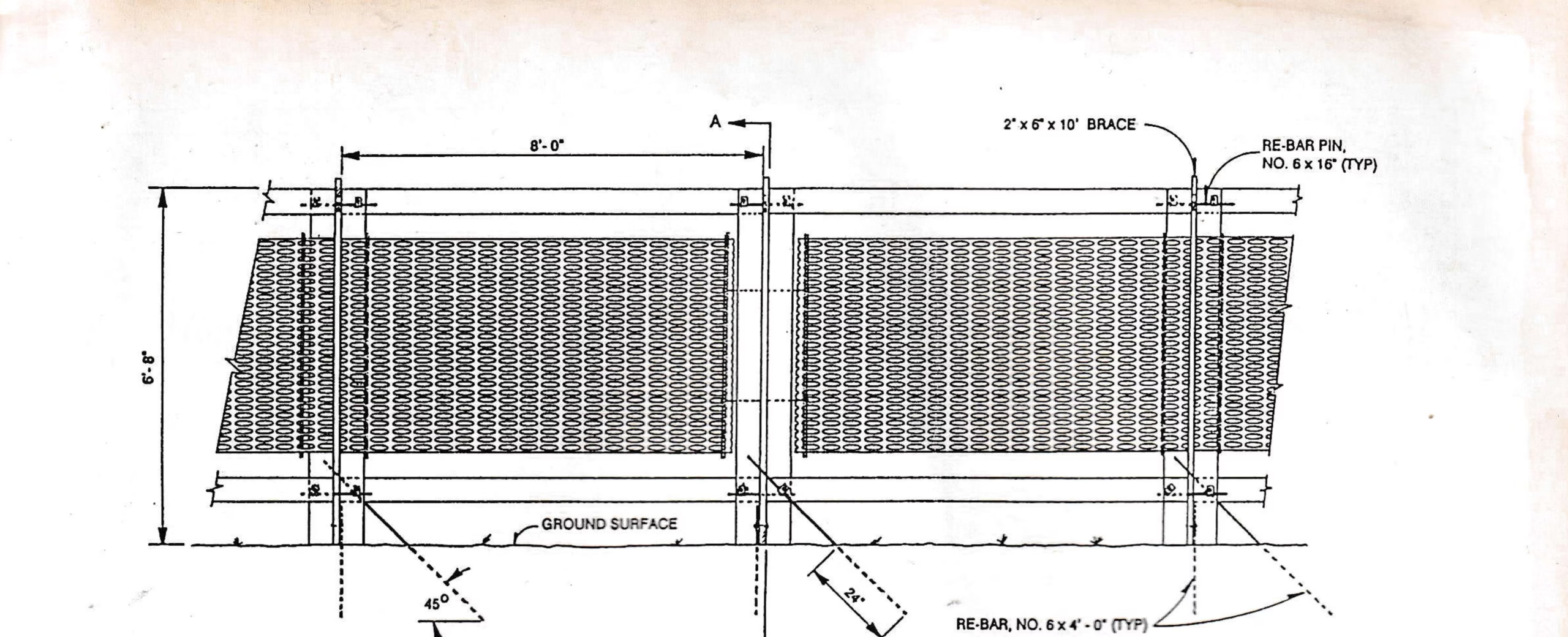
Last year, they installed 350 feet of the new fence on the western edge of the Great Divide ski run, where it could take advantage of the prevailing wind. Basically, the fence consists of sections of 2 X 6 lumber framing 4 X 8 foot Tensar panels, linked together and having a precise gap at the bottom. Stilson said that after two average snowfalls, an 8-foot-deep drift covered the width of the run, the fences remained clean and functional and enough snow was available to patch scour areas above and below the fence area.

“We’ve experimented with different kinds of fencing for a number of years,” said Schweitzer General Manager Tim Hinderman. “This by far is the best technology we’ve seen. Plus you don’t have to go in and dig it out.” Hinderman said the self-cleaning fence creates a snow-pillow on the run itself, not just behind the fence, so skiers never have to “ski the fence” to find snow.
“It’s the only reason we were able to open the Great Divide initially,” Stilson said. “We even had enough snow stockpiled in the fence area to push uphill or downhill to uniformly cover the ski run. Otherwise, it was scoured clean.”
Schweitzer’s first fence works so well that Stilson and Turinsky are building others, plus some 32-foot-long portable fences that can be moved by snowcat wherever snow is needed and wind is present. Moreover, Tabler’s design enables so-called “tall” fences (over four feet) to be installed fast.
“These fences are six-and-a-half or eight feet tall,” Tabler said. “They’re cost effective and require minimal time, effort or material to install. That, plus rapid put-up and take-down makes them unique.” What’s more, Tabler said the fences are designed to accommodate irregular terrain, such as that found at ski areas, and their modular panels can be overlapped to prevent gaps. In short, the fence system combines the advantages of old-style horizontal board fences with modern materials like Tensar Snow Fence, which makes the snow fence lightweight and manageable.
“The boards define the top and bottom of the fence, improving performance and helping to prevent ‘choking out’ at the bottom,” Tabler said. “And once it’s buried it won’t sag because the horizontal-board component provides the resistance necessary to properly tension the plastic.”
Also innovative is Tabler’s fastening system. Re-bar and U-clips tie the panels together and anchor the frame in the ground. Tabler said re-bar works well because it’s easier to drive into the ground than posts and will even bend around rocks or other hidden obstacles. “It’s a good anchor system for ski areas,” he said. “On good soils, you only have to drive it 2-feet deep and it will withstand wind up to 100 miles-per-hour.”
The Tensar Corp. is exploring licensing arrangements of its system with independent manufacturers. “We’ve ascertained a need,” Easterle said. “And with its unique set of performance and design features, this system will provide high value for the departments of transportation as well as ski areas.”
Portable Snow Fence Specifications
1) Snow-storage capacities, as given below, are 3 to 4.6 times that of a conventional 4-foot snow fence: 6 foot, 8 inch height: 13.5 tons per foot of fence length; 8 foot height: 20.2 tons per foot of fence length.
2) The fixed bottom gap and lower horizontal frame member prevent snow from being deposited in the immediate vicinity of the fence. This maximizes snow-storage capacity and snow-trapping efficiency, prevents damage to the fence and allows the fence to be removed at any time.
3) The fence can be erected with a 15-degree lay-back angle, which increases snow-storage capacity by as much as 25 percent. The design allows this angle to be maintained even when traversing irregular terrain. The ability to vary the inclination angle allows the fence to be custom designed for specific applications. Inclining the top of the fence into the wind, for example, produces a jetting action under the fence that displaces the drift farther downwind.
4) Weighing about 70 pounds, the panels, which can be fabricated quickly and inexpensively, are easily handled and erected by one person. Using plastic material in place of wood reduces weight as well as cost. The design will withstand 100-mile-per-hour winds.
5) Field installations of prefabricated panels require approximately three man-hours per 100 feet of fence, which is less than the time required to install a conventional 4-foot snow fence. Field installation of the 8-foot tall fence requires 90 percent less time than that required to build a series of conventional 4-foot fences having the same equivalent storage capacity.
6) The fences can be installed and removed with less disturbance to vegetation or soil than is currently required for conventional installations using steel T-posts.
7) The design allows such rapid installation that it would be feasible to install the fence for short-term protection to improve visibility at accident sites, or to prevent drifting at construction sites.