

Just when U.S. ski areas succeeded in garnering a series of World Cup opening races, the weather across the country performed a rare sequence of tricks. The Rockies, which had enjoyed early snow for several seasons, got little accumulations until after Thanksgiving this year. Meanwhile the East seesawed between November storms, thaws and freezes.
Despite the weather — thanks to snowmaking and grooming — all but one of the scheduled races took place — a record not achieved most years in the Alps when racers spend more time chasing snow from mountain to mountain then they do running gates.
Before the racers went to Park City for the first events, they had been on snow at several U.S. ski areas. Sugarloaf/USA, Me., and Keystone, Colo., were to have been the U.S. Ski Team’s early November training sites. Although a Thanksgiving dump in the Northeast ultimately proved to be a bonanza in the East, earlier unseasonable warmth in New England scotched the Sugarloaf session, and the men’s and women’s squads spent 10 days at Keystone. The resort, which as usual was the first in Colorado to offer skiing and the only one with substantial terrain open for the first month of the season, made snow earlier than usual on Starfire, a high blue trail on North Peak.
The Americans were joined by Austrian, Canadian, Swedish and Swiss racers, and Keystone had to turn away other teams which called requesting last-minute training time. Up to 200 skiers were training there long before the south-facing access run to North Peak was skiable. Keystone ran shuttle buses up a work road and segmented Starfire into separate training courses and teams were assigned training times and slalom runs.
At the same time, Italian, French and Soviet racers were at Vail/Beaver Creek. Vail opened its main mountain and welcomed 500 anxious skiers on November 4, the earliest opening since 1971, and had Beaver Creek operating in time for limited World Cup training and for Nastar pacesetting trials the third week in November. Though Beaver Creek was initially restricted just to the racers, the effort of making three runs on each of the two mountains skiable, totaling 121 acres with one foot of snow, cost $363,000 — calculated at $400 per snowmaking hour.
Paul Testwuide, director of mountain operations for Vail and Beaver, said about half of each mountain’s 2,000-gallon-per-minute capacity was devoted to preparing training courses on Beaver Creek’s International run and a racing trail Vail. “You always have to balance everything in light of energy, water and monetary constraints, and yet go about it as if you expect no natural snow will fall,” Testwuide said. “It’s a tradeoff. The racers have certain needs that we must meet, but you can never forget the customer who pays the way.”
Larry Lichliter, Vail Associates’ executive vice president of mountain operations, believing the investment to have paid off, said, “It’s really important to have as much snow as possible open for our Thanksgiving guests.” Vail also was praised in the ski-conscious Denver media for offering free golf during the balmy early days of the long weekend. Two hundred golfers, including some who skied and golfed on the same day, showed up, compared with the normal 300 on a summer day.
Other Colorado ski areas that opened with limited terrain slashed lift ticket prices: $10 at Aspen (one run); $12 at Vail, Beaver Creek and Eldora (three runs each); $15 at Telluride (one run); $16 at Loveland (two runs); and $19 at Winter Park (five runs). Several areas had over-$20 lift tickets: Crested Butte ($22 for 11 runs); Breckenridge ($24 for seven runs), Copper Mountain ($25 for three runs); and Steamboat ($29 for six runs).
Only Keystone had a ticket price of over $30, charging $32 for 10 runs and 10 lifts operating. Beaver Creek, Breckenridge, Copper, Steamboat, Vail and Winter Park each had three lifts running, and the rest of the 13 Colorado areas open by Thanksgiving were running just one or two lifts.
The resort with the biggest stake in the early-season lottery was Park City, which will be an Alpine skiing venue if Salt Lake City is awarded the 1998 Olympics. Observers said the area acquitted itself splendidly despite horrific weather swings and the eventual canceling of the meet’s final race.

“Park City is one of the best race organizers in the industry,” said Heinz Krecek, head of the women’s World Cup circuit. “They respond well in the face of poor snow conditions, which is important for an Olympic host. They have a lot of snowmaking and never have a problem with snow. Personally, I want the winter Olympics to come to the U.S. There are so many nice ski stations and America has done so much for skiing.”
Park City threw its heavy artillery onto Willy’s Run, which was recently renamed in honor of Willy Schaeffler, former U.S. Ski Team coach. It was estimated that during the three weeks before the races, 10,000 man hours were spent on snowmaking and another 5,000 on grooming and scaffolding. A battery of 70 snow guns fired 16 million gallons of water onto the course and produced conditions that left European athletes, coaches and press gushing in admiration that a top-caliber race could be put on in the face of no natural snow and a daunting freeze/thaw cycle in more than three weeks preceding the November 24-26 meet. To minimize meltdowns, snow was stockpiled when it was cold enough to blow. A winch vehicle spread the heaps along the run so serious course preparation could begin.
“There hasn’t been a miracle like this since Jesus Christ,” was the lead to one newspaper story.
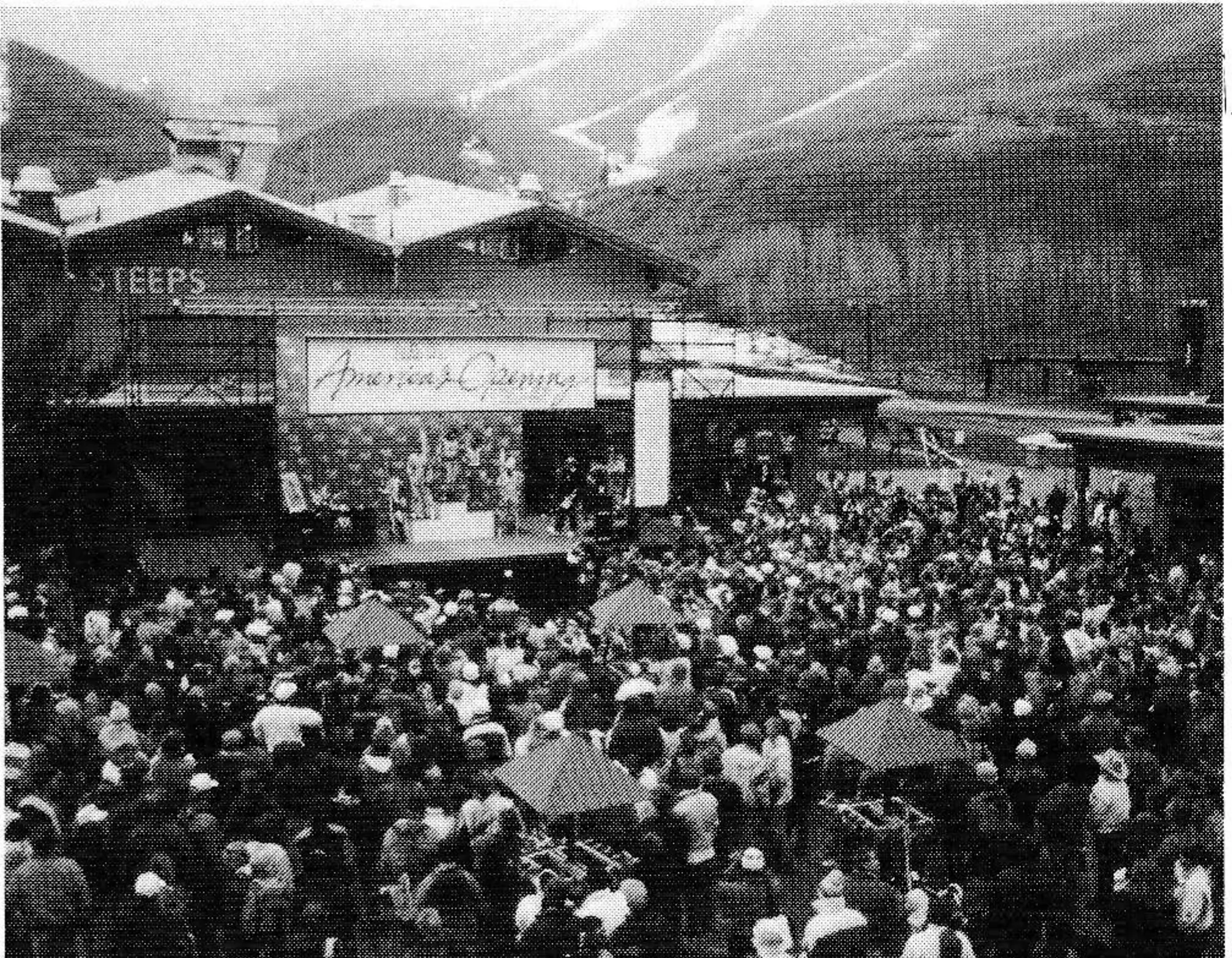
It was a $1.2 million miracle. The resort reprised its 1986 America’s Opening, which consisted of women’s technical events that came off splendidly despite an absence of natural cover in the Wasatch. The quality of the durability of the course this season was evidenced by the high proportion of finishers from the back of the pack, including a field of 72 in the men’s giant slalom. In fact, Nathalie Bouvier of France won the women’s giant slalom with a start number of 40.
What ultimately caused cancellation of the final race, the men’s slalom slated for Sunday, was not insufficient snow but freaky weather. The morning started with rain at the bottom of the mountain and heavy, wet snow higher up. Though shovelers managed to clear the course, the race jury was concerned about the snowpiles beside it as well as the fog-restricted visibility and lightning. Park City organizers made arrangements for racers and officials to stay through Monday and were even wiling to charter a plane to assure everyone’s arrival on time at Waterville Valley, N.H., for a Wednesday giant slalom. But with an uncertain forecast for the Wasatch on Monday, everyone agreed to move the slalom to Waterville.
Still, Park City received kudos for the race it put on despite the meteorological challenges. “It can’t help but work in our favor for the Olympic bid,” said Mark Menlove, Park City communications director. “We’d be running those in February, but the fact that they [the three races which were held] ran flawlessly in spite of the weather will help the Salt Lake Olympic movement.”
Without the men and matériel used on Willy’s, Park City could have opened two or three runs to the skiing public, but, said Menlove, “all out efforts were on the World Cup hill, because we felt our first obligation was to the World Cup both for the races and for the community.”