
A worthy investment for areas
Five young students are the deserving recipients of $500 scholarships for the next academic year, awarded by the Ski Education and Research Foundation (SERF) with funds from the Barringer and Williams Scholarship Fund. Our congratulations to Beth Adams, 20, of Wilmington, N.Y.; Randall Davis, 18, of Broadalbin, N.Y.; Glenna Hayes, 18, of Bozeman, Mont.; Susan Jackson, 17, of Ketchum, Ida., and Holly Smith, 18, of Springfield, Vt.
They, like the other applicants, were eligible by having a member of the immediate family employed in ski area operations, or so employed himself.
The hardest part, according to SERF President, David Judson, of Otis Ridge Ski Area, Mass., was in selecting five out of so many very well qualified applicants. Read the tabulation of need and qualification of the unsuccessful candidates and you want to give each and every one the same boost.
We urge our industry to support our own. A donation to Ski Education and Research Foundation, Inc., Suite 2700, 200 East 42nd Street, New York, N.Y. 10017 will do just that.
Why not pledge the lift receipts from a certain period of a certain day this coming winter? Your employees will appreciate it because it will be their sons, daughters, brothers and sisters who may benefit.
Just 115 areas raising $100 each would have provided enough money for all this year’s unsuccessful candidates!
A SAM Editorial
In support of ASAC
There are, of course, plenty of humourous definitions of what a ski area consultant is, but the jokes sour a little when costly and perhaps irremediable mistakes are made by a bad one. And the bad ones give a black eye to the profession. This is what the Association of Ski Area Consultants is all about.
Though formed earlier, ASAC took on new life at a meeting held during the NSAA convention. About twenty consultants got together and defined goals and objectives. Essentially, they wanted to subject themselves to a set of professional standards, and have ski area consultancy a recognized profession. They feel their customers have a right to expect high professional standards, and they want the respect that goes with the maintenance of such standards.
We welcome and salute these efforts.
A SAM Editorial
For a supplier voice—Sequel
In the Spring issue we suggested that “it might be useful if there were an association of ski area suppliers.” Since then, such an association has been formed and tentatively named Ski Area Suppliers Association.
We think this is a constructive move. It is extremely important in a scattered industry like ours to have contact. Written communication, such as this magazine, can do much to link area to area, and area to supplier; but there is no substitute for the give-and-take of personal contact.
When the first organized trade shows were announced by Ski Area Management in 1963, the plans called for three shows: east, midwest and west. We felt that in order to attract attendance by the smaller areas, and by the “nuts and bolts” equipment supervisors, it was necessary to stage regionally. As it turned out, circumstances forced us that first year to go with east and midwest shows only; and in the second and third years to the east and west only. In due course, one national show emerged, tied to the national NSAA convention. With the benefit of hindsight, this may have been the wrong direction.
Consider, for instance, the 2nd Annual Equipment Trade Show of the Midwest Ski Areas Association, held in March in St. Paul, Minnesota. If one national trade show were sufficient for area and suppliers alike, then how did this regional show become such a success—again, for both areas and suppliers?
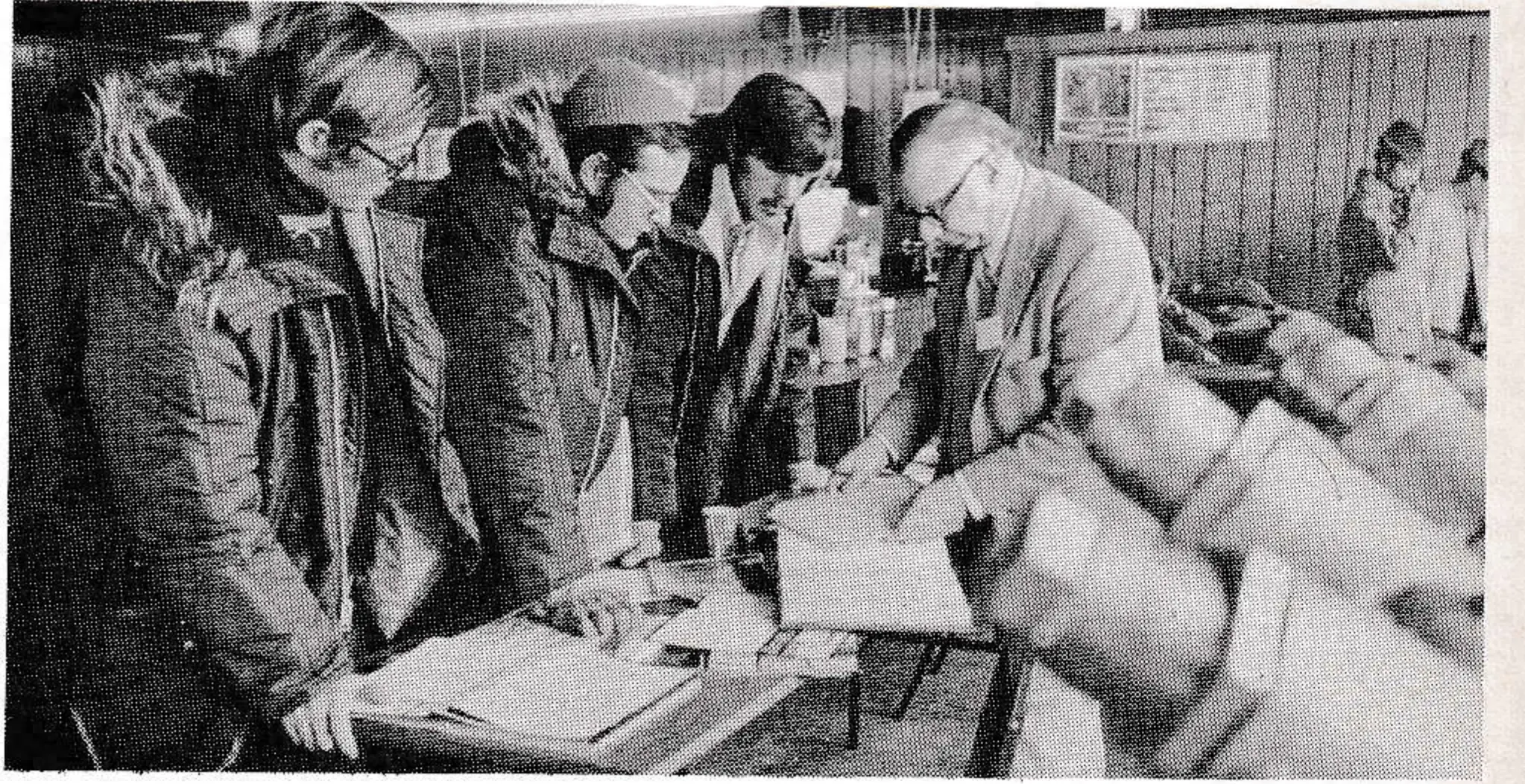
A very simple economic law applies here: areas can justify only so much expense to attend meetings and trade shows; and suppliers can justify only so much to get maximum contact with potential customers. If either part of the equation gets out of whack, the market place goes soft.
We think that SASA has the opportunity of doing something constructive for the whole industry. It can help NSAA in the planning of its mid-winter slope-grooming and snowmaking demonstrations, it can give NSAA some valuable input on the national trade show and it can be responsive to the needs of areas in providing further organized supplier/buyer contacts.
In addition, SASA can address itself to industry opportunities, such as standardization of parts, that will eventually make life much simpler for the area equipment men.
We welcome and support SASA.
A SAM Editorial
Opportunity and Challenge
Featured speaker at the NSAA banquet was John R. McGuire, Chief, U.S. Forest Service. Referring to the speech afterwards, Tom Corcoran of Waterville Valley, N.H., himself a Forest Service permittee, said it was “perhaps the most significant statement by a public official about our industry.” With apologies to Chief McGuire for whatever infelicities we have inflicted by our cutting, we present an abridged version of his speech.
I feel the next job is to combine the forces of the public land managers with the private development people such as yourself, to achieve the tremendous potential for the right kind of development and expansion in outdoor recreation as we are seeing in winter sports throughout the country.
I think we agree that the pressures for more outdoor recreation opportunities will continue to increase. A growing population with a high standard of living and added leisure time almost makes this a certainty. Coupled with this need for “more,” however, is the demand for “better” — better planning, better development, and better care of the environment we are using.
Now, I’m sure you will be interested in the direction the Forest Service will take in this atmosphere of “better” and “more” as it applies to winter sports. We think it’s a good time for your interest because we want and must have your active help and participation.
So you’ll know there has been no change in our historic attitude, we feel strongly that winter sports represents an appropriate use of the National Forests. Moreover, as an important segment of winter sports, we know that the need for high quality ski development is demonstrated all over the country.

In the next breath, let me again emphasize “quality” development, however. We have embraced as a major mission of the Forest Service a leadership role in quality land management. And, there is no better nor more highly visible field in which to demonstrate it than in ski resort development. We think the key to qualify lies in planning — interdisciplinary planning — as required by the National Environmental Policy Act.
Together we have recognized that the impacts of development are far broader than just where and how to build a ski slope. Entirely new towns usually spring up around each new ski development, such as in Vail; and existing towns have expanded around the older slopes, such as at Mammoth, Sun Valley, and Breckenridge. Unfortunately, a number of these communities have grown in a helter-skelter manner. Transportation and utility services for them have affected land far removed from the resorts themselves.
Determining the development of resorts and related communities requires our coordinated effort. We must become partners in resort area planning and management to assure order and compatibility of uses of our mountain forest lands.
How we accept our responsibility will be the key to the success of both our efforts. And I know it is easier for me to say than for us to do. So, I won’t tell you how to meet these challenges your industry faces today. I’ll merely suggest some policy.
First, I would say you should continue to strive for a strong national organization with continuing strong leadership.
Secondly, I would suggest you continue the fine start you have made toward self-regulation. Your record in tramway codes is outstanding—perhaps even a model of the capacity of an industry to impose realistic safeguards for the public through the American National Standards Institute.
At the same time, recognize that there are new and additional issues to be tackled. Environmental standards for development continue to appear. As they apply to ski areas, the question of who brings them into focus is up to you. And government supervision, control and regulation of service, rates and management are always on the horizon.
I’m not speaking just of the Federal government, either. President Nixon has told us of his desire to move as rapidly as possible towards increased delegation of responsibility to State and local governments. Certainly, your stake in this venture requires your participation and expertise at those other levels of government, in environmental matters, public safety, recreation community relations, growth and development involving ski areas.
The third consideration I would commend to your attention is an active interest and participation in public land management and land-use planning on all recreation-related lands.
Certainly, many of you have a very direct interest in the public lands. In general, your entire industry is keyed closely to public lands. This should be sufficient reason for you to have an equally strong interest in public land management policies. But I suggest that beyond interest, you have a responsibility to become knowledgeable about, and active in, the processes involved in establishing or rectifying public land policy.
In this country where growth has been tied to development of natural resources through free enterprise and private initiative, your industry should be a leader in public policy issues involving natural resources and public lands.
I hesitate to say it, but I do not see that leadership being displayed at this time. It is already too late simply to step into a void or vacuum. None such exists. Others are ahead of you, and the mantle of leadership will be difficult to don. In fact, simple participation will not even be easy.
The principle of sound land-use planning is gaining support almost daily, and it is here where you can take an active part in helping shape viable plans for recreation on both public and private lands. Congress is moving toward establishment of a land-use planning policy. Many hearings have been held and more are to come. Your organization should take part in them.
More specifically, the Forest Service is now engaged with the Bureau of Outdoor Recreation in efforts to develop a nation-wide recreation plan. Since you derive your livelihood from recreation, it is to your own best interests to assist in development of a sound plan.
With that, I will conclude by repeating that I think the winter sports industry has tremendous potential, and we in the Forest Service are eager to work with you to realize that potential. I believe you from the private sector and we in the government have already demonstrated that it is possible for us to cooperate to provide an outstanding service to the public. I am proud of our relationship.
Good luck, Slim
It now appears to be official. That long, attenuated Norwegian with the unlikely name of “Slim” Davis is retiring from the U.S. Forest Service. He hardly seems old enough for such precipitate action until we, who have known him, recall that for a guy who “drifted into skiing through the Forest Service” (his words), his drifting spans two generations of skiers.
Drifting is not the word to describe Slim’s years in skiing and the Forest Service. The mark he left here in Colorado, thence with the 10th Mountain Division during World War II, and finally to California where he ultimately was anchor man in the Regional Office of the USFS in San Francisco, his impact and the respect he enjoys throughout the ski area industry is hardly the expected achievement of a “drifter.” As one of my long-time ski area associates puts it, “Slim retiring from the Forest Service?!! My God! He’s the only one in the service who knows what the hell the ski recreation industry is all about—and who has the guts to make intelligent decisions about it.”
Strong words, perhaps; but they sum up our feelings about Slim. Where will the USFS find such a qualified replacement, especially a skinny Norwegian one, with an unlikely name of Davis?
Good luck, Slim.
Steve Bradley
Winter Park, Colo.