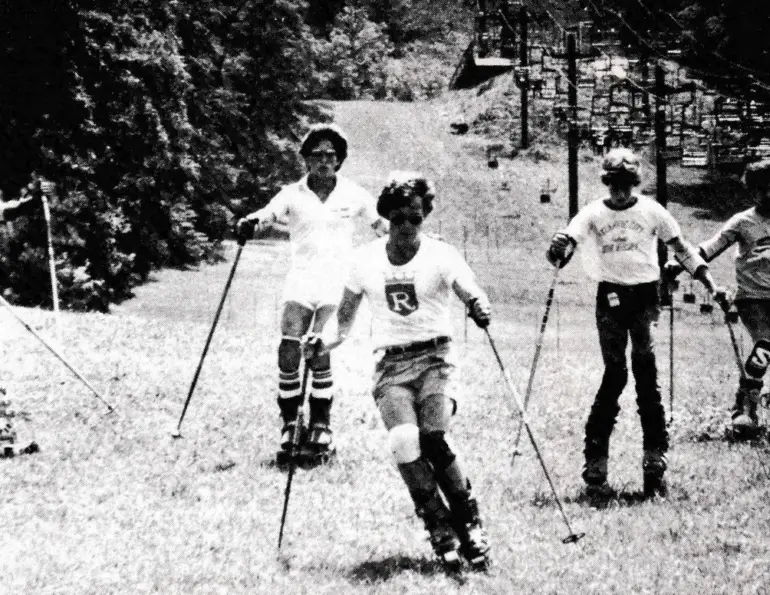
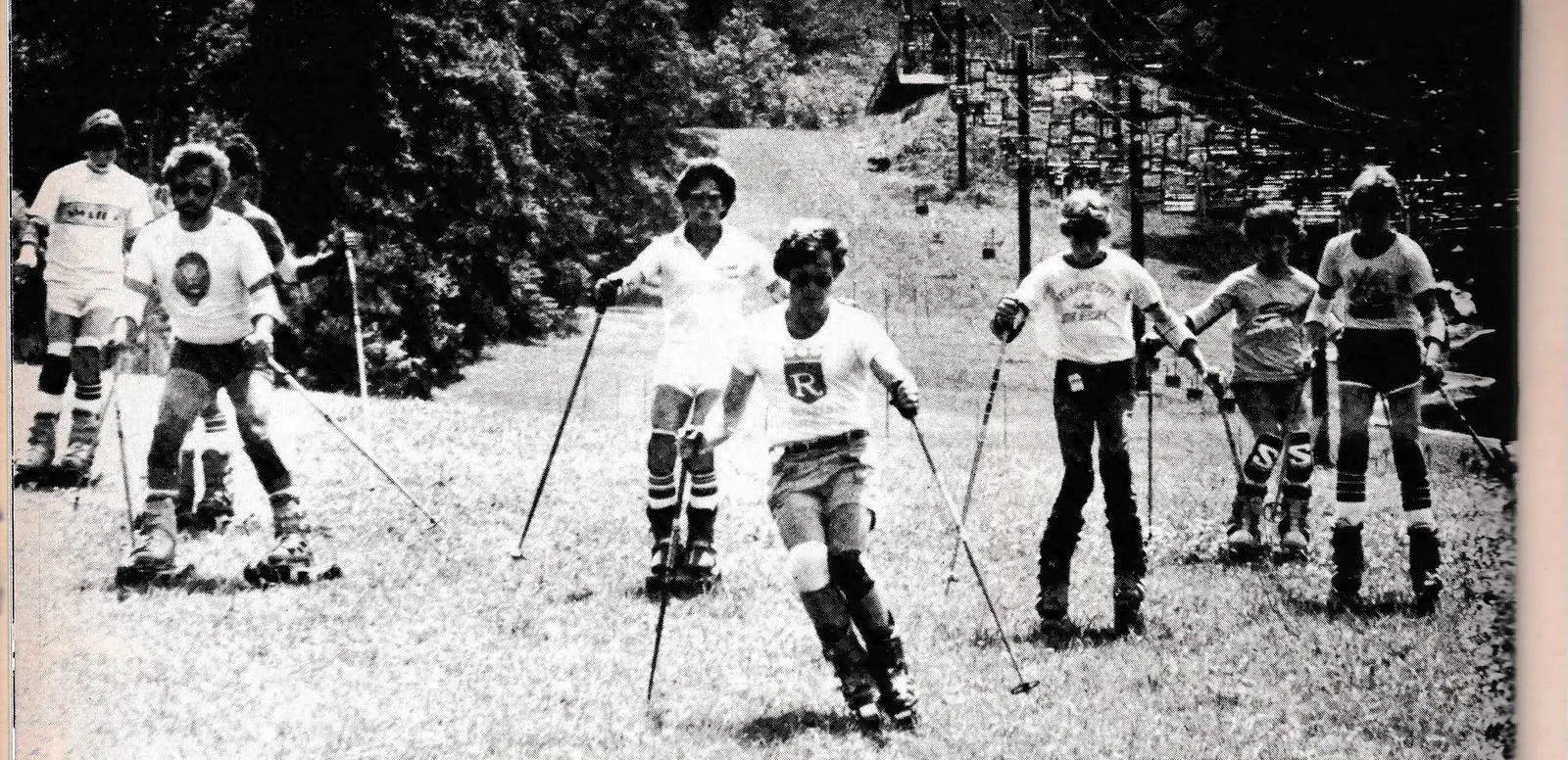
The grass skis of today are to “turf” skis what fiberglass skis are to hickory boards of the thirties. The original “turf” skis were heavy, wide-wheeled things that wanted to go only straight. Modern grass skis are relatively light and roll on caterpiller tracks that are easy to turn. From a distance the two skis look alike, but there the similarity ends.
Unfortunately the experience of area operators with those original grass skis in the late sixties, slowed acceptance of the newer versions in the seventies. Even with this resistance, however over the past three years 40 ski areas in the U.S. and Canada have installed grass skiing operations for spring, summer and fall business.
One of the leading grass skiing areas is Ski Liberty, Pa., where almost every weekend people line up to try the new sport. Ski Liberty also has an Alpine Slide to attract business and to amortize the cost of running the lift for skiers. With 61 pairs of grass skis, more than 1,600 boots from regular stock, using half-day sessions they regularly process 120 people a day on summer slopes.
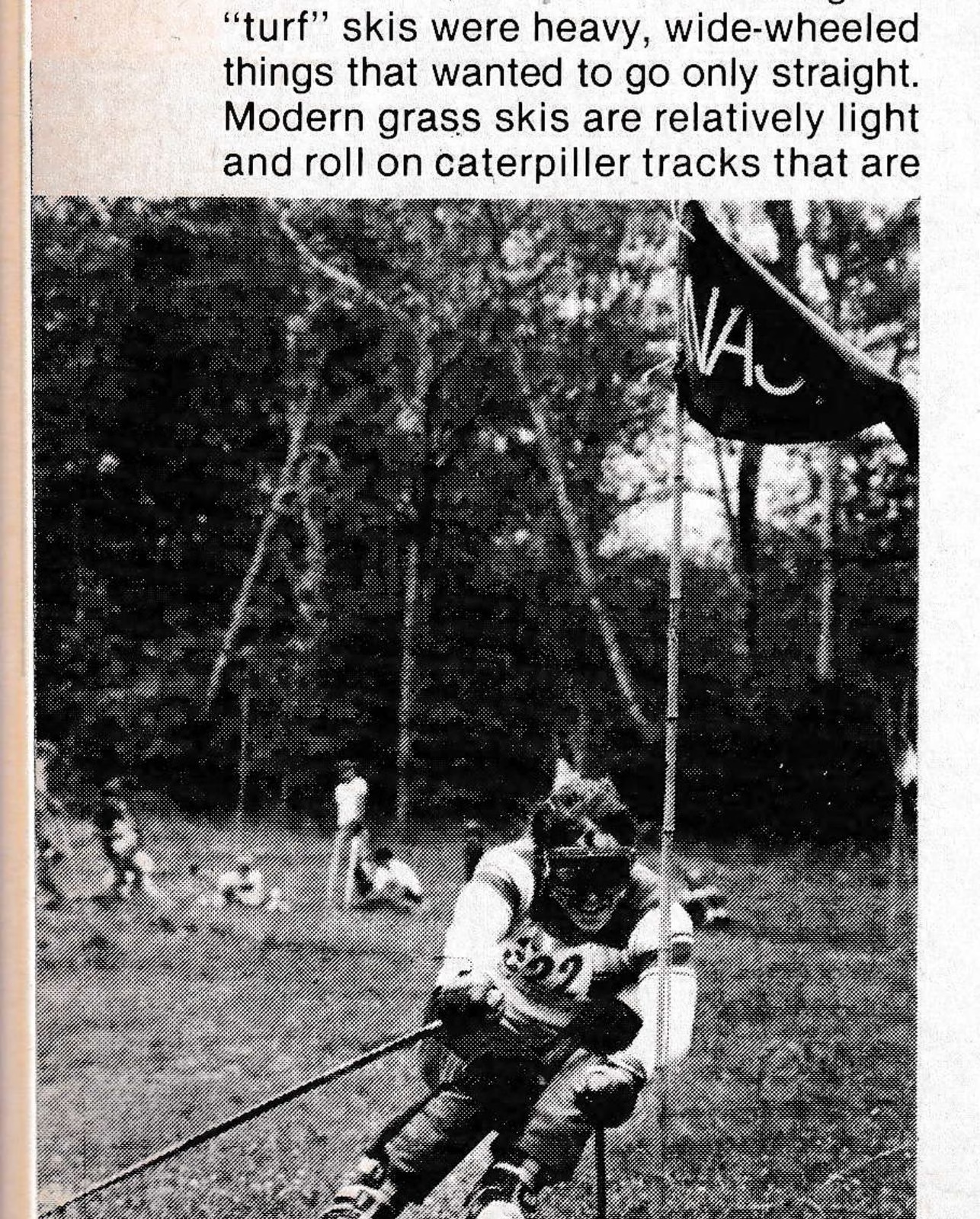
On peak weekends, beginning in August, Ski Liberty grosses about $1,000 and with minimum overhead in personnel—one lift operator is charged to grass skiing, one person in the rental shop, one person to supervise the operation and ski instructors when needed—meaning the net profit is substantial. In combination with the Alpine Slide, it makes an effective double attraction.
Prices last summer at Ski Liberty were $6 for a half-day lift ticket and $6 for a half-day of equipment rentals (whether or not the skier brought his or her own ski boots), with sessions running from 10 a.m. to 2 p.m. and 3 p.m. to 7 p.m. The all-day rate was $8 and $8 without the mid-day break. Grass ski lessons, applying the A.T.M. progression of snow skiing, were $4 for one hour group sessions.
New grass skiers are strongly encouraged to take lessons, even if they are experienced snow skiers. The reason is that not all the snow skiing techniques are used in grass skiing and, in general, the sport is much more precise than snow skiing.
The teaching experience at Ski Liberty indicates that rank beginners and advanced skiers learn faster than the novice to intermediate levels. The apparent reason for the beginner success is the quick adaptation to a non-slipping ski without the expectation of skidding learned on snow skis. Advanced skiers catch on quickly because they are already carving and edging to turn. For the middle group, the novices and intermediates, experience on grass skis can quickly break skidding habits and move them ahead in snow skiing technique.
Although the bindings, which come pre-mounted on the grass skis, are adjustable, but non-releasing there are few injuries associated with the sport. There are scraps and abrasions, but these can be alleviated with the use of skiateboard pads on knees and elbows. Aggressive skiers have fractured wrists, but leg fractures are practically un-heard-of because the short ski produces almost no torque. Ski Liberty has a ski patroler or first aid person on duty for emergencies.
Contrary to rumor, slopes don’t have to be groomed like a golf course. Water bars and ditches must be leveled (filled with large gravel and a layer of grass on top), and all but the smallest pebbles must be removed.
A hearty strain of grass stands up well, especially since most of the traffic is on weekends. Wide, fairly shallow (not steep) slopes are most skiable on grass skis. Rainly weather doesn’t deter the skiers, but does make the grass surface faster and slipperier. Slalom racing—growing in popularity—can cut troughs in the grass surface, but maintenance soon brings these areas back.

Three brands of grass skis are currently available in the U.S. The Rollka Grass Ski, made in Italy and distributed by Innovations Associates, Inc. of Chatsworth, Ca., has been the standard in the industry. It comes in four models: the recreational ski is 62 cm. long and has 19 elements (rollers on the tract), the children’s ski is 52 cm. long and has 17 elements, the slalom ski is 72 cm. long and has 21 elements, and the giant slalom ski is 78 cm. long and has 23 elements. They weigh from about four to seven pounds. One problem with the Rollka is the foot plate which is not long enough for larger sized ski boots.
The Locher Grass Ski was created by Horst Locher, ski school director at Bryce Mountain, Va., who introduced the Rollka to this country in 1976. Locher is a former member of the German National Grass Ski Team and now runs a successful grass skiing operation at Bryce Mountain.
Locher’s adaptation of the Rollka has less severe curves on each end resulting in less friction and wear; a reinforced frame allowing less twist; and larger, stronger foot plates. The combination of improvements seems to make the Locher ski edge easier and turn quicker, with less effort. They are available from the Locher Grass Ski Co., Bryce, Va.
The Ski Trac and Grass Hopper, made in Canada and distributed by Ski Trac, Menlo Park, Ca., was not as rugged and did not perform as easily as the other two brands when tested at Bryce Mountain in 1978.
The Rollka and the Locher recreational skis wholesale at about $95 with quantity discounts. Minimum start-up number for a grass ski operation is 25 pairs of adult skis. Of these about 15 should be the recreational size and type, 7 should be GS, and at least 3 children’s skis.
Maintenance of the skis consists of lubrication in a natural oil, which won’t harm the grass. Build a trough three to four inches deep and fill with a mixture of oil and water. Have skiers wade through this trough at the top or bottom of the slopes.
Grass skiing is new and as such a natural for television and newspaper picture story coverage. A few telephone calls and press releases with photos produces valuable promotion at Ski Liberty. Flyers were distributed in ski shops and at ski clubs. So far advertising has not been necessary for capacity days, “Think Grass!” bumper stickers are being contemplated.
Don Hubbard is grass skiing director at Ski Liberty, Pa., and is a member of the board of directors of the U.S. Grass Ski Association.