
My experience has been that many ski areas are doing a fine job in promoting and getting new skiers interested enough to come to the slopes. I wonder, however, whether the services for the skier once at the ski resort are always as sophisticated as the marketing and promotion efforts that brought him there. Do most ski resorts and ski schools really offer the most advanced, professional, and convenient programs for the new skier, child or adult? Or, are we continuing to permit situations where a new skier does not have the great fun and pleasure promised him by promotion and advertising, but instead has a horrible experience for his first day’s skiing that may go something like this:
- Arrive 9 a.m. and buys ticket. (Friend said to do this, not knowing that most areas do not require lift tickets for ski school students — especially beginners.)
- Looks for ski school desk, finds it, waits in line.
- Discusses various options — most of which he probably doesn’t understand — and settles on “weekend special.”
- Ski school desk tells him to hurry, because if he misses the 10 a.m. start he will have to wait for the afternoon session at 2.
- Starts search for rental operation. . .Finds it by spotting a long line.
- Goes through strange and unfamiliar procedures involving whole new language, and is eventually outfitted — hopefully not with beat-up, cheap-close-out equipment.
- Struggles to ski school meeting place by 10:30 and is told, “Too late! Come back at 2.”
He drove six hours the previous day to enjoy all the great scenery, congeniality and exhilaration that the advertisements had promised, and all he has done so far is to stand in long lines, be hurried through a bewildering system and then be told to cool his heels for a few hours.
This illustration points out the need for ski areas to improve their “Introduction to Skiing” programs at the resorts so that the new skier can enjoy his first day at the resort, his first time on the snow, and will want to come back for more.
Children are exposed to similar situations, and the results are even more devastating. They have just left the city and conventional classroom, ready for some fun and play, only to be placed in another authoritative classroom situation in Ski School.
Austrians Karl Koller, director of the famous Kitzbuehel Ski School, and Franz Hoppichler, coach of the Austrian National Team and head of the Austrian Ski Teachers Academy, have written a book, Frueh Ubt Sich (One who learns early, learns easiest), explaining how children should be introduced to the sport of skiing. There are 32 beautiful photographs portraying the fun and pleasure children can have in learning to ski. Even though Frueh Ubt Sich is based on teaching children, the basic principles of Koller and Hoppichler can easily be adapted to introducing adults to the sport. This book should be of interest to every ski school director and anyone connected with a ski resort. It gives not only a critical insight to teaching, but also refers to the needs of ski resorts to provide the best possible services for their customers.
In his preface, Professor Stefan Kruckenhauser writes, “Twenty-five years ago, Hannes Schneider told me, ‘Children and beginners are the gold mines of a Ski School.’” Taking it from there, Koller and Hoppichler point out in their introduction that skiing is especially suited to making children happy. Skiing provides exercise and play in fresh air, which is necessary for their physical and psychological development. Skiing provides the experience of body control and offers a closeness to nature. Skiing is a family sport regardless of age differences.
Why begin to ski at an early age? Experience has shown that the young learn easier. Particular ski technical movements can only be learned as a child or teenager. A child feels confidence on skis much faster than an adult, and with this security, grows the fun and motivation to do better.
At the heart of Koller and Hoppichler’s approach is “The new teaching plan,” and this features five fundamentals: 1) Playful learning; 2) Demonstrating; 3) Imitating; 4) Participating; and 5) Doing better.
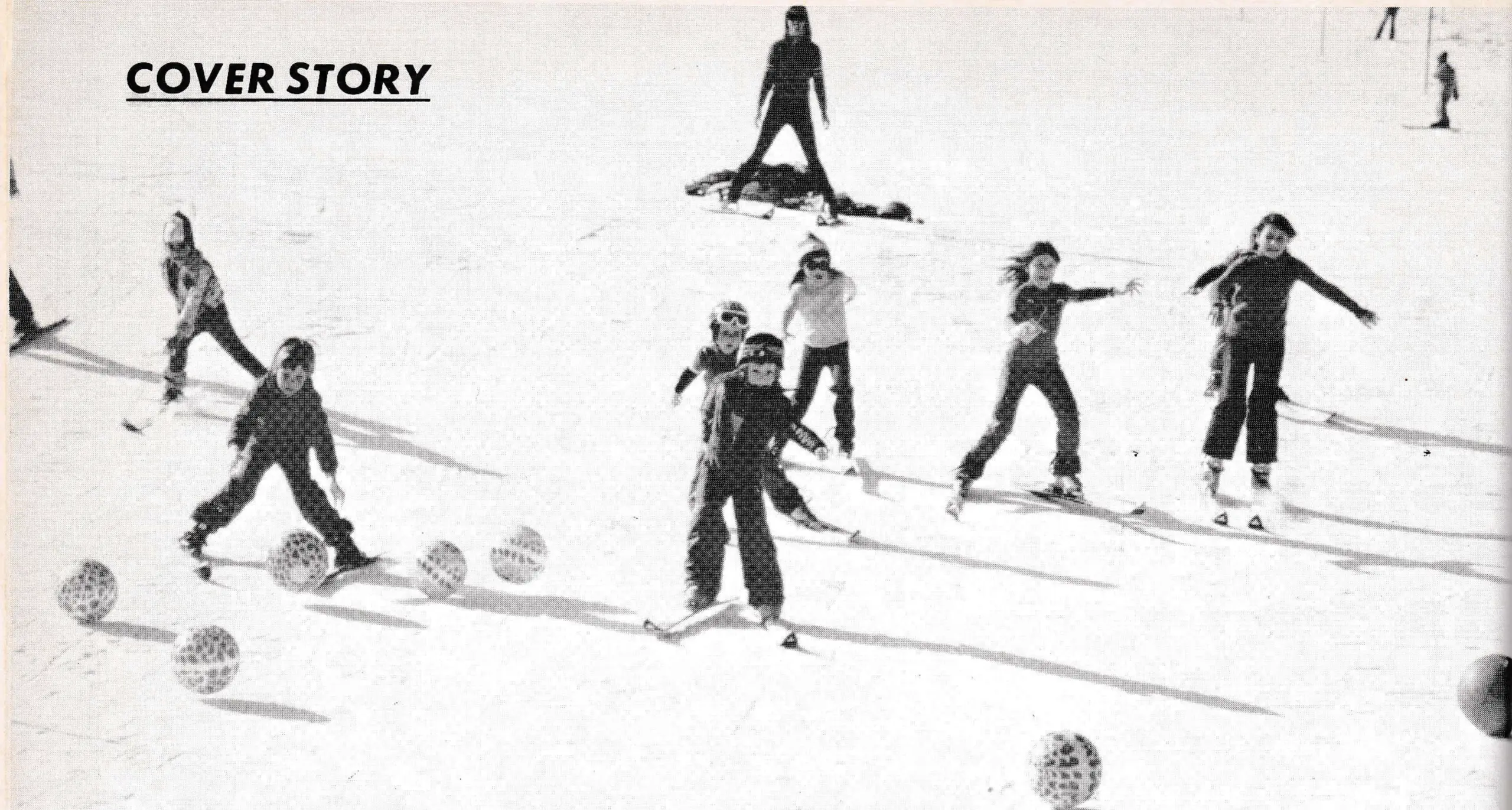
Teaching is often taken too seriously by parents and teachers. This causes many children to give it up or dislike any further lessons. A good knowledge of child psychology is necessary to teach children well. One has to feel what they like to do. The teacher should play with the children and have fun playing games. References to some of the subjects from the fantasy world of the child through processes such as a dwarf, a giant, a locomotive, etc., leads the child to feel comfortable on the ski slope. Demonstrations should be emphasized and shown with endless patience.
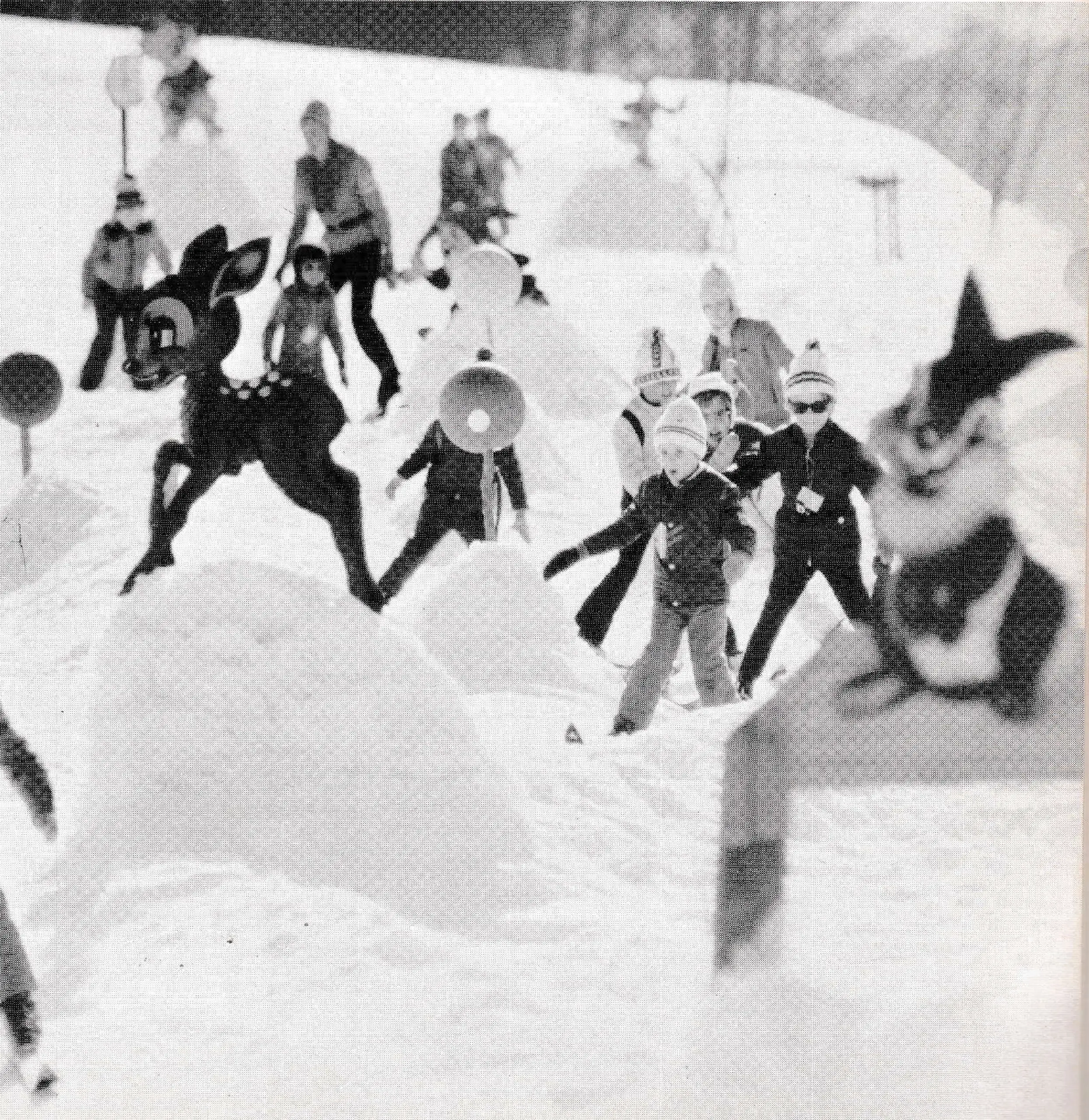
The Play-Slope and Terrain Garden are the basics for a children’s ski school. It is essential to separate and enclose the Play-Slope and Terrain Garden from the adult skiing, either with a wooden fence or rope or snow walls. Only without interference from adults can the children play happily. The area should be colorful. Happy figures such as Mickey Mouse, Donald Duck, etc., or animal story figures, take the stress away from learning and give the feeling of play and fun.
The Play-Slope should be created with optical parts: figures, balls, poles, snow houses, snowmen, flags, rings, etc.
The Terrain Garden, a separate area, is created with certain snow forms: The organ run (teaches balance, leg play); the bump run (teaches balance, turning aid, bump technique); the wedge run (teaches sliding, edge change, weight change); the cone (teaches side sliding, turning).

The Meeting Place should be in a flat area. Proper dividing means planning, organizaing and directing. The children should feel comfortable, quickly. Colorful signs and figures will help. The children should be divided according to their ability, age and condition.
The Baby-Ski Lift is an important part of a play slope. One useful device is the “Ski Carousel” (See Summer issue SAM,) which gives the first gliding experience and is also an exercise for learning to use lifts. The “Ski Carousel” is an electric-powered rotating cross. The child holds on to the arms, which can be adjusted according to height, and is pulled in a circle.
A children-oriented teaching method requires special talent and training on the part of the teacher. The motto for teaching children is: demonstrate — participate — play with — make better. To teach children means to have ideas. This demands much activity from the teacher. The teacher not only should know many games, but be able to demonstrate them perfectly. The care for the children is much more needed than simple technical direction or explanation. The child will grow slowly into skiing. Progress should not be demanded.
The key is: Movement — Games — Change. Children will, and should, learn to ski through play. During the lesson there should be no pressure. Rather than “you must,” it should be “you can” or “you may.”
The authors describe each teaching sequence in detail. The sequences are: exercise games in place. . .exercise games on the bar. . .straight run. . .wedge. . .wedge turn. . .balance and reaction. . .side sliding. . .turning. . .stepping. . .free skiing. . .tests, competition, team competition. . .races.
The authors also include a sensible section on equipment and clothing for children. Among their recommendations are:
- For small, physically weak children, short skis reach to the navel.
- For small children up to five years, maximum shoulder height.
- For children with better skiing ability, up to head height.
- Poles to reach under the arm pit.
Generally, children are better equipped than the adults because the parents do not economize on the health and technical progress of their children. Slowly but certainly, also, the industry is producing special equipment for children, rather than scaled-down adult models.
In summary, Frueh ubt sich is a great contribution to ski teaching and ski area services. I hope that this book will soon be translated and published in North America.