

Reviewing the B77.1 Standard
While most ski area administrators are aware of the American National Standards Institute’s “Safety Requirements for Aerial Passenger Tramways,” commonly known as the B77.1 Standard, it is generally thought of as something to specify in lift contracts as a reference that lift inspectors quote from when reporting on their inspections. The B77.1-1970 Safety Standard has a portion specifically devoted to the administrator’s responsibilities and just how that line of authority shall operate. Section 3 of the Standard, entitled “Operation and Maintenance” is aimed directly at the management of ski areas.
A review of Section 3 of the B77.1 Standard may give the impression that a ski area must have an elaborate organization to meet the requirements of the Standard. Actually, a close reading will show that a single rope-tow area can meet all requirements with a single person, while large areas with several lifts are presented with a clear-cut line of command and responsibilities.
The real point of this phase of the Standard is found in Section 3.2.1. It states: “All facilities covered by this Standard shall be operated by trained and competent personnel, and the owner shall be responsible for their supervision and training.” All too frequently, when litigation occurs, a lift attendant is found to have been given no more instruction than to report to a certain lift for assignment. While “training” does not imply that a formal schooling period must have been held, it most certainly does imply that a lift attendant should be given some degree of instruction in his required duties and the methods of carrying out these duties.
The key person in the uphill transportation facilities set-up is the “supervisor.” All other lift and tow personnel must report to him. He is given authority to deny access to any of the uphill facilities to any person that he deems unfit or not competent to use the equipment safely. He can close down equipment when he considers conditions unsafe. It is of the utmost importance not only that a competent supervisor be selected who will use these powers whenever necessary, but also that top management back up such decisions in front of skiing customers and other employees.
For each tramway, lift or tow, a person is designated as the “operator.” Under the direction of the supervisor, the operator is in complete charge of his facility. Only he can start his lift, and the safe and proper operation of his equipment is his sole responsibility. The Standard requires that the operator be “trained and experienced in normal and emergency procedures.” Additional personnel, if required, shall report directly to the operator.
On most tramways, lifts and tows, additional personnel are required to operate the equipment and attend to the passengers. These people are designated as “attendants” in all cases except on aerial tramways where the person in charge of each cabin is called the “conductor.” These personnel are under the direction of the operator and are responsible to him. They should give passengers instruction and offer physical assistance to passengers when necessary. They must be trained in both the normal and emergency procedures. An attendant or conductor must also have sufficient training so that he can observe and alert the operator to potentially dangerous operational or mechanical developments.
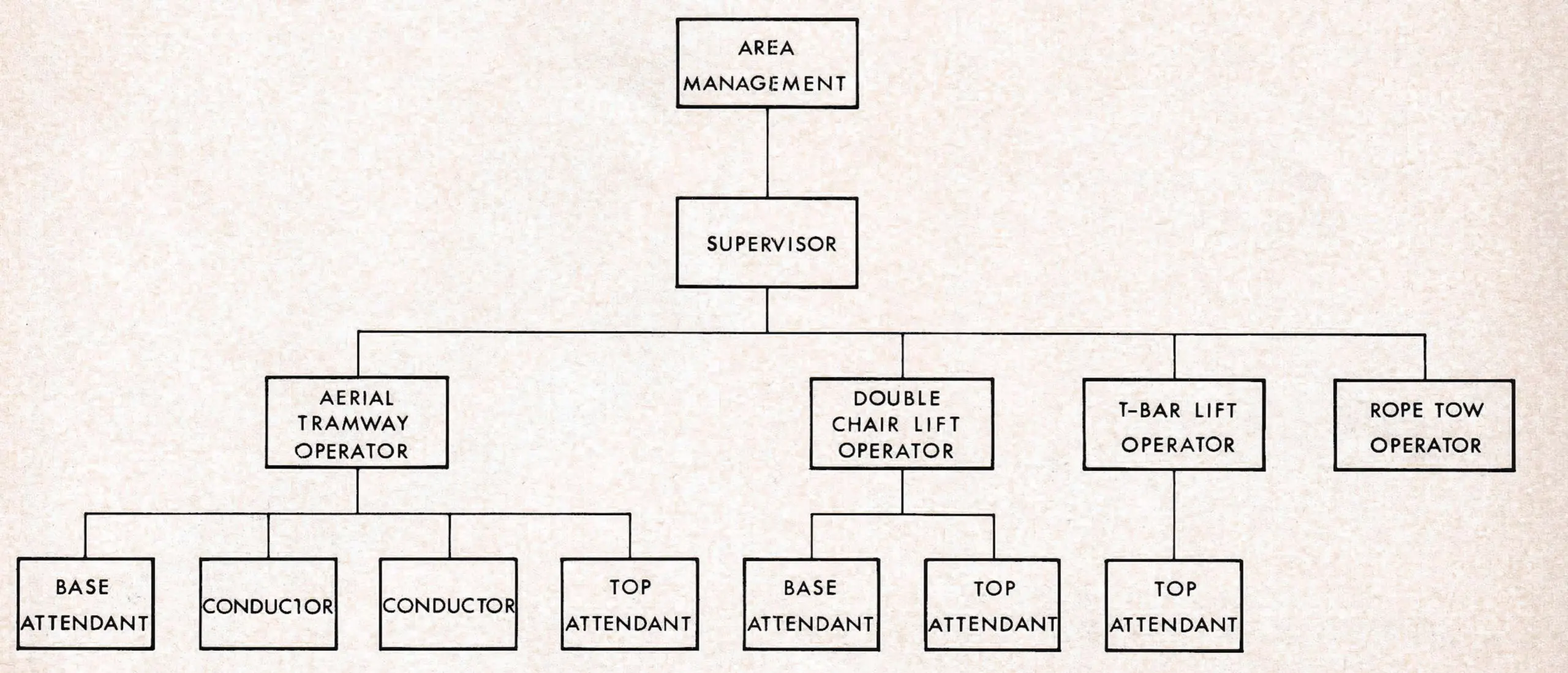
A typical operational chart is shown in Figure 1. The number of required attendants can vary from lift to lift, depending upon both the requirements of the Standard and the capacity (mid-week and weekend) requirements.
The B77.1-1970 Standard summarizes the duties of the Supervisor, Operators, Attendants and Conductors. These are listed in Figure 2 (see page 30), and such a listing should be available to each person so that his responsibilities are known.
The general requirements of lift operation are also detailed in the Standard. These must be supplemented with specific requirements for the mechanical operations of the lift as given by the lift’s designer. It is important to note that the designer is to furnish an operational manual, and no tramway, lift or tow should be accepted until such a manual is provided. The Standard’s requirements as detailed in Section 3.2.4 of “Operational Procedures” should be studied and a set of specific requirements for evacuation procedures, etc., drawn up for each lift.
Apart from these requirements, there is also a provision concerning first aid and, under the Standard, both supplies and an employee trained in first aid are required.
The importance of understanding and abiding by the requirements outlined in the Standard cannot be overestimated. Careful adherence to its provisions is in the best interest of skier safety and, as management is discovering, necessary to an area’s success.
Lift evacuation: another look
The techniques of ski lift evacuation and the proper evacuation equipment will receive close attention this season. Several accidents that occurred during evacuation last season have been reviewed and the equipment and techniques employed found to be seriously lacking.
As an example one area’s double chair lift was evacuated with conventional equipment using new ¾-inch-diameter manila ropes thrown over the lift haul rope. After some 50 chairs had been evacuated with one lowering device, the manila rope broke during the lowering of passengers from the next (and last) chair. A passenger was seriously injured as a result of the fall.
The recommendation of the proper evacuation ropes was submitted by the NSAA Insurance Plan to the American Cordage Institute. As a result, the Institute has recommended the use of ⅝-inch-diameter dacron rope. The larger diameter manila rope, it was found, could not withstand the sharp bending over the wire rope on the lift. The matter of evacuation from aerial lifts was studied by the NSAA Insurance Plan and area operators at a demonstration meet held at Mt. Mansfield, Vt., last month. Recommendations regarding materials and methods will soon be forthcoming.
FIG. 2—A summary of duties, as listed in the B77.1-1970 Standard, of the lift supervisor, operators, attendants and conductors.
Supervisor
- Determine that all tramways, lifts or tows are operational and that all operating personnel are trained, equipped and fit to perform their duties.
- Discontinue operation of any tramway, lift or tow due to physical, weather, personnel or other reasons.
- Enforce operational, maintenance and safety rules.
Operator
- Assume responsible charge of tramway, lift or tow.
- Assign and supervise all attendants on operator’s lift.
- Maintain an operational log book as required by Standard.
- Advise the supervisor of any conditions or occurences which may adversely affect operational safety.
Attendant and Conductor
- Maintain orderly passenger traffic conditions within attendant’s or conductor’s area of jurisdiction.
- Advise and assist passengers.
- Maintain surveillance of attendant’s or conductor’s area of jurisdiction. The operator should be advised of any unusual or improper occurences. Should a condition develop in which continued operation might endanger a passenger, the attendant/conductor shall stop the tramway, lift or tow immediately and advise the operator. The operator shall also be advised of changes in weather, ground or snow surface conditions.
Portions of the American National Standards Safety Requirements for Aerial Passenger Tramways, ANSI B77.1-1970, have been covered in this column. The complete Standard may be purchased for $6 a copy from American National Standards Institute, Inc., 1430 Broadway, New York, N.Y. 10018.