
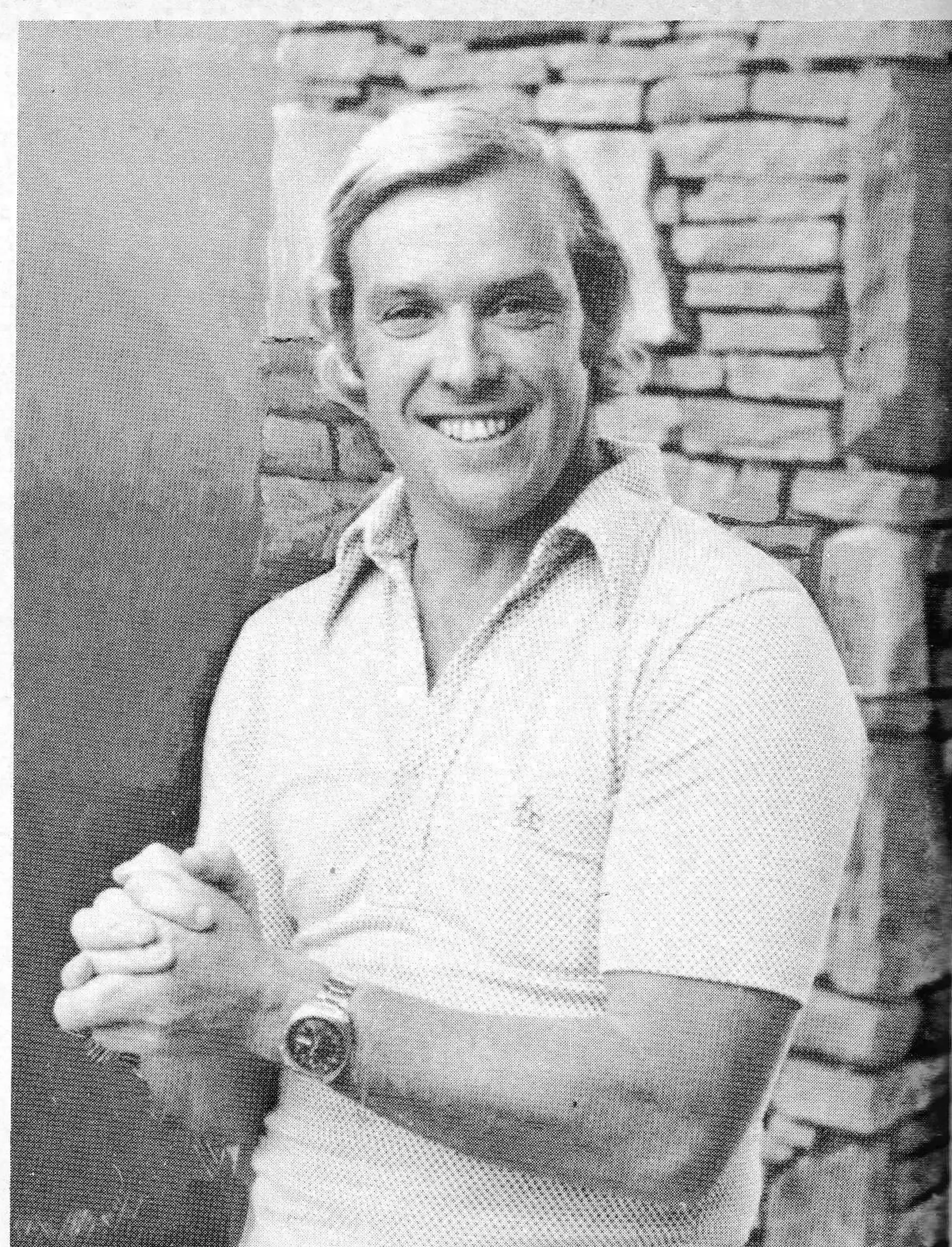
Ski patrol, trail crew, public relations, assistant manager, general manager, vice president, president and owner, foreclosed debtor and employee of the bank. The whole thing in 15 years — telescoped because John Christie moves fast, but in terms of experience, rather complete.
He did his “undergraduate work” under Amos Winter at Sugarloaf and got his “Masters” from Walt Schoenknecht at Mount Snow. People regarded him thoroughly trained and broadly experienced in the business of running a ski area. He learned his lessons so well there seemed to be no obstacle nor challenge unwilling to yield to his quick mind. Even Vermonters, who can eye second-generation natives suspiciously, granted this 35-year-old newcomer from Maine a supreme token of confidence when they elected him president of the State Chamber of Commerce just before he left Mount Snow.
It might be said he is a natural promoter who never had a defeat until the one that took him out of the ski business.
Even now he is walking proof that people who run ski areas may be the original model for all optimists. If it rains today, it will snow tomorrow. If you lost a ski area last year, there’s an exciting new venture to be learned this year. If there is a joy in total immersion in one’s work, there is a new dream that can make the old one fade out of sight.
In the case of John Christie it is no coincidence that his new boss is Maine’s “salesman of the year.” Now a vice president of one of Maine’s most creative advertising agencies, Christie is “doing all the time what I did best in the ski business — promote.”
John is so totally engrossed in writing speeches for political candidates and developing TV promotions that at this juncture he sees the ski business as an important but closed chapter in his life. Of course, he is too sage to close off his options. “I have to get tied to expansive ideas,” he insists, “whether it’s a destination resort or selling” his friend Bob Marks to the Maine electorate as their next U.S. Senator.
But he seriously doubts whether he could be lured back into running a ski area. If he were, he says, it would more likely be at a Bigelow than an Aspen; for John’s home — spiritually as well as geographically — is Maine.
Ironically, it is that pull of the land — certain mountains, lakes, states of mind — that brought him home to his first big defeat. Likewise, it is his feeling for Maine that helped shape his decision to remain there and abandon the ski business.
About his ill-starred purchase of Saddleback Mountain in northern Maine four years ago he says he has no regrets. Nor is there any bitterness, save possibly a corner reserved for a few bankers “who can make you feel guilty because you didn’t make it snow.”
Adversity, needless to say, has given him new insights into his own assets and liabilities as well as those of many of his colleagues. And new associations in the world of business have reinforced his perspective “that skiing is peopled by some rather spectacular individuals.”
Counted among his dearest friends to this day, he is proud to say, are “two of the most opposite kinds of people in the world: Amos Winter at one end and Walter Schoenknecht at the other.”
But let him tell the story in his own words, for it contains the stuff of which careers in the ski business are made — both then, and still.
What got you into the ski business?
I came back from a fellowship in Sweden (studying Icelandic literature) after graduating from Bowdoin, and went spring skiing at Sugarloaf in 1961. It was beautiful — sun powder snow, a young honey. Everything was right.
I only had $5 so when my buddy left, I borrowed another $5 and joined the ski patrol. I’ve always said the most I can lose in the ski business is $10 — and $5 of that was Bruce Chalmers’.
That summer I worked on the trail crew, and the next winter I became (manager) Amos Winter’s assistant. I headed public relations and learned under Amos until I became general manager the winter of ’65-’66.
I’ve often said Amos taught me the value of a dollar and Walter (Schoenknecht) that of a million. I remember once this guy comes up flashing all these credentials at Amos. “Hi, I’m Mike Strauss of the New York Times,” he says.
Amos doesn’t blink an eye but shakes his hand and says, “I’m Amos Winter of Kingfield. That’ll be six dollahs.”
I would submit had everybody listened to Amos more, Sugarloaf wouldn’t have had a debt overload. One of his great lines came at a Chinese restaurant. The Sugarloaf board of directors was locked in silence, pondering an important expansion decision. Out of the silence came Amos’ voice: “Pass the soy sauce!” That was about what he thought of it.
When I went to Mount Snow (as general manager, Oct. 1, 1968), it was a whole new world — besides a jump in salary from $12,000 to $20,000. That year the ski operation was making about $2 million and the hotel company $750,000 — virtually all of it in the winter. The summer I went there they grossed $60,000 in hotel rooms, which figure was $600,000 the last summer I was there.
I perceived three principal responsibilities for myself at Mount Snow. One was to humanize the resort because I think it grew so fast. There wasn’t much feeling among the staff, and there wasn’t any feeling of the staff for the consumer. I started right off with the clothing and an esprit, and, of course, I became very visible, where my predecessor, Harvey Clifford, who was extremely well organized, was virtually invisible.
I brought the middle management group into my confidence and really worked at opening channels of communication. We got the guys running the lifts giving skier feedback to the guy running the hotel.
Second, I felt it was imperative to develop the place on a 12-month basis instead of a four-month one. And third was to bring the total operating structure into a whole, clarifying relationships and functions.
Were you there when the investment decisions were made that eventually got Mount Snow into trouble?
The summer before I arrived that whole program had started and continued through the following year. $2 million — the second nine holes on the golf course, the airport, 30 rooms on Snow Lake Lodge, a new dining room at Snow Mountain Inn, Gondola 2, and the fifth floor on the base lodge — all in one fell swoop.
And the real problem was a third million in overruns. If Walter could have bitten off a million and serviced that for a couple of years. But he bit off too many. Then there were a couple of years that weren’t so good. Walter wasn’t prepared for the overruns, and it was a scale infinitely bigger than I was accustomed to at Sugarloaf, and the die had been cast. Still, I think Walter’s concept was right if you want to take that kind of chance. He really foresaw the environmental clampdown coming before anybody.
What was it like working with Walter?
Fabulous. More like an associate than a superior. The greatest thing was the first two winters. We traveled together all over the West and Europe visiting resorts, sharing our reactions. It was a spectacular education.
The image some people have of him is of a money-grubbing, super-developer sort. But as far as Walter is concerned, if everybody could come and ski free and leave thinking ‘this is the most spectacular place in the world and Walt Schoenknecht is responsible for it,’ and if he could have gotten the Ford Foundation to underwrite the operating costs as a philanthropy, that would have made him perfectly happy.
It was frustrating sometimes. There are various means of dissuading Walter once he has made up his mind, but logic is not one of them. You know, if I really disagreed, I wouldn’t try to show him the facts. I’d try to say that it hurt my feelings or something. That would mean much more to him. Or that someone might not like him.
He really likes to be thought of as somebody who has done something. And I hope he will be. He plowed an awful lot of new ground.
What was it like when Davos came in in 1971 and what were your relationships?
Mark Fleischman had developed a burgeoning enterprise at Davos, and I had a great respect for him. Of course, their resort experience had been at Big Vanilla (N.Y.), and I had the uneasy feeling I was going to see created at Mount Snow a huge Big Vanilla. That was contrary to my view of what a ski area should be.
I think Mark’s only real problem was he began to believe the things people were writing about him. He was just like all these guys that built these conglomerates. And it wasn’t until times started getting tough that they realized it wasn’t them — it was the ’60’s that made these things work.
When times got tough, what should they have done?
It’s what they did do and shouldn’t have. Borrowing more, changing pockets. They found some dummies to loan them another $2 or $3 million based not on earnings but on $9 million worth of assets.
I think Mark Fleischman’s premise was right: that the steady earnings of his meat business would help provide the capital with which a resort could operate and grow, and the resort would bring excitement to an otherwise dull investment. Unfortunately, it wound up in reverse with all of the loans not going into Mount Snow.
What was your main motivation in returning to Maine to buy Saddleback?
To have my own area. To prove something. “I can run other people’s ski areas very well. I really ought to do it for myself.” And I had seen through Walter’s eyes a vision of an integrated, high density destination ski village. I saw it wasn’t going to happen at Mount Snow, and I thought this was probably the way.
Christie bought Saddleback Mountain in Rangely, Maine in 1972. The deal was described by the man who sold it to him as the only purchase he’d ever seen where “the seller put up the down payment.” Actually, Christie did invest $10,000 of his own money. But the Gannett Publishing Company, the previous owner which had inherited the property, also put up $20,000.

Gannett, according to Christie, was willing to take a healthy loss — provided the buyer would be acceptable to the people of Maine and also could devise a “properly structured” loss. John accommodated them on both counts.
He wound up buying a $1.3 million investment for $220,000, plus taking over payment of a $240,000 Gannett note held by the Casco National Bank. Christie had to service the $240,000 bank loan but only had to pay the interest on the $200,000 he owed Gannett, who had already advanced him $20,000 on the down payment.
“But I knew even $240,000 of serviceable debt would be difficult to do,” he reflects. “So even before the deal I tried to get Hudson Pulp and Paper (landlord of the 1,600 acres under the ski area) excited about being a prospective partner in future development. And Hudson had every reason to believe it made sense.”
Christie says it made no sense for him to return to Maine “to run a little ski area, even if I owned it. I had to turn it into a destination resort.”
But from the beginning there were problems — starting with poor snow seasons back to back. The first year he was able to service his debt but had nothing left over. The second year — 1973-74 — was the East’s disaster year in which Christie lost $60,000, wasn’t able to service his debt, and agreed to let the bank take “peaceful possession,” removing his interest from the area.
John ran the area for the bank in the third year, and it snowed for a change. For the first time he made some money, about $60,000 — enough to pay off his personal debts but leaving some $40,000 in old corporate debts. In two years the venture had lost $100,000.
How did you approach your financial woes at Saddleback?
I had to call on a few friends to help me structure something to keep it going and also to encourage me as to my own sanity. With the banks indicating I should have told them it wasn’t going to snow I began to think: “Well they’re right. I’m the biggest f—up that ever came down the pike. How did I get the idea I ought to own a ski area? What a bizarre idea!”
But then three close friends and advisers (including Independent U.S. Senate candidate Bob Monks) would tell me nobody could run a ski area like I could and not to listen to those ———-.
It was just apparent that these problems I had long perceived—I had somehow deluded myself that they applied to everyone but me. One might call it the “Tom Corcoran syndrome,” where one is deluded into thinking his own charisma is sufficient to overcome the realities of these facts.
Tom and I are very similar in that regard. I think Tom knew the facts. . .that you couldn’t borrow that much money and make it work. But he thought like I did that we wrote this text for those other guys. Tom, of course, sees a potential at Waterville Valley, which does in fact exist. And while I still believe that with sufficient equity capital Saddleback would make a successful 2,000-bed destination resort, there was no reason for me to stay there and work for the Casco National Bank. . . .
The problem with most of these repossessed ski areas is that the people running them have local credibility, and nobody else knows where the f—– valves are in the cellar of the base lodge. That’s the frustrating thing for banks. There are a few guys — maybe I’m one of them — who are where we shouldn’t have been. But in general the management are the best people that should be there.
I understand there was a Sno-engineering study of the Reddington Bowl, into which you planned to expand, at the end of your third year there, when you had the opportunity to pick up an option and rebuy the ski area. And the results of that study made Hudson, which had invested $150,000 in your condominium sewage system, back out as an equity partner. What was Sno-engineering’s report?
Basically that both Sel Hannah, who initially had given the bowl a good report, and I had been wrong. Not enough intermediate terrain, too long a runout, and terribly ledgy. I had hiked it and flown over it but hadn’t spotted it.
And here my friends were such helps. They said, “You’re growing old and losing your self-respect and pride, and the bank has got you over a barrel. Tell ’em to stick it.”
. . .Finally, the bank agreed to sell Saddleback to the condominium owners for 50 cents on the dollar — around $150,000 with accrued interest. But even after my friends said, “John, do something else,” I felt: “If I can get it for $120,000. . .” I was still game to try to do it somehow.
So I offered them $120,000. And the condominium owners said, “We’re with you.” But the president of the owners’ association emerged as a potential competitor.
About that time my friends were saying, “If they give it to you, don’t take it. You’re not a boy wonder anymore. Don’t ruin your health.” I finally withdrew my offer. . .
In retrospect was Saddleback a mistake? Do you regret it?
Oh, no. I’ve really profited from whatever I’ve done. I agree with Muhammed Ali. I would do exactly what I have done. I would have just timed it a little differently. I should have bought Saddleback the year after which it snowed for the next three. I didn’t.
. . .If I had only been involved in the long-range planning function, I would probably feel more guilty about not having perceived the terrain problem in the Bowl. Even then it was disappointing but not devastating.
If you had known about the Bowl’s terrain problem, would you have bought Saddleback anyway?
(15 second pause) I would suspect so at that time because in my own mind I would have offset that report with some extensive optimism about the weather. (Laughing) “Well, that looks bad, but s–, it’s gonna snow, and I can make that place work.”
What more than anything else would you say you’ve learned from this whole experience?
(laughing) You shouldn’t base any of your decisions on somebody else’s judgment. And foremost on that list I would put bankers.
One of the last proposals put to me by a supposedly knowledgeable banker was, “Gee, John, it’s too bad you don’t own the land instead of Hudson. If we just had more land for security, we could loan you some more money.”
And I said, “Why you silly —-, can’t you see that’s the problem? You bankers are only interested in collateral! Can’t you see that we’re here today because I borrowed too much money consistent with what the place could earn. And here you say, ‘if we just had some more security we could lend you some more!’ Your only interest is what can you sell the place for after you repossess it.”
I’ve also learned one has to be extremely critical of one’s own judgment. You can’t make snap, emotional-type decisions out of which interest is going to have to be paid.
There’s the old argument that you can’t get a ski bum to run a ski area. There’s something to be said for it. But in the long run, I’d much prefer to teach a ski bum to read books than get some accountant fired up about the sport.
Now totally committed to learning the advertising business, after a few months on the Governor’s travel council and exploring a few ski area opportunities elsewhere, Christie at 39 often spends better than 12 hours a day at Ad Media’s exquisitely redone colonial building headquarters in Augusta. Obviously, he sees less of wife Jill and sons J.B., 11, and Flint, 7, at the new family home in Farmington, almost an hour away, than he used to. What has the whole thing taught him?
Don’t take it too seriously. I’ve long since stopped thinking about (Saddleback). I thrive on work, and I’m working just as long and hard as I ever have. Only now I don’t have to worry about the weather.
The Quotable Christie
- “I’m a natural promoter; I learned to be a manager — on the firing line. And I became a good manager at Mount Snow.”
- “I really do work best in crises. My calmest moment was probably when the summit lodge was burning down. I’m probably most tense lying on a beach somewhere.”
- “There are universal problems common to managers anywhere. The guy who had the job of how to clean out the dead Christians at the Coliseum had the same problems. How do you get the lions out? Clean up the place? It’s the same at Mount Snow . . . (Suddenly chuckling) only not so many Christians.”
- “I’ve always had the talent not to second guess myself or anybody else. Middle management appreciates that. Otherwise, they won’t do things for you. And I’m very serious about recognizing people working for me when they do a good job.”
- “Failure? I didn’t have any. My biggest failing was the inability to anticipate . . . what if it doesn’t snow for two years and Hudson Pulp and Paper pulls out. I don’t apologize for it, I think. Walt Schoenknecht didn’t build Mount Snow by saying, ‘what if . . .’ “
- “It might be said nobody should buy a ski area who doesn’t have a lot of money. But if I’d had a lot of money, maybe I’d be saying, ‘Make sure you don’t put your own into it.’ ’cause I would have lost mine.”
- My advice is that with today’s high interest rates and short mortgages you almost have to have a major share of your capital in equity. But I guess if you have to borrow, make sure it’s from a bank. Like Bob Monks says, ‘If you owe a bank $1,000, you’re in trouble. If you owe ’em a million, they’re in trouble!’”
- “The guy carrying a big debt trying to build a medium-size ski area — it’s a lot of goddamn work.”
- “My most satisfying success? In a reasonably short time turning Mount Snow into a profitable operation and a pleasant experience for the people who were there.”