
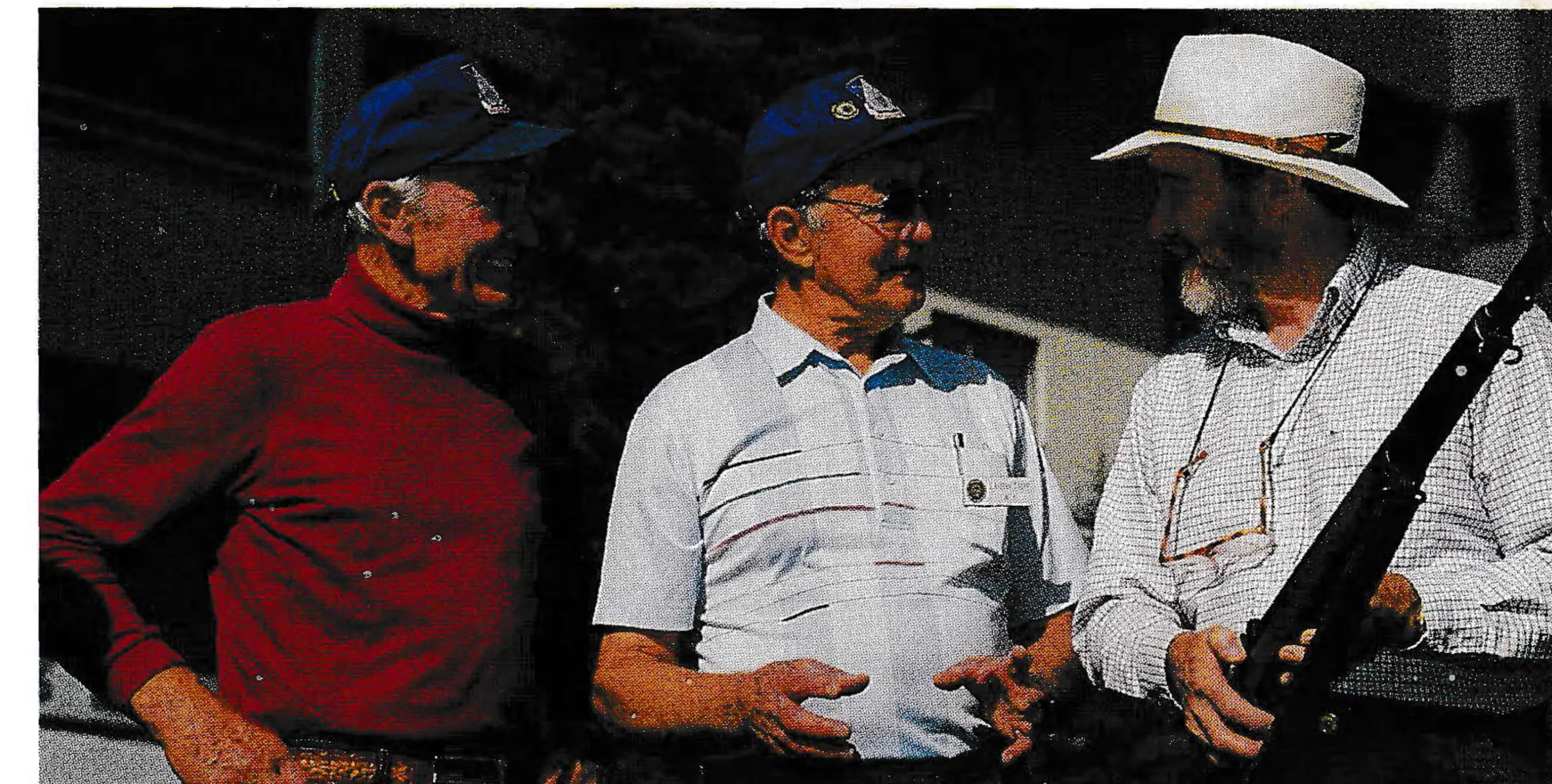
The setting alone told the story of the Tenth Mountain Division’s impact on the world of American skiing. Meeting for their fiftieth anniversary reunion in the modern super-resort called Vail, Colorado, the men of the Tenth, some of whom had never once in fifty years been back to the mountains of Colorado, were luxuriating in modern ski resort facilities, in a valley which had been little more than a sheep pasture when they had begun their training for war fifty years before in Camp Hale, three valleys south of the present day resort. And the very existence of this resort was due to the singular efforts of a small group of their Tenth Mountain comrades, three of whom were there to welcome them back to the mountains where it all began.
But Vail is not unique in reflecting the impact of the men of the Tenth on the American skiing scene. Among the more than 800 veterans of this renowned World War II fighting unit at Vail were 60 or more who have made a significant contribution to the postwar explosion of ski development throughout America. And there are at least 250 more Tenth ski pioneers who were not at the reunion, who either could not attend, or who had passed away.
Such is the legacy of the Tenth that one cannot name an aspect of the ski industry — equipment, ski clothing, ski area operation, instruction, coaching, publishing, marketing — where the honor roll of ski leaders and innovators does not include at least one, or in some cases several dozen, names of Tenth veterans. And many of these ski leaders were on hand at Vail.
But the reunion was not held to celebrate the Tenth’s role in the ski industry. As perhaps the last time these men could gather in Colorado’s high altitudes, this gathering was consecrated to the memory of the nearly 1,000 men who fell in the Tenth’s brief but bloody combat, and to the camaraderie these mountain men had developed on the battlefield, and during their rugged training at Camp Hale. It was a time to greet old friends, and make new ones out of shared experience. To pore over scrapbooks and photos of the war, to marvel at the primitive ski equipment they had used in the forties, and to spend hours over an amazing number of drinks recounting stories of “their” wars — stories that had in some cases been bottled up inside them for nearly five decades.
There was a serious, and constructive side to the reunion as well. At board meetings, general sessions and hotel room conclaves, Tenth veterans discussed the ongoing funding for their Association’s Foundation, which maintains the Tenth monument at Tennessee Pass, and funds scholarships and other worthy causes. They discussed funding for more huts on the Tenth Mountain Division Trail, between Aspen and Vail, and contributions of artifacts to the Tenth Mountain Division Resource Center in Denver. Many of them participated in the unique research being conducted by the Colorado Altitude Research Center under famed mountaineer Dr. Charles Houston. This project, testing some 200 veterans, constituted the largest research sample ever chosen to study the effects of altitude on men over 70. And all took pride in the selection of Camp Hale as a National Historic Site.
Admittedly, for those of us who have spent our lives in the world of skiing, the reunion was also an ingathering of old ski industry friends and associates. Not surprisingly, very few among us are still currently engaged in the ski business; those who are could be counted on one hand. Yet all, without exception, have kept their hands in skiing in one way or another. John Woodward, former executive V.P. of Anderson and Thompson Ski Co., has become one of the nation’s leading Masters ski racers. Dick Wilson, once editor of Skiing, is active in the ski racing programs of the National Handicapped Association. Leon Wilmot, former head of Ski Broadmoor and a U.S. Ski Association official, serves on the board of the Tenth Mountain Division Trail.
Even those who are still active have for the most part accepted a background role as they near retirement. LaVerne Trapp, founder and still head honcho at Pine Mountain resort in Michigan, admits he has relegated the day-to-day responsibilities at his mountain to his two sons. And Pete Seibert, founder of Vail, mans a research and development desk in the office of Vail’s beleaguered owner George Gillett, from which he regards with a detachment born of long experience the tribulations of this latest among Vail’s corporate owners.
Among the currently active ski industry personalities, two who were at Vail stand out: Nick Hock, former owner and still publisher of Ski Business magazine, and H. Devereaux “Dev” Jennings, the last and perhaps greatest of the old-school ski publicists and marketeers, who today presides as executive director of Ski New England.

Perhaps as important as the ski industry personalities who attended the Tenth reunion were some who did not. In his welcoming remarks to the assembled men of the Tenth, Pete Seibert recounted how his old boss and founder of Aspen, Friedl Pfeiffer, when Pete was bemoaning the lack of top jobs in skiing, told him, “Go build your own ski area!” Friedl could not attend the reunion for health reasons. Another pioneer ski area developer, Bill Healey of Mount Bachelor, Oregon, crippled with arthritis, sent an inspiring message to his former comrades. Healey is the driving force behind a major fund-raising effort for the U.S. Biathlon team, who will wear the Tenth Mountain insignia on their uniforms at the next Winter Olympics. Fritz Benedict, founder and prime motivator of the Tenth Mountain Division Trail and hut system, could not attend because he is immersed in a new and visionary scheme to link downtown Aspen to Buttermilk and Snowmass with a giant aerial tramway system.
Wandering the halls of the headquarters Radisson Hotel, one encountered dozens of men from every corner of the ski industry — from area management to ski journalists, from ski school directors, instructors and coaches to manufacturers and retailers, patrolmen and forest rangers.
Even without listing their worthy names, it is clear that the men of the Tenth have had a huge and lasting impact on American skiing. As this observer perused the displays of hickory skis and leather boots at the Reunion, then took in the high-tech, brilliantly colored equipment at Pepi’s or Gorsuch’s, the full impact of American skiing’s progress became evident. The men of the Tenth Mountain Division played an important part in fostering the great postwar ski boom, that led from the barracks at Camp Hale to the 1950 World Championships in Aspen, the 1960 Olympics at Squaw Valley, and back to the World Championships at Vail in 1989.
Having brilliantly fulfilled their military role by smashing the German mountain defenses in northern Italy in 1945, the Tenth Division’s ski troopers went on to play a seminal role in the development of American skiing. Who can blame them for taking a quiet pride in their accomplishments as they gathered, perhaps for the last great reunion, in the Colorado mountains where their legacy began.
Bob Parker, member of both the National and Colorado Ski Halls of Fame, is one of the Tenth’s most illustrious alumni in the ski industry. Originally a journalist and editor of Skiing, he joined Vail in 1962 and directed that resort’s marketing for many years. In his retirement, Parker is doing graduate work in archeology and geology.