

Chile is a country undergoing rapid, encouraging change. The rightist Pinochet government is about to hand over the reins to a civilian government and Chile boasts the healthiest economy in Latin America. With single-digit inflation, a real annual GNP growth of five percent, and unemployment under eight percent and a positive balance of payments based on healthy exports of copper and agricultural products, Chile can be said to be building the kind of prosperity that creates political stability — and the chance for increased tourism.
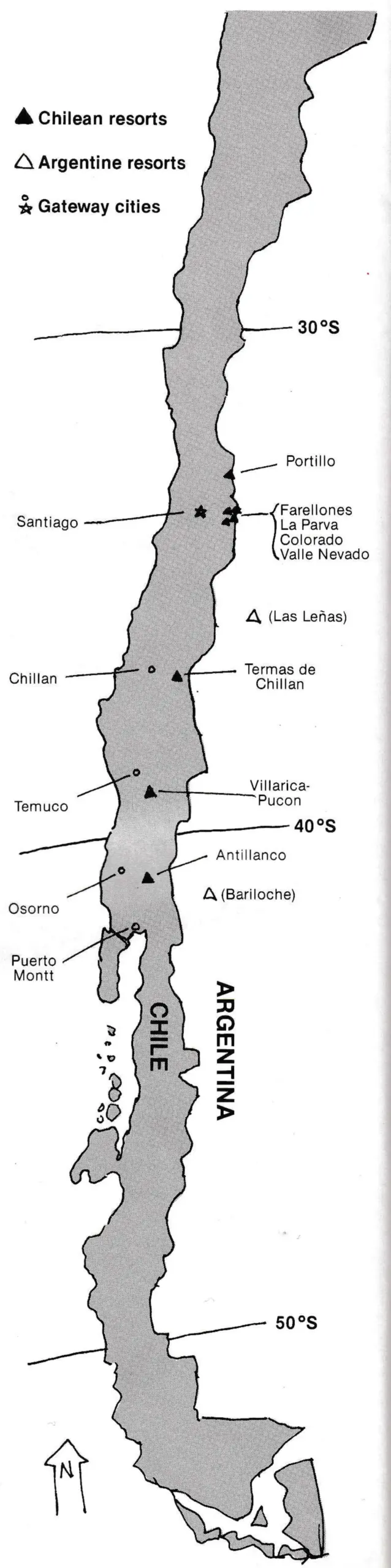
It’s that promise of tourist dollars that has lured a number of Chilean and foreign corporations to invest heavily in Chile’s ski industry recently. Five years ago Chile had five lift-served ski areas; now there are 16, with eight more on the drawing boards. Some of these resorts are vast: the potential skiable area at Termas de Chillan (owned by the city of Chillan, about 300 miles south of Santiago), spreads over 17,000 acres (1,500 acres have been developed so far); Valle Nevado, developed by the Frenchman Roget Godino, a board member of Les Arcs, could cover over 21,000 acres at full build-out. The French have already invested $35 million in the project, and expect to put in another $300 million, according to PR director Brigitte Vexelmans.
While the Chilean government is anxious to bring in foreign investment, and while the economic climate supports construction, the growth of skiing in Chile will inevitably be limited by the market — by the number of skiers willing to travel there. Vexelmans admits that Valle Nevado cannot yet fill the 500 beds in place and that the lifts — modern and French as they may be — can as yet comfortably accommodate only about 2,000 skiers per day.
To find out how the Chilean ski resorts might fare in the years to come, I interviewed Henry Purcell, owner of Portillo. Purcell, a native New Yorker, has managed the resort since 1961, and acquired control in 1973. In 1962 he and his brother David purchased La Parva, some 30 miles to the south as the crow flies; they sold La Parva in September to a pair of Chilean investors.
SAM: First off, how has the business climate changed for you as the governments have changed?
Purcell: President Frey, who preceded Allende, was left of center and difficult to deal with. But under Allende we were on the list of businesses the government planned to take over. Their procedure was to instigate labor problems, then send in a government administra- or who would bleed the company to a shell so the state could buy the owners out at 10 cents on the dollar. We are lucky the government fell before they got to us. The economy began to turn around in 1979. The 1982 recession was painful. Pinochet’s finance minister, Hernan Buchi, is a smart fellow from the University of Chicago, and he’s created some effective policies to encourage investment and growth. We expect the Christian Democrats under Aylwin to win the coming election. Aylwin has promised to continue the present business-oriented policies, which have after all produced the strongest legitimate economy in South America. (Aylwin won the election.)
SAM: Does that economic growth mean you’ll see more skiers here?
Purcell: The standard of living is still much lower than in the fully developed countries and it will be many years before a significant proportion of the population can afford to ski. Even with a $12 lift ticket, only people with a comfortable income can ski. I’d say Chile has about 15,000 skiers now, out of a total population of around 13 million (it may be higher now because it’s been a long time since the last census). Brazil has about 15,000 skiers, and Argentina perhaps 35,000. We can also bring in skiers from Venezuela, Peru and, of course, from the U.S.
SAM: How much as been invested in Chile’s ski areas thus far?
Purcell: Total investment in South American resorts is between $100 and $120 million, not including housing. For instance, there are 20,000 beds in Bariloche, but they do more business in the summer than winter.
SAM: And where do your skiers come from?
Purcell: Here at Portillo, in a typical year, 20 percent are from Chile, 30 percent from Brazil, 35 percent from Argentina, the rest from Peru, Venezuela, North America, Europe and Japan. Right now Argentina is suffering from hyperinflation and very few of them can afford to ski, so that’s hurting us. It affects Las Lenas and Bariloche more, of course.
SAM: So local skiers are in the minority.
Purcell: We do have a day-skier market from the Santiago area. Portillo fills up during our school holidays in July. In fact, we’re normally booked solid through the winter. Space becomes available in the hotel only when a storm closes the road, once or twice a winter. When that happens, people cancel. We can fill those beds by bringing people in by helicopter. It’s a $50 flight. We have 478 beds now, and we can get another 500 day skiers on the hill on weekends and holidays. Because of the high occupancy rate, we’re turning our ski school bunkhouse into more twin rooms. The real limiting factor is foreign flights to Santiago. LAN (the national airline) is 99 percent full and all the other airlines are the same.
SAM: Do you run year-round?
Purcell: Yes. The road up here continues through the tunnel to Argentina and it’s the main route for international trade across the mountains. There’s a lot of traffic on the road and we run a kind of motel operation to serve it in the summer. But it’s difficult to develop summer business beyond that.
SAM: Are the new resorts, like Valle Nevado, going to be able to find a skier market to justify the investment they’re making?
Purcell: Valle Nevado will have to market very aggressively to create new skiers. Chile now has more skiing than the skier population warrants. That skier population is growing, though it’s hard to measure how fast. Las Lenas produced a lot of new skiers in Argentina, and that, in turn, has produced more skiers for us. Neither La Parva nor Colorado (both resorts adjoin Valle Nevado) has marketed to the international market.
SAM: What kind of competition does Valle Nevado represent to you?

Purcell: They compete directly with La Parva and Colorado.
SAM: Because the three areas adjoin, do you think they’ll cooperate in some kind of Three Valleys arrangement?
Purcell: They are not now interested in a combined lift ticket, but the necessity of international marketing should eventually make a combined lift ticket attractive.
SAM: If the international market is so important, won’t you have to compete in quality with industry leaders like Vail?
Purcell: We are under pressure to do a better job of slope grooming. We need more equipment and better skills.
SAM: How do you reach the international market now?
Purcell: At Portillo, we don’t have the size to market as Las Lenas does, with full-page ads in the North American ski magazines. But we do market through travel agencies and by direct mail. Eighty percent of our sales are return business.
SAM: How does your business differ from what goes on at a North American ski resort?
Purcell: It’s quite different. We have a staff of 375 people, or almost one employee per guest. That’s because we’re so isolated and we have to provide all our own city services: sewage, electricity and so on. So we need housing for the personnel.
SAM: What about the major costs a North American resort has to carry — liability insurance, interest on capital investment, labor, snowmaking, real estate taxes, energy costs?
Purcell: Liability insurance is a negligible cost. We don’t make snow, because average annual snowfall is 10 to 15 meters. Real estate taxes are negligible. Energy costs are low — gas and oil costs 80 cents per gallon in Chile and coal is cheap. Labor is, of course, lower than in North America, and there’s a national health insurance program that includes even the indigent, so that’s not a real cost for us. The cost of capital equipment is 18 to 20 percent higher. We have higher freight just to get it here and 18 to 20 percent customs.
SAM: What is the future of tourism in general in Chile?
Purcell: Very good. Chileans love tourism and have been successful promoting it. We have our own travel agency and do most of our business in visitors from outside Latin America — mostly North America and Germany. South Chile is very beautiful, like Washington and Oregon, but with more volcanoes and lakes. It’s lush, with spectacular fishing. The only impediment to growth there is the lack of hotels. But foreign investment should provide more hotels. There are Belgian, Arab and Chilean groups putting in resort hotels.
SAM: Do you expect the improved political climate to encourage more Americans to travel here?
Purcell: Since the last election, the U.S. press has been much more friendly toward Chile, but it will take one or two years for this to have an effect on U.S tourism.