


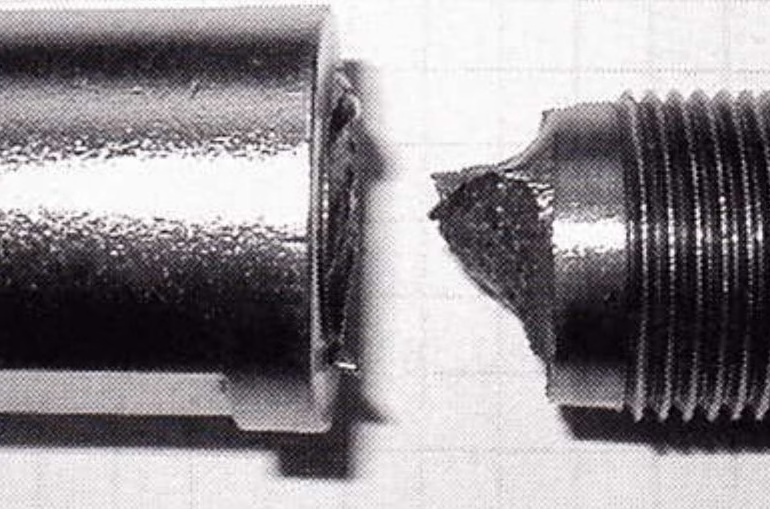
Most people have probably picked up a wire or a paper clip and flexed it back and forth until it broke. That is an example of fatigue. On the other hand, someone with superhero strength might be able to give one yank on the wire and fracture it, causing it to break. That would be an example of overload.
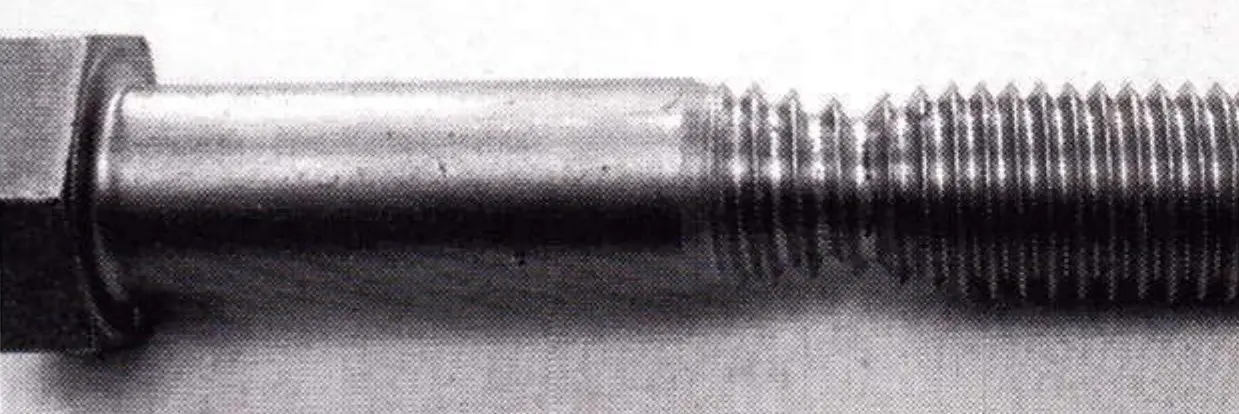
Owing to the lack of superheros these days, it has been estimated that 90 percent of all mechanical failures result from fatigue. Cyclical stressing of components through regular use is usually the culprit. This is also what is usually behind failures of wire ropes, bearings, gears and many other mechanical devices and components found at mountain resorts. And manufacturers are clearly aware of this because properties called fatigue strength and fatigue life are frequently used as design criteria.
Though fatigue failures are the most common, overload failures are rarer, yet fairly straightforward and easy to understand. These types of failures fall into two categories. One, ductile overload failures, describes parts that are deformed as load is applied beyond its yield strength. The metals copper, aluminum and low-carbon steel are typical ductile materials that can be reshaped under pressure such as when they are drawn into tubes or struck with a hammer. The second category is brittle fractures, which describes how metal parts can fracture cleanly into two pieces with no apparent distortion or elongation of the component. Bearings, heat-treated steels, glass and ceramics are typical of brittle materials. While damage occurs to ductile materials at winter resort operations, it’s the brittle failure that can often be the most devastating and which we will concentrate on here.
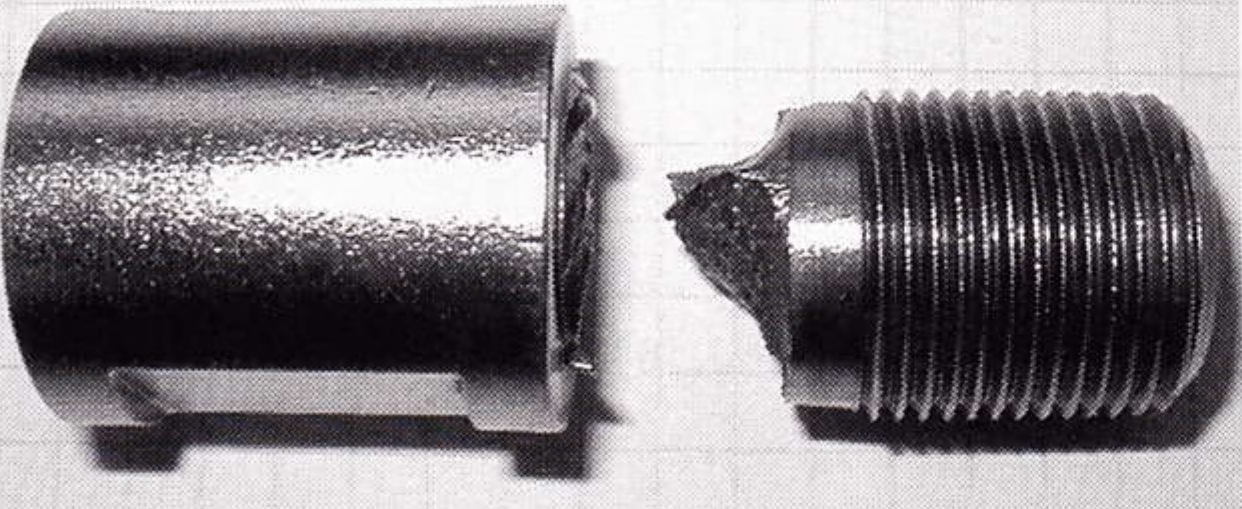
Brittle Metal
Most equipment and machinery in our industry is made from relatively ductile low-carbon steel. If there is an overload failure, the parts should bend and distort long before they fracture. But there are situations when materials that would normally fail in a ductile manner become brittle. We’ve all heard stories of how truck parts and tools used in the extreme cold fractured at relatively light loads. And many people have heard stories about the Liberty Ships used in WWII that literally broke in half while sitting dockside because their steel hulls became brittle in extreme cold.
My own first real exposure to low-temperature embrittlement had to do with a bracket used as a rigging support that fractured and dropped its load. The bar was made from a medium carbon steel and was welded to a building column. For years it had been used for rigging jobs that had traditionally taken place in summer with loads as high as 20,000 pounds. But once we were doing the job in late November when the temperature was about 25 degrees F. While lifting some rigging equipment that weighed less than 2,000 pounds, the bracket broke like it was made of glass.
The bracket was made from a ductile material and we had expected that, if there were a failure, it would bend and distort. But in this case the piece fractured from low temperature embrittlement. As carbon steel and low alloy steels get cold, they become less able to absorb impact loads. What can be confusing is that these metals don’t become weaker (they can carry the same amount of load at 200 degrees F that they carry at -50 degrees), but they become less able to withstand impact loads. Their strength isn’t affected, but their toughness is greatly compromised.
One of the surprising aspects of this phenomenon is that in some cases “low temperature” really isn’t very cold. For example, 1030 steel, a common steel with 0.30 percent carbon, is great at absorbing impacts above 100 degrees but loses that ability as it cools to moderate temperatures. Even low-carbon steels, though affected less easily, lose impact strength as the temperature drops, especially once the mercury dips below zero.
Before going any further, it should be emphasized that:
- This reduction in toughness occurs with loads that are applied very rapidly, that is, impact or shock loads. Some examples of this are hammer blows, parts that are dropped and lift chairs that hit tower or terminal structures.
- Austenitic stainless steels (i.e., 300 series stainless steels), the most common stainless steels found in pipe, tubing and industrial brackets, are not affected by low temperatures and retain their toughness to cryogenic levels.
Brittle fractures can be devastating because the cracks grow by cleavage, which means they split the plane between the grains of the metal rather than actually tearing the structure. This means that once the crack starts, it can propagate with very little energy. In ductile materials, cracks grow by shearing or actually tearing the bonds of the grains and this takes a great deal more energy than cleavage. One way to better understand these two types of failures is to compare a crack in a piece of glass with a tear in a piece of paper. The paper tear won’t grow longer unless there is continuous and significant energy placed on it to tear its fibers. But the crack in the glass grows rapidly with very slight energy because of brittleness, meaning the bonds between the glass molecules fracture readily.
Welds and Residual Stress
The steel industry tests steel components for the extreme temperatures at which they can withstand certain stresses and impacts. One of the values given certain types of steel components is its notch toughness as measured by the Charpy V-notch test. The test is performed at a given temperature and is used to determine how much shock a component can absorb without failing.

The term notch toughness is used because notches, grooves, complex joints and similar changes in shape tend to make metals more susceptible to brittle fractures. In the Liberty Ships, for example, the cracks almost always started at the corners of hatches or similar welding points where significant stress existed. Once a crack appears at a high-stress point, it doesn’t take much to finish it off.
The Liberty Ships suffered the same problem that caused failures in two recent examples I have seen and worked on. Both involved weldments. In one case there was a tiny crack at the root of the weld in a rigging bracket, while in the second case two large structural beams were welded together at a sharp angle. The result in both situations was that stresses were concentrated at a single point. Again, in both examples, when the shock load exceeded the toughness of the structure, cracks started and propagated almost instantly across the part.
Both components were about 0.30 percent carbon, meaning the impact strengths of both components at 75 degrees were more than twice what they were at 20 degrees. That’s an indication as to why light shock loads were able to crack each of the welds in two.
Making Good Choices
Proper equipment design usually eliminates shock load problems by dissipating them. But certain stresses and impacts that can’t be avoided in the normal day-to-day activities of a ski area go beyond design criteria. When working with and making choices about metal equipment, there are some basic factors that should be kept in mind. Among them are:
- Material chemistry—Carbon has the biggest effect, but many other elements also come into play. Nickel is particularly important and more than 13 percent nickel (found in austenitic stainless steels) essentially eliminates any concern about embrittlement. Also, shafts and parts made from chrome-moly and nickel-chrome-moly steels, the 4100 series and 4300 series steels, are usually much tougher in absorbing impacts than plain carbon steels.
- Load application rate—The faster the load is to be applied, the more likely the fracture will be brittle. When the U.S Air Force jet cut the wire rope that sent the Italian gondola crashing to the ground, the load was applied so fast and with such force that not only was the fracture brittle but the rope was broken in two places as first the wing and then the tail shattered it.
- Residual stresses—Stresses that are locked into the component due to the normal welding and fabrication process reduce the ability of a material to withstand additional stress. A part has the ability to absorb just so much load and when it starts out with a preload (the residual stress), it’s restricted in the amount of additional load it can accommodate without failure. In a similar manner, cold working steel, such as cold-rolled shafting, etc., also results in reduced impact-absorbing ability. This happens because the process of cold-rolling elongates the grains, which adds stress while strengthening the metal.
From a practical standpoint, it’s important to realize that impact loads are sometimes needed, but they can cause disasters if the parts aren’t designed for them. Hammers are notorious for causing more harm than good. It is sometimes tempting to try and knock ice and snow off of metal structures and equipment with a hammer, and while low-carbon steels should be able to withstand such treatment, many other metals will not. There are numerous brackets, mechanical equipment, pump components, steel bolts and machined parts on grooming vehicles that should never receive hammer blows. And never use impact wrenches at very low temperatures, not until the piece has been slowly warmed up.
Another type of hammer blow is the water hammer. Whether its a water line that gets shut off rapidly or a plug of ice that jams a line, the effect can cause pressures 10 times the operating pressure of the component and can pull pipe supports out of the ground and rupture high-pressure lines.
Impatience when trying to get things started in the morning, especially when it’s particularly cold, can cause loads of trouble and should be avoided. A three-year study showed that 25 to 30 percent of machinery failures in the ski industry is due to operator failure to follow proper operating procedures. So before you find yourself holding two pieces of what used to be one steel component in your hands, remember these three truths about overload failures that result in brittle fracture:
- They really aren’t very common, but frequently show up in unexpected locations because people don’t understand the effect of impact loading.
- They occur instantly as the load is applied.
- And they can be substantially affected by both material temperature and residual stress.
When you are out on the hill working on a piece of machinery, also remember the Titanic. It was low-temperature embrittlement that did her in.
