


Timberline Lodge (Mt. Hood, Oregon) this past summer installed a portable Pomalift, believed unique in this country, to augment its late-season uphill facilities. A pioneer in summer skiing and racing facilities, Timberline found that increasing enrollments in its various off-season programs were rapidly outgrowing the temporary facilities (rope tows and Sno-Cats) that had been used in previous summers high on the mountain.
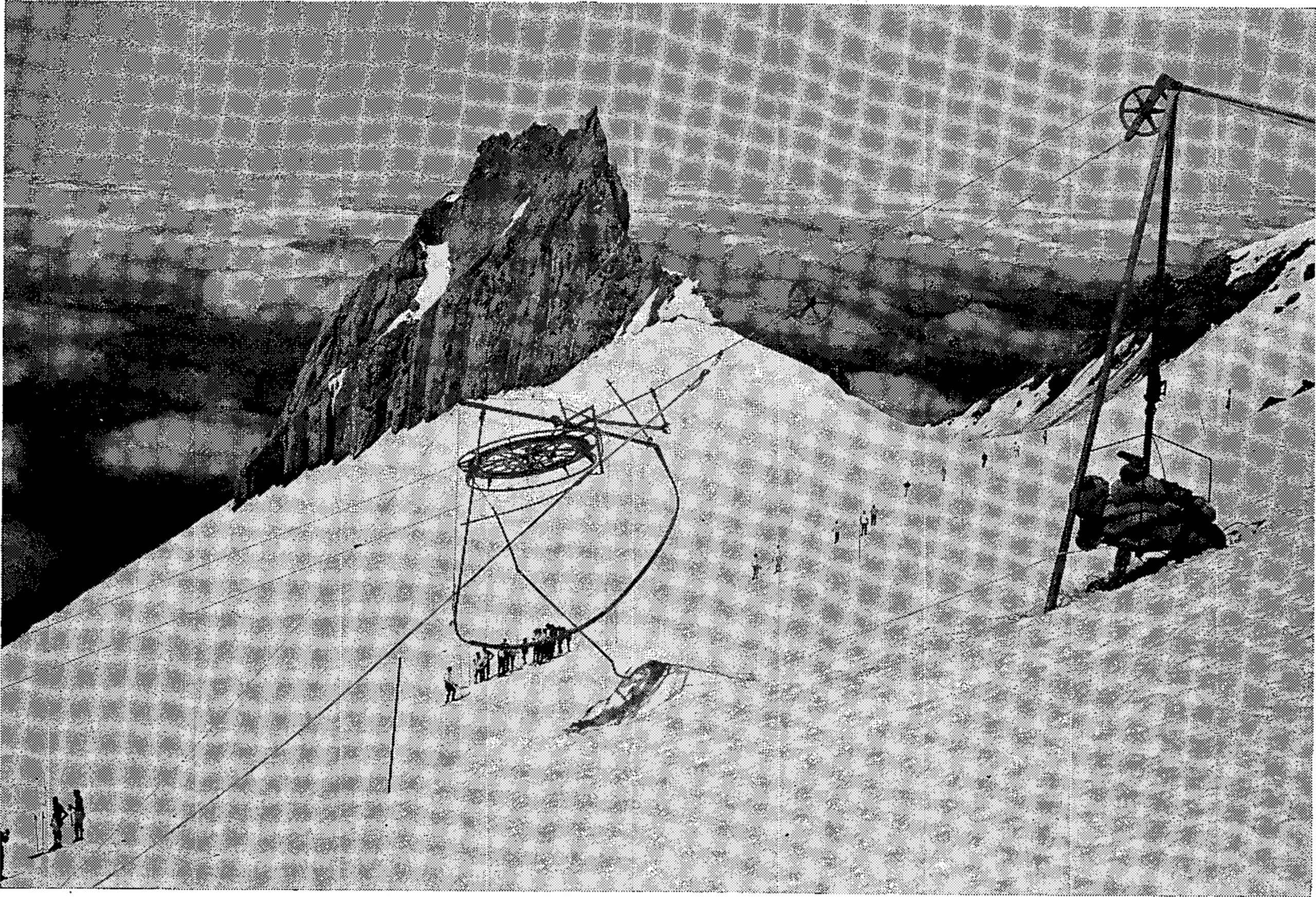
Operator Dick Kohnstamm looked for a more workable, higher capacity method of uphill transportation. It had to be portable to follow the ever-changing pattern of Hood’s summer snowfields. It had to be sturdy to stand constant usage and movement. It had to be economical to justify the off-season operation. He settled on a portable model of the popular French-made Pomalift, similar to one in use for several seasons now atop the Italian side of Mont Blanc at Courmayeur, Italy, and installed the entire unit on Mt. Hood’s snowfields for trials.
To check out the lift before receiving full U.S. Forest Service approval (Kohnstamm operates on National Forest lands), the unit was first set up adjacent to Timberline Lodge. Later, it was dismantled and moved more than two miles (over 2,700 vertical feet) up Mt. Hood to the summer operating slope. His first location there was at the 8,700 foot elevation. Sno-Cats serve this level with numerous daily trips until mid-summer thawing opens up a wide belt of rock which they cannot cross. After the Cats could no longer reach the high area, the portable Poma was moved down to a lower location which permitted use of heretofore unattainable summer slopes.
Kohnstamm charged no fee for use of the lift at the higher point, where the $3 Cat ride brought in sufficient income. Since the lower location opened up a new service within walking distance of the top of the lodge’s Magic Mile permanent lift, he put a $2 all-day charge on the new lift at this location and found enthusiastic acceptance. This winter, indicates Kohnstamm, he’ll move the portable Poma to a school slope much lower on the mountain, then move it back up again next summer.
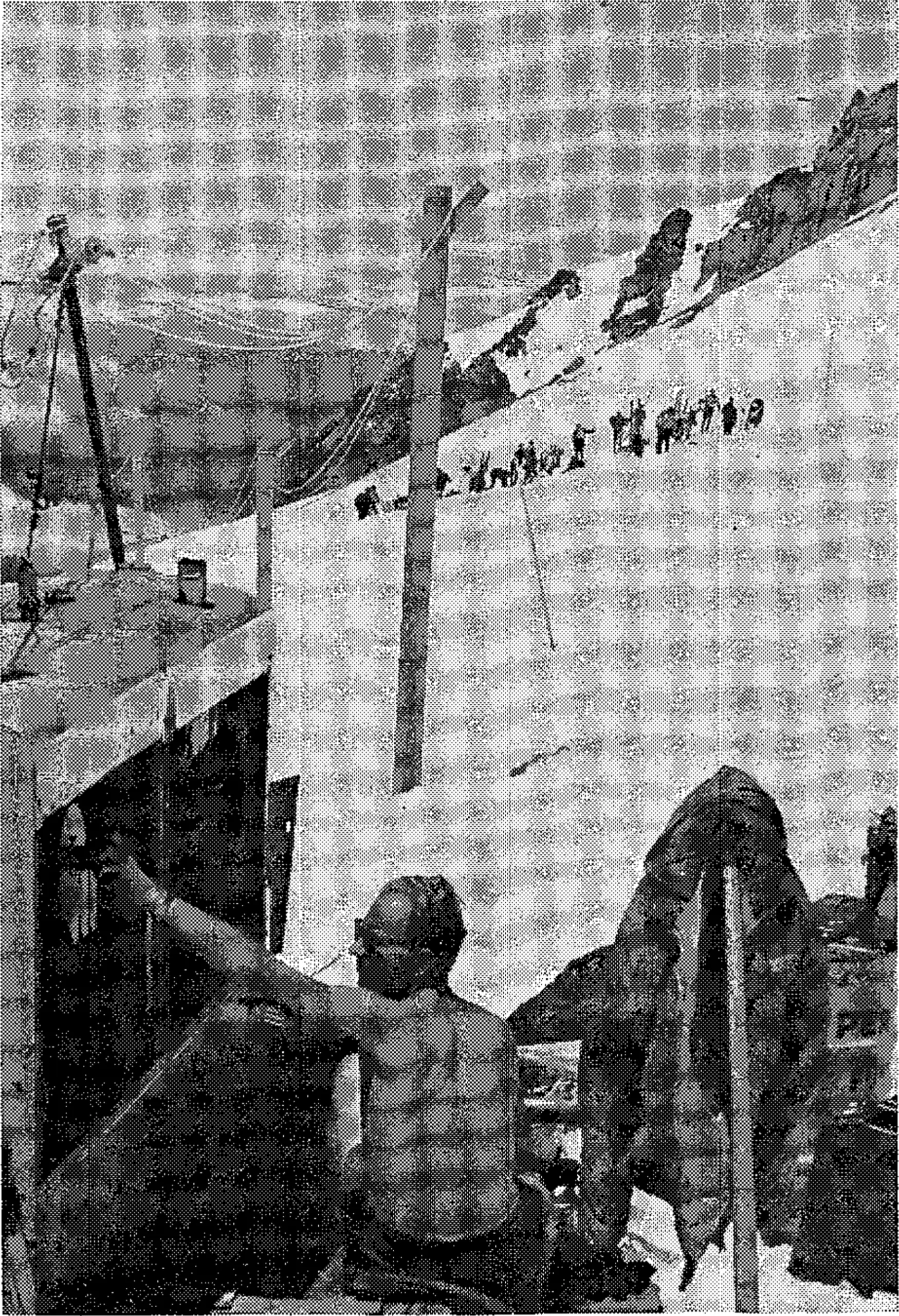
Kohnstamm encountered no major problems moving the lift components from site to site. Its towers can be towed easily behind the lodge’s fleet of Sno-Cats. However, the power unit had to be winched more than a mile up the final slope, using a three-part line.
The installation involved a bottom tower, a tripod-type upper terminal and four intermediate towers. Each was guyed four ways with 4-mm wire rope with a 12-inch-diameter, four-foot log, buried about seven feet into the snow as a deadman for each guy. A T-shaped extension above the sheave arms carried the guylines high enough to extend well out and clear of the traveling cable. Kohnstamm found it important to keep the snow packed solidly around the guylines; he used an Oliver OC4 tractor with extended wooden pads and bulldozer blade to pack the deadman, then distributed straw over the snow to inhibit melting. The same principle was used to bury the deadman at the upper anchor, buried at a 12-foot depth.
Although the entire lift is designed to be set up on a snow base, Kohnstamm decided to place the 6,000-pound engine-generator power unit on a firmer foundation. He located it on a bed of open rocks, some 300 feet away, with the power lines rigged on temporary wooden poles sunk into the snow.

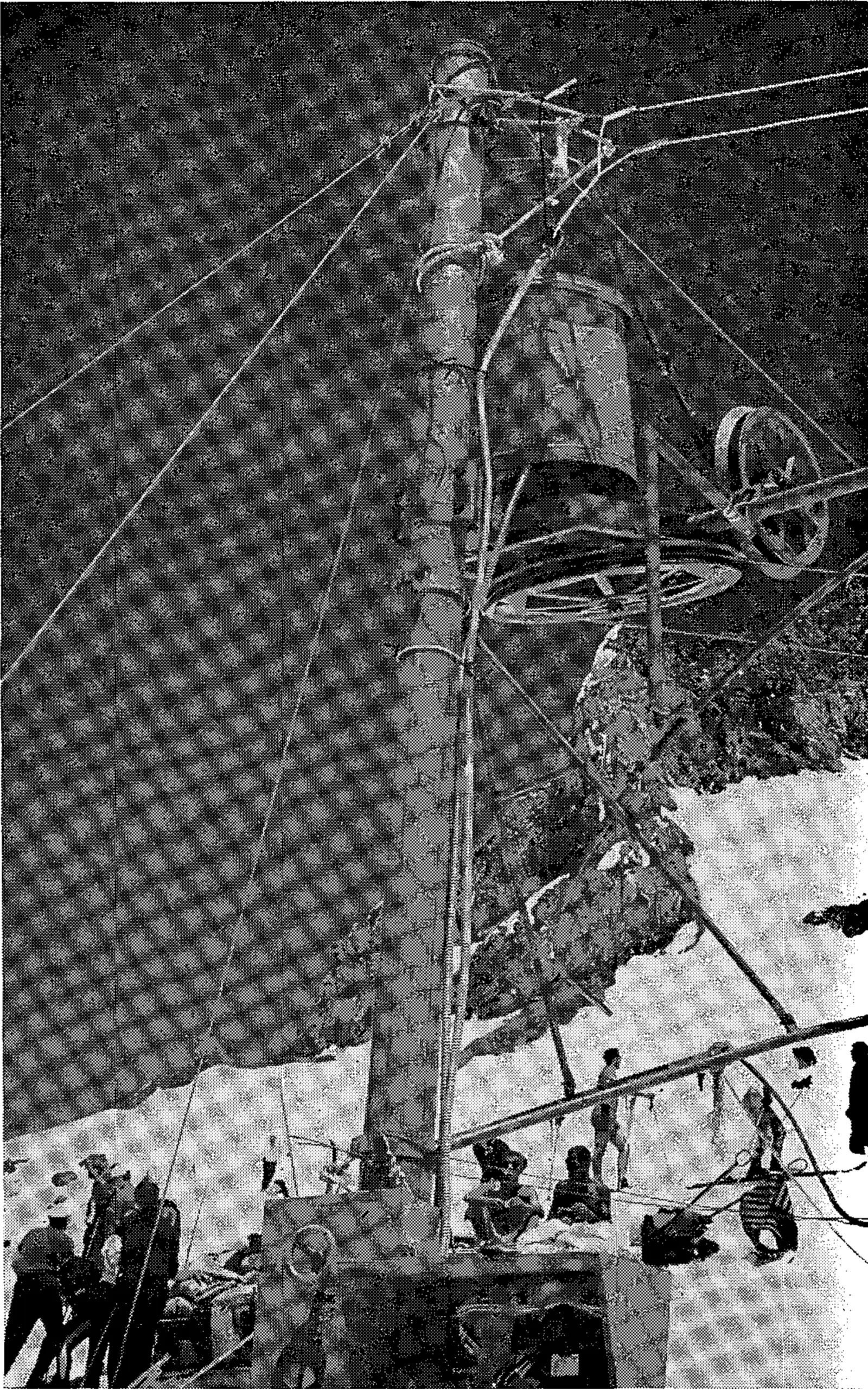
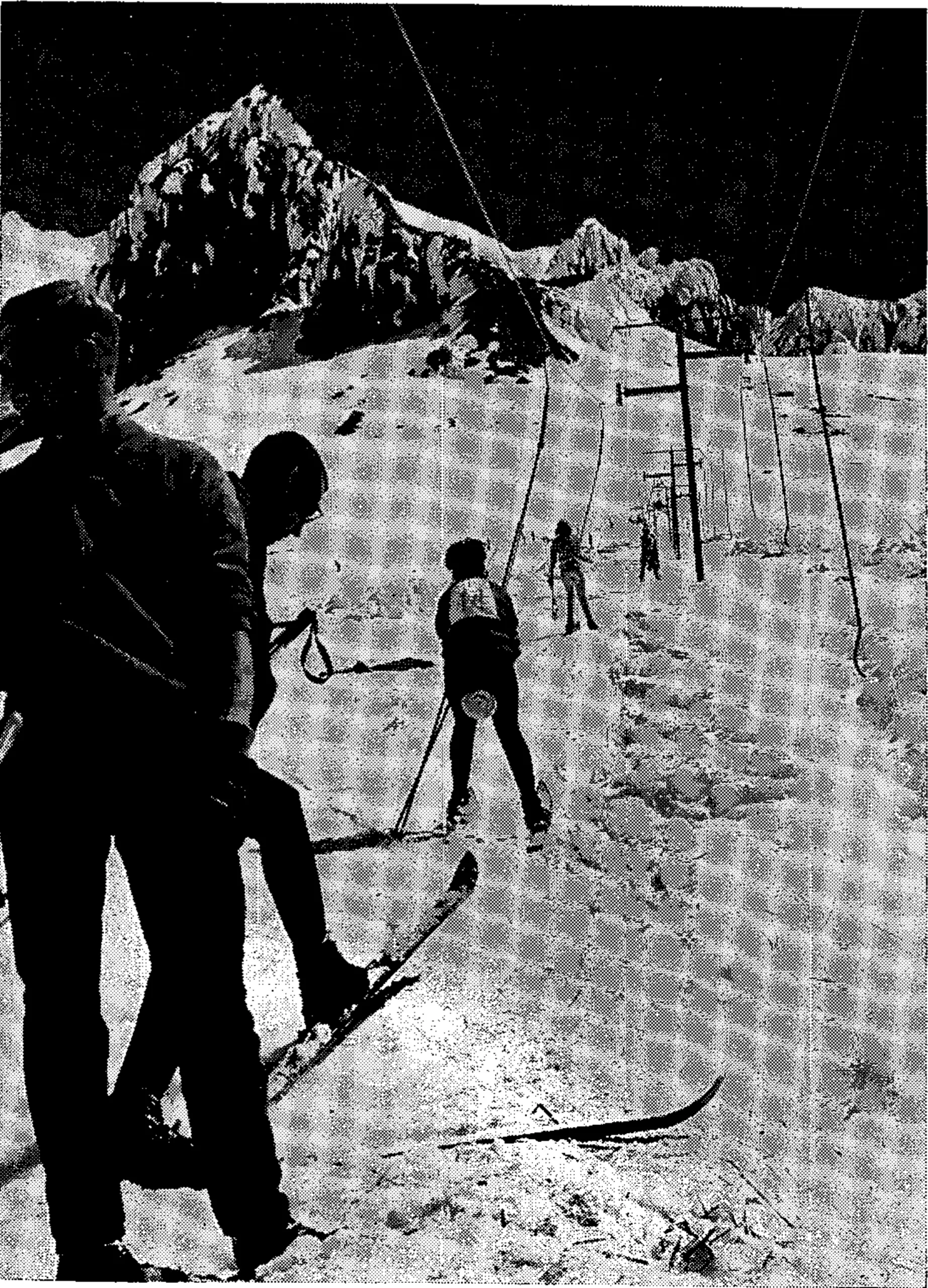
A compact 15-h.p. electric motor actually drives the lift through a small bullwheel at the bottom. Hold-down sheaves guide the 4.5-mm main cable onto the bullwheel. The cable operates at a speed of 2 meters per minute and is equipped with 32 platters with provision for more if required. In contrast to the conventional Pomalift where platters are disengaged from the live cable as they reach the bottom, the platters on the portable Poma revolve on the circuit at all times, simplifying the unit considerably.
The portable installation represented a modest $9,000 investment and provided a capacity of 230 skiers-per-hour (which could be augmented to 320-per hour) on a slope which was previously “down” for the summer. It operated from June until mid-August, moving up a line of 1,240 feet with a vertical rise of 315 feet. It required four men working six days to accomplish the initial installation including the tedious up-mountain move, but an experienced crew, following an established procedure, can trim this to four days or even less. Breakdown of the unit for moving required less than two days. For operation, a four-man crew was used—a generator operator, two men at the bottom station and one at the top.
The entire lift, crated as it arrived from France, including tools, weighed only 9,568 pounds, not including the separate engine-generator unit.
The lift was powered by a Continental 372 6-cylinder engine and a 25,000-watt, 440-volt General Electric generator producing three-phase 60-cycle power.
During its first summer of operation, the lift drew up to 100 paying recreational skiers per day in addition to some 60 student skiers in the summer racing program. Kohnstamm expects to expand these figures in future seasons and feels that such a lift can be made to pay at any ski area where higher glacier-type slopes are available but bare lower slopes handicap summer use.