

Belle Mt., near Trenton, N.J., can not claim 120 days of skiing, but does claim the equivalent to 120 days this past winter. The area operated two skiing shifts a day. Daytime operation started at 10 a.m. (9 a.m. weekends) and continued to 4:30 p.m. Evening skiing started at 5:30 p.m. and ended at 10 p.m. The two daily periods of operation and a total number of operating days in excess of 65, all add up to well over 120 days of day-only operation.
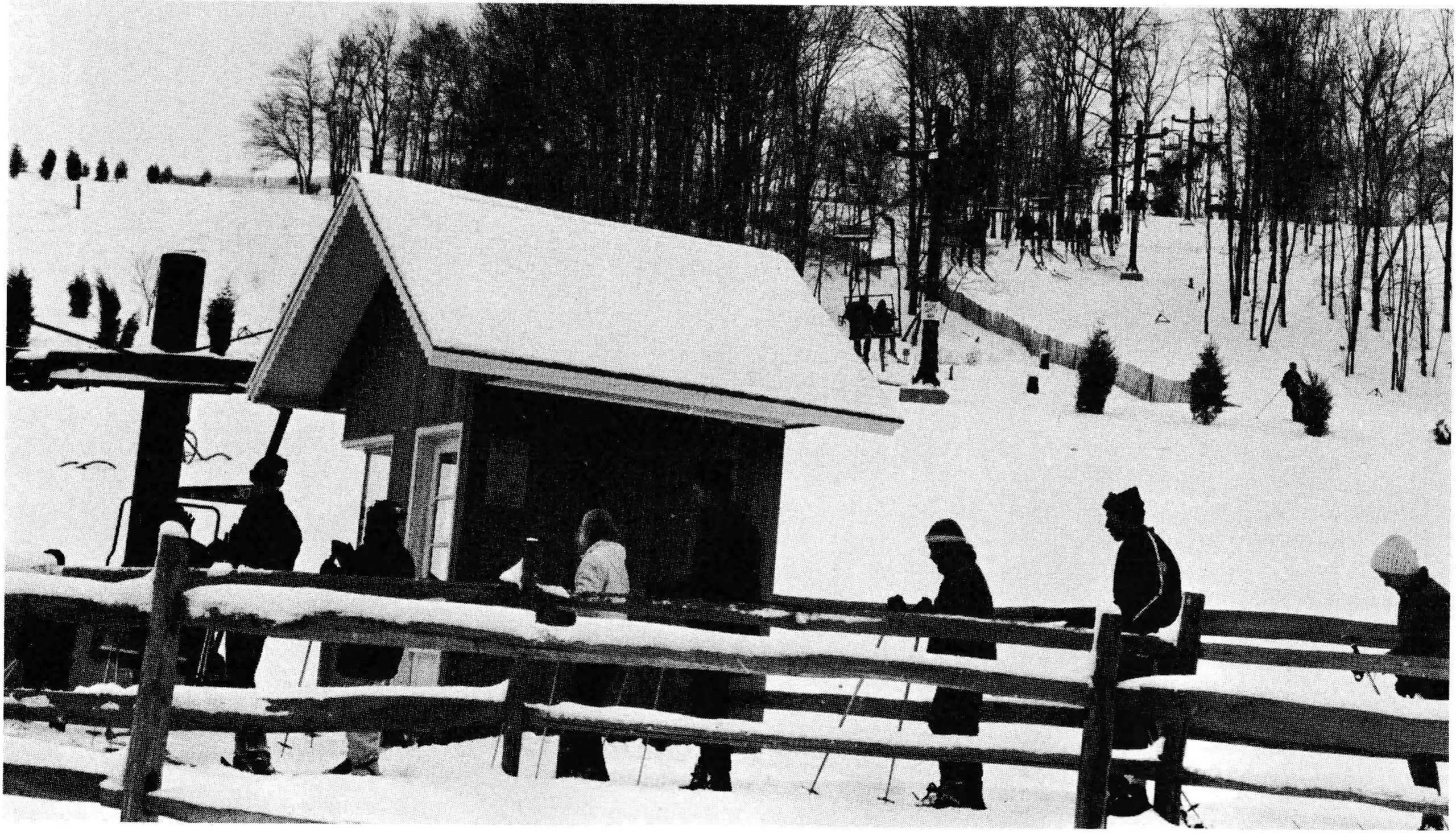
Belle Mt. area is owned and operated by the Mercer County Park Commission. It is near the Delaware River, four miles upstream from the site of Washington’s famous Christmas Eve crossing during the Revolutionary War. Until this past season, uphill transport was by three fiber rope tows. Last summer Belle grew — acquired a double chairlift and a wire rope tow, discarded two fiber rope tows, and added an intermediate slope and beginners’ area. Snowmaking was revised and expanded to cover all slopes and trails. Night lighting was extended to cover the entire area.
The management of Belle Mt. is under James Haggerty, general superintendent of parks, Mercer County Park Commission. Michael Niski, utilities engineer, Mercer County, designed and supervised the installation of the snowmaking and lighting expansion. During the ski season, three shifts operated and maintained the area. The first started at 8:30 a.m. Snowmaking was completed, lines blown down and guns and hoses removed from slopes and trails. Snow was packed and groomed and the area opened at 10 a.m. This crew operated the area throughout the day period, closing at 4:30 p.m. The second shift, starting at 4:30 p.m., regroomed the area and reopened at 5:30 p.m. This shift operated the area until the 10 p.m. closing, then started the snowmaking system and turned the snowmaking operation over to the third shift at 12:30 a.m. The third shift continued snowmaking throughout the night.
Skier Visits — Day vs. Night
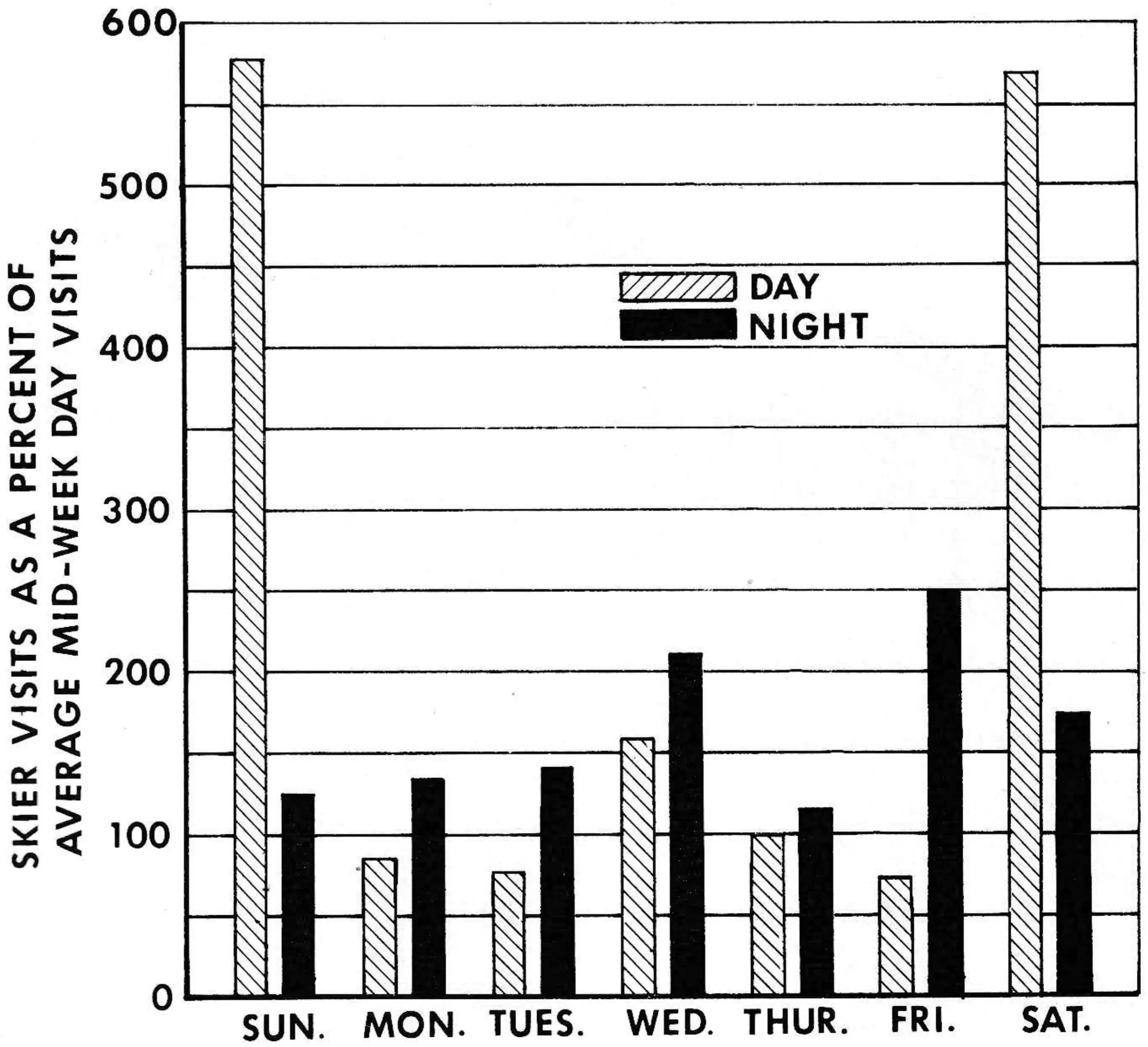
A typical three-week January period was selected to compare day and night attendance. The average daytime attendance for weekdays was determined and individual day and night attendance figures were compared to this weekday daytime average.
Figure 1 presents the average attendance for each of the 14 operating periods during the average January week, based on an average midweek daytime attendance factor of 100. During weekday operation, the most popular daytime period was Wednesday, with Monday, Tuesday, Thursday and Friday running below the daily day average. Weekend daytime attendance ran almost five times the average daytime midweek attendance. Night attendance exceeded day attendance Monday through Friday. Weekend night attendance did not differ greatly from midweek nights. The most popular evening for skiing was Friday.
Total daytime attendance for a typical seven-day period was 18 times average attendance. Total nighttime attendance for the same period was 12 times average weekday attendance. Night operations accounted for 41 per cent of total weekly attendance, about equal to total daytime weekend attendance. Simply put, night operations added a second weekend to daytime weekly operations.

An interesting aspect to Belle Mt. operations is indicated by their record for one Wednesday in January when local schools were closed due to weather conditions. Attendance on this day soared to over four times the weekday average. This Wednesday was not counted in average statistics, but reflects how extraordinary demands can occur.
Lighting—How and Why?
Based upon previous tests at Belle Mt. using mercury vapor lights, quartz iodine fixtures were selected. The mercury vapor lighting had given unsatisfactory results because of a blue effect. If you want skiers to look like ghouls, use mercury vapor.
The quartz iodine lights selected were 1500-watt units, mounted 30 ft. high. Distance between light structures is five times the mounting height (150 ft.) with two fixtures per structure to maintain a nearly uniform degree of lighting along and across the slopes. Distribution of 277 volts to the lighting circuits was chosen, and the electrical distribution lines varied. The poles selected were hinged to permit ground level maintenance by pivoting the entire upper pole section and rotating the luminaires to ground level. The original quartz iodine lamps have been in service for five years, and no relamping has been necessary. No maintainance was required during the entire 1969-70 Winter season, due to an excellent original installation and close attention to detailed design, use of waterproof junction boxes, etc. Many electrical problems occur in ski areas because of false economy during installation.
By providing uniform, low-intensity general lighting, night skiers often find better visibility than during the day, especially in “flat light” daytime conditions. Additional investment in lighting equipment and the increase in operating costs for a second shift to operate the area is more than justified by the number of skier-visits night skiing produces. There is no indication that the accident rate is drastically different from daytime, perhaps because snow conditions remain more uniform. The high usage this area has experienced on Friday evening indicates that with night skiing, the skier starts his weekend Friday evening. Belle Mt.’s experience should be of interest to areas located near population centers where, with only a few minutes of travel time, a skier can enjoy two to four evening hours of skiing.