


Development
State-owned areas questioned in New Hampshire
A subcommittee of New Hampshire’s Citizens Task Force has issued a preliminary report questioning state operation of Mt. Sunapee and Cannon Mountain. The committee feels that income from skiing is too speculative to use for projecting state budget estimates, that government red tape hampers effective ski area management and that allowing state-owned areas to compete with private areas is contrary to the basic tenets and traditions of American commerce. If the full Citizens Task Force committee approves the subcommittee’s recommendation, the matter will be brought to the next session of New Hampshire’s General Court for possible sale or lease of Cannon and Sunapee.
Aspen buys interest in Breckenridge; plans growth
To say that skiing has become big business in Colorado is like commenting that the automobile is important to the economy of Michigan. Nowhere is this truer than in the ski capital of the nation, Aspen. With residents and more-than-casual ski visitors disturbed at the growing over-crowding, the Aspen Skiing Corp. realized it was facing some tough questions and that it had to take some action.
One of the answers surfaced late in January. Aspen was branching out: it was going to Breckenridge, a former mining town some 80 miles west of Denver, where ski gold had recently been discovered. The Breckenridge ski area, to be sure, has existed—and prospered, largely as a Denver day-trip area—for many years. Late last year, however, a group of travel experts (including a couple of former executives at United Air Lines) discovered that the town offers possibilities for a “6000-person, $35 million,” four-season, housing and recreation development right at the foot of the ski area. Breckenridge ski area was controlled by H. L. Baum, Jr., and although rumor had it for a while that the Breckenridge Co. wanted to buy him out, what finally happened is that the Aspen Skiing Corp. “bought Baum’s interests.” These interests included not only the existing ski area—on peak 8—but expansion rights to two adjoining hills, called peaks 9 and 10 right now but due to be renamed soon.
Development will begin soon, with the Breckenridge Co. breaking ground for the first group of lodges and condominium complexes. The Aspen Skiing Corp. will begin cutting trails on peaks 9 and 10 and plans to install the first new lifts below the base lodge and right at the housing complex in the village, in the Spring of 1971.
—I. William Berry
Ken R. White Co. to head expansion at LTV’s Mt. Werner
LTV Aerospace Corp., owner of Mt. Werner ski area, has named Ken R. White Co. of Denver to take over the planning for expansion which will eventually turn the resort into a year-round recreation complex.
According to Paul Thayer, president of LTV, “We’ve entered into purchase agreements on an additional 1000 acres, and the time has come for comprehensive planning.” The White Co. has six months in which to submit a systems plan for the area’s development.
Working as a consultant on the project is Alexander McIlvaine of New York City, a well-known resort planner and architect. He has worked on planning for Squaw Valley, (Calif.), Stratton Mountain (Vt.) and the Playboy Club Hotel ski area (Lake Geneva, Wis.).
Mammoth prepares giant steps for future
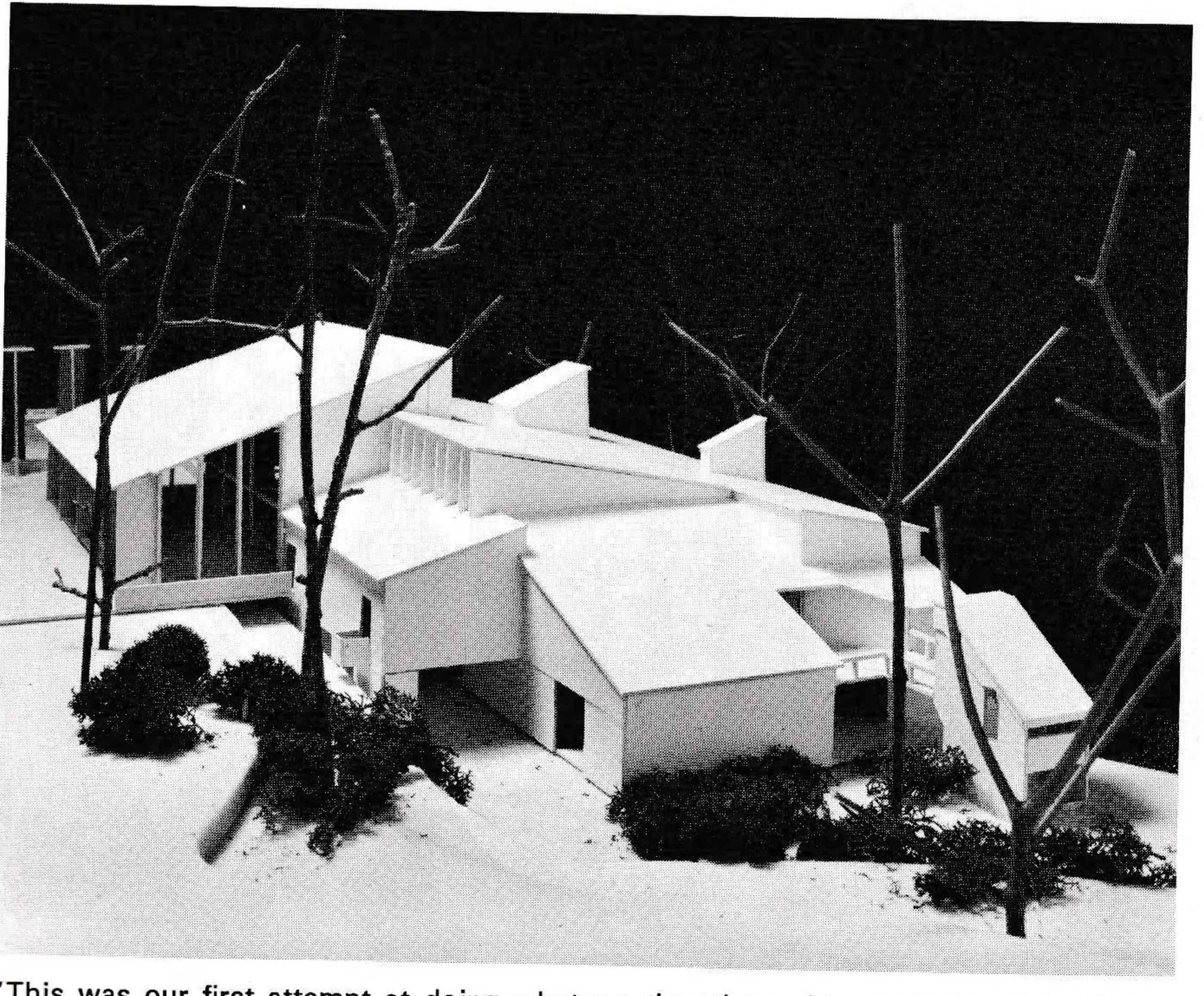
Mammoth Lakes, the California town hosting skiers who come to Mammoth Mountain, plans to expand capacity to 80,000 beds by 1975, according to the report of a Winter meeting of the Mono County Board of Supervisors. The entire plan includes installation of an automated dual-rail system to eliminate some of the problems caused by automobile traffic, exhaust and insufficient parking. Earl Brown, president of California Sierra Airline, stated that his operation could provide ample service into the area in the future.
—Luanne Pfeifer
LionsHead new gondola opens with roar
One mile west of Vail is the new LionsHead area, recently the site of a gala gondola debut. The $4.2 million gondola is two mi. long and services three sq. mi. of new ski slopes. The opening ceremonies were attended by Colorado Governor John Love, actor Eddie Albert and Simba, a 500-pound lion who served as a mascot for the day’s festivities.
According to Peter W. Seibert, Vail Assoc. president, the lift is designed to increase the area’s out-of-the-valley capacity by 77 per cent and to eliminate most holiday lift lines. The opening of the gondola began a $50 million expansion plan which aims at increasing the value of the complex to over $100 million by 1975. A condominium project of $2.5 million is underway at Lions Head and expected growth for the two Vail centers combined aims at a total of 10,000 beds by 1975 (compared to the present 5000 beds).
“We are projecting 1,250,000 skier days on our lifts in 1975,” said Seibert. “This will create a lift income of some $9 million. On the basis of present ratios of lift income to total resort income, this would result in a Winter income for the Vail community of some $45 million per year.”
Projections are for complete year-round activities and facilities for the many conventions which use Vail during the Summer. A new 18-hole golf course was completed last Fall. Vail Assoc. has recently acquired 2600 acres, in addition to the Meadow Mountain, Inc. beginner’s ski area, about five miles west of Vail at Minturn, Colo. They plan a golf course for the new land. A Vail Assoc. representative contends that Vail will one day be the largest ski resort in the state, with runs beginning in the back bowls of the area and ending up five miles away at Minturn.
—Lois Barr
Seven Springs makes plans for big future
Herman Dupre, president of Seven Springs ski area, says in seven years there will be nothing in the world to equal his area.
“Right now, we have the finest lodge in the world right at the base of the slopes,” says Dupre. “This $2 million lodge houses an AAU regulation pool, a game room, numerous shops, first class room accommodations for 500 guests, banquet and conference facilities, as well as a dining room/restaurant and two lounges.”
Future plans include a gondola to the highest peak in the area (3010 feet), a restaurant at the top of the gondola, a large lake area (already dug at the top of the mountain) for ice boating and fishing, a 7000-ft. landing strip, a mile-and-a-half from the lodge able to take any plane made today and an expanded snowmobiling terrain using the new golf course and trails in surrounding state parks. Condominiums around the golf course to sell from $29,500 to near $100,000 are also planned.
A new double chairlift was added this season, and the vast North Face slope was cleared. With a 940-foot vertical, this slope has more ski terrain than the rest of the area put together. It raises the vertical drop at Seven Springs by nearly 300 feet.
—Johanna Welty
Aspen region holds secret to eight possible areas
A recent Forest Service report named eight potential ski areas in the Aspen area. According to John Burns, district forest ranger, the list is derived, not necessarily from a feasibility study, but from interest shown by private parties. The eight areas are New York Peak, east of Aspen; Siever’s Mountain, between Maroon and Willow creeks; Red Mountain, the Woody Creek side to the north of Aspen; Cooper Creek-Kellogg, above Ashcroft; Hayden Peak, along Castle Creek to Ashcroft; Little Annie, behind Aspen Mountain ski area; Owl Creek, between Snowmass and Buttermilk Mountain; Smuggler Mountain on the Hunter Creek side, northeast of Aspen.
Washington state plays host to new ski area
Yodelin, a new ski area in Washington, opened for weekend skiing with an 1800-ft. chairlift and a Tyrolian-type lodge. Owner/operator W. C. “Wendy” Carlson looks forward to four more lifts and a cable car. Development is also underway in the Village, with private homes and condominiums in the plans.
Cockaigne makes debut second time around
The Cockaigne Ski Resort in upstate New York was sold to Jack Dean and Jack Van Scoter, two Fredonia businessmen. Earlier this year, when the area was forced into bankruptcy, it was purchased by the Jamestown bank.
The two new owners will form a corporation and continue to operate Cockaigne as a ski area, with possible plans for year-round operation.
- Western Resorts, Inc., moves into the first phase of its $5 million expansion plan at Mt. Baldy with the installation of a new access lift to Devil’s Backbone and a 5500-foot Stockton Flats chairlift. A gondola and four chairlifts are scheduled for the 1970-71 season.
- Intersnow, Ltd., of Chicago is franchising Western-style Snow Ranches which will offer snowmobile rentals, tobogganing, Winter games and ice skating. Four branches will open in December in Buffalo and Syracuse, N.Y., Worcester, Mass., and Minneapolis.
- Joseph T. Zoline predicts that his Telluride ski complex in the Colorado Rockies will open for the 1971-72 season. More than 4200 acres have been purchased and it is expected that $150 million will be spent on development there over the next 20 years.
- Two commercial villages for Boyne Mountain and Boyne Highlands have been designed and are now in the hands of contractors. The European-style villages will have restaurants, gift shops, outdoor cafes, and real estate and information centers.
- Two booklets defining and explaining multiple-use planning and management of natural resources in the Intermountain region have been prepared by the U.S. Forest Service. “Multiple Use in Action” explains the on-the-ground application of multiple-use management on National Forest System land. A companion booklet, “Multiple Use—Mandate for Management,” discusses multiple-use planning procedures and zoning. The booklets may be obtained by writing the U.S. Dept. of Agriculture, Forest Service, at 324 25th St., Ogden, Utah 84401.
- Sepp Benedickter has sold Rebel Ridge, in California’s San Bernadino Mountains, to the owners of Pierpoint Landing in Long Beach, Calif. Benedickter, who was previously associated with Holiday Hill and Blue Ridge, is planning to open a new ski resort near Hebgen Lake, Mont., next year.
- Professional Care Services, Inc., is planning a year-round resort in Allenwood, Pa. Ski facilities will include 25,000 feet of trails, snowmaking machinery and chairlifts for all slopes.
- A ski jump permitting jumps up to 235 feet is being built alongside Pine Mountain at Iron Mountain, Mich.
- Thomas Scileppi, a Long Island contractor, has purchased the Hillside Inn in Narrowsburg, N.Y., from Skip Siegel. One T-bar will replace two rope tows at the 37-year-old resort; trail expansion is planned for this Summer, and there is snowmaking and lighting for night skiing.
Technology
Ski Incline moves to prevent erosion in the Lake Tahoe area
The massive development of Lake Tahoe has recently caused conservationists to sound the alarm for fear of erosion, siltation pollution and muddy water. At Ski Incline, however, positive action is being taken by Austrian-born Luggi Foeger, a former ski instructor, to see that the resort does not contribute to what might become a serious situation in the lake area.
According to Foeger, the primary problem is the elimination of erosion by “reducing the velocity of the water”—through a drainage network from whatever source it may come — rain, runoff from higher up the mountain, melting snow on the ski runs.
The water is carried by strategically placed culverts and pipes into a big main culvert, which has six openings at various stages of its downhill course. In addition to acting as “surface intakes,” these openings are constructed to slow down the flow of water, thereby picking up deposits of soil and minimizing the chances of subsequent erosion.
Grass has already been planted over much of the terrain cleared for ski runs, and sod has been embedded as reinforcement. Trees are considered precious, if not sacred. One day last Summer Luggi looked out of the lodge and saw a bulldozer operator come perilously close to a ponderosa pine. He charged up the hill and fired the man on the spot.
“I hired a new man,” he said, “and trained him myself on the importance of trees.”
—Bob Lochner
Avalanche forecast? A possibility in near future
The U.S. Forest Service, under the direction of meteorologist Arthur Judson, is collecting data on avalanches, with the ultimate goal of making an “avalanche hazard rating index.” Such an index, when used in conjunction with a mountain weather forecast, would aid land managers in predicting avalanche potential for specific areas. The information is gathered in 12 western states at 42 locations from Alaska to California and east to Colorado.
Data collected by the Forest Service, the Colorado State Highway Department, ski areas and mining companies are all sent to a central office of the Avalanche Research Project for evaluation. This is the third year of the project, and Judson plans to use computers for data analysis. He hopes to establish relationships between weather and snow conditions and avalanche occurrence. According to Judson, the index could ultimately serve as an avalanche warning service for the entire western part of the country.
First chairlift opened at Glenwood Acres
Glenwood Acres ski area near Buffalo, N.Y., has a new chairlift. The Sneller lift was to have been completed earlier, but its installation was delayed by the sudden death of the area’s owner and developer, Robert Crone.
The lift is reportedly the country’s first chairlift with tilting styrofoam seats to keep snow and ice from collecting.
Aerial tram hangs passengers in mid-air
The Squaw Valley aerial tramway, reportedly the world’s largest, recently stopped in mid-air, 250 ft. above ground, loaded with 121 skiers. The cause of the stop was a power failure. Passengers were evacuated with a “straight jacket” device and winch cable and then with a 12-passenger cage car used for maintenance work. The entire evacuation was completed in four hours. Passengers arrived safely on the ground and were given a free, one-day lift ticket as remuneration for their inconvenience.
Hunter’s K-27 set for use by daredevils
Hunter Mountain Ski Bowl’s expert slope, K-27, is running smoothly and earning its reputation as one of the toughest runs in the East, thanks to the Snow Master, a new grooming machine. The slope opened about a year ago, but packing and grooming had to be done by foot due to its steepness. According to General Manager, Orville Slutzky, the Snow Master has saved the day for Hunter. It can go up and down K-27, keeping it packed and groomed for the daring skiers who brave its challenge.
With a 15 to 80-in. base, and no heavy snow in the foreseeable future, Hunter made snow like mad. The area kept its season running strong until after Easter.
One good deed deserves another
Buzz Bainbridge, vice president and general promotion manager of Jackson Hole Ski Corp. in Wyoming, decided the time had come for extreme measures when the area was virtually snowless and the Christmas rush was just a few days away. He contacted a firm in Boulder which agreed to perform the necessary cloud seeding for the tidy sum of $6000 a day. Within hours of the seeding, it was snowing at Jackson Hole. According to Bainbridge, the entire village helped out with the cost because, although it was high, the overall savings were over $100,000.
- Dodge Ridge likes to call itself “California’s foremost family resort.” The skiing is good, especially for intermediates. Purdy claims part of the mountain’s popularity stems from “the best-groomed slopes in the Sierra. Our six Sno-cats and two tractors are going all the time.” Total driving time from San Francisco is about four hours, but according to Purdy, “the bulk of our skiers comes from the Peninsula, East Bay or the Santa Clara and San Joaquin Valleys.”
- Vail Associates used a crop-dusting technique last summer to fertilize newly seeded trails. More than 230 acres were spread with grass seed and then dusted from the air with a granular-type nitrogen phosphate fertilizer.
- Brandywine Ski Center in Northfield, Ohio, covered their slopes with Holly Plastics’ plastic chips for pre-season training of instructors and ski patrol. The skiers reportedly found the snow substitute highly successful.
Finance
Economic study says Vermont areas losing money
A survey of ski areas in Vermont has put some statistical teeth into the rumor that ski areas are not profit makers. The study, commissioned by the Vermont Ski Areas Assn., covers 18 areas and includes estimates for non-reporters. Between 1964 and 1968, these areas showed a cumulative loss after taxes, including real estate sales, of $3,465,730, while capital investment grew from $22,124,026 to $38,051,232.
In a breakdown of fixed assets, the study showed lifts dropped as a percentage of total assets from 41 per cent in 1964 to 32 per cent in 1968. In the same period, investment in snowmaking grew 10 times from 0.5 per cent to 5 per cent of total assets. Equipment went from 13 per cent to 16 per cent, base lodges from 16 per cent to 14 per cent, utilities from 3 per cent to 4 per cent, land (including trails) from 17 per cent to 13 per cent.
The survey broke areas into three classifications based on capital investment—up to $500,000, $500,000 to $1 million, and over $1 million. Looking at revenue sources at class I areas, lifts contributed 76 per cent of total revenue in 1968 against 88 per cent in 1966, as restaurants grew from 9 per cent to 19 per cent. Ski school and ski shop revenues were steady at around 2 per cent each. In class II areas lifts accounted for 62 per cent of total revenue in 1964 against 54 per cent in 1968. Restaurants were constant at about 15 per cent, as were ski schools at 5 per cent. The share of the total revenue figure held by ski shops increased from 10 per cent to 14 per cent, and real estate moved from 9.5 per cent in 1964 to a high of 13.6 per cent in 1966 and back to 8.6 per cent in 1968. In class III areas lifts accounted for 51 per cent of gross revenue in 1964, against 49 per cent in 1968. Ski schools were steady at about 8 per cent, ski shops around 15 per cent, restaurants 12 per cent and real estate about 2 per cent.

Fees paid to the state government by Vermont areas rose 47 per cent between 1964 and 1968. The fees hit $194,972 in 1968 against $132,998 in 1964, covering lease payments and parking-fee payments.
NSAA approves financial procedures for World Cup races
Members of the NSAA have unanimously approved an agreement which specifies financial and administrative procedures for national and World Cup races held in the United States. Ratified by the USSA Board of Directors on January 6 in Stowe, Vt., the agreement will go into effect for the 1970-71 season. Provisions of the agreement include methods for determining the suitability of a particular area to host national or international Alpine events, a system for rotating the privilege of hosting an event among qualified areas and a clear delineation of respective responsibilities and rights for the USSA, the individual area and any television producer who carries the competition. NSAA representatives included Richard Garis and various area operators; USSA members included Bill Nagle, Graham Anderson and Willy Schaeffler. The agreement was the result of three successive meetings beginning last Summer.
Grosstal and Cockaigne both purchased at foreclosure sales
Grosstal Ski Center in Olean, New York, was purchased at a foreclosure sale early this year by Joseph Herger of Port Alleghany, Pa. The area, which started operating in 1963, is to be renamed the Wing Hollow Ski Area.
Financial and legal problems have plagued the Five Mile Development Corp., whose stockholders include 25 National Football League players, since a lift accident in February of 1968 when a 10-year-old boy was killed and 30 persons injured. Subsequent lawsuits started a financial backslide from which the corporation never really recovered.
Herger is confident, however, that Wing Hollow will buck the trend and have a successful season. New rest room, snack bar and restaurant facilities have been installed while the New York State inspector has inspected the troublesome chairlift, proclaiming it “the safest in the state.”
Also sold at bankruptcy sale was the Cockaigne Ski Resort near Sinclairville, N.Y. Marine Midland Chautauqua National Bank of Jamestown foreclosed on the $633,865 mortgage held on the property and subsequently bought it for $300,000. The bank hopes to sell the entire property as a package deal. In the meantime the area has been leased to Nickolas C. Barnes, former president of Cockaigne, Inc.
Suburban Propane buys option in Glen Ellen
The Suburban Propane Gas Corp. recently purchased an option from the Glen Ellen Corp. and Walt Elliott, corporation president and area general manager. The option is exercisable up to May 15 and entitles Surburban Propane to buy the corporation and Elliott’s land, with negotiations still in the works for the new inn under construction.
Suburban Propane had a highly successful year in 1969, increasing 31 per cent in net income over the previous year. In the recreational field, Suburban Propane is rising quickly to a position of importance, with increased demand for their miniature gas furnace by recreational vehicle manufacturers. During 1968 the company introduced three new units for the recreational vehicle market. Suburban provides much of the fuel for heating and cooking at many of the ski areas and other resorts built in recent years.
- An $8 million underwriting of convertible, subordinated sinking fund debentures for Vail Associates, Inc., was recently completed by Boettcher and Co., Denver. Proceeds will be used for purchase and construction of new ski lifts, […] buildings and equipment, and for the acquisition of additional properties in the Vail, Colo., area.
- Benguet Consolidated, Inc., a Philippine corporation, announced the purchase of 75 per cent of the stock of Valley Royal Development Co. Ltd., Vancouver, B.C. It is the firm’s third recent move into the recreation market.
- The $2 million Mammoth Mountain Inn has declared bankruptcy and gone into receivership for the second time since its opening in 1958.
- Catamount, Inc., in Hillsdale, N.Y., is offering $249,500 twenty-year subordinated notes to the public in the principal amount of $500. Each note holder is entitled to a free season pass valued at $105. Proceeds of the sale will be used for general improvements at the area.
Suppliers
Unique Unimog makes debut in U.S.A.
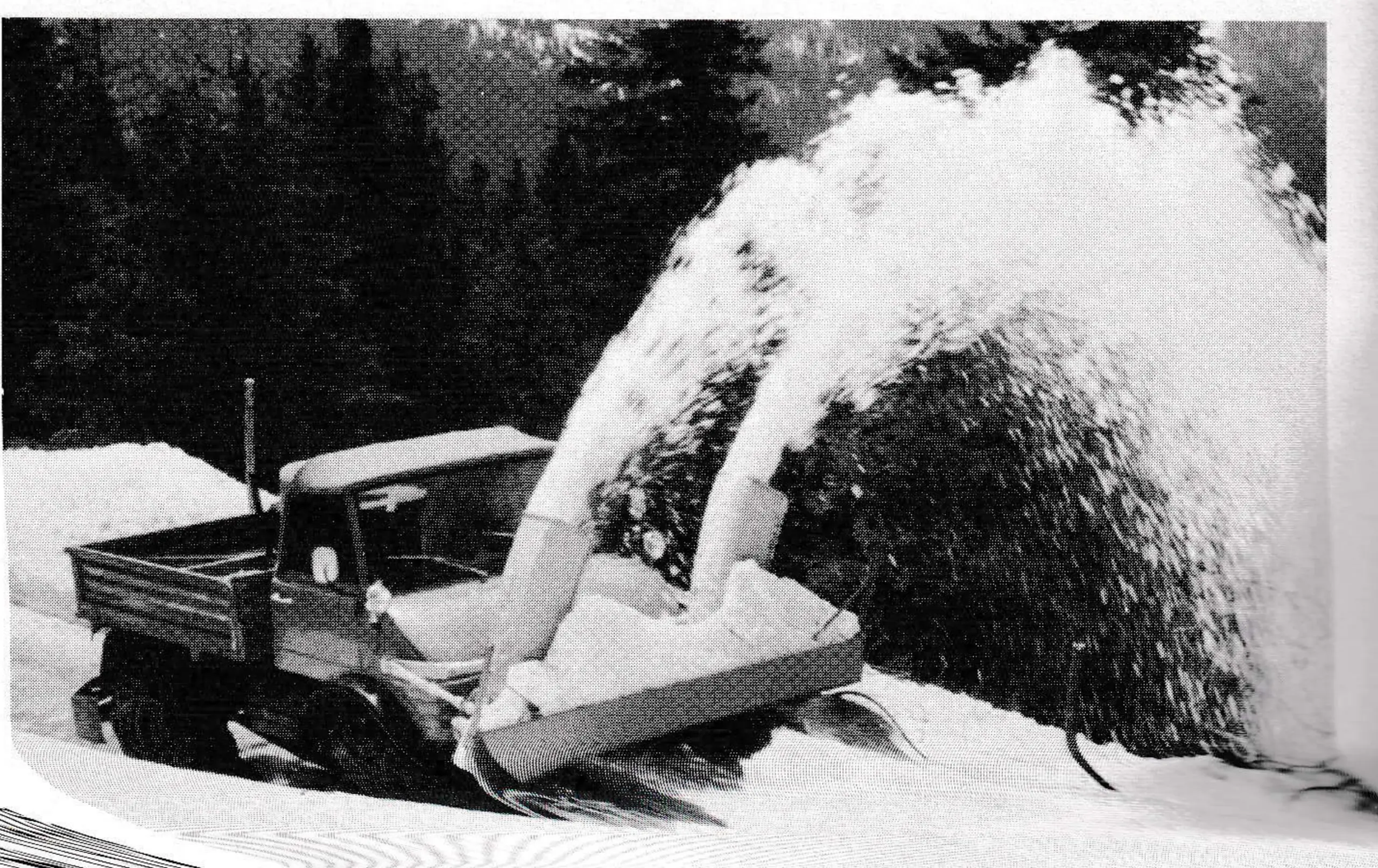
A multi-purpose vehicle which reportedly can deal with almost every snow situation is coming on strong in the U.S. and Canadian markets. The Unimog, from Daimler-Benz, has three types of attachments specifically designed for snow maintenance: a plow with various blades, a rotary blower and a drum-shaped cutter. According to the manufacturer, the Unimog can clear a maximum of 2800 tons of snow per hour with the blower attached; with the cutter the machine can clear a high of six tons in one to two minutes.
The four-wheel drive Unimog comes in three models — 411, 421 and 406 (heavy-duty) — all with eight-speed transmission and four equal-size tires for increased traction.
According to the U.S. Mercedes representatives, the company is accelerating its sales now that all the kinks seem to be ironed out. A reported 13 U.S. ski areas as well as several national parks, already have purchased the Unimog. The vehicle sells for $6800 to $9500, depending upon attachments desired.
Riblet boasts early orders for next season
Riblet Tramway Co. President, T. R. Sowder, says he does not feel any effect from the so-called “recession.” The 74-year-old company is already working on new lifts for over 10 areas: two at Snowmass-at-Aspen, two at Lionshead (Vail), one at Baldy (Sun Valley, Id.), one at Wildcat (N.H.), one at Jesse James (Ky.), one at Mt. Bachelor (Ore.), one at Mt. Spokane (Wash.), four at Conquistador (Colo.), one at Dodge Ridge (Calif.), two at Keystone (Colo.), a bubble lift in Corinthia (Vt.), a small chairlift at Boreal Ridge (Calif.), a high-capacity double chairlift at Breckenridge (Colo.), and a high-capacity double chairlift at Pine Mt. (Mich.) for beginners.
The No. 9 chair at Snowmass is reportedly the largest lift ever installed. It will have a 300 hp electric motor with a 1½-in.-thick traction rope which has a breaking strength of 184,000 lbs.
Riblet’s success is often attributed largely to the financial aid they offer their clients. According to Sowder, however, they have offered this service in the form of payment deferments for the past 12 to 14 years. “Not even 50 per cent of the present lifts ordered were financed by us,” said Sowder.
Heron Engineering, two Poma firms form giant
Heron-Poma Co. is the newborn result of a merger between Heron Engineering and two Poma companies (Poma Aerial Tramways, Poma North America). The new company will cover the field of lift making from simple Pomalifts to cabin trams. Heron-Poma, with combined sales of over $1.5 million, is said to be the third largest lift manufacturer in the United States. The announcement of the merger was made by Rike D. Wootten, president of the Mentor Corp. (parent firm of Heron); Erwin A. Reschke, president of Heron; and Jacques Belle, president of Jean Pomagalski S.A. (of which the two Poma firms were subsidiaries). Terms of the agreement include the exchange of Mentor stock for the two Poma companies’ assets and the stipulation that the principals of the Poma sales companies will stay on under the guidance of Heron.
Pomagalski, founded in 1935, began to produce in the United States in 1953 and has installed over 400 lifts in this country. Heron, which was founded in 1945, was responsible for Aspen’s first chairlifts and reportedly for the first double chairlift in the world, at Berthoud Pass, Colo.
Management
Head introduces GLM program for area schools
Head Ski Co. will offer ski areas a package Graduated Length Method ski instruction program under a franchise agreement as an addition to the area’s regular ski school.
Karl Pfeiffer, Head’s director of professional services, aims to sign up 20 ski areas for the Head-way program. He is concentrating on areas near major population centers, because it is hard to persuade a first-time skier to drive four hours to an area. Also, these cities are where Head’s television advertising hits hardest.
Under the plan, an area pays a $1000 franchise fee. In return, the area benefits from the television promotion and is provided with all the signs and promotional aids for the program. To qualify, the area rental shop must carry at least 100 pairs of three-, four- and five-ft. skis, enough to outfit 50 pupils.
“Our surveys show a high percentage of skiers leave the sport after they try it once,” Pfeiffer explains. “We hope GLM will keep them in skiing because they can progress quite quickly with it. At Killington, we found 95 per cent of the people could learn to ski when GLM was used.”
The Graduated Length Method evolved from a SKI Magazine experiment at Killington when Pfeiffer was ski school director there.
Sugarbush uncovers interesting facts on skier motivation
A Skier Motivation Study conducted by the Sugarbush ski area (Vt.) has been looking into and dissecting the man on the slope since 1965. No longer can area operators make predictions on growth figures or the length of lift lines. The study hopes to reveal what makes skiers tick by asking two questions: “What is skiing to you?” “Why do you ski (or not ski)?” The survey takes in the attitudes expressed at two major Vermont ski areas.
Responding to the question on what skiing means to the individual, 56 per cent looked at it as sheer exercise, 21 per cent went mainly for the après-ski, 13 per cent called it a mental release, 3 per cent considered it a status symbol and the remaining 7 per cent had other definitions. The second question examines the consistency between what one thinks of skiing and why one actually skis. Response showed 36 per cent considered the excitement of man versus the elements sufficient, 31 per cent seek comaraderie, 18 per cent consider it personal expression and the remaining 15 per cent look on skiing as discovery—the esthetic experience of escaping the crowded cities and getting back to nature.
Jiminy wants benefits of in-depth management
Kissing Bridge Corp.’s concept of in-depth area management was put into practice this year at Jiminy Peak in Hancock, Mass., and continuing at Mt. Ascutney in Windsor, Vt. According to Kissing Bridge president Bob James, “No one man can possibly know all there is to know about the management of a ski area and all its ancillary businesses. The only way to cover all the bases is through an organization of experts in the different phases of the overall management job.” Through its Ski Management Services division, Kissing Bridge provides other areas with a carefully selected full-time manager backed up by the entire S.M.S. staff.
Great Gorge cited as largest Nastar area
Great Gorge Ski Area, Inc., has run a larger number of races through its National Standard race course than any other area in the country, according to Gloria Chadwick, Nastar coordinator. The pacesetter for the area is Dave Scott, who has a handicap of eight.
Already 514 racers have run in the daily Nastar races. Additional Nastar races were scheduled for Wednesday afternoons and Wednesday evenings in March; two weekend races were also held, on March 8 and March 14.
Hard sell pushes ski club to retort
The Modoc Ski Club in Alturas, Calif., has been the subject of some high-pressure salesmanship recently. Late in February the office of the Cedar Pass ski area manager received a package containing a type of splint and addressed to the area’s ski patrol. The office had never ordered the item, although a notice enclosed in the package stated that if the splint were not returned to the company, Jamed International, Ltd. of San Diego, within 30 days, the ski area would be billed for the cost of the item ($99 plus tax). The note also said that the patrol could use the splint and return it within the 30-day period.
The area operator’s office, irate about soliciting of this sort, wrote a letter expressing its feelings to the company and suggesting that the company either pick up the package as soon as possible or send a check for $5 to the office for handling, so the package could be returned C.O.D. The Modoc Ski Club also sent a copy of their letter to SKI AREA MANAGEMENT, in the hopes that our bringing the incident to the attention of our readers might discourage the use of selling tactics of this type in the future.
People
Camp folds Sugarbush tent
Phil Camp has left Sugarbush ski area in Warren, Vt., where he handled marketing and publicity, to form Profits, Inc., a marketing consulting service for ski areas and ski industry companies.
Camp started in the ski industry in 1959, working part-time at Killington, Vt., where he later became vice president of marketing. One of his best-known exploits was an aerial survey of competitive areas to count cars in the parking lots and thus determine Killington’s share of the skier market.
On the premise that the ski industry should be doing more research into what skiers will want tomorrow, rather than only grinding out publicity to lure them there today, Camp is offering a package of marketing services to ski areas.
Camp has an undergraduate degree in public relations and communications and has done graduate work in business administration at Boston University. He is a member of the board of the Vermont Development Corp.
Taking over Sugarbush’s public relations functions is Chandler Weller.
- Walter Foeger, vice president of Dutchess ski area, Beacon, N. Y., received the Austrian Gold Medal “for meritorius service in the field of International Relations” at the end of March. A native Austrian, Foeger is known as the developer of the Natur Teknik ski teaching method.
- Brian Bry, a graduate of Middlebury College and former manager of Streeter & Quarles Corp., has been appointed ski shops director by the Sherburne Corp., owner/operator of the Killington, Vt., ski resort.
- Mt. Reba at Bear Valley, Calif., has a new assistant to the general manager in the person of W. F. “Bill” Bonazelli.

- Mt. Hood Meadows ski school director, Rene Farwig, has been chosen to coach the American team for the 9th Interski, scheduled for Garmisch-Partenkirchen, Germany, in January 1971.
- Pat Dasko, former public relations director for the Aspen Chamber and Visitors Bureau, is now publicity and promotion director for Aspen-Wildcat, a new recreational community project.
- The annual reunion of the Sun Valley Ski Club took place January 18-24, with Lowell Thomas as toastmaster. Honored guests included Averell Harriman who, much to his own chagrin, skied constantly, Friedl Pfeifer and Charles Proctor, who in 1936 journeyed from Dartmouth College to the then incipient ski area.
- Jim Low, the 69-year-old business manager and partner at Mansfield Skiways near Alliston, Ontario, Canada, died recently. Low developed the area from pasture land starting in 1960 and has always been a ski enthusiast. He was on the slopes the day he died.
- Lee MacDonald has resigned as executive vice president of the American Skibob Assn.
- Grover Cleveland Robbins, 50, president of the Carolina Caribbean Corp. and founder of the Hound Ears Golf and Ski Club, died recently. Carolina-Caribbean’s properties include Beech Mountain, N.C., the South’s largest ski area.