

Would you believe the excerpts above are from a letter dated January 15, 1973 — one of the worst periods, weatherwise, that the East has ever experienced? Furthermore, these comments were directed at a mountain manager at a ski area in the relatively snow-sparse South.
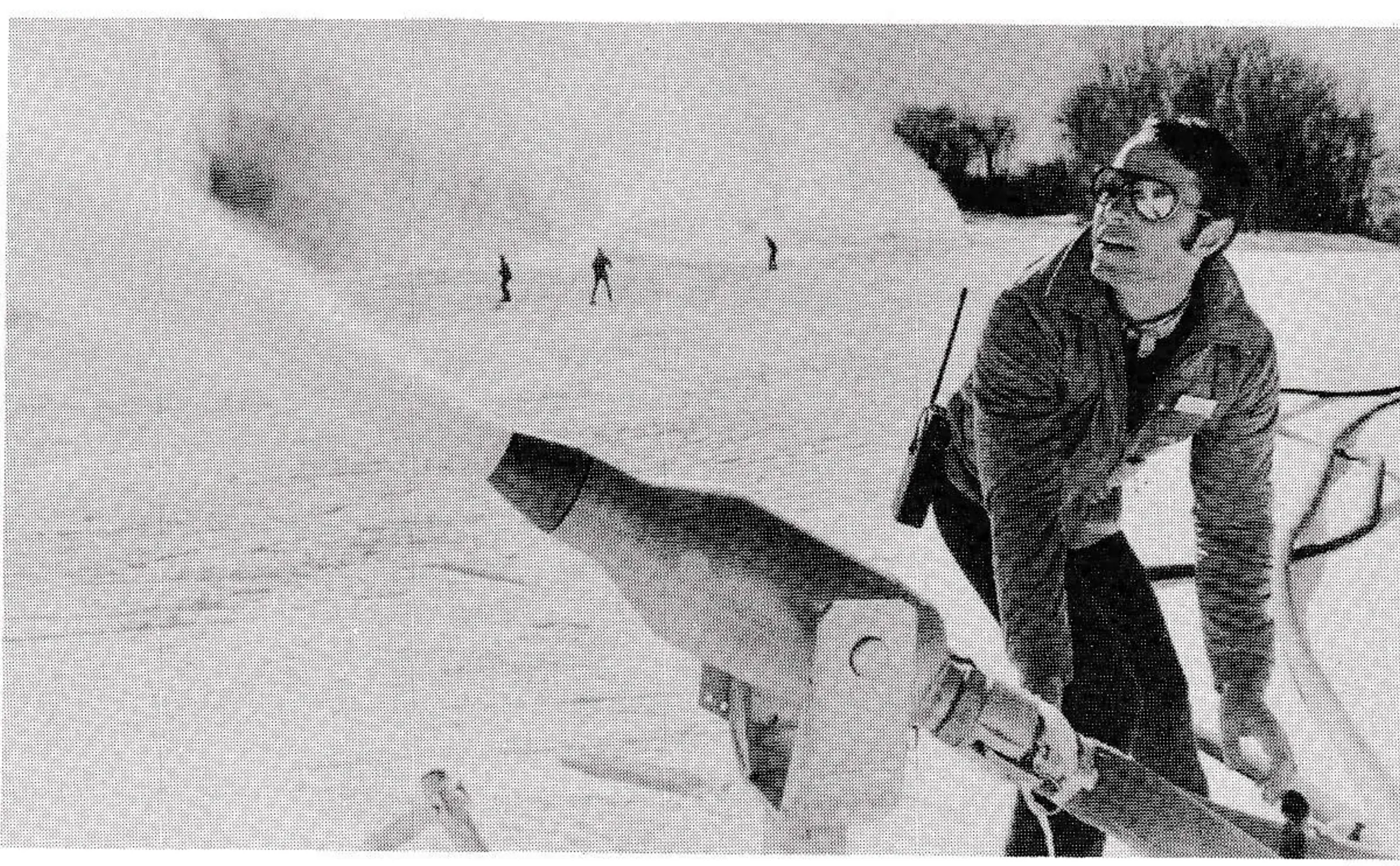
The man in question is Bob Ash, mountain manager at Sugar Mountain, North Carolina, who has gone beyond simply coveting every snowflake; he has devised a system for controlling them. Ash works on the premise that there is more to snowmaking than simply making snow. He believes that snowmaking is subject to management systems that apply to any other manufacturing process, which can maximize efficiency and minimize costs. The key to his operational breakthrough is in two parts: (1) simple forms and color-coding for better communication and teaching (2) a centralization of the mechanisms of control in a building called the Slope Control Center.
The basic forms used by Ash — the Master Snow Plan, the Hedco Master Sheet and the Sugar Mountain Ski Report — are pictured with a typical day’s information and explained in accompanying text.
An additional use of the forms is to conduct probing studies. Each time the snow depth is changed, because of wear and tear of skiers, natural snow, rain or other elements, or, especially after snowmaking, a crew member conducts a probing study. Every 50 feet down a slope, he tests and records the snow depth several times across the slope. Thin spots are probed at closer intervals to determine size and shape for future repair work with snowmaking.
In addition to these forms, Ash keeps vast records of almost every variation that can occur on a mountain. A full-time secretary catalogues such items as temperature, humidity, wind direction, and forecasts. Ash uses these records from the past five years in combination with his current data to predict snowmaking feasibility.
In addition to color-coding snowmaking instructions and results on paper, Ash color-codes most of the apparatus around the mountain. Hydrants are yellow for electricity, green for water, and red for air, which makes for a more efficient work operation. Lifts on maps and for real are also color-coded red, green, brown, yellow, and blue.
For the full-time crew of 12, the colors are second nature, but for the 60 winter people Ash says colors are easier to teach and remember than numbers are.
The Slope Control Center at Sugar was designed and built especially to carry out its specific function, but Ash believes that some kind of appropriate facility like this could be found at many ski areas. Though the cost seems high — $6,000 for the building alone — he maintains that it pays for itself, because Sugar has twice as much skiing as its competition. The instruments for the tower Control Panel came to a total of $4,775 (wet and dry bulb recorder $675, pressure recorder $900, four temperature sensors $580, water flow meter $1,500, air flow meter $200, weather system $500, HP 45 computer $400, and dew point calculator $20). A remote control TV camera, which he hopes to add in the future, is about $5,200.
Sugar’s snowmaking consists of both an air and water system with an IR Centac 110, 11,500 cfm. air compressor and two 600 hp 5-stage horizontal water pumps with a discharge head of 1,875 feet. This system, along with several miles of large diameter air and water buried piping, is controlled by a fluidic electric control system designed by North American Ltd., London, Ontario, Canada. It is backed up by the largest (to date) bank of six Hedco Mark II electric airless snowmaking machines.
The vertical drop at Sugar is 1,200 feet, the highest in the Southeast, and with 100 acres under snowmaking, what could you expect but “powdered sugar?”
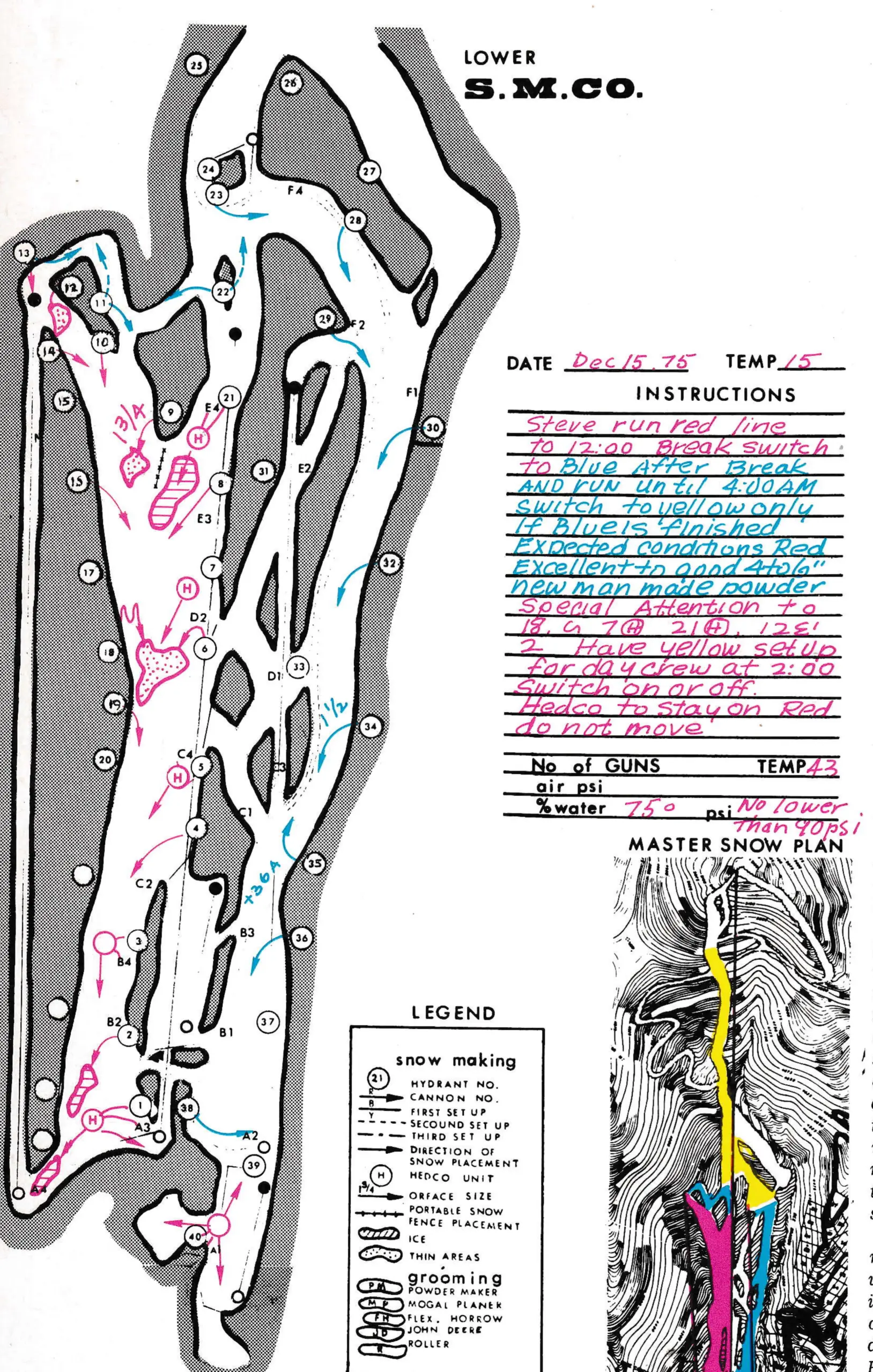
The Master Snow Plan is printed on heavy card stock (8½ x 14) with a map of the lower part of the mountain on one side and the upper on the other. The maps overlap to provide space to mark snow plans at the midpoint. They are scaled at 300 feet to the inch and show the location of all hydrants, proposed hydrants, electrical stations for Hedco units with circuits coded to avoid overload, on and off ramps, lift lines, permanent lift fences, and stabilized roads. At the bottom is an explanatory legend for these items and those that will be written in later.
In the lower right corner of the card is the actual Master Snow Plan: a map of the entire mountain on a scale of 1,000 feet to the inch. The work-up of the plan begins by color coding this smaller map for snowmaking with the highest priority slopes marked in red, the second in blue, and the third in yellow. Lifts that are to be in operation after the snowmaking are colored red, while optional lifts are coded with a broken red line.
The next step is to mark the larger map showing areas that the mountain manager or the ski patrolmen have reported as needing special attention, such as icy spots or thin areas (see legend for symbols used on the maps). Using current weather and snowmaking data and that from previous years, the amount of snow that can be made is computed according to the number of slopes needing cover and the repairs needed for problem spots.

Finally, suggested gun placements are marked on the maps using the legend symbols. Specific instructions are written on the space on the right side, along with the date, temperature and other data. Plan cards are then duplicated, waterproofed with acrylic spray and distributed to foremen at a briefing session.
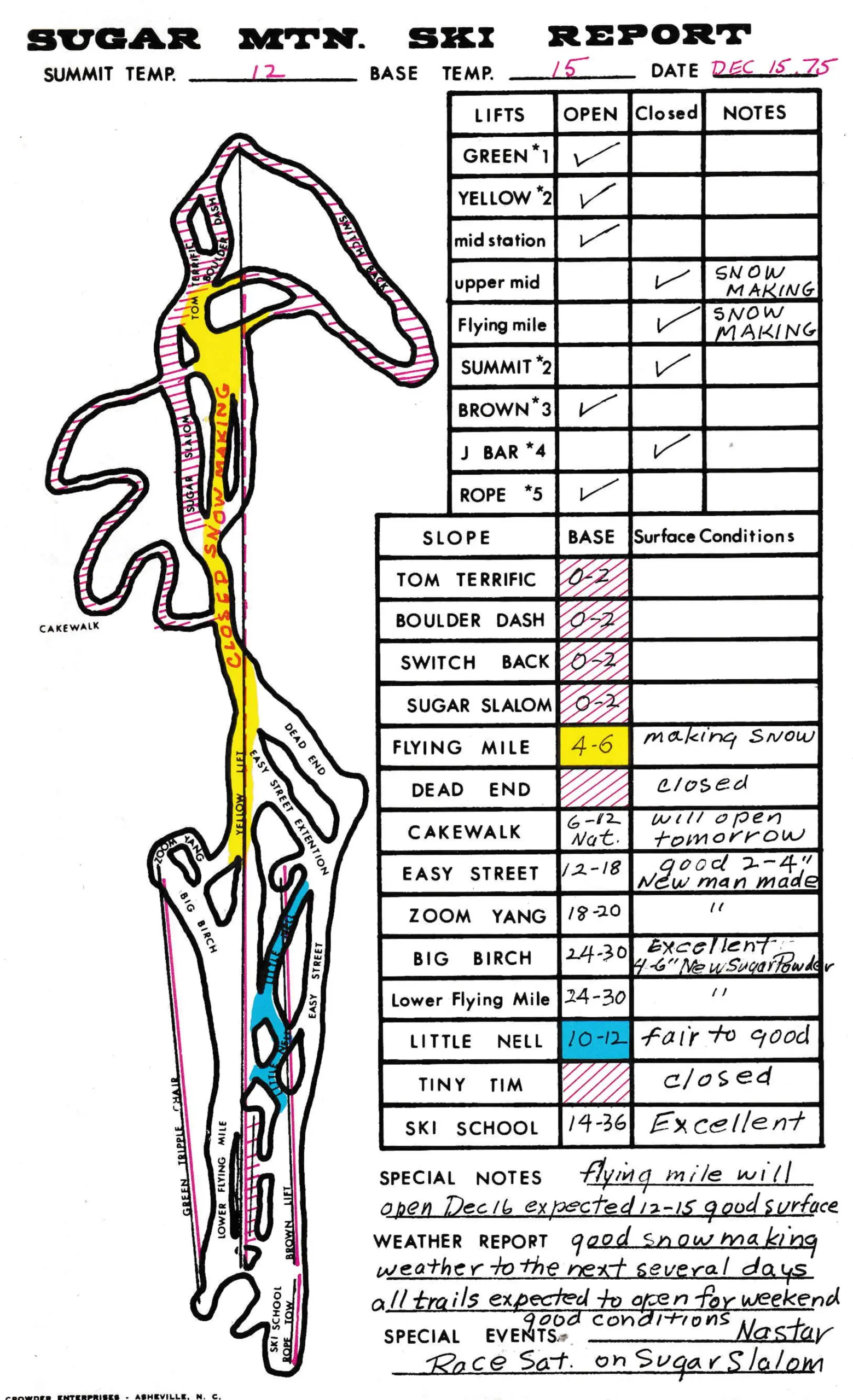
The Sugar Mountain Ski Report is prepared at 7:30 a.m. and 5:00 p.m., daily and distributed to media outlets and posted around in the resort for guests. A recorded message is also put on an automatic answering device.
The form itself shows a map of slopes with their names and lifts indicated. Slopes which are open with good to excellent conditions are not marked in order to reflect the image of snow. Slopes that are open, but with fair conditions are marked in green; slopes open, but with poor conditions are marked yellow. Slopes that are closed are marked with red stripes.
On the right side of the Ski Report form is a chart listing all lifts by name with boxes to check indicating whether they are open or closed and relevant notes. Below that, all slopes are listed with spaces to indicate the snow base depth and notes about the surface conditions. At the bottom there is space for information about weather, special events and other notes of interest.
The beauty of this form is that it is quick and easy to fill out with precise information, using color codes and symbols similar to those used on the Master Snow Plan. When forecasts and intentions about snowmaking are added to this report, the emphasis is always on accuracy rather than hollow promises. “We have committed ourselves to have all red areas the next day’s skiing with the conditions noted,” says mountain manager, Bob Ash. “There is no fooling today’s skier, unless you just want quick money and don’t mind an area with a terrible reputation.” The form looks impressive and makes a good presentation to the skiing public.
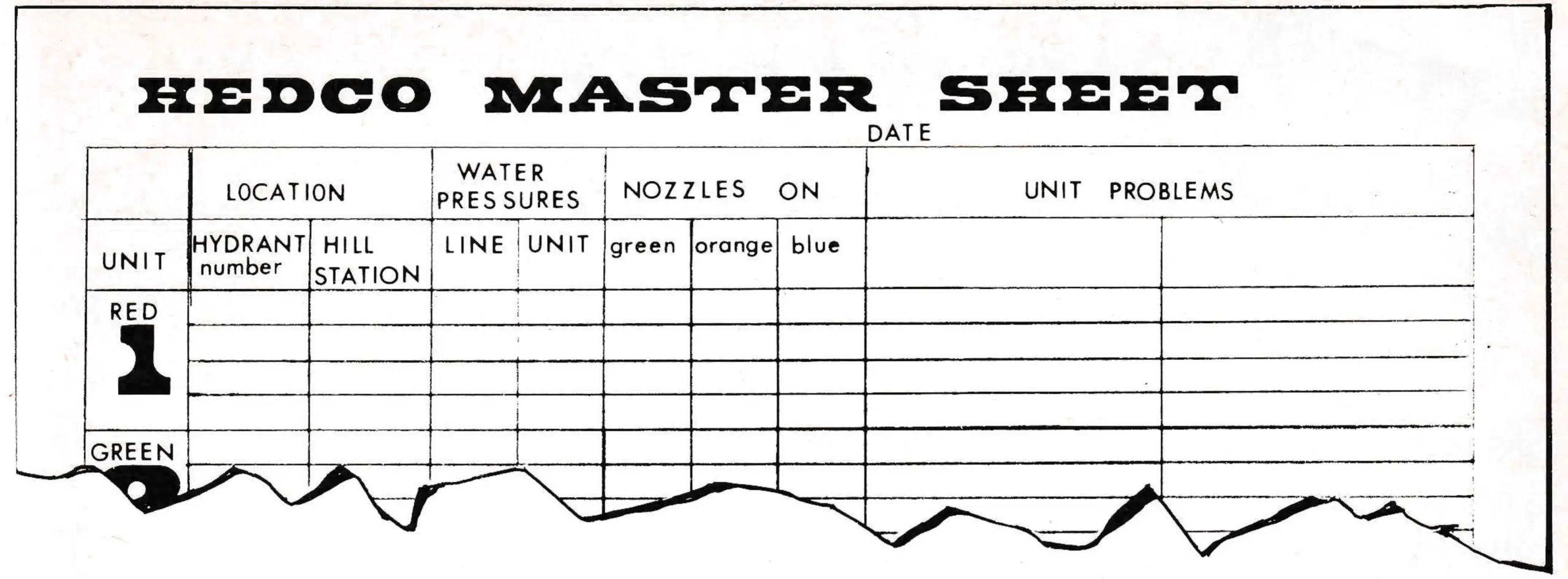
The Hedco Master Sheet is a record which the Hedco foreman fills out every day. With these records, filed in the Control Center, the mountain manager can keep tabs on need for maintenance and possible future breakdowns. Each Hedco unit is painted a different bright color, so with binoculars he can check its condition from as far away as half a mile.
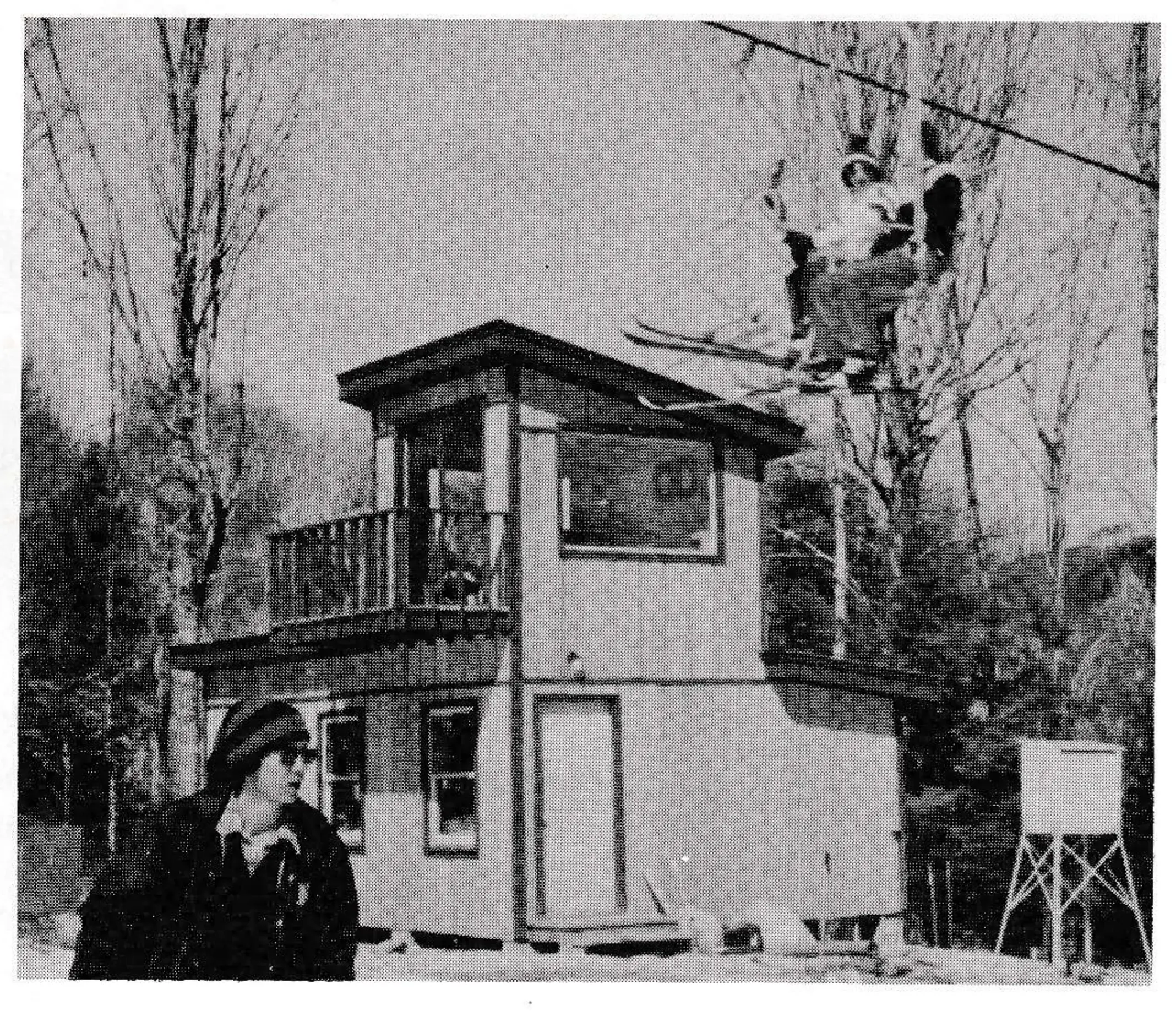
The Slope Control Center is the operations center for all mountain crews with monitoring equipment for lifts, grooming, ski patrols, and, most important, the production of snow. Aside from the Control Panel (described below), the Control Center has binoculars, sling psychrometer, drawing board, drafting machine, a weather sign for skiers, and a dimmer for interior lights. Plans call for a later addition to starlight remote control TV camera with a zoom lens, placed to view any part of the mountain, day or night.
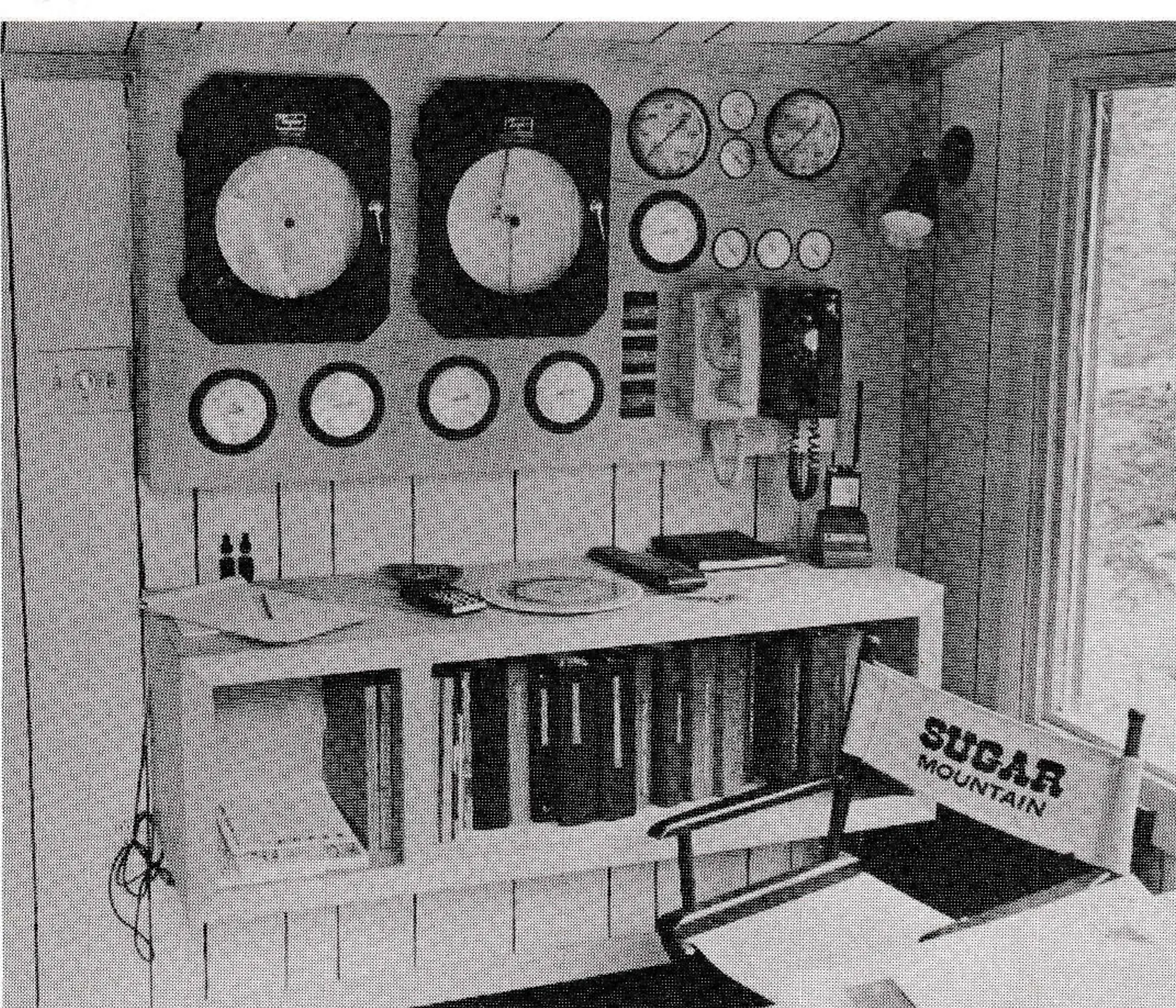
The Control Panel in the Slope Control Center, has an array of sophisticated monitoring devices, the better to make snow. This new tool in ski area management, has the following meters, recording and communications equipment: (1) a 24-hour wet and dry bulb temperature recorder with a 10-inch disk chart (2) a 24-hour water and air pressure recorder with a 10-inch disk chart, sensed off the main snowmaking lines near the Center and adjacent to hydrant No. 2 (3) measuring dials for four thermometers located at different elevations on the mountain to sense snowmaking temperatures (4) a water flow meter of gallons per minute sensed at the pumping station upstream, above the turbulance caused by valving (a recording unit may be added later) (5) an air flow meter sensed at the Centac compressor (6) a meter of water temperature sensed at storage (7) a meter or air discharge temperature sensed off lines (an air and water temperature recorder may be added later) (8) time recorders of all major lifts (9) a wind speed indicator sensed at the Center (10) a wind direction indicator sensed at the Center (11) a barometric pressure indicator sensed at the Center (12) a gray telephone system for internal calls to lift shacks, first aid station, and compressor house (13) an outside telephone (14) lift shut-off switches on the side of the panel to prevent accidental tripping.
Just below the Control Panel is a cabinet holding various items for convenient use. These include: a psychometric computer (dew point calculator); Hewlett Packard HP 45 computer; a two-way business band radio to reach four snow cats, the compressor house, snowmakers, engineering, the ski center, security and construction areas; manuals, snow records, lift logs, etc.; and forms for snow charts, snow reports and other inhouse operational records.