


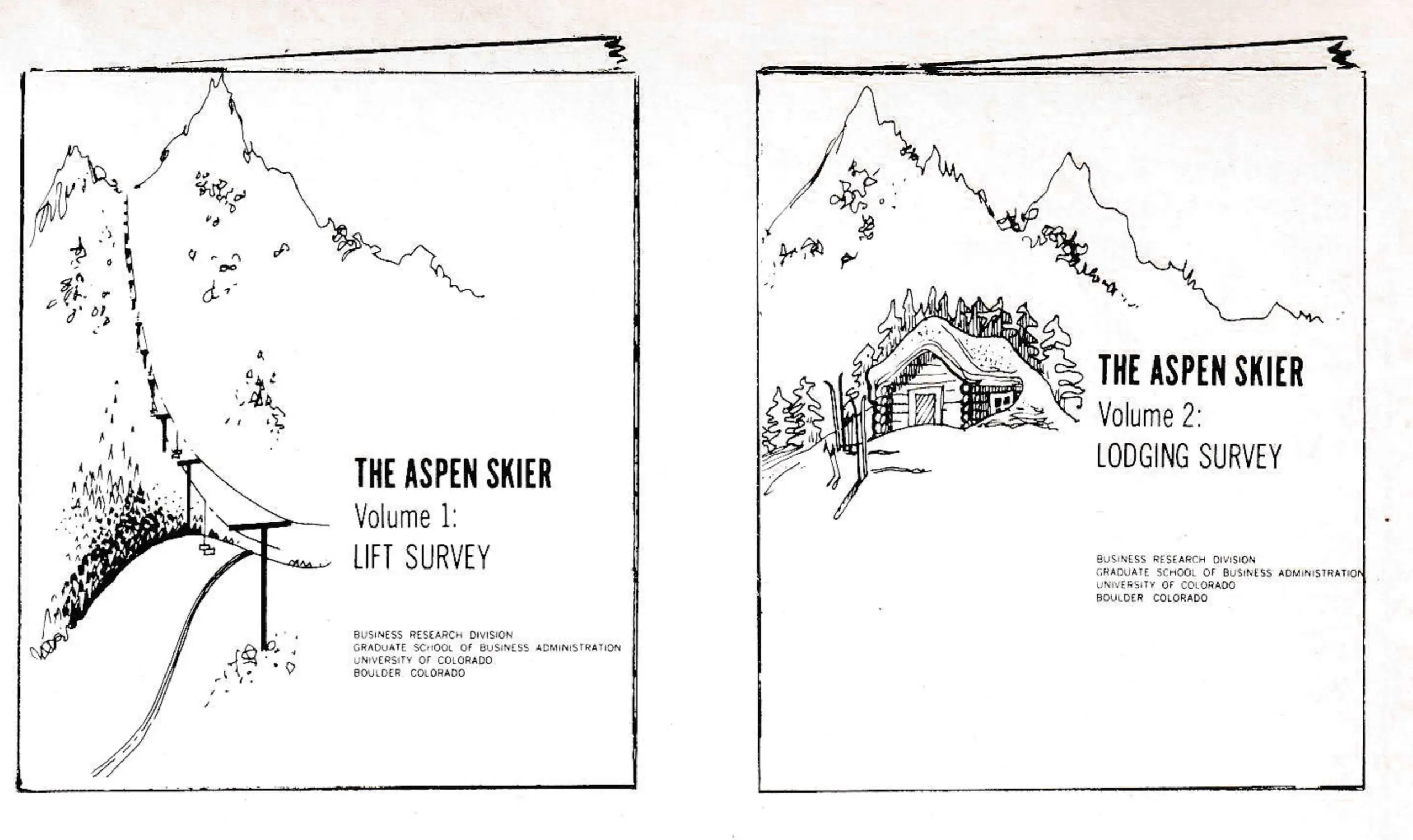
The four Aspen ski areas (Aspen Mountain, Aspen Highlands, Buttermilk-Tiehack and Snowmass) handled a total of 1,260,289 skier-visits during the 1973-74 season. This was an increase of 736,330 skiers or 140 per cent over the number skiing Aspen when the last skier market study took place in 1968. Two market studies were conducted in Aspen during the latter part of last season and serve to update our knowledge of this new vacation skier market.
Aspen is indisputably the number one vacation ski destination in North America. While others such as Vail, Mammoth, Heavenly-Squaw, Alta-Snowbird, Sun Valley and Stowe may debate the quality of the vacation experience, no other ski resort handles these numbers. Aspen and Colorado ski vacation resorts also draw skiers from all sections of North America as will be seen in the findings of these studies. Based on one key finding, that the average Aspen skier spent 6.44 days skiing while at Aspen, then there were 195,700 skiers visiting Aspen last winter.
Who are these vacationing skiers? Where are they from? Are there any significant changes in this market vis-a-vis the last few studies that are now over five years old?
These two studies were joint efforts by the University of Colorado Bureau of Business Research and the Aspen Chamber of Commerce, directed by Dr. C. R. Goeldner, who, incidentally, is the man conducting the NSAA Economic Study. The lodging survey represents a statistical sample of guests of Aspen lodges during the week of March 17, 1974. Data is based on 665 returned questionnaires, an excellent 57 per cent response.
The lift survey is a statistical sample of all skier-visits during the five week period February 24 – March 29, 1974. This data is based upon 604 interviews.
Both techniques introduce some bias. Both, however, represent practical, economical methods of market research, and given the typical budget restraints, must be judged as infinitely better than no research at all. The assumption that all Aspen skiers are similar to these samples is probably more right than wrong. To carry this assumption on to all Colorado-bound vacation skiers may stretch credibility, and certainly this sample can not be called representative of vacation skiers in general and-or skiers in general. (Although I suspect that planners will eagerly seek this current data, since it is the only new data in existence.)
I find two very significant items. First, the Aspen skiers come from all fifty states, Canada and abroad. Their geographic distribution closely parallels the North American population distribution, with of course expected lower percentages from the south, and greater proportions from the Rockies and midwest, where Aspen has a locational advantage. Table I shows the geographic skier distribution compared to the geographic population distribution. The “penetration factor” measures the relative distribution of the Aspen skier market in relation to the geographic distribution of the North American population. A factor of 1.00 indicates that the proportion of Aspen skier-visits is equal to the proportion of the population. For instance, look how closely New England and Canada are to supplying their relative share of Aspen Skiers.
| Geographic Region | Percent of Population (Jan 1, 1973) | Percent of Aspen Skiers | Penetration Factor |
|---|---|---|---|
| Great Lakes | 18.4 | 27.3 | 1.48 |
| Middle Atlantic | 19.4 | 16.0 | .83 |
| Pacific Coast | 12.3 | 10.2 | .83 |
| Great Plains | 7.5 | 10.1 | 1.35 |
| Rocky Mountain | 4.0 | 9.5 | 2.38 |
| Southeast | 17.9 | 8.7 | .49 |
| New England | 5.4 | 5.8 | 1.07 |
| Southwest | 9.0 | 5.5 | .61 |
| Canada | 6.0 | 6.3 | 1.05 |
| 99.9 | 99.4 | 1.00 | |
| Foreign | .5 | ||
| 99.9 |
Second, the Aspen skiers come from very affluent households. They are highly educated, professional and managerial types with 50 percent from households with annual incomes of over $25,000! (The lodging survey found 62.4 percent from this top income bracket.)
While we know that skiing is an expensive sport and that a ski vacation at a top resort takes a large share of the family’s discretionary income, the question naturally arises; “Are we pricing skiing out of the market?” and-or “With the cost of skiing so high are we severely limiting our market?” (A concurrent question is “Can we significantly decrease the cost of skiing?”; however, this is logically another subject and cannot be covered here.)
The lodging survey and airlines survey were remarkably similar in their findings concerning skier expenditures. The mean (average) expenditure per person per day was $69. Thus, the average family of 2.9 persons, staying 7.1 days in Aspen spent between $1,300 and $1,400 on their 1974 ski vacation.
Since this “average” family earned $25,000 annually, their ski vacation costs 5.4 percent of their income, not an exorbitant share. (Incidentally, 35 per cent or $472.50 represents the cost of air transportation.)
As an indication of the market potential, let us just analyze the upper half of the Aspen skier market. These families are from the affluent, over $25,000, professional and managerial, highly educated socio-economic strata. Since they represent 50 percent of the 1973-74 Aspen skiers, there were about 100,000 skiers in this category. Sales Management, “Survey of Buying Power”, 1974, shows that 7.8 percent of U.S. households have an effective buying income of over $25,000. Thus, there are over 5 million U.S. households in this affluent category. Aspen currently hosts less than 0.7 percent. In fact, all of the vacation destination ski areas in Colorado (13 areas) host less than 2.0 percent of these households, the most eligible ski vacation market.

The studies also reveal much about the habits, experience and opinions of these skiers. Seventy-five per cent of the skiers rated their Aspen skiing experience “better or much better than other ski vacations you have taken”. Ninety-three respondents took the time to write helpful comments and their verbatim responses are included in the report. Twenty per cent were favorable and complimentary, which is unusual as normally only the disgruntled bother to comment. Gripes centered on the expense (13), the crowds (12), air transportation (12), intra-area bus service (6 plus 6 compliments) and “Aspen is overdeveloped” (7). Finally, however, 93 per cent said that they plan to return in the future. A corollary to this high degree of satisfaction and great propensity to return in the future is that 41.2 per cent of these skiers were visiting Aspen for the first time.
One interesting fact was that 35.7 per cent of the skiers in the lift survey were on some type of package plan. While the data is not quite comparable, this appears to be a significant increase from 1968 when the D.R.I. study of Colorado skiers found only 7.6 per cent of the skiers expenditures were on package plans.
There is one significant trend apparent when the socio-economic characteristics of Aspen’s 1974 skier are contrasted with the 1968 Aspen-Vail skier as described in the Denver Research Institute’s massive study of tourism in Colorado. Women’s lib is very apparent! Married skiers are up 76 per cent from 31.8 per cent in 1968 to 56.1 per cent in 1974. The proportion of females on the slopes increased 38 per cent from 26.4 per cent in 1968 to 36.6 per cent in 1974.
Of course, costs have risen as have average incomes. The question is how much?
Aspen skiers median incomes grew 97.1 per cent, from $13,700 in 1968 to $27,000 in 1974. Expenditures at the ski area increased 81.2 per cent, from $24.50 skier-visit in 1968 to $44.40 skier-visit in 1974. (Aspen’s ski lift ticket prices rose only 53.8 per cent from $6.50 in 1968 to $10.00 in 1974.)
These trends can be viewed in perspective by comparing these increases to the national increase in per capita buying income. Per Capita Effective Buying Income grew 54.8 per cent over the same six-year period, from $2,697 in 1968 to $4,176 in 1974.
These are but a few of the highlights of these, the only known current skier market research studies. The 1974 Aspen skier appears to be at the top end of the affluency scale. It will be interesting to compare their characteristics, habits and preferences with skiers in general. I suspect that their demands and expectations will continue to escalate and given the current Aspen, no-growth attitude, that an Aspen ski vacation will be out of the ball park for the majority of skiers within five years.
*The studies reviewed here are: The Aspen Skier, Vol. 1 (Lift Survey) and The Aspen Skier, Vol. 2 (Lodging Survey). The price of each volume is $10, and is available from the Business Research Div., Graduate School of Business Administration, University of Colorado, Boulder, Colo. 80302. A third study, entitled “The Airline Skier,” referred to in this article, but not specifically reviewed, is also available for $10. This March 1974 study analyzes the nature of the skier departing Denver by air.