

How much potential ski area income is lost annually through customer and employee theft? How much is lost from internal embezzling? From shoplifting? From the petty theft of supplies and inventory? How many potential customers are skiing free on the lifts? Is a 10 per cent figure too high an estimate for some ski areas? Obviously the answers will vary dramatically depending on both the management philosophy involved, and the caliber of the operation.
Bring up such questions at an area operators’ meeting during the cocktail hour, and some pretty spirited, finger-waving discussions may follow. For the fact of the matter is that a potential income loss of 10 per cent may be a conservative figure for at least some operations.
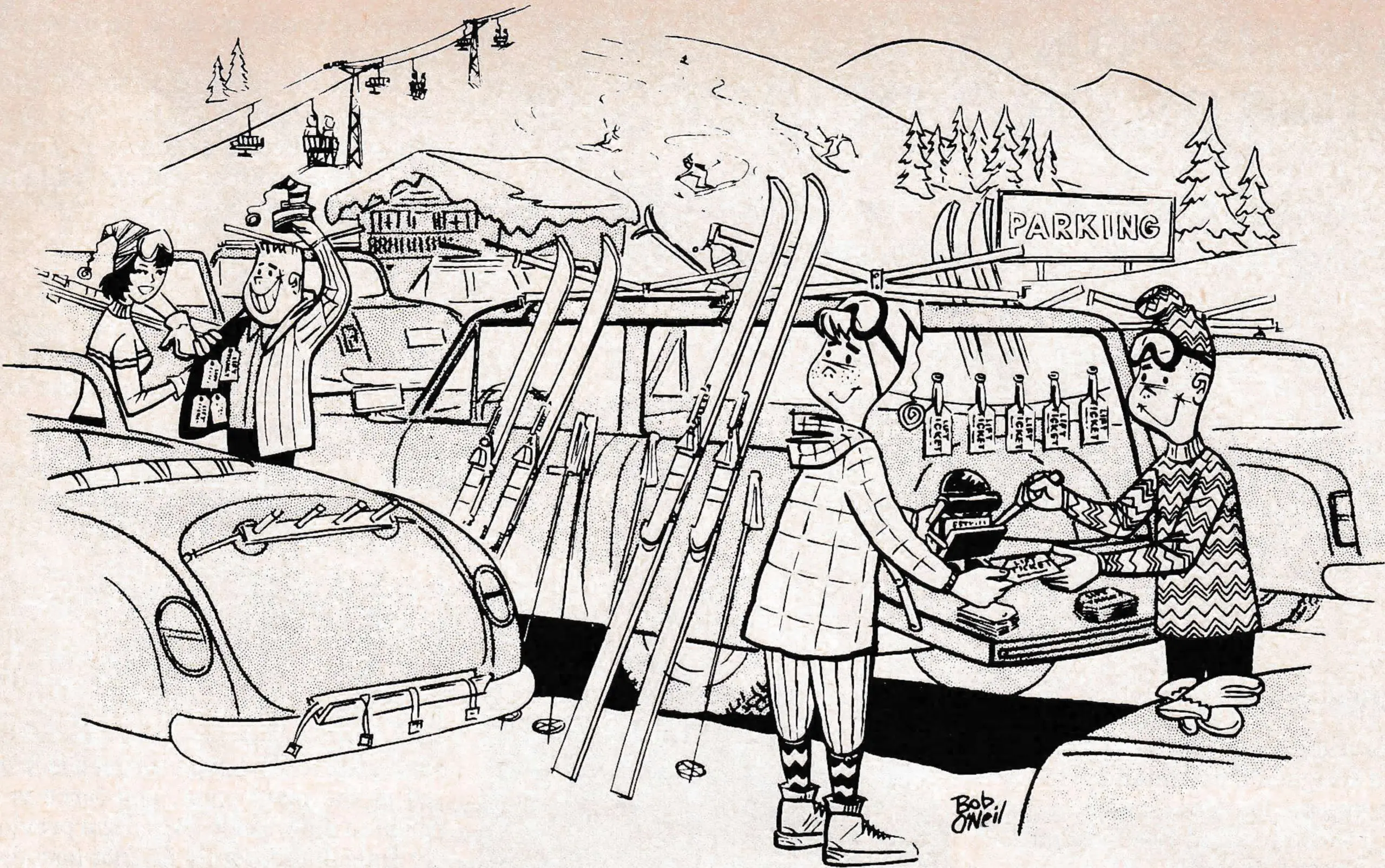
The question again came to mind when booting up in the parking lot for a day’s skiing at a major California area. The conversation of the obviously high-income family parked next in line was fascinating. The impeccably attired father was very carefully rehearsing his pre-teen son on what to say if he was asked to show a lift ticket — a lift ticket that Father evidently had no intention of buying for his son.
“Now remember, Son, be completely surprised and act helpless. Say to the checker, ‘Oh! my lift ticket’s gone! It was attached to my zipper! See! The zipper pull has broken off!’ ” And it was. Father continued, “Now where did you buy the ticket? . . . What time of day? . . . And what did the ticket seller look like?”
“I’ll look at the seller before skiing, Dad,” the son replied.
“Good boy,” said Father, obviously pleased at his son’s acting ability.
In actuality, Father needen’t have bothered with the careful rehearsal. During a full day’s skiing not once did anyone on the many lifts show the slightest interest in whether we or anyone else had lift tickets.
Is that ski area’s lack of lift ticket checking an exception to industry standards? Is it reasonable to believe that internal supervision in other phases of the area operation are adequate, when in fact the money controls on the lifts are non-existent? These were questions running through one’s mind while enjoying an after-skiing beer in the area bar.
Another nagging thought: “Just how has the industry created an image with many, that it is not really stealing to cheat a ski area of lift services?” It might be difficult to imagine that father coaching his son to shoplift from their local supermarket, yet quite easy to visualize him at a cocktail party bragging to friends of how he ripped off a ski areas for lift tickets. In fact with some peer groups, it is a status symbol.
These thoughts come to an abrupt halt with the realization that without a word, the bartender had just casually picked up the dollar originally laid on the bar for the beer, and placed it in his tip glass—which was a giant-sized brandy snifter. The sum of money in the glass would make a bartender at the best-tipping lounge in Last Vegas green with envy. We ordered a second beer and sat back to watch.
His style of operation? No sophisticated chicanery for this bartender, no sir! Simple, straightforward, out-in-the-open theft was quite good enough for him. Simply multiple ring the sales after serving 5 to 6 separate parties. And forget to ring about every third beer sale. Money approximately equal to the amount of the unrung sales found its way to his tip jar. In addition, orders for employees were simply not charged for.
For this ski area the question then should be asked, “Just what is the loss to the company in potential gross income on an annual basis, from such methods of operation?” Is 10 percent an exaggeration? Perhaps. But many an outside auditor might feel it could easily be more. And in any case, for this ski area it is likely the difference between the long-sought fiscal stability, and its present continuing financial problems.
In addition to such fairly common “petty theft” practices are the “horror stories,” most of which, when discovered, are dealt with very quietly.
Recently one western operator was shocked to learn that a trusted, had at some point stolen ticket stock from the main inventory. Subsequent reconciliations missed the shortages. The ticket seller was then simply selling a few of his own supply during each shift and pocketing the money. An audit established the income loss at a minimum of $8,000 to $11,000. The loss was not insured.
An unusual incident? Likely, but then consider the experiences of a large, neighboring ski area during the same period. An outside audit first revealed that the only time lift tickets were actually checked on the lifts was when members of the Executive or Board of Directors were skiing. Which was a rare event.
A casual audit of the office indicated a multitude of loss exposures. Season pass control cards were not machine numbered or reconciled. This allowed one of the night supervisors to sell bogus season passes to ex-college friends for $50 each. The income was pocketed. With the method used and lack of controls it was impossible to identify the passes at the lift. The estimated loss was in the low thousands.
At the same area a reconciliation of the ticket inventory revealed that one and two tickets had been removed from many of the bundles still on hand. As ticket inventories in the past had never been “effectively” reconciled, it was then impossible to establish the exact loss. A figure in the lower thousands might be conservative. The list could go on if space permitted, with significant losses identified in the food, beverage, and gas inventories, and with courtesy tickets. Because of inadequate records, none were covered by insurance.
Go back to the opening and unanswerable question of “how much potential area income is lost through theft?” There is no information or data, but consider that F.B.I. statistics indicate that 5 to 6 percent of each shopper’s dollar goes to cover losses from shoplifting and employee theft . . . That the value of material stolen from business and industry by employees is 5 times the value stolen by professional burglars and outside shoplifters. . . . That in a one-year period a firm like Montgomery-Ward fired 3 percent of its work force for theft-related offenses. Consider that according to the statistics the majority of shoplifters are under 18.
Then consider that many skiers do not feel that cheating on lift tickets is really stealing. That a significant portion of each area’s customer base is youth. That it is safe to assume that non-existent or casual ticket and money controls simply invites a theft problem.

Then a 10 percent loss in potential income for some areas seems less and less like an exaggeration. And for that matter, what area can say that even a 5 percent increase in income with no accompanying rise in operating expenses, would not have a dramatic impact on the financial statements?
Where is the largest potential income loss for the ski area? Most often it is at the lifts, with potential customers skiing free. This is defined more accurately as “theft of services” a loss of net dollars.
Do most ski areas in fact have thorough lift ticket checking controls? What are the standards at the average operation? Is it easy or difficult to ski free? Before answering review the accompanying graph — “A 12 Ski Area Survey Comparison Of Lift Ticket Checking Standards.”
| Survey criteria | Ski area A | Ski area B | Ski area C | Ski area D | Ski area E | Ski area F | Ski area G | Ski area H | Ski area I | Ski area J | Ski area K | Ski area L |
|---|---|---|---|---|---|---|---|---|---|---|---|---|
| 1. Number of times personal lift ticket checked compared to number of lift rides. | 0 of 11 | 0 of 7 | 60 of 60 | 1 of 13 | 0 of 9 | 3 of 5 | 3 of 8 | 13 of 13 | 0 of 29 | 4 of 6 | 1 of 17 | 0 of 8 |
| 2. Thoroughness of personal lift ticket checks. | No checks | No checks | Excell’t | Poor | No checks | Fair | Poor | Fair | No checks | Fair | Poor | No checks |
| 3. Apparent frequency and thoroughness of lift ticket checks of other skiing customers. | No checks | No checks | Excell’t (all) | Very infreq. checks | No checks | Occas. checks | Occas. checks | Nearly all checked | No checks | Nearly all checked | Very infreq. checks | No checks |
The information was compiled by the author over a six-week period one season ago, in preparation for training seminars. While 12 ski areas are not ncessarily representative of the industry, the informaion should be relevant for review purposes.
For all intents and purposes the average ski area in the survey had no lift money controls whatsoever. (Could a movie theater or supermarket stay in business with similar money controls?) Lift ticket checking at seven of the twelve areas was non-existent. At two areas an attempt was made, but the efforts were casual and would prevent only the “faint of heart” from boarding free. In other words nine of twelve ski areas, either intentionally or unintentially, chose not to check the lift tickets of customers.
At two areas (H and J) a skier bent on cheating would usually be able to ski free, but would have to put at least some degree of effort into the attempt. Lift money controls there would then have to be rated good, as the standards would satisfy most management’s objective of “preventing the majority of potentially good customers (and employees) from “trying” to ski free. While such systems would not likely stop the hardcore cheater, there are differences of opinion as to whether such efforts are really worth the returns.
Note the use of the phrase “prevent from trying to ski free,” since it would seem reasonable to assume that the objective should always be “prevention” rather than “apprehension”.
Note also the inclusion of “potentially good employees” in the prevention effort, since temptation applies equally to customer and employee. Area G in the survey would be a good example. I had occasion to ski with one of the employees from the hotel I was staying at. She was using the I.D. Season Pass of one of the ski area (male) employees. Three other hotel employees also used the same pass on their days off. No-one on the lifts ever payed the slightest attention to whether the picture matched the bearer. Her room-mate, who skied with us, had no ticket at all, and wasn’t the slightest bit worried about being caught. When tickets were being checked on the nearest chair, she simply used a second lift from the base area, where it was evidently common knowledge the crew “never” checked “locals” for lift tickets.
Area C was one of the largest and busiest included in the survey. Lift ticket controls and operating standards in general were consistently exceptional. Lift ticket checking came as close to perfection as one could hope for. No-one was missed. Season pass photos were regularly checked against the bearer. Line maze controls and loading ramp maintenance was excellent. The loading process was smooth and efficient. Stops were rare. Linebreaking was non-existent. And the customer relations of the personnel was consistently superb.
Going back again to the origianl questions. How much potential income is lost at Area C? In all likelihood, very little. Is the return worth the effort for Area C? The answer would have to be a very emphatic yes! And not just because of the obvious income controls. The fringe benefits of the other superior operating standards would have to be considered invaluable from a marketing standpoint.
What about the other 11 ski areas in the survey? How much potential income is lost at each? How much is being lost at your area?
The Lift Ticket and Lift Personnel
A review analysis of the system in use might ask the following questions: (It is understood, of course, that any system is only as good as the people who execute it!)
- When considering the lift ticket, does the style, size, and quality of the daily ticket contribute to the east of visual identification? Or does it hinder? Are ticket colors sharp and bright? Is there a suitable contrast between ticket types? Are tickets easy to alter or counterfeit? Can the ticket consecutive serial number be easily read? Are the various ticket categories always the same color? Or are there irregular color changes?
- Is the daily validation code large and easily identified? Does the validation background provide a contrast to highlight rather than camouflage? Is the code at least to some degree unusual? Will it present some difficulty to duplicate or alter? Is the daily code symbol predictable beforehand?
- The quality of the daily code validation can really help or hinder the ticket Checkers. Is the code (hopefully) printed? If not, is the ink bright? Indelible? Is the code impression sharp?
- Is the code applied consistently, evenly, and in the space provided? Or is it blurred, dull, and off the ticket? Most samples in the 12 ski area survey were faint and vague. At four ski areas the validations were consistently off the ticket, and were virtually unreadable—not much of a problem, however, as none of the four checked lift tickets.
- Is there a sufficient number of lift personnel to adequately check tickets? Without staff fatigue? Or is a loading operator also expected to check? (An impossibility). Is the line maze adequate? Does the maze assist the ticket checking process? Is the maze designed to prevent linebreaking?
- The all-important human element: Are the ticket checkers alert, active, enthusiastic and personable? Or are they blase and indifferent? Is the same ticket checker always on duty, and at the same position, or are lift positions rotated for freshness? Is the ticket checker a strong enough personality to deal effectively with problem skiers?
- A consistently thorough effort by the ticket checker is needed to make the system work: Are all boarding skiers checked? Or are some missed? Are some skiers able to stonewall through without actually showing a ticket? Is it easy to “outwait” the checkers?
- Is the ticket checker frequently engaged in idle talk with “in” skiers or off-duty resort employees? A very common occurrence and a significant problem at the small number of ski area operations in the survey, who were attempting to check tickets. The one exception: Area C.
- Is the ticket checker properly positioned to adequately see everyone? Does the checker grasp and examine each ticket and wicket attachment? Is a ticket punch consistently used? Only one area (C) in the survey used a punch, even though such a method greatly assists the ticket checker, and may significantly lessen customer irritation.
- If photo I.D. season passes are used, is the picture likeness regularly checked with the bearer? Including employee I.D.’s,if used? Were hats or dark glasses allowed when the picture was taken? Does the season pass have an easily visible pass number? Are the passes and employee I.D.’s machine numbered consecutively, when printed?
The Management Ingredients For Successful Lift Ticket Checking Controls
The existing management philosophy is the first consideration of any ticket checking plan. A manager wishing to review his ticket checking operation might first ask the following questions:
- Are there structured management objectives for lift ticket controls? Does the product satisfactorily meet the objectives? Is there in fact a simple yet effective lift ticket control policy? Is the policy generally followed? By all of the staff?
- Does management really care? Participate? Supervise? Does management consistently support and enforce the lift ticket policies? Or are exceptions all-too-frequently made (without explanation to the checkers?)
- Does management really know how thorough their lift ticket controls are? Especially under normal conditions as contrasted to when the lift grapevine has alerted the operators and supervisors that management is on the hill. What is the ski area’s real reputation for ticket control standards?
- Does management frequently review ticket checking standards with the lift supervisors? Is the supervision frequent and enthusiastic, and participatory in nature? If not, why not?
- Are ticket checkers treated as responsible, trusted, important employees? How is their honesty evaluated on initial hiring? Is there a selection process? Are backgrounds checked? Are ticket checkers trusted with replacement tickets?
- Are all ticket checkers provided with—and understand—the established ticket control policies? Do they realize the importance of checking? Is there a formal training program? For employees hired later in the season also? Is the function of each position simply described? With easily understood lines of responsibility and communication?
- Is effective supervisory assistance always available to the checkers when needed? Do supervisors consider ticket checker problems important? Are possible solutions considered in a timely manner? Are suggestions and ideas continually solicited from ticket checkers?
- Are checkers able to deal effectively and cheerfully with lost tickets, over-age children, tickets attached on the wrong spot, transferred tickets, counterfeit or altered tickets, problem customers? Are supervisors aware of and understand peer group and employee pressure on young ticket checkers? Do they support and encourage checkers with the problem?
- Is there in fact a consistent lift ticket attaching policy? Is the policy generally followed? By everyone? If tickets are customer attached, what is done about those attached to belts, gloves, hats, etc? If the ski area policy is “attach the ticket only to the pants” . . . is the policy in actuality, enforced—that is, enforced consistently and without damaging area/skier relations.
- Does everyone boarding a lift have to have a valid lift ticket, season pass or visible employee I.D? If not, why not?
Norm McKinnon, with 24 years of ski industry experience ranging from instructor to general manager, is the author of Lift Operator’s Handbook.