

Many areas are reluctant to host major competitive events, believing that the expense, effort, and imposition on their ticket holders from closed trails and busy crews is not justified by the amount of press they receive. This will remain a popular opinion among many ski area operators until amateur racing becomes more spectator and press conscious, and the ski areas themselves are able to capitalize on the news value of these events.
The fact is most sports events are staged for press and television. The Super Bowl, the Masters, boxing, auto racing, tennis — all are “manufactured” for television. There is talk in Olympic circles of staging the Games solely for television and the press pool, with little or no public participation at the site. As one of my reporter friends is fond of saying, “Anyway, the view is better from the bar stool.” While seemingly ruthless, this is justified, for a far greater number of people will witness an event via television than will ever line the edge of a course. The public interest in sports, competition, and exotic locales is proven, but it takes knowledge, skill, and experience to capitalize on the new worthiness of ski competitions.
How can a resort make the most of its events? How you get the press to cover an event? What does the press need? Who is the press?
During the winters of 1974 and 1976 I was the press director on the Chevrolet Freestyle Tour. Our production team and competitors “played” many North American resorts, allowing me to see some excellent press operations and to help those areas which had none. Working with the ski areas’ publicity personnel I devised a program which insured all our competitions adequate press coverage. The program included three parts: pre-event publicity and planning; event coverage and press liasion; and follow-up. The program outlined below is designed for coverage of a major ski competition, which includes network filming and local TV coverage. While applying this plan to a minor Class “A” race may be like killing a mouse with an elephant gun, the program broadly outlines what needs to be done and gives ski area personnel an idea of what the press needs.
An expanded version of this program is now being prepared by a team of ski writers and reporters as part of a project sponsored by the Eastern Ski Writers Association, and will be available to ski areas this fall.
Pre-Event Planning
Scheduling: Early planning of competitive events will result in added publicity in slick magazines, event calendars, tourist listings, etc. Planning your event so it does not conflict with a nearby major race (the Olympics or a World Cup race) will assure you much better coverage by the press.
Press Invitations: Remind the press of your event at least two weeks prior to the actual competition. Send an invitation, or a letter outlining press arrangements and facilities you will offer. Send this to all key news outlets — wire services, regional dailies, TV and radio stations — plus the general ski press.
Pre-Event Release: One-week prior to the event send out a competition update release. In it indicate who will be competing, the importance of the event, personalities, schedule, and any interesting items such as this being an Olympic qualification meet, or highlight a close competition between racers.
Fact Sheet: Before the event, prepare a press kit on your area and fact sheet on the event. The sheet contains the names of the officials, location of various courses, a detailed schedule of competitive, social, and press-related events. Include information on press facilities, who is in charge of press liaison, outline uphill transportation, lift cutting privileges, time for press conferences, etc.
Start Order: Printed start orders for each event should be ready the night before the event. These must contain the running order, bib numbers, seed points, and little else. Both photographers and reporters will require these to plan their shooting and interviews.
Pre-event Planning: At least a week before the event phone all prime news outlets: wire services, dailies, radio and TV stations, plus the important ski press such as Ski Racing. Check to see if they plan to send a reporter and/or photographer. If so, what special facilities do they require? If the outlet is not planning to send someone, ask if you can service them. Ask for their deadline times, the form the results should be in, offer to provide pictures, written copy, or in the case of radio, a phoned-in “actuality.” For major events such as state final competitions I’ve found TV stations eager to receive 16mm film hand-outs. An off-duty TV cameraman can be hired to shoot specifically for your requirements, in color, and your release can accompany the film for airing Saturday and Sunday evening.
Press Center Planning: Once you have an idea of the nature and number of news people attending the event, you’ll know what must be ordered for the press center: phones, rental typewriters, Telex, press kits, badges, coffee cups, etc.
Staff Briefings: Days before the event, especially a major event, all ski area personnel involved should meet for a thorough briefing. Gate keepers and ski patrol must be informed that certain reporters and photographers and camera crews will be inside the fence, and must not be evicted except in case of danger. Security personnel and press center staff must be briefed on procedures and the schedule. A competent photographer must be located and briefed on the needs of the PR staff.
Event Coverage and Press Liaison
Press Center Facilities: Reporters need a quiet place to write and phone in their stories. This room should be easy to locate, secure and well supervised. Writers and photographers will wish to store tape recorders, cameras, and personal gear while on the hill, so the Center should be manned at all times by ski area staff. Close supervision of the Center will be required immediately after the event to minimize the number of non-essential people there. Only writers actually writing should remain in the room. A social center should be available elsewhere. The Center should have direct communication with the officials or score keeper on the hill as some reporters will have early deadlines and not be able to view the final runs. A major event will require darkroom facilities for wire service photographers, and a Telex machine for transmission of both pictures and copy.
Press Center Staff: It is important to have a knowledgeable person on hand at the Press Center at times when it is in use. This person should be able to help reporters and photographers with special requests for facilities, copy service, phone connections, and uphill transportation. The staff should be familiar with the ski area’s office operation and competition schedule.
Credentials and Press Personnel Screening: There is nothing like a race or freestyle contest to turn the press pool into a lake. However, adequate press coverage is not achieved by lining the course and finish area with anyone remotely related to the media. Ad salesmen, pressmen, the local wedding photographer not only clog up the arena, but create an unsafe condition for the competitors. Plus, the more non-essential people there are on the hill the less effective will be those who should be there. In Europe no one covers a race who is not a member of one of the sports writers organizations. No so in America. Not all ski writers and photographers are members of U.S. Ski Writers or its regional chapters. Careful screening of who gets press credentials is essential.
Generally, acceptable credentials are: membership in U.S. Ski Writers or its regional associations, a letter from a recognized news outlet, an individual known to the ski area, or prior contact with the ski area by an individual. Verbal press ceedentials are not only un-professional, but un-trustworthy. In a word, be “tough.”
Arm Bands and Access to the Course: In freestyle contests, where there exists an element of danger, it has been my policy to restrict arm bands and access to the course to legitimate and responsible photographers only. Reporters can watch from the safe side of the fence, but should have access inside the finish area for interviews. Everyone covering an event for the press should have some means of visible identification which is recognizable by course officials and security people.
For safety sake I require all photographers inside the fence to remove their skis, and to venture no further inside the course than an arm’s length from the fence. Bunching up of photographers is also a dangerous situation.

Finish Area: The finish area in any competition is a special place. It is a prime location for photographers, a place for interviews, autographs, accidents, and much confusion. Access to the finish area should be restricted to legitimate members of the press, with proper identification. Security by a uniformed guard is often necessary in major events to keep out kids, dogs, and all non-essential people. The finish area should be entirely enclosed with snow fencing for safety and security sake, with one small and well guarded exit-entrance.
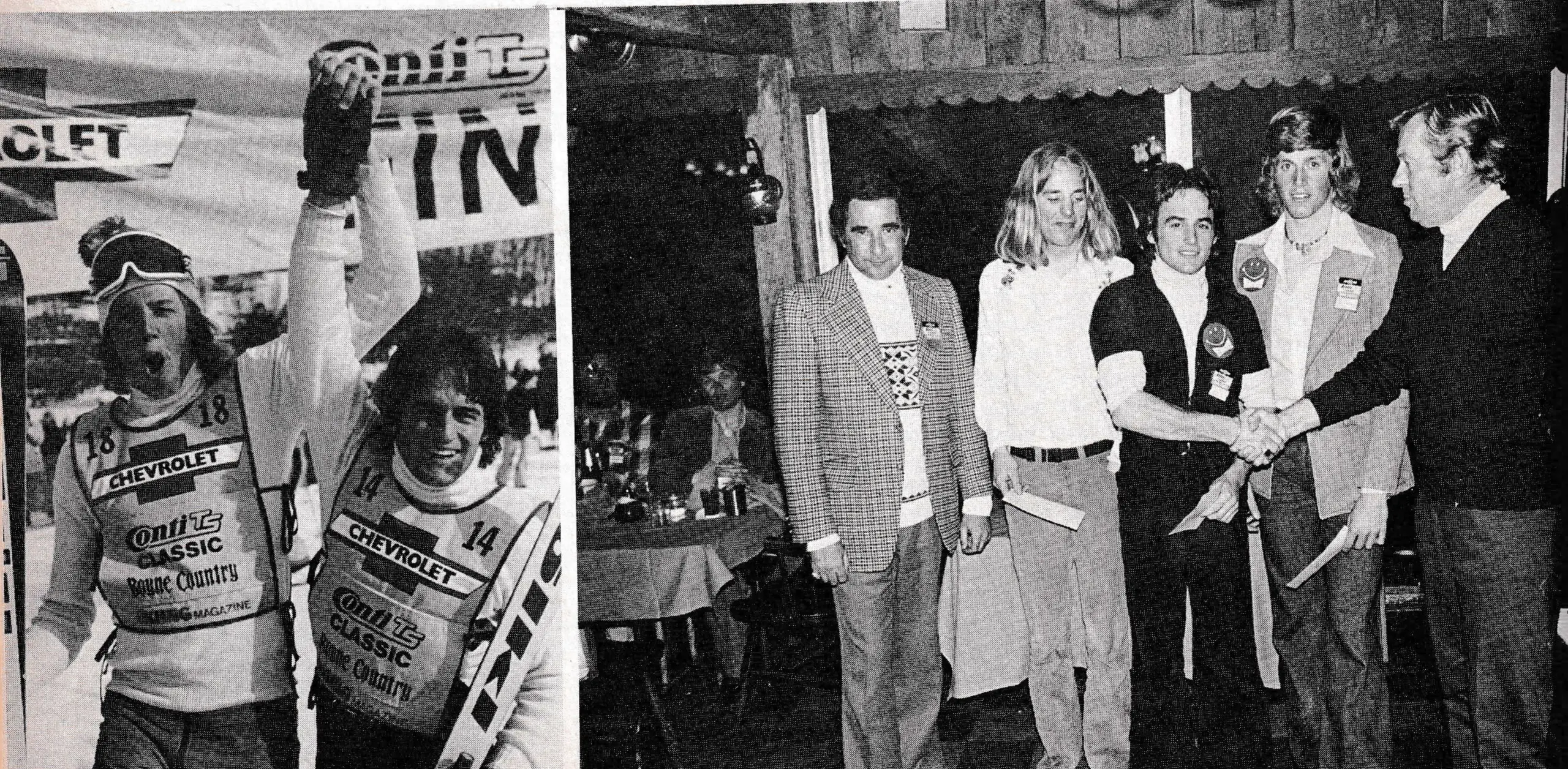
Finish Area Photographs: The best, and most used photographs of ski competitions and events are not the action pictures, but the shots taken immediately after the day’s winner has been announced. Competitors should be prepared to be in the finish area for interviews, group photos, and the excitement of winning — which is so much a part of competition. A formal picture-taking session staged here will produce much better results in the press than the traditional “grip and grin, pass the check” pictures often sent out.
Uphill Transportation: In some cases reporters and photographers, especially TV cameramen, either do not ski, or have too much equipment to lug by hand and require a tracked vehicle to get to and from the course. This service can be provided on a scheduled basis, or as a special one-time request. Where the course is lift-serviced, the area should be prepared to carry non-skiing press up and down that lift.
Lift Line Cutting: In cases where event schedules are tight, it is desirable to offer reporters and photographers the privilege of cutting certain lift lines. This can be done on a one-time basis in the morning, or by special written permission.
Result Sheet: The most important single item in any race is the result sheet; without it there’s little record that anything happened. However, most result sheets produced by competition officials are of little use to the press. They are too lengthy and, often, too late. People in charge of getting out the results should keep the following in mind:
- The necessary information is name, hometown, sponsoring ski club or ski area, bib number, place, and time or score.
- The first five, then the first ten places should be made available as soon as possible. Minutes count around 5 P.M. The list of remaining places can wait, if necessary, until the next day. The major press is interested in, and has room for, the first five to ten places only.
Hometowns are necessary for the regional dailies, sponsoring ski area names for additional coverage in the ski press and area newspapers. Bib numbers are important so that photographers can match number to picture, and speed is the most important aspect of all.
While on the Chevy Tour I devised a method of phoning the last three remaining places to the typist in the Press Center from the hill. When the reporters arrived breathless from their dash down the hill, the result sheets were complete, printed, and waiting for them.
Post-Event Press Conference: The pro racers and freestylers now conduct press conferences with the five winning competitors immediately after the contest. This should be done inside, away from autograph seekers. No special facilities are usually needed, just a central place that’s quiet and secure from the public.
Runners for Pictures and Results: In almost all cases I’ve found it necessary to line up a reliable “runner” to drive photos, results, releases, and even 16mm film into the nearest city. This one person, or in some cases two different people, cover the wire services, TV stations, and major daily newspapers with material that will be on the air that night, and in the papers the next morning. Runners are easily obtainable in exchange for one or two lift tickets.
Post-Event Follow-Up
Wrap-Up Release: A final release written by the area’s staff should provide the necessary information about the winners, the information about the event, weather, course conditions, element of competition, and other interesting facts. This should accompany the result sheet (and not be simply a recap of the result sheet) to publications such as Ski Racing and other competition journals, local weeklies, and the major ski magazines.
Home-Town Mailings: A package of information should be sent to the hometown newspapers of each of the top five (or ten) winners. This package can include: the wrap-up release, result sheet, and a photo of the individual, or winning group, suitable caption.
Ski Racing: This publication seldom uses releases from other than major races, and also arranges for their own people to cover the event. However, Ski Racing, and most other ski competition publications such as the Stowe Reporter and the regional ski association journals, will carry the results of most class races. In this case, Ski Racing says they must have the results in their hands by the Thursday following the competition.
There is no “right way” to assure that your race or special event will receive front page coverage. There are too many variables. They key is personal contact with your local wire services, editors, news reporters, and broadcasters. Barring this or having your event compete with a major news break or other sports event, you may have to do the job of providing press coverage yourself. This requires an ability to write a news release that resembles a legitimate news story and not brochure copy, plus an understanding of deadlines and prior arrangement for feeding the information into the established news outlets.
Sports coverage is news. People out there want to know who won the race at your mountain that weekend, as a matter of interest and a matter of record. Added public exposure for your area is readily available through the news worthiness of exciting competitions, but it takes hard work, planning, and some experience, and some knowledge of how the press works to get it done.
David H. Lyman is a writer, photographer, and editor of the “Student Skier.” He served as press director on the Chevrolet Freestyle Tour in 1974 and 1976, and was the director of Mount Snow’s News Bureau in the late sixties. He is now the director of the Maine Photographic Workshops in Rockport, Maine.