
The Vail gondola accident last year focused the attention of aerial tramway and ski lift interests on a previously little known or used procedure for testing wire rope and track strand. Electromagnetic testing has since become a byword of our industry, and our ski area managers, among others, should have a working knowledge of the test procedure. They should know where and when the testing is applicable; the essentials of the test procedure and equipment; and, the advantages, limitations, and misconceptions involved in its use.
A Non-destructive Test Procedure
The electromagnetic procedure is one of several methods of nondestructive testing used to assist an inspector in appraising the condition of a wire rope or track strand. It is applicable to aerial tramways and ski lifts involving extensive lengths of both moving and stationary ropes and strands. The test procedure has these advantages:
- It is sufficiently accurate and revealing for this application.
- It is inexpensive for the extreme lengths of rope and strand involved.
- Equipment is highly portable and may be used by relatively inexperienced personnel.
- A printout is immediately available for observation, study, and permanent record.
Radiographic (X-ray), ultrasonic, acousticemission, infrared techniques and other non-destructive test procedures are used and offer advantages for a specific location in a rope or strand.
The electromagnetic test is intended primarily to locate and to identify anomalies in both interior and exterior wires and wire weld failure; more intensive testing reveals loss of wire cross section by abrasion and deterioration by corrosion.
All non-destructive tests of wire rope or strand are intended to aid an inspector. They are not an inspection in and of themselves. They supplement the extremely essential visual observation and measurements made by the inspector. The non-destructive test is only as good as the test equipment, the technician taking the test, and the interpretation of test recordings. A striking parallel exists with the use of an electrocardiogram to supplement other examinations of the heart in the instance of a complete physical examination for a person. The EKG is an essential supplement to the physician’s examination along with other tests. It may be administered by a technician, but its value arises from the cardiologist interpreting the recording and the physician’s correlation with other observations and information.
The Electromagnetic Test Principle
Essentially, the electromagnetic testing instrument creates a magnetic field wherein lines of force flow through the steel wire of the rope. Discontinuities in the steel create small magnetic poles, and a leakage flux across them creates magnetic flux lines. A conductor cutting the flux lines introduces an electromotive force. In the instrument, a sensing coil passing over the area induces current in the coil and produces a voltage. This voltage is amplified or processed and recorded. Technical papers are available for those interested in details of the theory, procedures, and equipment used in this testing.
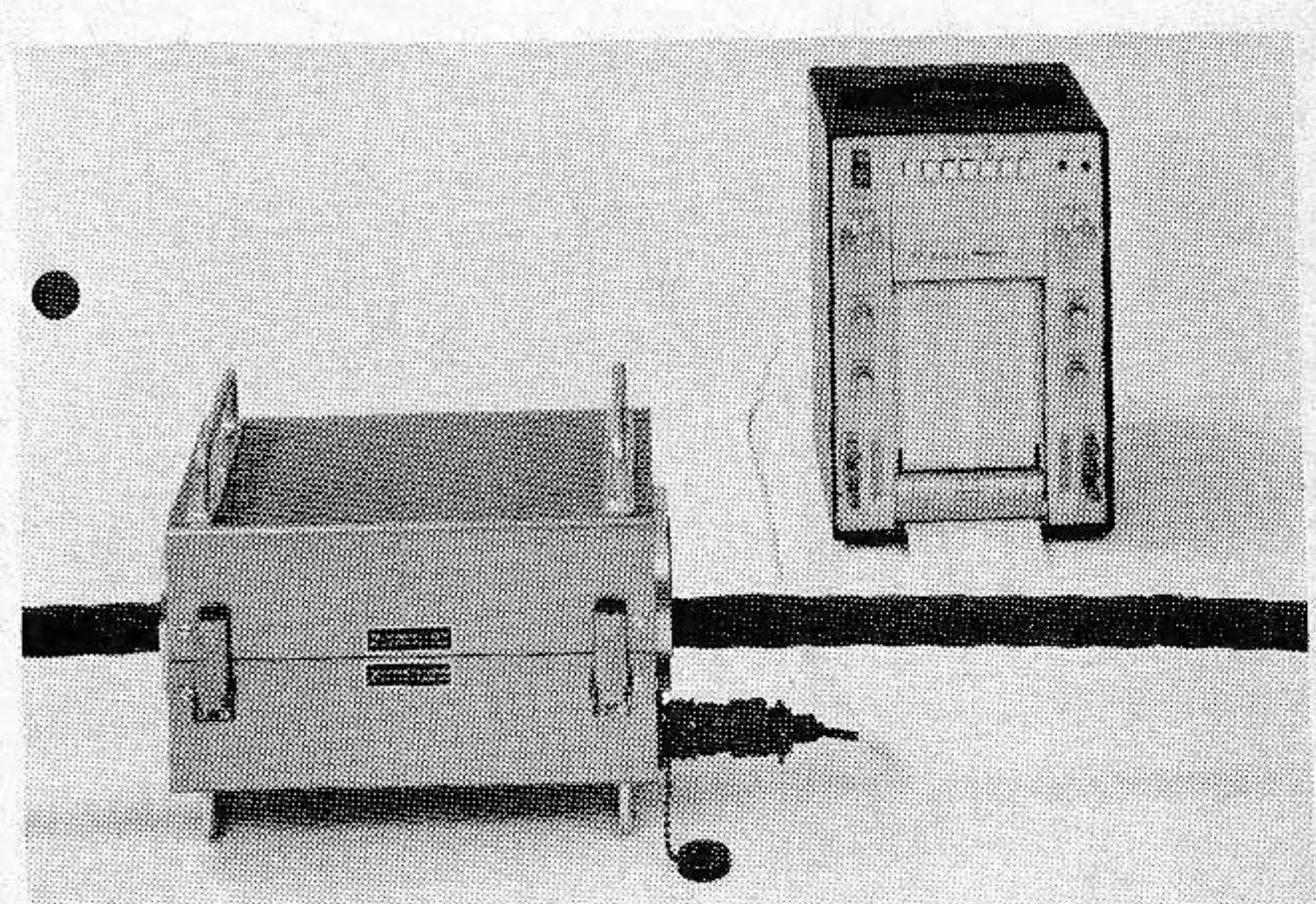
Essential components of the instrument, then, are (1) a detector to magnetize the test material; (2) a coil to pick up an induced voltage in a disturbed magnetic field; and (3) a recorder to translate electric impulse to a printed diagram.
Obviously, the foregoing is an oversimplification of the principle used, the physics and electronics involved, and the intricate mechanisms used to accomplish the sensing and recording. It should be sufficient here to note that after some 70 years of search for a practical non-destructive test procedure, this principle has been judged the most appropriate and applicable for wire rope and strand in aerial tramway applications. Recent developments have made the test equipment easy to use, reliable, and effective in its operation.
Electromagnetic Testing Application
Electromagnetic testing is applicable to any wire rope or strand in aerial passenger tramway and ski lift application. Very frequently, however, the complexity of testing and the additional information it provides the inspector do not warrant its use. This is most often true for relatively new ropes and for ropes with carriers attached. At the same time, its use on track strand which has been used extensively and has broken exterior wires is recognized as essential. The testing of a new rope, and particularly a new strand, is advisable to establish its initial condition and as a basis for comparison in later testing.

The current American National Standard Safety Requirements for Aerial Passenger Tramways, ANSI B77.1-1976, has no mandatory requirement for use of the electromagnetic testing device in wire rope or strand inspection. Most state codes have not yet introduced a mandatory requirement. The recently issued Forest Service Manual Interim Directive No. 2, 7325.1, specifies conditions under which use of the device is required to supplement the inspection process for locked coil track strand. These requirements are similar to those of some European countries and international organizations; they are expected to be introduced by other authorities having jurisdiction in the United States at an early date.
Electromagnetic Testing Procedure
For aerial tramway application, the electromagnetic testing equipment most often uses permanent magnets and a battery-powered detector and recorder. The test machines are highly portable, have an independent power source, are relatively maintenance free, and can be used under virtually all weather conditions. For convenience, a moving rope is most often run through the machine, positioned at a convenient location in a terminal area. This is the procedure for haul ropes of continuous circulating or reversible gondola and tramway systems. It is also used for the wire rope of chair or surface lifts when carriers are not attached.
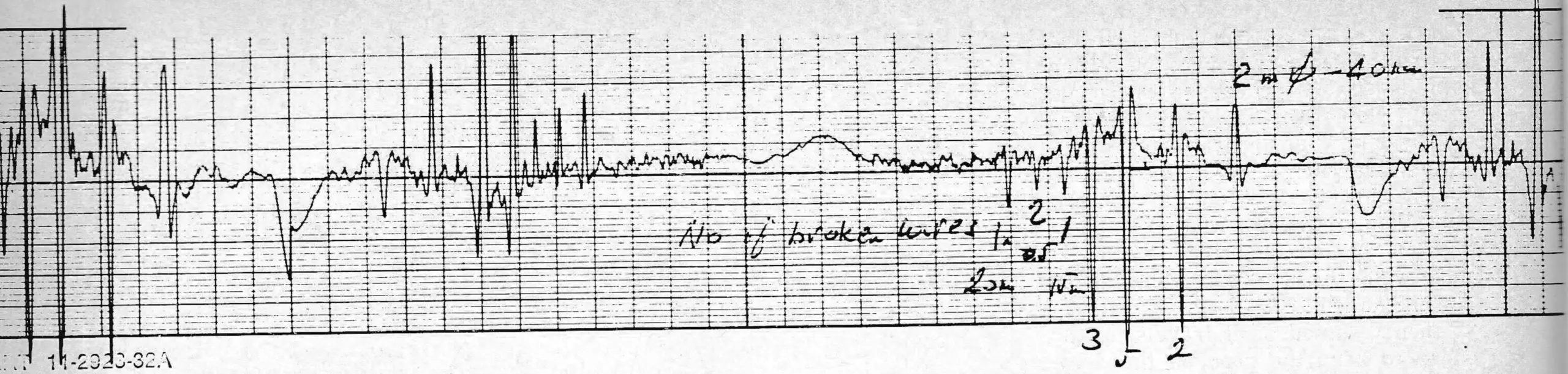
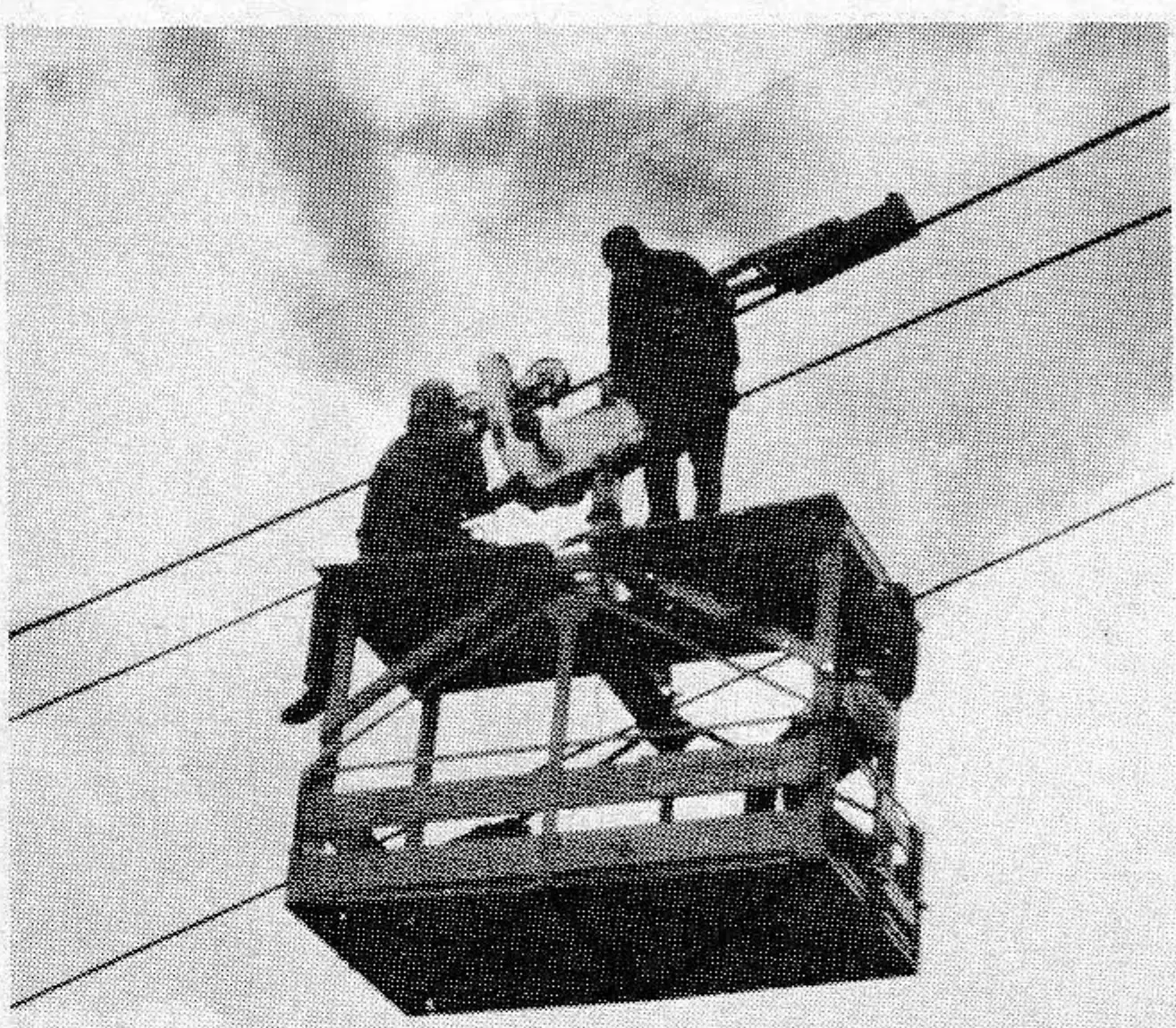
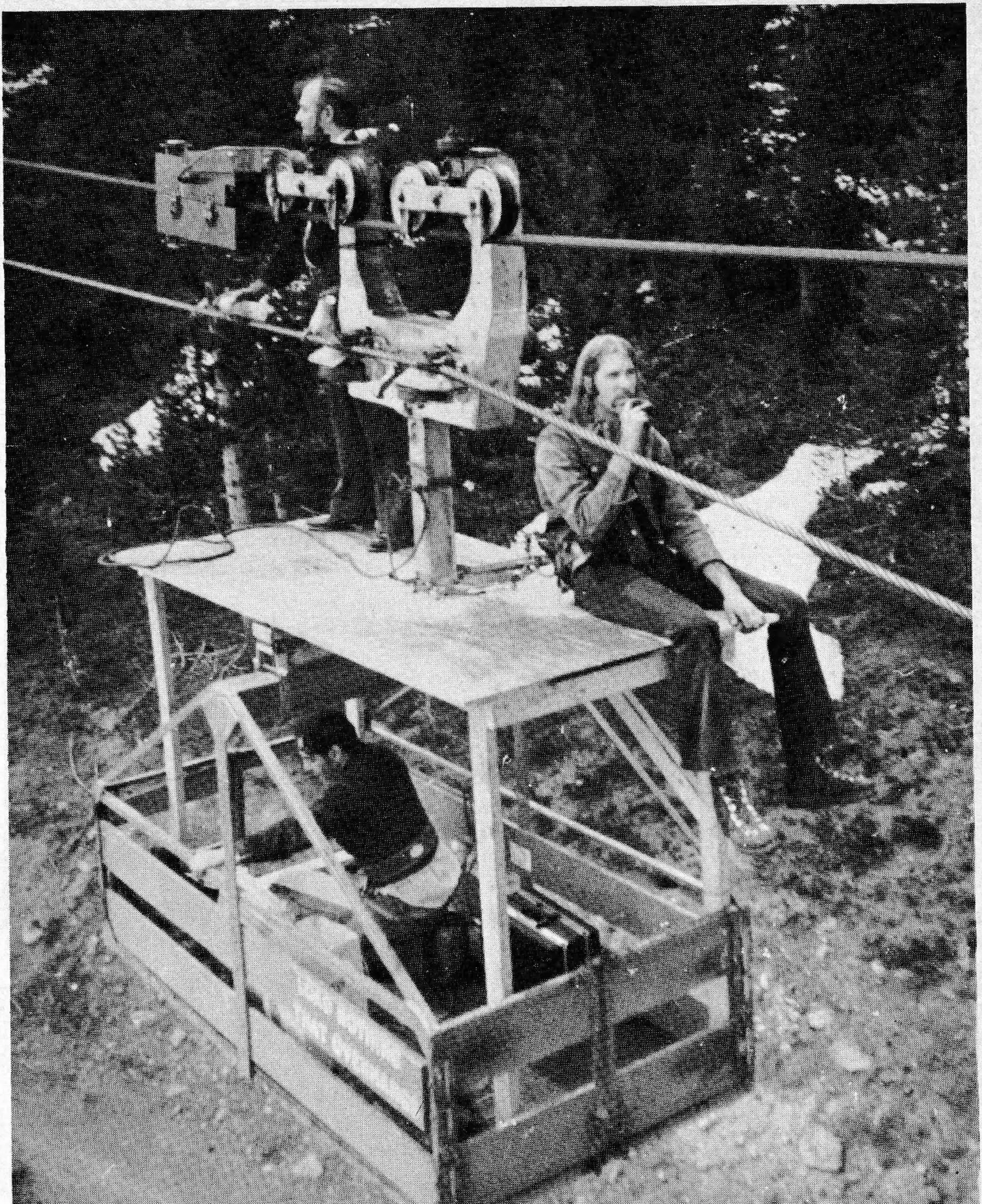
For the track cable of bi-cable systems and other stationary wire rope or strand, the instrument is moved along the cable. Most often, it is attached to and propelled by a carrier. Most instruments permit moving over support saddles and slack carriers along the line without interruption of testing. Speed of the rope through the machine, or the machine along the rope, is critical to the testing procedure. The machines correct for a measure of speed variation within defined lower and upper limits; test speeds of 200-300 feet per minute are the most common. A generator provides linear relationship between the length of rope tested and the length of diagram chart paper. A ratio of 1:100 for chart to cable length is frequently used; the constant ratio permits ready comparison with diagrams previously taken. Anomalies are readily located from reference points along the cable and corresponding marks on the chart.
Test procedures may vary considerably for the machine being used, the rope or strand under test, and other conditions of the tramway. Sensitivity of most machines can be varied to accomplish the desired degree of testing. Calibration from a test sample is desirable in producing a highly readable diagram. Catalogs of typical anomalies have been published to facilitate interpretation of diagrams.
When corrosion is a major concern, the testing may be varied considerably from that used when broken wires are the principal concern. Some machines intended to operate with the detector completely encircling the rope or strand may give relatively poor results in passing over tower saddles or the slack carriers of track strand, using only a portion of the detector.
Most often, it is impossible to use the machine in terminal areas and at end connections of fixed ropes. Extremely careful visual inspections or other non-destructive test methods are required at those points. Analysis of the printout at the splice of an endless moving rope requires particular skill. Without exception, a comparison of a test chart with one taken by the same machine on a new rope or strand is most meaningful; it suggests the advisability of testing a new rope or strand before initial operation.
Summary
Electromagnetic testing is becoming increasingly available in the United States. Its use as an essential supplement to visual inspection of wire rope and, particularly, track strand is increasing. For those applications where the capability warrants the additional expense, the procedure is a welcome addition to others in assuring the safe operation of our aerial tramway and ski lift facilities.