

| 1980’s | 1990’s | |
|---|---|---|
| Master Planning | rare | more frequent |
| Design | infrequent | frequent |
| Construction (earth moving) | infrequent (mostly ski road adaptation and/or cutting) | frequent |
| Master Plan Type | retrofit of existing operation | retrofit and new – especially golf and real estate |
| Development Motive | add-on-operator’s intuition | profit, market-sensitive |
| Affiliations | diverse | diverse |
| Seasonal Use | largely winter uses of trails | multi-season, multi-use – biking, walking, skiing |
| Environmental Complexity | low | growing rapidly |
| Location | diverse | more urban-oriented, often selected for site strengths |
| Sophistication | low end | growing rapidly |
| Snowmaking | rare | frequent, especially at high-use and urban areas |
| Major Issues | financing, profitability | financing, profitability, land access, environment, landscape management |
| Design Innovations | limited | extensive (staff facilities, landscaping, day care, terrain gardens) |
For a variety of reasons – financial, regulatory, aesthetic and market-related – the frequency of cross country center planning promises to change dramatically during the next 10 years, as will the number and character of cross country operations. A three-year-old “ripple” of planning is already under way, as evidenced by seven areas being planned in the U.S. and Canada and a dozen more projects, largely golf clubs and real estate developments, looking at the planning process. Three of the current areas are from scratch and the four others retrofits. Two are associated with functioning guest ranches, four with an existing lodge or hotel and one with a snowcat manufacturer’s factory.
In contrast to alpine areas, cross country areas seldom have been developed on the basis of site strengths (dependable season, diverse terrain, aesthetics, expansion possibilities). The majority of the 800-odd commercial cross country operations in the U.S. are affiliated with parent businesses (inns and lodges, golf courses, alpine resorts, property developments, parks, etc.).
In the 1970’s and early 1980’s, factors such as distance from population centers and accessibility on good roads were seldom considered vital factors in establishing a center. Perhaps because so many operators were dedicated skiers long before they were business people, they assumed the inherent attractions of the sport would be enough to draw many customers.
It’s a tribute to operators’ tenacity and to market potential that the majority of cross country owners have hung on. Even more remarkable, according to the annual CCSAA/SIA Operations Survey, most centers are profitable.
Trails have usually received the lion’s share of operators’ attention and monies. But emphasis often has been on system size and grooming quality rather than market needs such as developing novice and intermediate terrain, incorporating vista points and increasing comfortable carrying capacity.
Understandably, owners have pursued paths of least resistance (and least investment). A reasonable guesstimate is that 80 percent of groomed trails use open space (golf courses, meadows) and abandoned skid roads, or involve cutting and brushing rather than earthmoving. Most current cross country trails have little or no commercial role in the dry seasons, with the exception of golf courses.
Similarly, facilities often have developed piecemeal, so parking capacity, food service square footage, size of rental shop and number of kilometers of trail may be out of synch. Result: unpredictable skier experience and unreliable cash flow.
In contrast, a thoroughly planned center presents to the world an attractive and balanced whole, gives good service to targeted clientele and offers financial stability to its owners.
Master Planning Process
Cross country master planning involves multi-faceted strategies. From a business perspective, it’s intended to assure a concept is feasible, can help secure investors and is a key to efficient operations. From an environmental viewpoint, planning serves as insurance against misuse of natural resources, is a statement of commitment to protecting the land and optimizes recreation’s aesthetic potential.
Planning asks questions such as: What kinds of development are most appropriate? What site, scale, markets, character and themes are desirable? How fast is reasonable buildout and how should phasing run? It addresses issues such as access, lodging, products and competition; it uses research, analysis, dialogue and testing to arrive at optimal solutions.
A master plan is a document with supporting graphic detail (maps, drawings of site relations). It provides an expression of an area’s goals, needs and priorities for development of site, services and facilities. The plan generally follows a process illustrated in the accompanying Study Approach, starting with a detailed inventory and analysis of existing conditions, while identifying probable opportunities and constraints. (This step is critical in understanding and beginning to resolve issues affecting development and operations.) These phases can also help educate public lands managers in the numerous cases where access to federal, state or municipal lands is necessary.
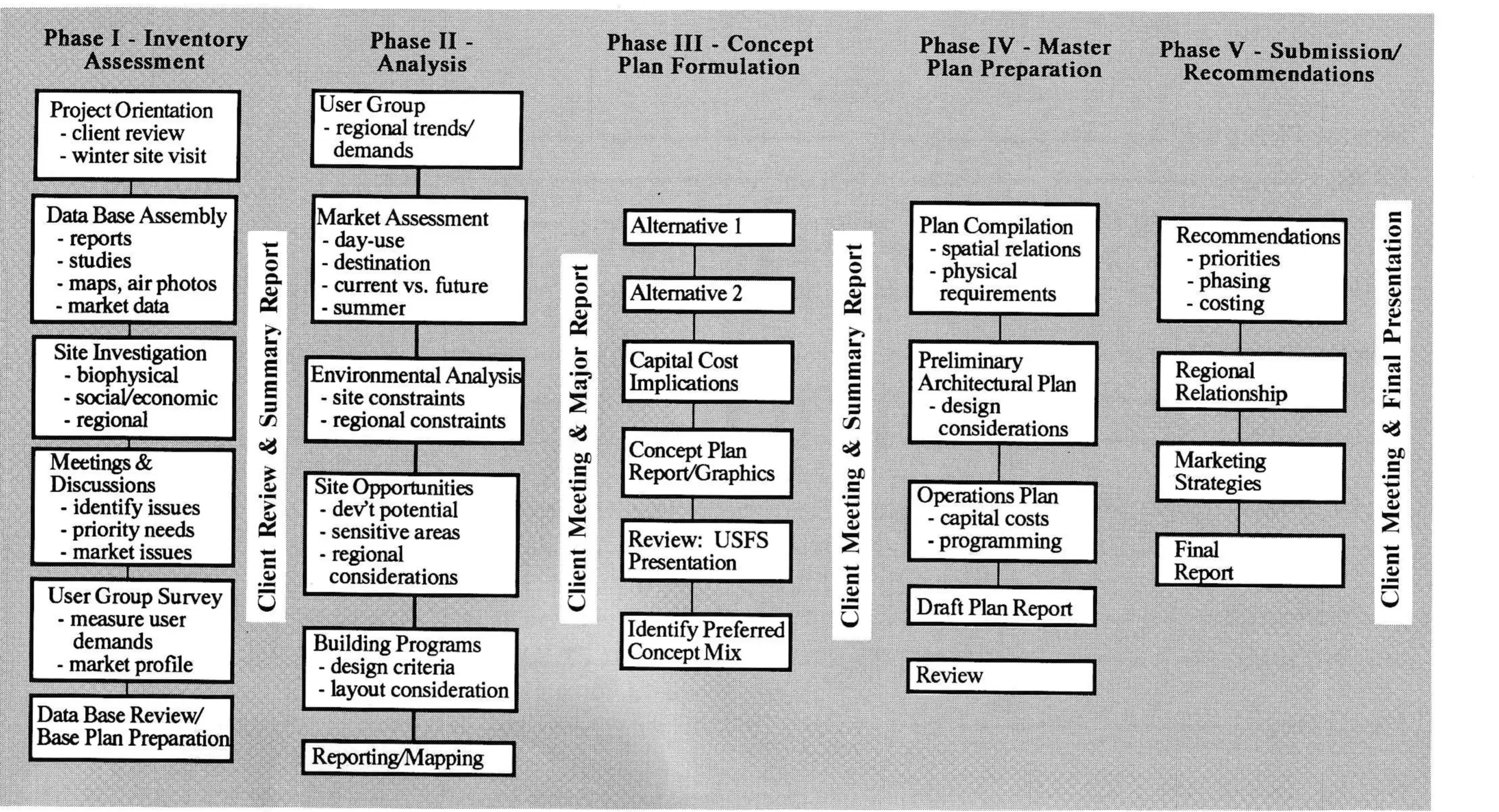
From here, the planning process generates alternative development concepts. Choices can provide a vision between minimum and maximum dollar expenditures, low and high intensity levels of development and other scenarios that allow a client to constantly assess goals and objectives. Out of this review, the best options are selected and refined in a preferred concept, which forms the base for a final master plan.
The final master plan provides clear definition of the project’s scope – siting, scale and size, as well as preliminary estimates of costs and phasing. It probably also addresses marketing, financing, operations and management.
The master planning process should be dynamic, flexible and tailored to each situation. Ideally it involves everyone with a stake in the results, including ski area owners and managers, public lands and regulatory agencies, user groups, the surrounding community and environmental interests. Properly completed, it provides the impetus for successful development and growth.
Market Awareness
Over the next decade, we can expect further transformation, largely resulting from operators’ increased awareness of both existing and potential clientele. Primary concentration will be on satiating the needs and expectations of current winter markets. But there will be increasing emphasis on winter facilities and complementary programs that create new markets (new in terms of profiles, volume and activities) and accompanying movement toward facilities that are productive in several seasons.
Planning can also help reduce dropout. According to National Sporting Goods Association data, 1,431,000 people who skied in 1987 didn’t do so in 1988. There are probably two major explanations for this skier loss: lack of snow and a less-than-optimal skiing experience. Planning solutions include building snowmaking into both retrofitted and new operations and developing high-quality, balanced facilities, with programs run by professional staff.
Future Trends
Prophecy is a hazardous profession, but we’ll fearlessly risk the following predictions, most of which have been prefigured in the past two years:
By 1992, at least 30 new operations – both new operations and retrofits – will open each year in the U.S. (about three times the current rate), the majority involving some degree of planning. Most will be day and weekend areas affiliated with other businesses – particularly golf clubs, alpine areas and real estate developments – located near population centers.
Market research will play a major planning role in order to justify costs and time. It will affect site selection, facility development, design features and programming in order to meet the needs and expectations of specific market segments, maintain quality of experience, absorb unprecedented numbers of skiers and provide financial return in several seasons.

Cross country areas will remain diverse in affiliations with increasingly varied recreation menus to attract year-round tourism. Examples: the master plan for Galena Lodge, Id., involves evolution from a cross country day business to a small year-round destination resort; Jasper Park Lodge, Alberta, is expanding on-site winter activities (cross country, sleigh, and hiking trails); and Gatineau Park, Ontario, is restructuring and redeveloping existing multi-season trails.
Staging areas will play as pivotal a role in skier satisfaction (and consequent client loyalty) as trails. Both trails and staging areas will be planned for multi-season roles.
Trails themselves will be built to higher standards, handling more diverse, heavier, market-targeted traffic (skiing, horses, mountain bikes, orienteering, walking/running, nature/interpretive and fitness). Trail aesthetics will become exceedingly important to an increasingly sophisticated public.
Thought will be put into mundane, but critical, facilities, particularly parking (capacity, circulation, drop-off, paving and bus slots) and toilets (number, heating, placement, square footage, women’s needs).
A circularity will assert itself regarding investment and return. Planning, design and development will be relatively expensive. (Construction of some arterial trails already costs $15,000/km without snowmaking or lighting.) Consequently, visitor volume and profit centers will receive priority in both business plans and physical development, particularly for terrain gardens.
Expect to see a growing degree of public/private cooperation in developing new tourism attractions such as cross country ski centers. This may involve a medley of agreements including transportation systems, snow clearance, coop promotion and even cost-sharing partnerships with public agencies providing anything from land to loan guarantees.
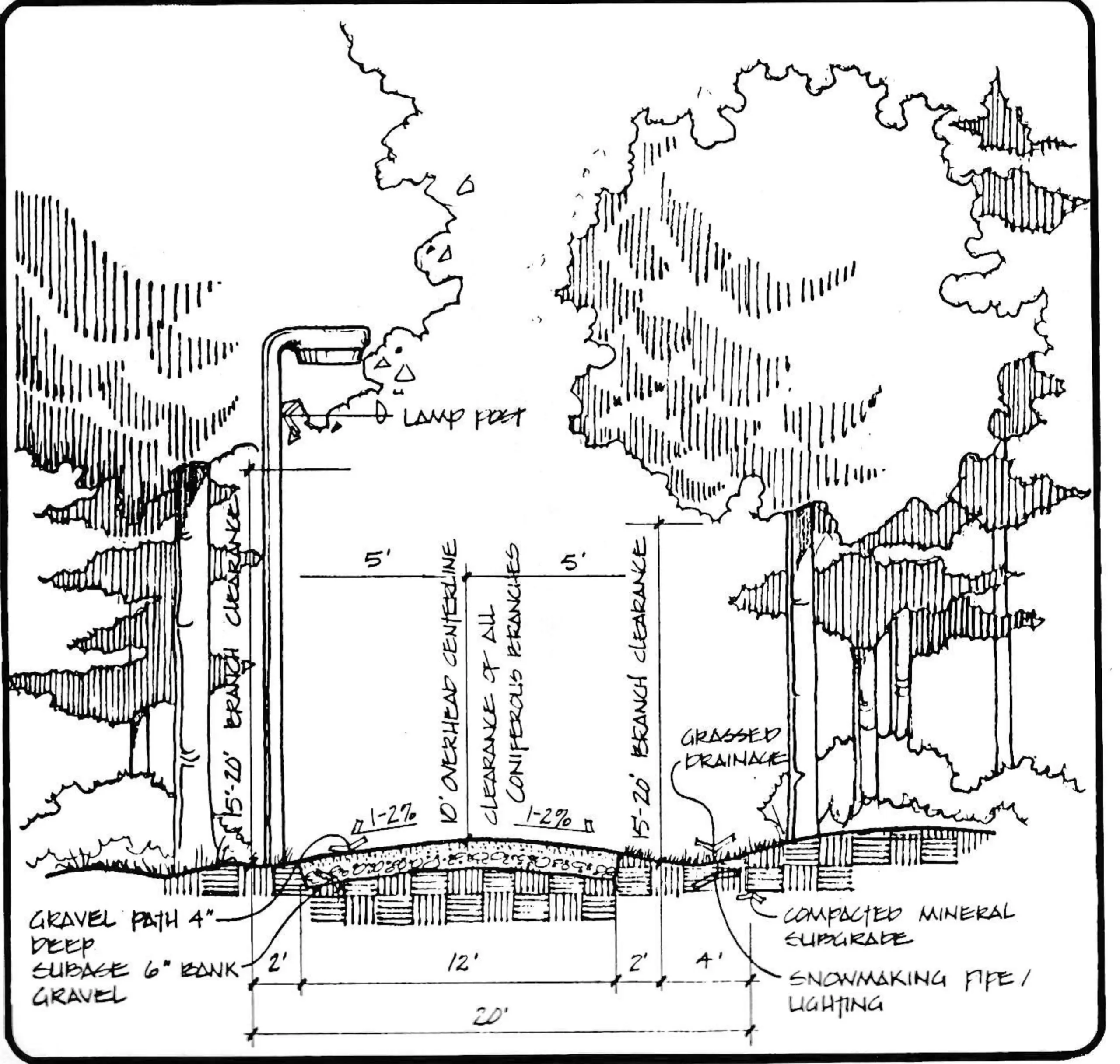
Cross country will become embroiled in environmental issues, already familiar to alpine operators, when it becomes clear that a successful area must do more than cut back brush and fell trees. Many trails in the 1990s will be built – involving earthmoving, installation of drainage mechanisms and bridging – at the same time they are designed to harmonize with the landscape. An effective master plan can both identify and resolve these complexities.
Through the 1980s, it was assumed that growth in kilometers of trail meant increased skier volume and profits – in many cases a false assumption. For the 1990s, except in the west with its enormous expanses of federal land, emphasis will be on carrying capacity while maintaining quality of experience. Few new areas will have more than 50 kilometers of groomed trail. Constant expansion will become a personal choice rather than a business requirement.
The majority of operations near population concentrations will incorporate snowmaking and lighting in order to assure operation during peak season.
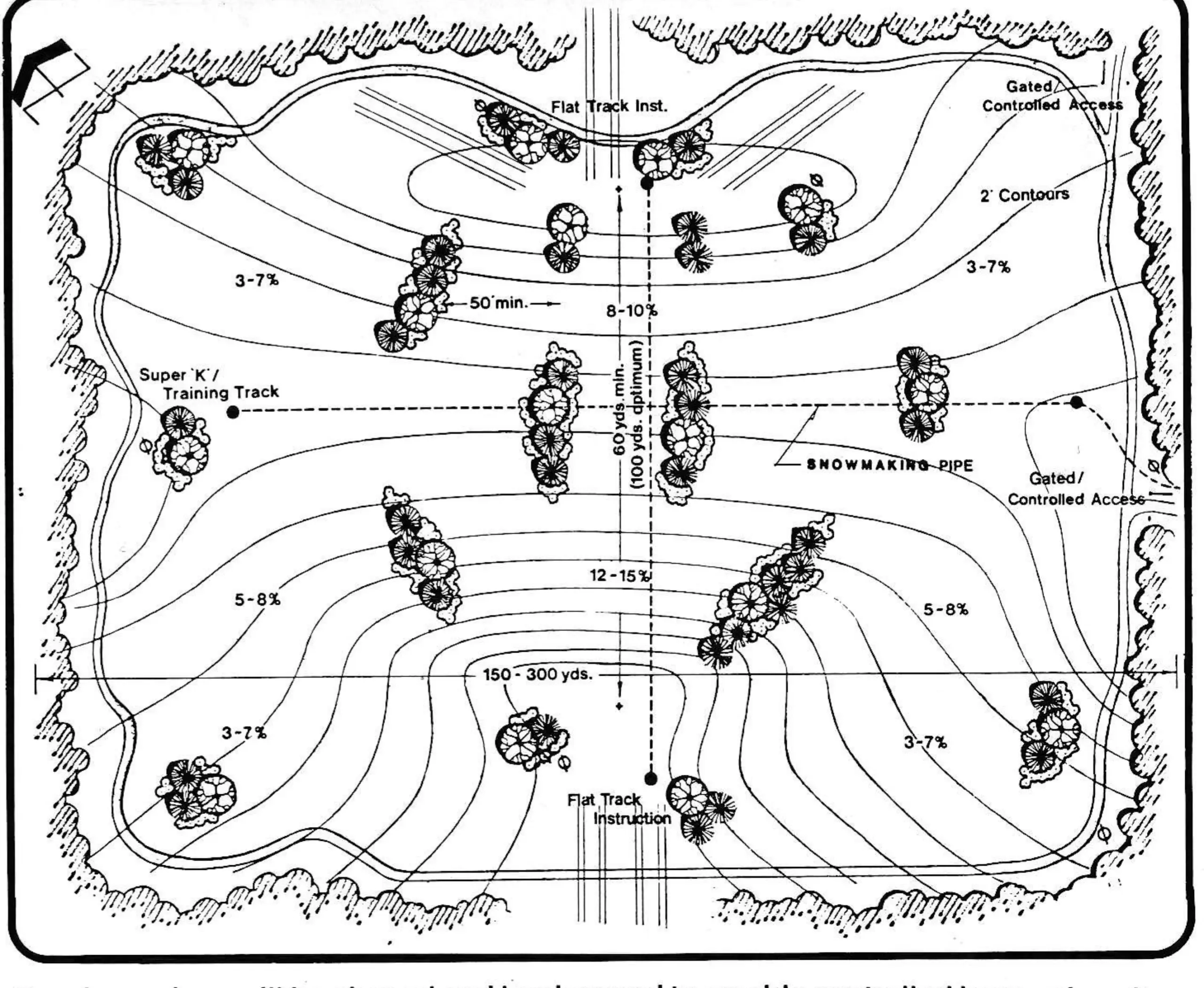
Where terrain is suitable or can be shaped, one way to increase absorption will be to lure skiers off groomed trails to distraction points (play areas, views, shelters).
Operators who opt for planned rather than shotgun development will be of two types: current managers/owners with unusual vision, realism and flexibility; and new operators who are more business people than skiers. Ultimately there will be stiffer competition from other cross country areas; some operators will foresee need to use planning to create brand loyalty from first-time skiers as well as favorable word-of-mouth reputation.
Winter activities at cross country areas will further diversify, including snow play, snowshoeing and, for a few areas, surface lifts for practicing downhill techniques and connecting trails at different elevations. For some operations, there will be an ironic return to nordic skiing (touring, huts/yurts, guide services) – analogous to alpine areas offering both groomed slopes and off-piste skiing – rather than exclusive concentration on grooming for diagonal stride and skating.
With increasing dependence on skilled staff, their needs will receive new attention – housing as part of improved benefit package; lounge, storage, lockers, showers . . . .
A final forecast: demand for consultants with nordic planning experience will grow exponentially.