


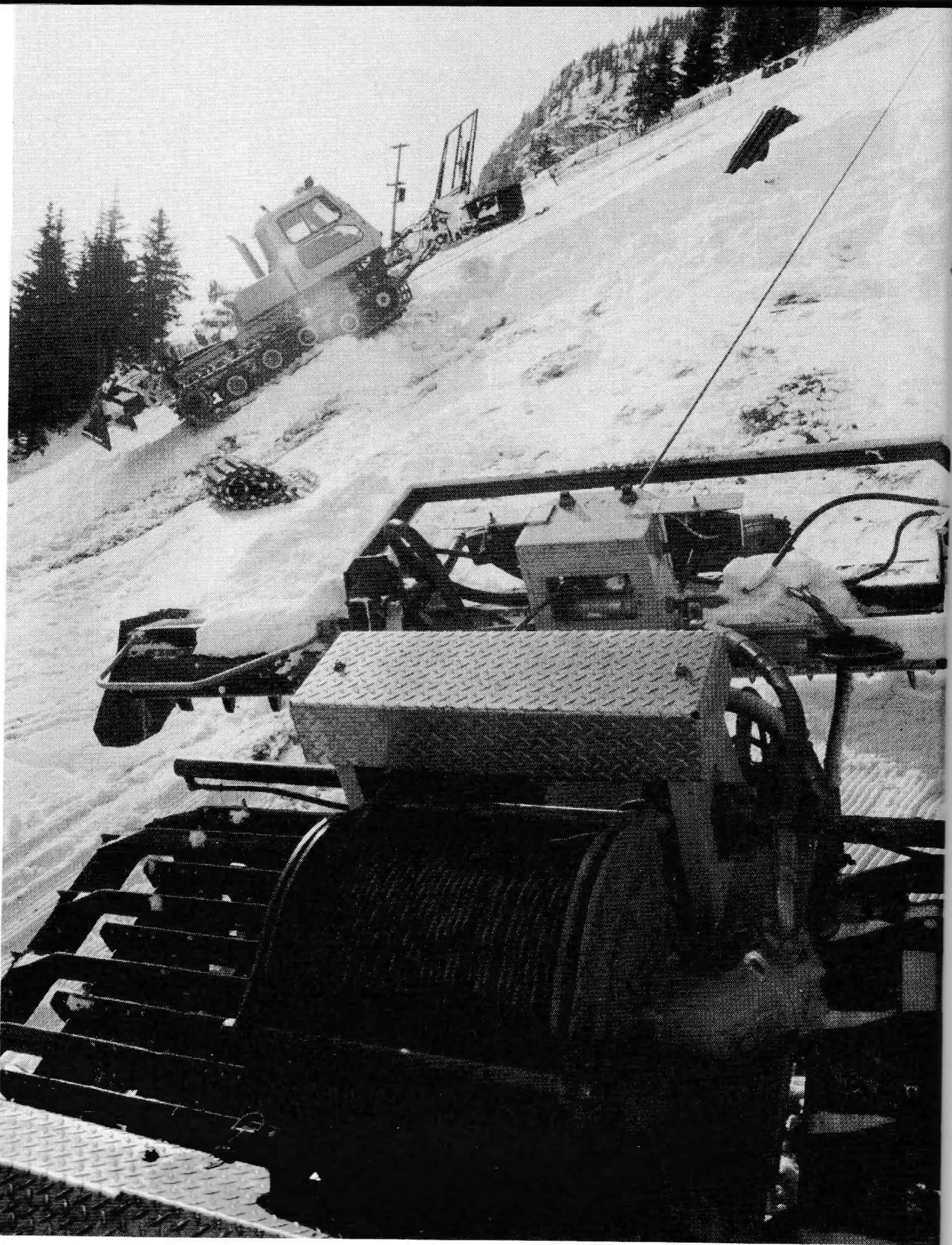
Mt. Norquay near Banff in the Canadian Rockies, has long been famous for its super steep skiing and ferocious moguls. While this has been great for barroom stories and one-liners — “it starts out vertical then steepens right up” — it has not attracted great numbers of skiers. Furthermore, Mt. Norquay has excellent beginner terrain, but not much in the way of intermediate terrain, so the question has always been: How can we make the steep terrain less intimidating so intermediate skiers can enjoy it?
The terrain involved, known as the Big Hill, looks like half a cone backed up against a huge cliff. The cone and the chair lift that services it, known as the Big Chair, rise 1,300 feet vertical above the beginner slopes below.
There is no easy slope on the cone. The gentlest of the three ski trails on it has a long continuous pitch on over 55 percent grade. The steepest trail, the Lone Pine, has 800 feet of vertical in one continuous pitch of greater than 60 percent with shorter pitches up to 75 percent.
This type of terrain cannot be groomed by conventional means. On a few occasions, in the best of packed snow conditions, the bravest of our vehicle drivers have managed to get ordinary snowcats close to the top of the hill. Needless to say, on descent they were much more concerned with survival than with grooming. When winch vehicles became available, it looked as if one of these machines would be able to cure the problem of the man-eating moguls that grew on these slopes.
Another problem that exacerbates the Big Hill situation is limited snowfall with low temperatures and very low humidity. In the long periods between snowfalls, much of the snow turns to temperature gradient or sugar snow. Most of its mass is lost to sublimation — passing from a solid to a vapor state and evaporating — and what is left does not pack into a firm base but remains like loose grains of sugar. This leaves the Big Hill as a grassy slope with a few moguls scattered across it most of the time.
Over the many years that Norquay has operated (first chairlift in Western Canada in 1948), untold effort has been expended trying to get the snow packed into a base before it turns to sugar. Herds of people have tromped up and down the hill boot and ski packing, and crews have experimented with various chemicals. Nothing has been effective; the moguls still form and the bare patches grow.
Could a winch vehicle solve this problem by making quick efficient packing possible? Last fall Norquay purchased a Bombardier winch vehicle to find out.
The top of the Big Hill is very restricted with only a six-foot-wide shelf cut into bedrock as a route to the trails from the top of the chair. We wanted to groom as close as we could to this shelf, even though the slope up to it was over 60 percent. To do this from anchor points would have required multiple anchor points across the width of the slope. A way to get by with fewer anchor points was to stretch a 5/8-inch cable across the top of the hill between two points (from A to B on the illustration). On this cable was suspended a double traveling block (C on the drawing) with a single sheave through which the cable from the winch vehicle passes. The anchors used (A, B and E in the illustration) are expansion bolts drilled 12 inches into the solid bedrock.
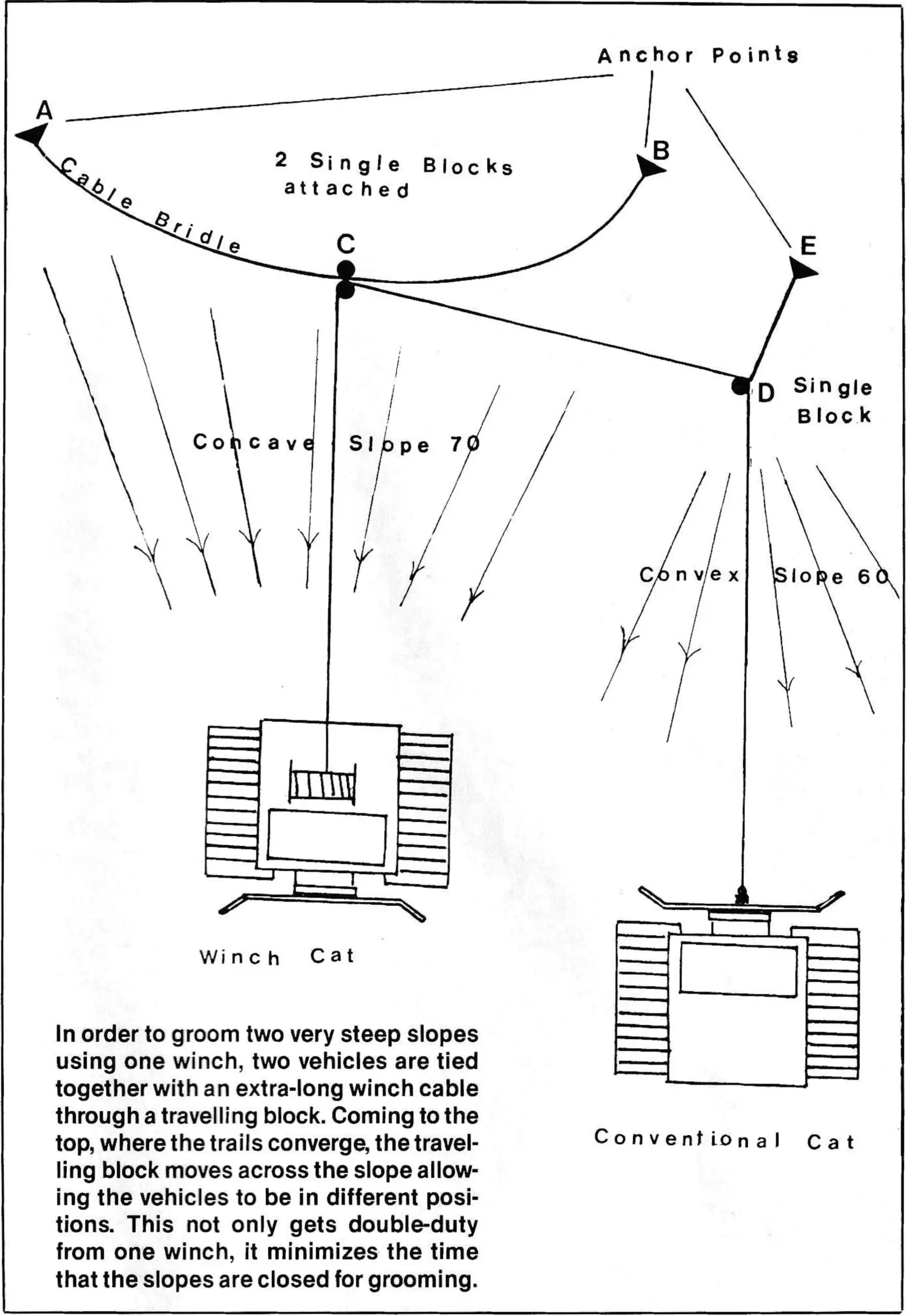
To further optimize the use of the winch vehicle and be able to groom two runs at once, we connected our second Bombardier, a BR 400, to the winch. We used 2,500 feet of 1/2-inch cable, passing it through a single block (D) to tie the two vehicles together. The second vehicle was tied-in facing uphill with a heavy sling under the blade to the second axle. A cage was built up on its blade to protect the driver if a cable broke.

With this technique, the winch controlled the tension on the cable between the vehicles. The winch vehicle, coming uphill backwards, back-bladed the tops off the moguls and tilled them on the way down. The other vehicle pushed moguls uphill and backbladed them on the way down. For a day’s effort we had two runs groomed smooth to the highest standard. One of these runs had never been groomed before, while the other had, at best, a couple of passes down the center leaving ridges and snow boulders for the patrol to beat down with shovels and skis.
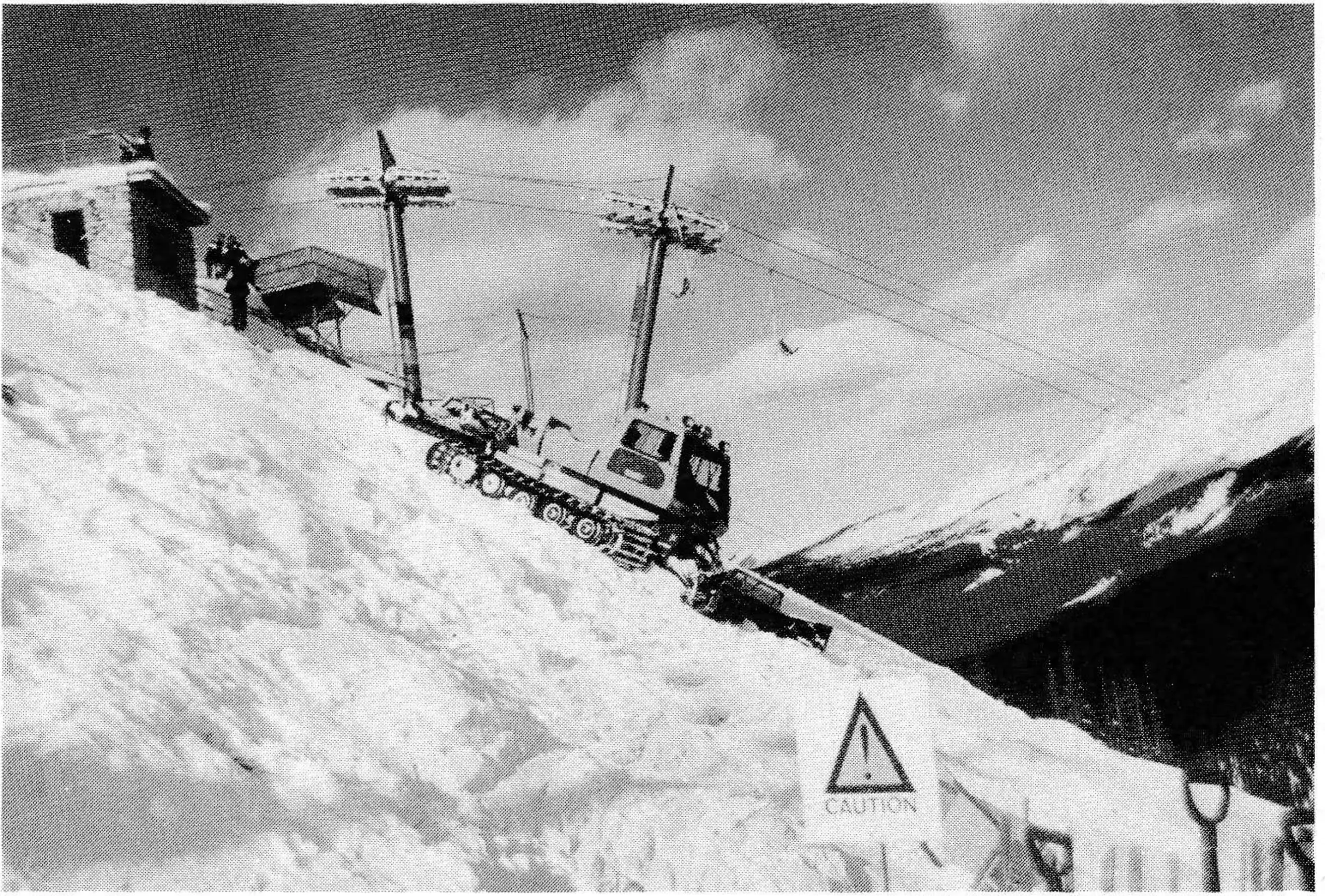
After our initial test with this technique, we let the snow set up overnight, then opened the two trails to the public. The response was tremendous; skiers loved it. Local skiers who have skied Norquay for years said they had never had such good skiing on the Big Hill. We had line-ups on the Big Chair purely because of the grooming. Usually that chair only has a line-up after a really good snowfall.
The long-term effect on the snow was also good. The moguls were much slower to build up on the areas that were machine-packed and when they did form, they were less square-cornered and easier to ski than on terrain that had not been machined. In the spring, the machine-packed snow also resisted melting for significantly longer periods.
The down side is that grooming this way is expensive. There is additional maintenance to be done on the winch and the cables wear out fairly quickly. Grooming a steep hill in our snow conditions too often would, in itself, start to wear out the snow. We feel that two or three groomings a year should be the maximum.
Another problem is sliders — skiers who fall down and can’t stop sliding. We always have the lift operators and patrol on this hill on the lookout for skiers who don’t have the skills for such a steep terrain. They try to catch less-skilled skiers before they start down and encourage them to ride back down on the chair. When the hill is groomed smooth, we double our vigilance and the patrol works hard to discourage people from skiing too fast.
Overall, however, we are very pleased with the results of grooming this hill. We have lots more to learn about it and will continue to monitor the snow conditions and the effect on the skiers.