


As ski resorts struggle with the issue of seasonality, the need for a diversity of recreational activities, particularly in the summer, and broader relevance to society grows in importance. Two years ago, Winter Park, Colo., addressed these needs with a unique project and the help of several non-profit organizations and a crew of volunteers.
The National Sports Center for the Disabled (NSCD), well known for its participation in skiing for the disabled, proposed a facility adjacent to the Winter Park base area that would accommodate people of all abilities for hiking, camping, fishing, cross country skiing, snowshoeing and environmental education. This new facility, called the Outdoor Center, would complement existing programs for the disabled at Winter Park in downhill skiing and rock climbing.

Volunteers for Outdoor Colorado (VOC), a volunteer-based non-profit organization whose mission is to instill in Coloradoans a sense of responsibility in their public lands, agreed to lead the project, providing design and engineering expertise as well as construction labor and help in logistical and volunteer coordination. A project team of more than 15 members, all volunteers, was formed.
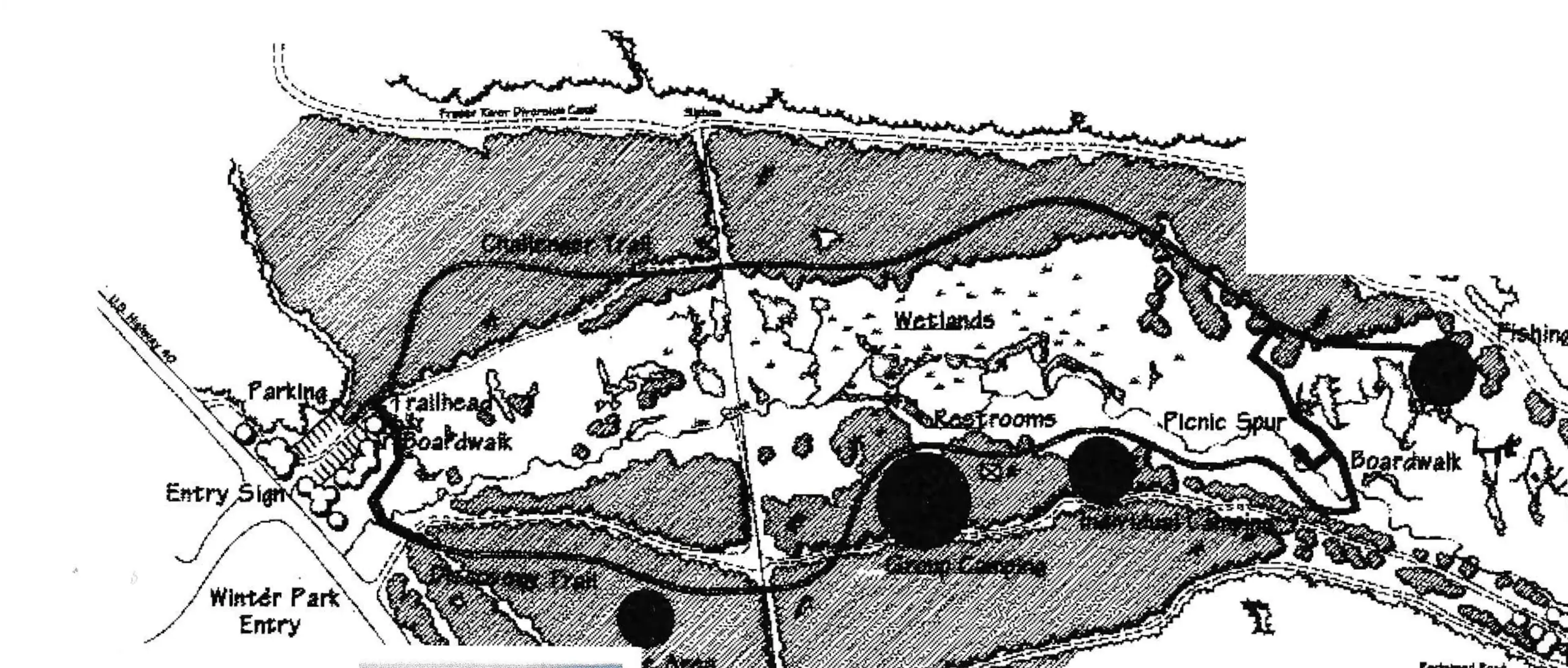
In September 1991, the volunteer design team, which included several landscape architects from the public and private sectors in Denver, representatives from Craig Hospital (specializing in rehabilitation to provide input on disabled populations) and engineering consultants with structural and soils engineering expertise, began preparing conceptual plans for the project. They aimed to create a looped trail system, boardwalks through the Jim Creek wetlands, camping and picnic facilities and access to beaver ponds for fishing.
There were five major hurdles that had to be overcome in order for the project to succeed: 1) technical problems with foundations for a boardwalk in the wetland; 2) coordinating local, federal and state agencies with non-profit and private organizations; 3) fund raising; 4) logistical considerations; and 5) recruiting a volunteer work force.
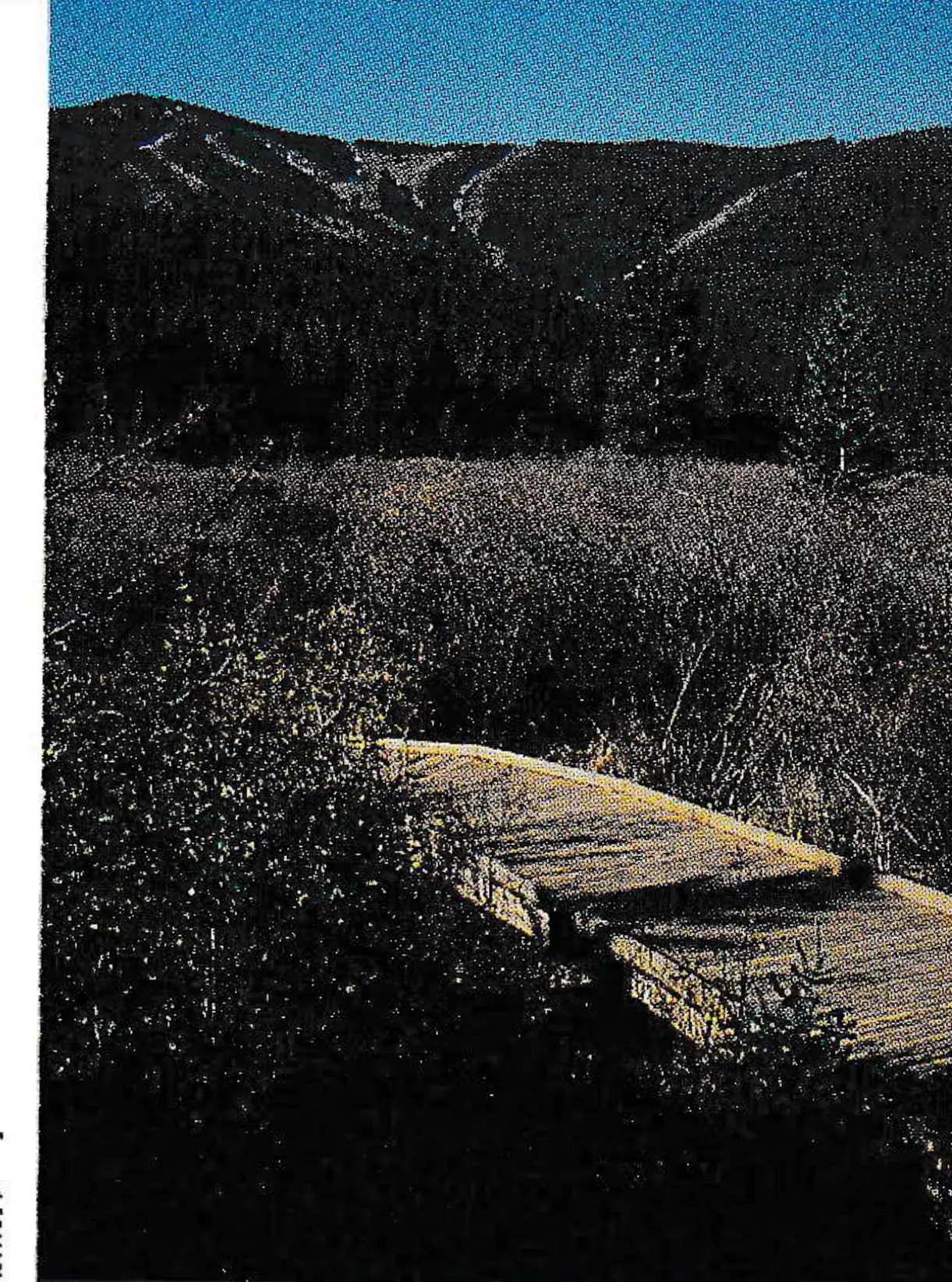
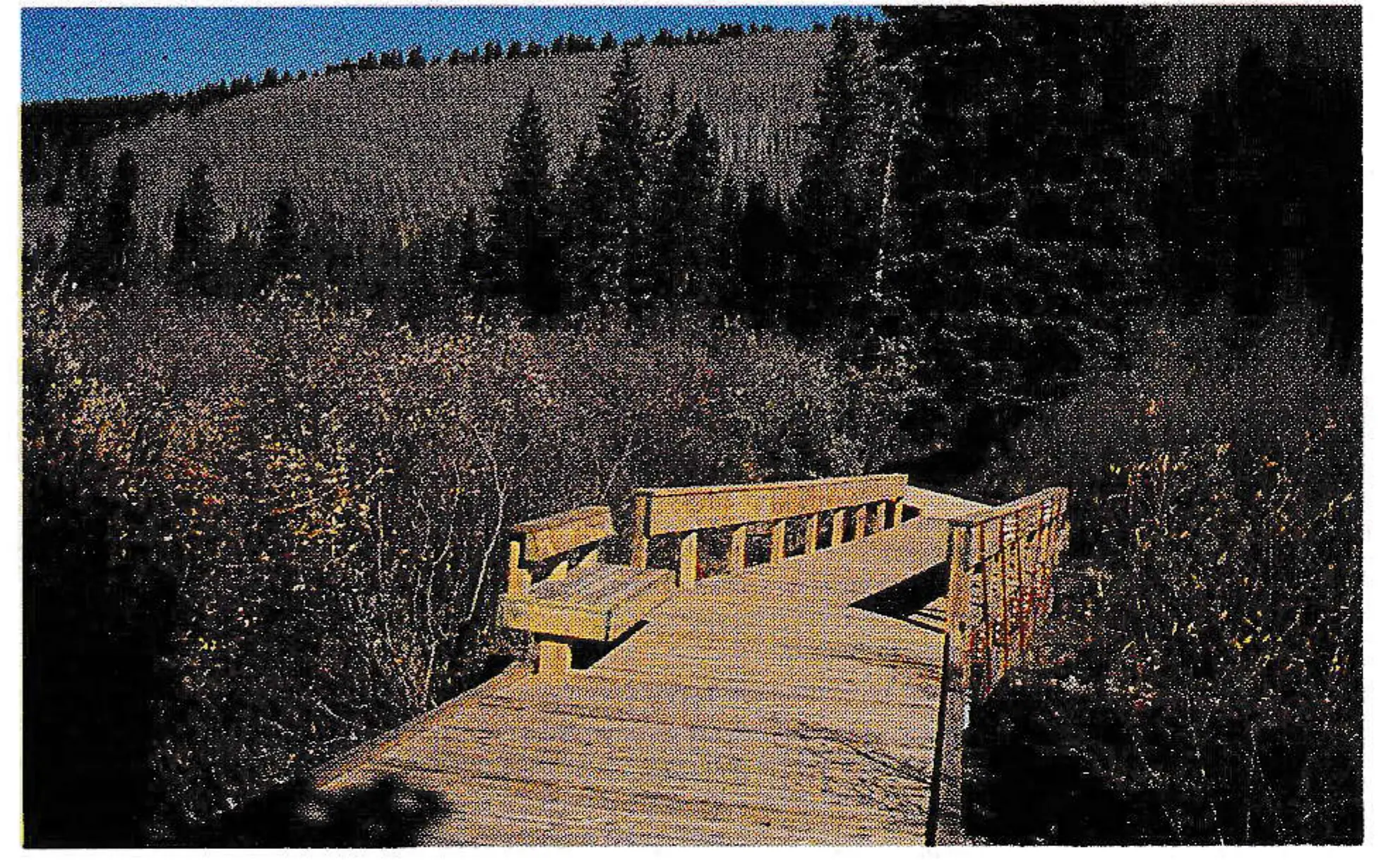
The Jim Creek base area is a sensitive environment filled with willows, beaver ponds and the meandering streams. The project designers wanted to have minimal impact on the wetland while providing opportunities to experience the unique environment found there. The resulting conceptual plan consisted of a looped trail leading from the parking area directly across Highway 40 from Winter Park with a boardwalk spanning the wetland in the center. Included in the plan were numerous benches, picnic facilities and a campground to accommodate both groups and individual campers.
During the winter of 1992, plans were refined and discussions initiated on how to complete construction of the ambitious project with volunteer labor over one weekend in August 1992. While this was going on, members of VOC and NSCD began an ambitious fund raising effort to produce the estimated $430,000 that the project would require. Winter Park agreed to supplement the project with the use of staff members and equipment for surveying and construction.
Once spring arrived, the boundaries of the Jim Creek base area were mapped and reviewed with the Army Corp of Engineers to determine exactly where boardwalk construction would be necessary. This mapping resulted in approximately twice the amount of boardwalk than that estimated by the design team. At this point, the team decided to split the project into two phases in which the volunteer construction could occur over one summer weekend in both 1992 and 1993.
A key ingredient to the design of the project was developing a foundation system for the boardwalk that would minimize impact to the wetland. After numerous ideas were discussed and discarded, the design team settled on an innovative approach using three-inch steel helical anchors that can be screwed into the ground by a special torque head mounted onto heavy equipment.
Two types of trails were designed, both accessible, but accommodating varying ability levels. The Discovery Trail, a 2,880-linear-foot trail, connects the trailhead at Highway 40 with the campground and central boardwalk. The Challenger Trail picks up on the other end of the boardwalk and leads back to the trailhead on the opposite side of the valley.
The Discovery Trail meanders through the open forest, connects to the campground and then winds its way up Jim Creek to the wetland crossing the boardwalk. It is constructed of crusher fines (crushed stone of angular nature to allow for compaction and adherence), which have become the accessible-trail material of choice because it is compressible and has a natural appearance. Properly constructed (by trenching the trail and filling with a minimum of six inches of fines), trails made of this material have a lower initial cost and lower maintenance costs than other accessible surfaces.

While the Discovery Trail was intended for use by all disabled populations, the design team had a difficult time designing an alignment that would meet the objective of a slope less than 6.5 percent grade. Portions of the six-foot-wide trail exceeded this slope, rendering negotiation of this trail difficult for some people. Plans for building flatter switchbacks at steep areas are scheduled for 1993.
The campground consists of raised tent platforms for easy accessibility, picnic tables, grills and a central fire ring for group activities. Trails through the campground connect camping sites with the Discovery Trail and group facilities including the fire ring and portable restrooms screened by wooden lattice enclosures. The tent platforms, constructed of wood using a simple post, beam, joist and decking construction, are state of the art in terms of accessibility, but due to their placement and wood construction, provide a feeling that they belong in the forest. The campground, constructed entirely by volunteers, is about 70 percent complete and will be finished in the summer of 1993.
The Challenger Trail, with a natural earth surface and narrower trail width, was intended for more mobile visitors and sport-chair users. Ironically, the grades of this trail turned out to be flatter and more negotiable than the more friendly Discovery Trail. At 3,000 linear feet in length, the Challenger Trail also winds through the forest on the opposite side of the valley and provides spectacular views of the Winter Park ski area.
Each trail has an eight-foot-wide by eight-foot-high cleared corridor in order to accommodate cross country skiers, but winter trimming along the trail was necessary due to the tremendous amounts of snow the valley receives.
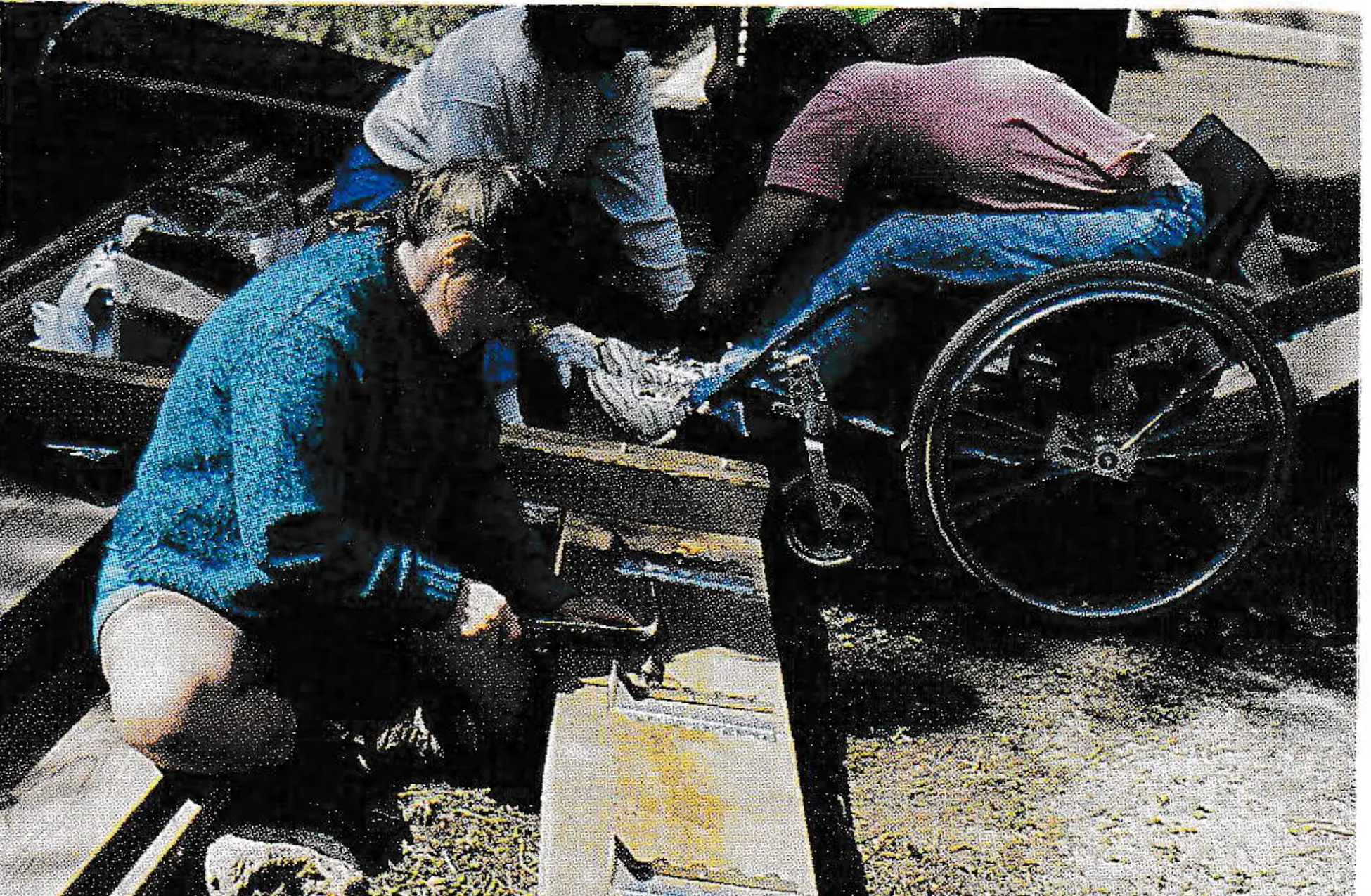
Construction of the boardwalk was fairly complicated due to the wetness of the valley floor and the sponginess of the soils. Prior to the volunteer construction weekend, the design team supervised installation of the helical piers. The process took a crew of three two weeks to accomplish, due mainly to the fact that the backhoe used to install the piers often got stuck in the marshy soil. Once installed, the anchors were surveyed and cut to the desired vertical alignment and custom U-brackets to hold the beams were put in place. This done, the boardwalk was ready for skilled volunteer carpenters and other volunteers to do hammering and hauling. The lesson learned during the installation of the piers in the summer of 1992 was well taken and the piers for the 1993 construction of a boardwalk spur and picnic deck are already in place. Winter installation with a track-mounted drill rig made the operation go much smoother.
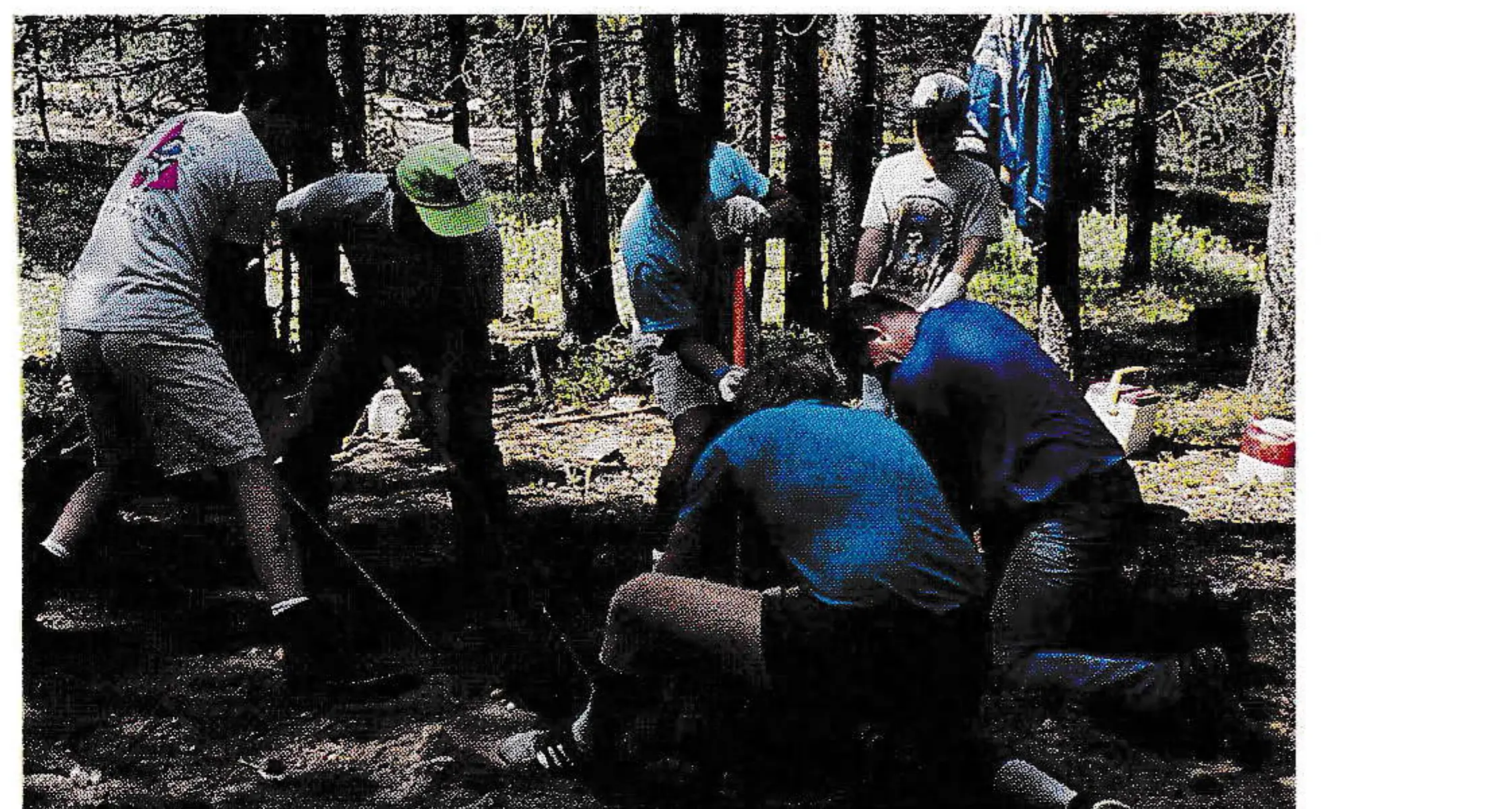
Finally, on the weekend of August 22 and 23, approximately 600 volunteers participated in the actual construction of the project. Many of the volunteers had first-hand experience with disabled people either through friends or families. A number of the volunteers were themselves disabled and able to participate through a unique program at Craig Hospital.
The partially completed project has already been in great demand among hikers, cross country skiers and campers. Proud volunteers, who made the project a reality, are frequent visitors to the Winter Park Outdoor Center, bringing family and friends to share their considerable efforts in making accessibility to outdoor recreation possible.
Carol Adams is an associate with the landscape architecture firm of Design Workshop and was the senior designer for the Winter Park Outdoor Center. She also serves on the board of directors for Volunteers of Outdoor Colorado.