


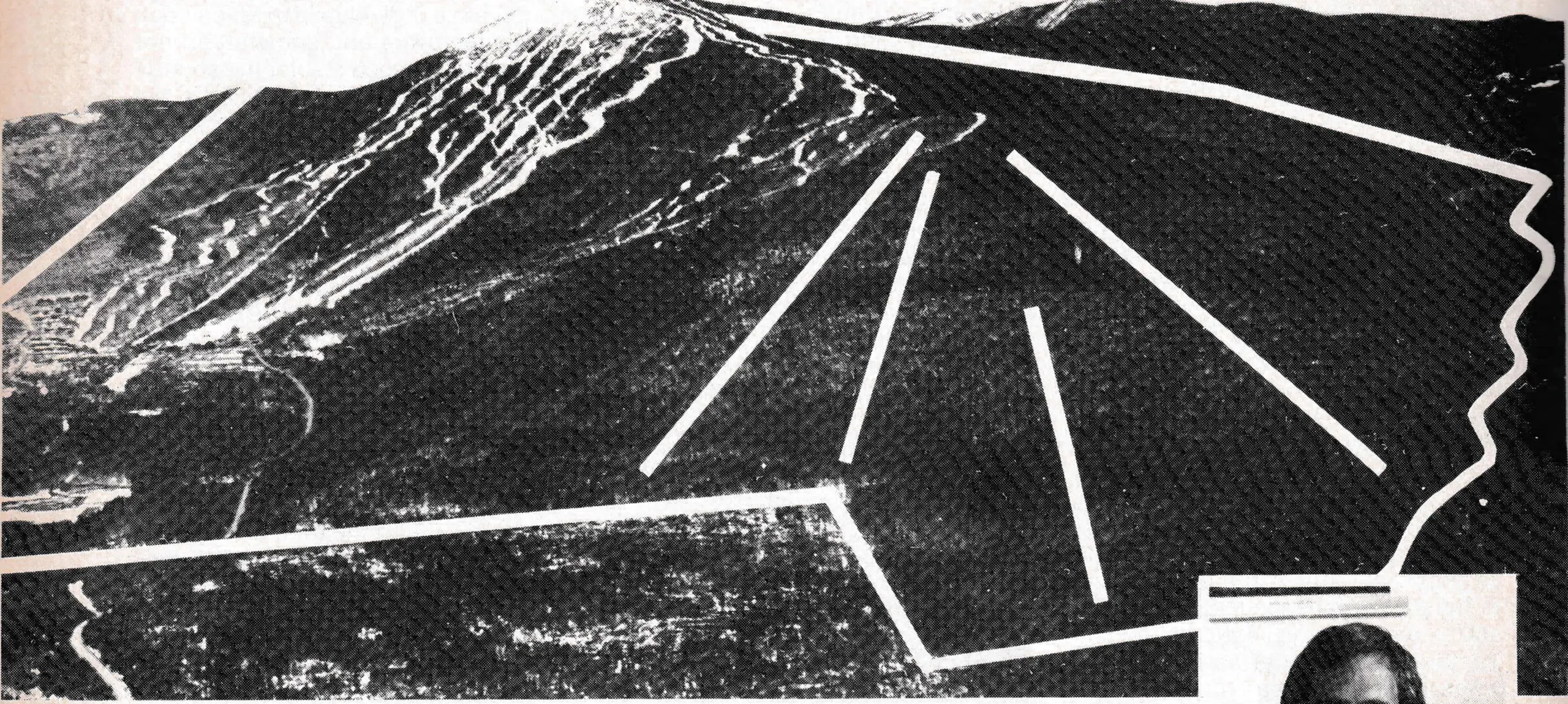
If you said any one but Sugarloaf in Maine—you lose.
Sugarloaf is the only resort in the country, let alone the East, in which nothing substantial stands between it and putting 20,000 skiers on the mountain a day—and housing all 20,000 next to the slopes.
Look at the facts:
- Sugarloaf Mountain and the adjoining terrain is all in under private ownership from the above-timberline top of the big peak down to the “arms” on Burnt Mt. and Crocker Basin to the left and right. These arms can be (or have been) bought by Sugarloaf Mountain Corporation.
- Sugarloaf lies in the town of Carrabasset Valley which, as incorporated, supplies the legal basis for expansion to a potential maximum of 20,000.
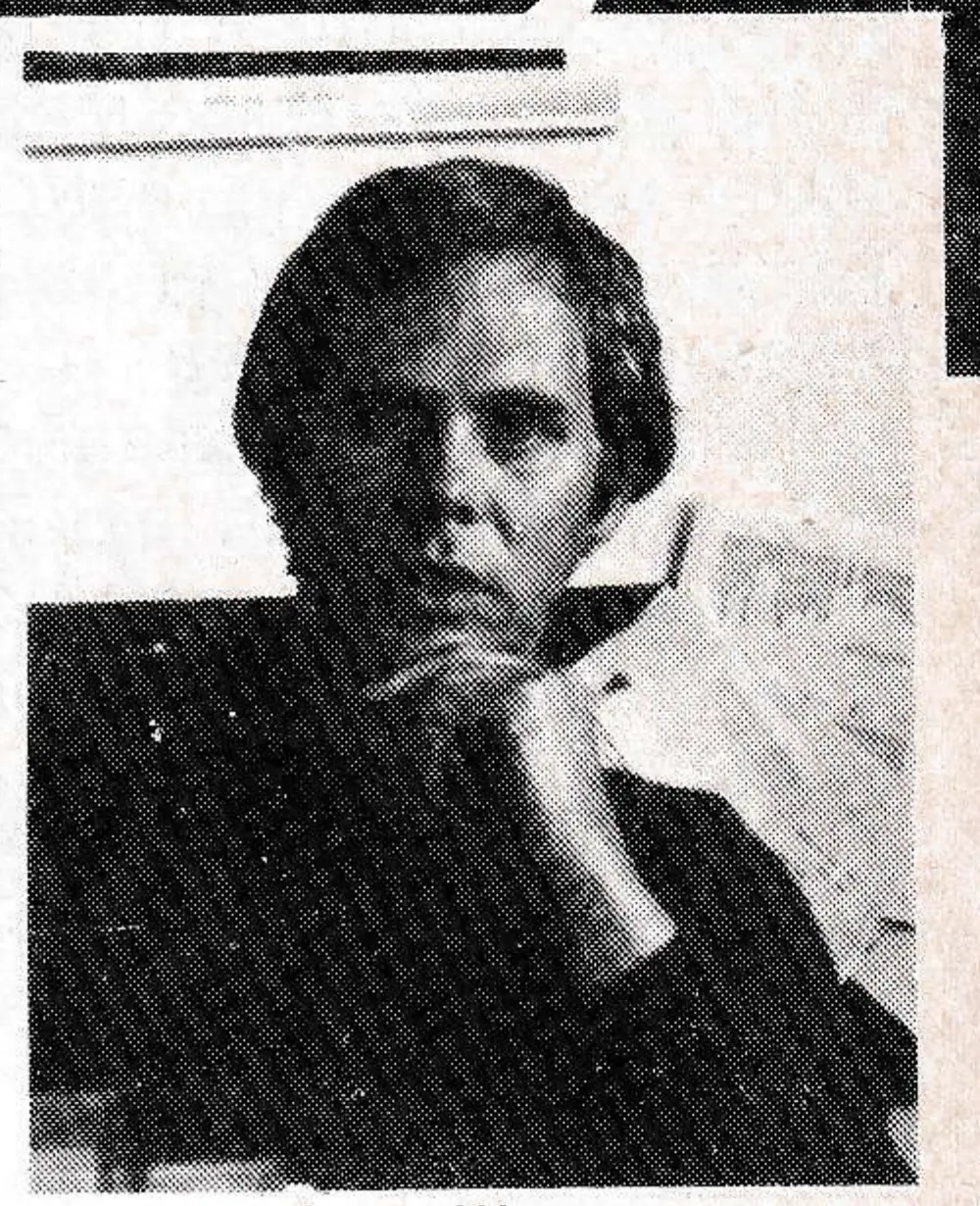
- Sugarloaf is headed by 32-year-old Larry Warren, who served in the comptroller’s office under three previous presidents of the corporation—each of whom added a needed dimension to the management infra-structure. Warren in his turn will ensure the necessary fiscal solidity of the coming expansion. Warren is first selectman of the town of Carrabasset Valley and helped draft the incorporation papers. He is now a resident of 10 years’ standing in the community where the average age of the voters is 25 or so.
Those are just for starters.
Every other year, one ski magazine or the other comes out with a story labelled, “The Sleeping Giant of . . .” (fill in the name of a state of Alp). In Sugarloaf, we have a sleeping behemoth, so to speak—at least by comparison.
The reason lies in Sugarloaf’s history, one quite different from that of the usual Eastern resort of destination dimensions. While nearly every other Maine resort has, in recent history been static or in deep trouble—moneywise—Sugarloaf has gone slowly and steadily along its growth curve. In spite of the low profile of its first generation of existence, its growth curve now is beginning to look exponential. In layman’s terms, Sugarloaf is growing by leaps and bounds.
This is true not only in regard to the mountain’s ski terrain but in regard to the plentiful corporation-owned developable real estate. The question of whether the East can build a ski village to rival the big Western ski towns has now been answered positively. It can, and probably will, at Sugarloaf.
The above qualifies on the one hand as wild speculation; on the other, it has going for it the dictum that “in skiing, if it can happen, it will happen.” Probably the not-altogether-happy development of Vail is a paramount example: Given easy access by skiers, a major resort tends to keep on growing until it hits a legal or physical limitation, or until its operation controverts some basic law of economics.
Possibly Vail is the closest to Sugarloaf in terms of original situation: when Carrabassett Valley was incorporated, it had some 20 voting residents. Five years later, it has 200 or so. Considering the township has roughly 30,000 acres (not all skiable of course), the potential for a large number of permanent residents is undeniable. In essence, like Vail, Sugarloaf will eventually have created its own mega village, at the base.
Unlike early Vail, the ecological thinking behind the early Sugarloaf is sophisticated and powerful; more likely to preserve more of the original character of the territory. (There is, after all, a considerable time lapse between the two.)
The Making Of Sugarloaf
The resort underlies a huge privately owned mountain begun in 1954 with a 1,600 acre purchase by a local ski club. Slowly, it grew to have—through trial and error (at a not too-costly level of financing)—a management, money and physical infrastructure solid enough to stand the test of expansion at a rapid rate.
Among the differences between Sugarloaf’s history and that of other eastern ski towns is that the resort grew so slowly early on that most attempts to build significant numbers of beds in Carrabassett Valley away from the slopes were not very successful. Therefore the mountain management is now free, relatively, to put the skiers on the mountain, controlling the building of an on-slope village that will keep pace with the skiing, and vice versa.
What looked like a pokey down-East pace has turned out to be a blessing: Sugarloaf can match and soon will lead the trend in the East toward building a Western type on-slope village (or European type on-slope village, if you will). Stowe, Stratton, Killington, to name three, have been making strenuous moves in that direction. It makes sense: the money in the ski industry is in having destination business. (Destination skiers are getting increasingly sophisticated about the difference between staying in a place where you drive to ski every morning and drive back to eat every night, and staying at a resort where you can walk to skiing in the morning and walk back to dinner every night.) In the wake of the “eastern village movement” has come, definitely, more destination business to those resorts, with increasing on-slope beds, an increase coming sometimes from relatively virgin territories such as south of Mason-Dixon, or from the Caribbean islands—where a considerable prestige attaches today to a ski vacation. (Vail has experienced, of course, a parallel pheonomenon, with South Americans, to the extent of having to put up bilingual signs.)
This season Sugarloaf has completed the bounding of a mall, or pedestrian area in its small but burgeoning village. Included in the compact mid-rise (maximum four stories) village buildings round about are some 20 shops, bars and stores, all with an unmistakable down-East flavor. (Somehow neo-Barvarian has not exhibited great affinity for the skiers in the state, and vice versa. The Capricorn, a good inn on Route 27 being the only fairly obvious example of Austromainiacal architecture.) The management of Sugarloaf is keeping the faith, architecturally.
The Financial Underpinning
cause of his accountant background, ident, Larry Warren, knows well, because of his accountant back ground, the most important thing in the financial life of a resort is the ability to get a good long term flat rate mortgage (no big balloon payment on the end) so that it can pay off in regular modest size amounts the capital needed for long-term expansion. Sugarloaf, until it got a $2.8 million state-guaranteed loan from the Maine banks in 1973, was in the classic chicken-egg dilemma of not being able to show a very profitable projection because it wasn’t able to expand sufficiently to benefit from economies of large scale operation (such as leverage in purchasing, paying salaries that would attract hardworking efficient people, and buying topflight equipment, such as the four Pisten-Bullys it now has.) Since 1973, borrowing for corporate needs hasn’t been a problem: the economies of scale are in operation, projections are healthy-looking and the mountain has just had three good years, each of which broke the profit record of the previous and ended the past fiscal year with a $300,000 profit.
The kind of financial leverage that large-scale operation and consequent profitability affords is demonstrated in that in spite of a real scarcity market, Warren has been able to go to Maine banks with which the corporation keeps accounts and obtain the mortgages necessary to keep condominium and home buyers coming at an increasing rate. Currently, Sugarloaf gets 25 percent of its gross from real estate operations, a sum that should be clipping the million dollar mark this coming fiscal year, and then some.
The reason, again, has been Sugarloaf’s history: the early corporate managers were conservative. The total borrowed in the first 20 years was about $300,000, so that the expansion from a one-T-bar two-trail resort in 1954, to the multiplicity of one gondola, three T-bars and three chairs, was accomplished with minimum indebtedness, and mostly at a cost far below present replacement. The corporation’s debt service is well below average. It was in line for a state guarantee.
Geopolitics of Resort Building
What happens when a resort comes out at odds with a good proportion of the resort citizenry can be cited in the case of Aspen, where the town put a lid on growth without consulting the resort management. There has been a contretemps ever since, with the town threatening more drastic measures, and the corporation sending its development money out of town, in spite of the potential for expanding the Aspen terrain.
That kind of thing is not happening nor going to happen at Sugarloaf.
Larry Warren arrived in 1971 into what was then a territory of two unorganized townships, Jerusalem and Crockertown, to do some skiing at Sugarloaf while looking for a CPA job in Portland and roundabout. Warren was hired by the Sugarloaf management, settled in Jerusalem (which then had a population of 20 voting adults), and got interested in having Jerusalem, Crockertown and Wyman organize into townships. For one thing, organizing would reduce taxes (set by the county for unorganized towns), and for another, enable the towns people to use tax money to send town kids to private high schools, if they so wished. In 1971, the three towns’ held a meeting at the nearest available hall, the Sugarloaf base lodge. Jerusalem voted 17 to 6 to organize; Wyman voted 1 – 0 against; Crockertown 5 to 3 against. But Crockertown changed its mind two years later and voted to be annexed to Jersalem, the two together to be called Carrabassett Valley. The future of Sugarloaf was there and then made bright in the land-use plan for Carrabassett Valley submitted to and approved by the state. (Wyman is still resolutely unorganized.)


The town of Carrabassett Valley is cognizant that its future lies in both offering recreation and preserving the milieu that provides the recreative atmosphere. Carrabassett Valley voted to put $50,000 as a one-third contribution toward making trails and a central building for hiking and cross country, and for conserving for light recreational use a 2,200 acre piece of public land in the middle of the township. It also voted $5,000 toward making the only lodge in the neighboring 40,000 acre Bigelow preserve usable for cross country and hiking.
The geopolitical status of Sugarloaf seems to be as secure as that of any resort in the country.
The Management Infrastructure
Larry Warren was hired by King Cummings, the area’s first full-time president, in 1971. Warren became comptroller under Charles Skinner, the next president and first professionally experienced manager. (Skinner a snowmaking expert, put in Sugarloaf’s current system. Bill Sim, from Dart Resorts, came in as president next, and introduced staff training for employees to give visitors a feeling of welcome and support. (Maine people are pretty much inclined that way, anyhow.) Warren is continuing the training and expanding it to inn and restaurant employees.
The only future financial problem is the availablity of mortgage money for new owners of on-slope condominiums and homes: the ability of Maine banks to support the home owner growth of Sugarloaf is limited, although that limit is not yet reached. However, Warren feels that it is possible to bring in mortgages from New York banks by offering high enough rates, if that seems necessary.
In case there is a mortgage shortage, the growth future would stretch out, and require re-financing but the man at the helm, Warren, is expert in the financing field. Sugarloaf currently needs a financial mind to lead it, and that need has been filled—just as in the past when it needed a particular type of president, that type seemed to come onto the scene.
The one unfilled need that the resort presently does have is for a slopeside hotel of a hundred rooms or more. Warren thinks that he can get that in by 1981 season, given the present projections. The hotel is, however, a question mark because most money that goes to financing hotels goes to year-round resorts and to chain-managed hotels, such as Marriot.
The other question mark is year round resort potential. Presently that is limited, because Sugarloaf is not on a body of water, doesn’t have a contiguous golf course and limited tennis. The village was shut last summer, except for one restaurant. It has had a convention this summer: it successfully handled the Appalachian Mountain Club annual meeting by dint of a meeting tent and good weather. But that was it for big summer business.
An Enormous Potential
With the potential for putting in—easily—the 10 additional lifts that would be needed (according to the tentative plan) to handle 20,000 skiers on the mountain (compared to a top limit of 5,000 today) and the possibility of expanding into other village centers—if that seems reasonable—plus the many miles of trails available for cross country skiing in the 2,200 acres of public land set aside for light recreation, plus the 40,000 acres of Bigelow wild land (available for those skiers who want adventure as well as touring), the skiing future for Sugarloaf does not seem hung up on physical limitations.
Management depth: C. Susan Mason, vice president of Mountainside Corporation, the wholly owned real estate subsidiary; Hazen McMullen, operations manager and the “old man of the staff” at age 39; and Tom Hildreth, director of marketing all have been with Sugarloaf through the lean times and have proven abilities at operating under stress and strain while developing innovative and cost-efficient techniques.
And although the resort has to go to the state for final approval for each subdivision of condominiums or free standing homes, the state—under the land use plan—cannot withold approval, provided that the reasonably stringent zoning codes are complied with. So there doesn’t seem to be any legal limitation of consequence, either.
The hang-up, if one comes, will come in the financial sector.
What could go wrong?
Well, the gas situation could get out of hand: Sugarloaf survived the last gas crisis by contingency planning (tour buses from Bangor and Portland, etc.) and by having the employees all agree to take on extra hours to get the resort through, which they all did with good will. Sugarloaf feels sure that it can do the same, should the gas scarcity be a factor this winter, or next.
Year-around is, of course, the ideal: Sugarloaf is going to have to get there, too, to rank with the big ones in the West. But presently it will take more than merely planning summer programs; it will take the energy of a good number of exceptional, talented residents in the village and the valley, who can expend the creativity and time necessary to build programs—with the help of the resort. That era is well off into the future.
In the meantime, the condominiums, the homes, the lifts, the restaurants, the shops, are coming on line with accelerating frequency, geared to the regular tick-tock of planning, approval and implementation. It’s a routine. And a nice one. And although there has been “no hard and fast decision,” as Warren has said, to take Sugarloaf to the limit, there is every reason to be genuinely optimistic that, as the millenium closes in on Maine, Sugarloaf will be sliding into greatness in a national sense in the same easy natural way with which it has taken its course so far.